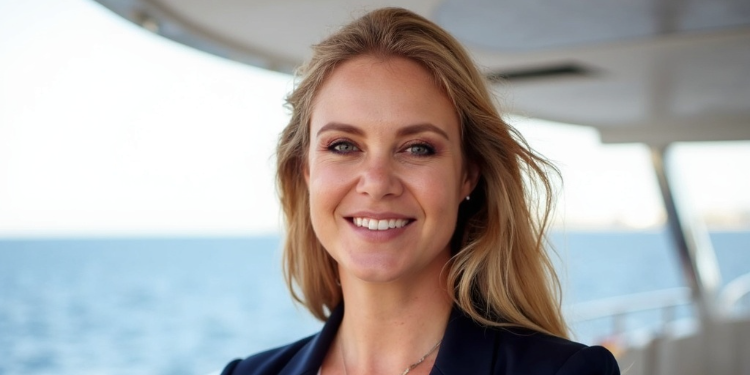
Caity De Chasteigner Dumée-Duval's move from South Africa to Mauritius marked a turning point in both her personal and professional life. After years in the fast-paced world of corporate advertising, she chose to embrace a different rhythm, one that places family, creativity and balance at the centre. Now based in Tamarin and founder of Eighty Twenty, a creative agency, she reflects on the leap that brought her to the island, the challenges of starting a business as a newcomer, and the philosophy that now guides the way she works and lives.
Can you tell us about your life journey?
I was born to a Rhodesian father and a British mother, so feeling like an outsider is basically my factory setting. While I have a deep love for South Africa, I never quite blended into the status quo. I was always slightly adjacent to it, waving politely from the sidelines. Add to that the reality that crime stopped being “news” and became daily updates on family WhatsApp groups, and it started to weigh heavily.
I have a degree in Creative Brand Communication, plus what can only be described as a tasting menu of brief studies in Architecture, Photography and Graphic Design, or, as it's now fashionably called, Visual Communications. I spent a good chunk of time collecting creative skills like souvenirs, but nothing ever felt quite right until I accidentally-on-purpose fell into experiential marketing. Turns out I like ideas you can walk through, touch, feel and Instagram, not just stare at on a screen. Once I found experiential, everything finally clicked… loudly, colourfully, and with a bit of chaos.
Without dwelling on South Africa's challenges (because it will always have my heart), the cut-throat nature of the corporate advertising world was also taking its toll. At some point, I realised I was craving a different pace, a different energy, and a life that felt a little less like survival mode and a little more like living.
Was there a specific event or turning point that triggered your decision to change your life and move to Mauritius?
The real turning point came when I found out I was pregnant with our second child, right as the KZN riots were unfolding. Suddenly, “What's for dinner?” was replaced by much bigger life questions. I wanted better for my kids, and honestly, you can't argue with the fact that in Mauritius, the grass is not only greener, it's also thriving. And just like that… we packed up our lives and crossed the ocean.
Join the Mauritius community
Get regular tips and advice to make the most of your expat life
How would you describe the “old” Caity compared to the person you are today?
Our move to Mauritius coincided with the birth of both our children (now 2 and 4), so I was already in the midst of a major life transition, which has been supported by Mauritius' family-friendly lifestyle. Prior to becoming parents, I lived a largely selfish “work hard, play hard” corporate lifestyle of “work hard, play hard” corporate culture, which was not conducive to long, lazy, stress-free family days at the beach. Mauritius has supported not only my work/life balance shift (which involves a lot more “life” than “work”), but it has also forced me to form new social circles with like-minded people who strive to put family first - while enjoying nice things at the same time.
Why Mauritius? Was it an obvious choice from the start, or an idea that gradually took shape over time?
My husband is Mauritian (though he's spent the last 20 years working across Africa), and he'd been quietly hoping to return home one day. Between a growing family, a strong pull towards safety and balance, and an island that felt like a deep exhale, the decision pretty much made itself.
What were you hoping to find in Mauritius that you no longer found in South Africa?
I was hoping to find a fresh start. Somewhere driven more by acceptance than fear. A place that felt multicultural in the best way (something South Africa does beautifully), but with a slower rhythm that allowed space for family, sanity, and the occasional deep breath. I wanted stability, in work, in life, and in the future we were building, without constantly feeling like the ground might shift beneath our feet. And, most importantly, I was looking for a place where nature isn't a weekend escape, but part of everyday family life. In Mauritius, it turns out that family time comes with sunshine, sea air and the occasional barefoot meeting… which felt like exactly the upgrade I was hoping for.
What role did the expat community play in your professional rebirth?
The expat community has been absolutely integral to keeping me sane. Mauritius may be a small island (though somehow still bigger than you expect), and the expat network brings a wonderfully global perspective to island life. South African and Mauritian cultures are very different, so having people around who get the in-between space has made the transition far less daunting. The community is made up of expats from all over the world, and it's been a real privilege to connect, socialise, and do business with such smart, funny, and genuinely caring people. They've very quickly become our family away from family, proof that sometimes the best part of moving countries is the people you didn't know you needed.
For me, the expat community is a social support network, but I know many expats who work together and facilitate local business networking too.
How did the idea of creating Eighty Twenty Agency come about?
I've worked as an Executive Creative Director for many years and still consult to South African agencies. While I had autonomy in my role and a seat at the executive table, there was always the quiet realisation that what I was building was never truly mine. I wanted to take everything I'd learnt and create a boutique agency in Mauritius that reflected more than just a business strategy or clever mantra, something rooted in a real, lived life philosophy.
My husband and I have always tried to live by the 80/20 principle (or thereabouts – life is messy). No matter how chaotic things became in South Africa – Covid, economic downturns, crime, competition, corporate curveballs – we made a conscious effort to keep the balance tilted towards joy, meaning and connection, both professionally and socially. While the Pareto Principle is technically about cause and efficient effect, we've chosen to apply it to life: focus on what truly matters, put energy where it counts most, and let the rest make a little less noise. That philosophy now underpins not just how we work, but how we live.
What were the biggest challenges when launching the agency?
Being an expat was a real challenge, but not an insurmountable one. I prefer the term “Newpat” to “Expat” as I don't aspire to be defined by what I was, but many locals do not view it that way. Some expats come to Mauritius to make money hard and fast, without a desire to understand and appreciate local culture (both socially and corporately). My husband, being Mauritian, has been a major help in bridging the gap as he added permanence and relatability to what would otherwise be seen as an “expat offering”. We initially struggled to access supplier networks as we were “unknown” fish in a small pond, but a year on, we have begun to earn the respect of major industry players.
As an expatriate, did you have to adapt the way you work, pitch, and communicate?
Absolutely. As a communications professional, it is my duty to immerse myself in different corporate cultures, industries, and products. Put myself into the mind of the shopper or consumer, so to speak. This was no different, while also entirely different. It takes time to acclimate not only to the language (French and Creole) but also to the social nuances that can only be taught by the best teacher with experience. That, and the occasional masterclass from my husband and local friends.
What does a “typical” day in your life in Mauritius look like?
Living in the West in the coastal town of Tamarin, the humidity gets me out of bed early. After dropping my children off at the private nursery and pre-primary schools close by, I usually head to a beachside restaurant to do a quick status meeting and answer emails. Once my admin for the day is complete, I set about attending meetings throughout the island or working on proposals from my home office.
The best part about owning my own agency is the flexibility to collect my children from school at 2 pm and spend the rest of the afternoon and evening by their sides. This may include extra murals, but most often, a quick visit to the beach or an afternoon in the swimming pool is the preferred option. The proximity of our local and expat friends means that many afternoons are spent together, and we embrace old-school neighbourly values such as taking turns making dinner or swapping fruits from our garden trees. There is a deep sense of value for simple pleasures, which is what makes Mauritius so valuable to us.
Are there things you still miss from South Africa today?
Of course. The natural beauty of South Africa is very different from that of Mauritius. And you cannot beat the rhythm of the African bush. South African wildlife is unmatched, and people are immediately welcoming in most circles. Mauritian circles are a little more guarded to protect the long-nurtured, family-style dynamics. But they are so worth the effort once you become a member of this great, extended family.
What would you say to those who dream of leaving everything behind but don't dare to take the leap?
I'd say this: if it were easy, everyone would be doing it. Taking the leap isn't glamorous – it's uncomfortable, expensive, emotional and filled with moments where you wonder if you've completely lost your mind. But that's the price of change. Freedom is not free; it costs certainty, familiarity and sometimes your ego. What you gain in return is choice – how you live, how you work, and what you prioritise. You don't have to leap blindly, but you do have to move. Because staying put out of fear has a cost too… It just charges interest quietly over time
You live by the 80/20 principle — “smart, but make it fun.” How does this mantra guide your life today?
I don't think this mantra has ever felt more true than it does now. I may only work a few hours a day (most days), but those hours are ruled by ruthless strategy and planning so that the rest of my time is genuinely mine. That's the trade-off. The reward is being present for the simple pleasures – not filtered through a phone screen, but felt properly, with warm sand between our toes and the soundtrack of children laughing in the sunshine.
We work hard, but we work smart. And then we live – fully. It's not easy, and it's certainly not always neat or predictable. But it is intentional. And without question, it's worth it.
As a globetrotter at heart, I love bringing ideas, stories and wildest dreams to life. Now based in Mauritius, I lend my pen to Expat.com and other inspiring projects.