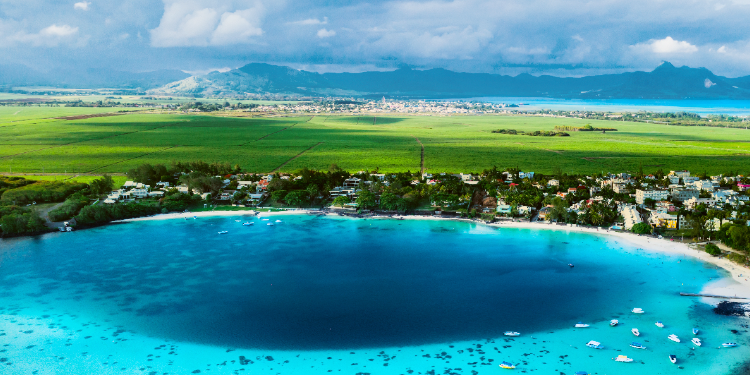
For years, when people talked about moving to Mauritius, two areas dominated the conversation: the North and the West. Grand Baie meant social life, shopping, and restaurants. Tamarin and Flic-en-Flac offered that sun, surf, and after-work lifestyle. Then, gradually, the South began attracting a new wave of expats seeking something different: more nature, more authenticity, and less congestion. From Bel Ombre to Mahébourg, including Baie du Cap, Riambel, Blue Bay, and Pointe d'Esny, the southern coastline offers unspoiled landscapes, villages that still move to a Mauritian rhythm, and the pleasant sense that time flows a little differently here. So why are so many expats now choosing to settle in the South? Here is the full picture.
North, West… and now the South: A new equation for expats
It's no secret that the North and West remain the most traditional choices for settling in Mauritius. There are more shops, bars, restaurants, sports clubs, private schools, and secure residential developments. In short, everything feels within easy reach, which is reassuring, especially at the beginning. But after some time, many expats start looking for something else: a quieter setting, fewer traffic jams, more greenery, and a deeper connection to Mauritian life.
When people talk about “the South,” they are actually referring to several distinct areas, each with its own atmosphere, lifestyle, and expat profile.
On one side, the South-East, around Mahébourg, Blue Bay, and Pointe d'Esny, is attracting more and more expats because it offers a balance between local life, accessibility, and a relaxed pace.
On the other side, the South-West, from Bel Ombre to Le Morne, appeals to a more specific crowd: lovers of raw nature, water sports, and wide-open spaces.
There is also a more rugged, wilder South around Souillac and Rivière des Galets. This region is deeply authentic, with fishing villages, dramatic cliffs, endless sugarcane fields, and a coastline that remains largely untouched. It is stunning, but still rarely chosen by expats because it is more isolated, less practical for daily life, and far from key infrastructure.
Today, the South-East in particular is attracting a new generation of expats who are not necessarily seeking nightlife or extensive infrastructure, but rather a gentler, simpler everyday life.
Cynthia and David, who settled in Mahébourg, explain: “My husband and I lived for years in the Paris region. When we decided to have children, we couldn't imagine raising them in a big city. So we moved to Aix-en-Provence, near Marseille. It felt like the right compromise for us. After four years, we felt the urge to try living abroad. Since we're lucky enough to work remotely from anywhere, we took the leap. Mauritius ticked a lot of boxes. Online, everything pointed to the North as the main expat area. But we wanted to form our own opinion. So when we arrived, we spent time exploring each part of the island. We chose the South because it's much quieter and less urbanised. The North reminded us a bit of the French Riviera. We didn't see the point of moving here just to be surrounded by expats and shop at Super U. We wanted to step outside our comfort zone and truly blend in. Today, we have zero regrets. We feel much more aligned with what we really wanted.”
The pull of authenticity: Villages, markets, and local life
Mahébourg, the island's former capital, feels very different from Grand Baie. The atmosphere is more working-class, more Creole, more rooted in local culture. There is a lively market every Monday, a waterfront promenade, small shops, local snack stalls, and a strong sense of community life.
In villages like Baie du Cap, Souillac, and Rivière des Galets, you experience what many describe as the “real” Mauritius. Few expats choose to settle in these villages, but those who do often speak of a deep sense of cultural closeness: you are not living alongside Mauritians but living with them.
Éléonore, who has lived in Bel Ombre for three years, shares: “Living in the South was an obvious choice for me. I never considered another region. Today, 95% of my friends are Mauritian, and I'm really proud of that. I speak Creole; I feel fully integrated. It's a shame that Mauritian nationality isn't easy to obtain because I truly feel like I belong here now. I feel exactly where I'm meant to be. I'm not a temporary expat passing through; I chose to put down real roots. And I can't imagine living anywhere else.”
Join the Mauritius community
Get regular tips and advice to make the most of your expat life
Turquoise lagoons, mountains, and the “Wild South”
The South of Mauritius is sometimes called the “Wild South” due to its less uniform, more dramatic coastline, with cliffs, strong waves, and some of the island's most spectacular views.
Highlights include:
– The coastal road between Bel Ombre and Baie du Cap is often described as one of the most beautiful drives on the island.
– Le Morne rising against the horizon.
– Less crowded beaches.
– The cliffs of Gris-Gris, rocks battered by waves, scenic walking trails.
– Inland tea plantations, sugarcane fields, and omnipresent greenery.
It's paradise for those who love walking, hiking, driving simply to admire the scenery, or stopping at a quiet beach to watch the waves. This is far from the “flat lagoon–sun lounger–cocktail” version of Mauritius. In the South, there is relief, wind, and movement.
Frédéric, who now lives in Le Morne, explains his choice: “A few years ago, I came to visit a friend who teaches kitesurfing here. I have Parkinson's disease, and I wasn't sure how things would go. I loved it. The most incredible part is that my tremors completely disappear when I'm on the board. I can't explain it. But it feels miraculous. Now I'm hooked on this sport, as it gives me relief from the disease. For two years, I kept flying back and forth whenever I could to kite here. As soon as I retired, I moved permanently. I found a small apartment in Le Morne. I kite every day and spend most of my life in the water. I couldn't be happier anywhere else.”
You often hear: “Yes, the South is beautiful, but there's nothing there.” That's not really true, or at least, not anymore.
Yes, the South has fewer restaurants, bars, shopping centres, and sports clubs than the North or West. But it is far from empty:
– Blue Bay and Pointe d'Esny offer cafés, restaurants, water activities, and a stunning lagoon.
– Around Bel Ombre, several hotels and estates provide restaurants, spas, golf courses, and outdoor activities.
– Mahébourg has shops, banks, markets, and everyday services — everything you need to live comfortably without driving north every week.
What truly changes is the pace: fewer traffic jams, fewer distractions, less “everyone's going out tonight, are you coming?”
In the South, daily life feels more grounded. You don't feel bored. You feel like you can breathe.
Eymerick, 32, describes his journey: “I've lived in Mauritius for ten years. When I arrived at 22, all I wanted was to go out, eat at restaurants, and party. So naturally, I settled in the North. I lived in Péreybère and enjoyed the nightlife for a few years. At 27, I met my wife Agnès, who is Mauritian. She lived with her family near Riambel. For almost a year, we were constantly driving back and forth to see each other. At some point, we had to decide: North or South? The South won. As I approached 30, I wanted something different. I wanted to settle down and be surrounded by nature. A calm environment to raise a child. Today, we live next to my wife's family. We have a little girl. We walk on the beach almost every day, and it's nothing like the crowded beaches in the North or West. We really value our peace and quiet.”
From luxury seafront living to more affordable housing options
When it comes to property, the South offers two distinct profiles.
On one side, there are high-end areas such as Pointe d'Esny and certain developments in Bel Ombre and Baie du Cap, featuring upscale villas and apartments, often under PDS or IRS schemes, targeting international buyers with strong purchasing power.
On the other side, towns like Mahébourg offer more affordable options, with rents generally lower than in Grand Baie or Tamarin for comparable comfort.
According to a recent rental market analysis by Creole Mauritius, the South and South-East provide strong value for money: exceptional surroundings, direct access to the sea and nature, and lower costs, provided you do not need to commute long distances daily.
Louise and Mathieu learned this the hard way: “We first moved to Albion because we didn't want to be too far from the French school in Tamarin for our children. Looking at the map before arriving, the distances seemed reasonable. Big mistake. The traffic was unbearable. It became unlivable. We made a radical decision: we took our children out of school and started homeschooling. We reorganized our entire lifestyle to minimise time spent on the road. We've been living in Pointe d'Esny for a year now. We have a large garden, the sea nearby, and we finally feel alive again.”
Remote workers, families, retirees: Who moves to the South?
After speaking with many expats in the South, and reading feedback in social media groups and forums, several recurring profiles emerge.
Remote workers seeking peace
Those who work mainly online and have flexible schedules appreciate the South for its calm, natural beauty, and slower pace.
Families wanting a gentler lifestyle
Some families choose the South to give their children a quieter environment. There is less traffic, and many areas still feel like real villages.
Some parents opt to send their children to schools in the North or Centre and organize their schedules accordingly. Others choose schools closer to home. This requires careful planning, but many feel the trade-off is worth it.
Retirees and semi-retirees
The South is increasingly attracting retirees looking for tranquility, seaside walks, gardening, snorkeling, and simple pleasures. For them, the South ticks every box: nature, authenticity, and a peaceful atmosphere.
The small drawbacks to keep in mind
A few realities are worth considering:
– Fewer entertainment options. If you enjoy trying new restaurants three times a week, attending after-work events, concerts, and trendy brunches, you will need to embrace a different rhythm or plan regular outings elsewhere on the island.
– Transport. Without a car, life can quickly become complicated. Buses exist but are limited in frequency and direct routes.
– Services and schools. Everything is available, from banks and supermarkets to doctors, but often on a smaller scale, with fewer choices.
– Weather. The South can be windier and occasionally cooler, especially in elevated areas.
The South: A lifestyle choice more than a location
Choosing the South is not just about picking a place on the map. It is about choosing a way of life.
For many expats, it comes after a first chapter in the North or West. They start there, find their bearings, then gradually feel drawn to this part of Mauritius that seems to have pressed “pause” a few years ago, without being disconnected from the rest of the island.
The South is not for everyone. And that is perfectly fine. But for those who want to slow down, breathe, and experience something closer to authentic Mauritius, it is increasingly the obvious choice.
As a globetrotter at heart, I love bringing ideas, stories and wildest dreams to life. Now based in Mauritius, I lend my pen to Expat.com and other inspiring projects.