Mauritius is known not only for its turquoise lagoons and volcanic landscapes but also for its deeply rooted spiritual heritage. Hinduism, Catholicism, local traditions, and alternative spiritual paths coexist on the island, shaping a unique spiritual landscape in the heart of the Indian Ocean.
Grand Bassin (Ganga Talao): The heart of the Hindu faith in Mauritius
Rising more than 550 meters above sea level in the highlands of the Savanne district, Grand Bassin, also known as Ganga Talao, is undeniably the island's most iconic spiritual site. This natural crater lake is regarded as the most sacred Hindu site in Mauritius and a major pilgrimage destination, especially during Maha Shivaratri, which is usually observed in February or March.
Its spiritual importance dates back to the late 19th century, when Hindu indentured laborers came to associate its waters with those of the Ganges in India, even bringing sacred water there symbolically. At the entrance, the towering 33-meter statue of Mangal Mahadev overlooks the site, reflecting the deep-rooted devotion of Mauritians to their faith. Surrounding the lake are several temples and shrines dedicated to different Hindu deities, offering visitors a vivid insight into religious architecture, rituals, and offerings.
The site invites quiet reflection and is open to everyone, whether pilgrims or visitors simply seeking stillness and serenity.
Shri Sockalingum Meenatchee Ammen Temple (Kaylasson Temple), Port Louis
In the Sainte-Croix area of the capital stands one of the oldest and most significant Hindu temples in Mauritius: the Shri Sockalingum Meenatchee Ammen Kovil, commonly known as the Kaylasson Temple.
Built from 1854 onwards by members of the Tamil community, this Dravidian-style temple is remarkable for the richness of its carvings and its sense of calm, despite being located in the heart of the city. Its sculpted façades, vivid colors, and constant presence of worshippers highlight the central role of Tamil Hinduism in Mauritian culture.
Beyond its architectural appeal, the temple remains a living place of worship, hosting major religious celebrations for the community throughout the year.
Join the Mauritius community
Get regular tips and advice to make the most of your expat life
The Riambel Vortex: Energy and renewal
In the village of Riambel on the southern coast, a less conventional site attracts visitors and spiritual seekers alike: the Riambel Vortex.
Set amid natural surroundings, this location is described as a natural energy point conducive to meditation, contemplation, and spiritual renewal. While the concept of a vortex is not supported by established scientific evidence, many people come here in search of calm and inner balance, drawn by the peaceful atmosphere of the site.
The area is open to the public free of charge, with access available during the hours indicated by local organizers.
Located in the heart of the capital, Saint Louis Cathedral is the seat of the Catholic Diocese of Port Louis and one of the oldest religious buildings in Mauritius. Its origins date back to the 18th century, shortly after the arrival of French settlers, although the current structure has undergone several reconstructions over time.
First built in 1752, the original church was destroyed by a cyclone and rebuilt on multiple occasions, particularly during the 19th century. Its understated architecture, marked by colonial and neoclassical influences, stands in contrast to the bustle of the surrounding city center.
Still an active place of worship, the cathedral plays a central role in Mauritian Catholic life. It hosts major diocesan celebrations, ordinations, and key moments in the liturgical calendar. Open to both worshippers and visitors, it offers a space for reflection and quiet while embodying an essential chapter of Port Louis' religious and urban history.
Other Catholic places of reflection
While Mauritius is home to a wide range of Catholic churches, a few stand out for their history and atmosphere:
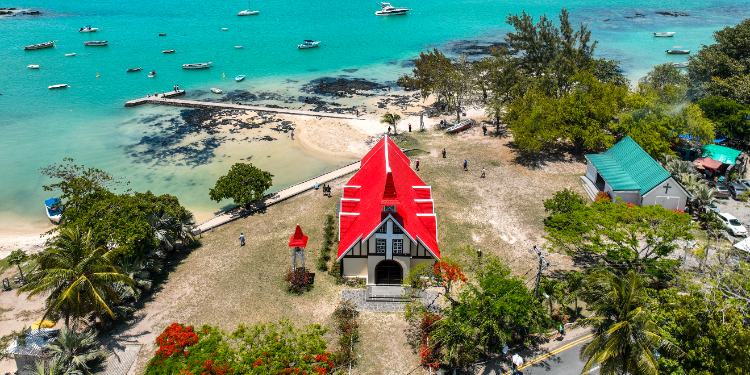
Notre-Dame Auxiliatrice in Cap Malheureux: famous for its iconic red roof and ocean views, this church is a popular place for prayer and spiritual relaxation.
Marie-Reine-de-la-Paix in Port Louis: perched on Signal Mountain, the white statue of Mary overlooks the city. Erected in 1940 as a symbol of peace, it has become a place of reflection and introspection, while also offering panoramic views over the bay.
These sites are open to all, whether practicing believers or visitors seeking a quiet moment. Both are firmly rooted in local Catholic tradition, even if they do not always feature prominently in tourist guides.
On the island's northeast coast, the Spiritual Park at Pointe des Lascars is a modern sanctuary that brings together spirituality, history, and nature. Designed to honor the legacy of Indian workers who arrived in Mauritius after the abolition of slavery, it combines traditional Hindu symbols with sculptures, landscaped gardens, and meditation areas.
The park features several monuments dedicated to deities such as Ganesh, the god of wisdom, as well as other key figures from Hindu mythology. Facing the ocean and set within carefully designed surroundings, it offers a peaceful setting for walks and quiet contemplation.
Hare Krishna Ashram, Bon Accueil
Located in the village of Bon Accueil in eastern Mauritius, the Hare Krishna ashram is a spiritual center where the practices of the Hare Krishna movement, chanting, music, dance, and shared vegetarian meals, are open to both devotees and visitors. The ashram reflects the communal and celebratory dimension of certain spiritual traditions, highlighting the importance of music and collective chanting in devotional practice.
Notre-Dame-de-Fatima Chapel, Petite Rivière Noire
This small open-air chapel welcomes worshippers in a natural setting, combining architectural simplicity with an atmosphere that encourages reflection. It illustrates the diversity of religious expression in Mauritius, where even modest sites can offer meaningful spaces for meditation and quiet contemplation.
Kwan Tee Pagoda, Port Louis
Located in the Les Salines district of Port Louis, the Kwan Tee Pagoda is the oldest pagoda in Mauritius, founded in 1842. It is often considered one of the oldest pagodas in the Southern Hemisphere and stands as a powerful symbol of the arrival and heritage of the Chinese community in Mauritius during the 19th century.
The pagoda is dedicated to Kwan Tee (Guan Yu), a historical figure who became a deity associated with loyalty, justice, and protection. It also houses altars dedicated to other major deities, including Kwan Yin, the goddess of compassion, and Mazu, the protector of seafarers.
Easily recognizable by its bright colors, curved roofs, and traditional ornamentation, the pagoda follows feng shui principles and opens onto small gardens that provide a sense of calm despite its central urban location. Still active today, it welcomes both worshippers and visitors, especially during the Chinese New Year and major religious festivals.
Across the island, natural elements such as centuries-old banyan trees, nature reserves, stones adorned with flower garlands, and secluded waterfalls are viewed by many as places imbued with meaning and suited to meditation or quiet reflection. While these are not formal sanctuaries, Mauritian nature itself is often perceived as an open-air temple, praised for silence, presence, and connection with the environment.
As you can see, Mauritius is far more than a beach destination. It reveals a rich spiritual map, where each site tells a story of heritage, faith, and cultural encounter. Whether you are seeking religious immersion or simply a moment of peace, the island offers experiences that open both the eyes and the mind.
As a globetrotter at heart, I love bringing ideas, stories and wildest dreams to life. Now based in Mauritius, I lend my pen to Expat.com and other inspiring projects.