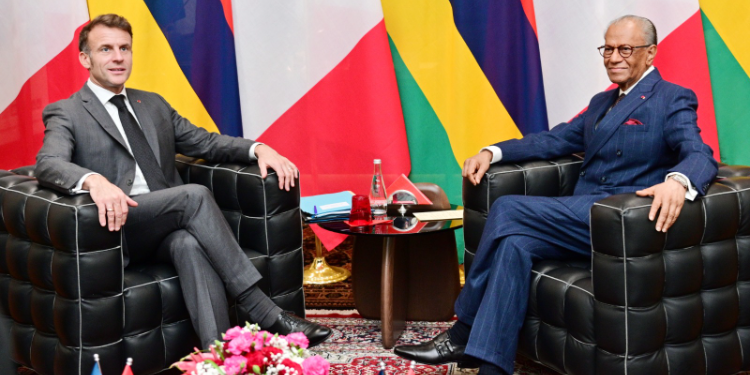
A symbolic homecoming strengthening long-standing ties
Postponed in April following the death of Pope Francis, Emmanuel Macron's visit was marked by high diplomatic expectations on both sides. He was welcomed at SSR International Airport by Prime Minister Navin Ramgoolam before beginning a packed program of institutional meetings, joint announcements, and the signing of cooperation agreements.
This year has already seen multiple encounters between the two leaders—in Madagascar for the Indian Ocean Commission Summit, in Nice for the UN Ocean Conference, and at the Élysée Palace for bilateral talks. During this visit, Emmanuel Macron also met several Mauritian ministers and paid a courtesy call to President Dharam Gokhool at the State House, further reinforcing the depth of Franco-Mauritian relations.
A renewed bilateral partnership built on energy and water security
Energy production and the stability of Mauritius's national electricity grid were central to the discussions. In response to ongoing challenges in electricity generation, both the French Development Agency (AFD) and the French energy group EDF have offered technical assistance to assess the island's grid and strengthen hydraulic infrastructure. The initiative will be developed in collaboration with the European Union.
Water security, another priority sector for the Mauritian government, forms part of the broader cooperation framework signed during the visit. Emmanuel Macron emphasized that addressing resource management, climate vulnerabilities, and infrastructure resilience requires coordinated action between countries that share common environmental challenges.
Education and technology: A new bilingual and digital dimension
Emmanuel Macron and Dr. Navin Ramgoolam also reaffirmed their joint intention to modernize the Mauritian education system. This includes launching a highly selective bilingual French–English academic pathway in public schools, continuing the implementation of French BTS programs in Mauritius, and integrating emerging technologies, particularly artificial intelligence, into the curriculum.
Furthermore, the inauguration of the new French Embassy in Moka is expected to streamline administrative processes for French expatriates, Mauritians, and the growing number of Mauritian-French academic exchanges.
Maritime security at the heart of Indo-Pacific cooperation
One of the strongest announcements of the visit concerned maritime security. Emmanuel Macron revealed several new joint initiatives, including coordinated mobilization of French naval assets and Mauritian aerial surveillance, along with expanded training opportunities through the Indian Ocean Academy.
The objectives are clear: protect exclusive economic zones, fight illegal fishing, combat narcotics trafficking, and strengthen the regional fight against organized crime. The presence of representatives from Réunion Island and Mayotte highlighted France's strategic commitment to the wider Indo-Pacific region.
The French president also praised Mauritius for its leadership in ocean governance, especially through its swift ratification of the BBNJ treaty on the protection of marine biodiversity beyond national jurisdictions.
Discussions also touched on the joint management of Tromelin and shared perspectives on political developments in Madagascar.
A shared vision for global governance and multilateralism
In his address to the press at the Sir Harilal Vaghjee Hall in the National Assembly, Emmanuel Macron stressed the deep human, linguistic, and strategic ties binding the two countries. He highlighted the convergence of French and Mauritian positions on major global issues such as climate disruption, biodiversity loss, geopolitical instability, and the erosion of trade balances.
He also reaffirmed France's commitment to multilateralism and international law—an approach he said is fully shared by Mauritius in its own diplomatic engagements.
Prime Minister Navin Ramgoolam underscored the symbolic and strategic significance of Macron's visit, describing it as a major moment in a world that he considers increasingly unstable and marked by “stances that challenge the established economic order.” He expressed gratitude to France and Costa Rica for their leadership at the UN Ocean Conference in Nice, noting that ocean issues are “existential” for small island states like Mauritius. Dr. Navin Ramgoolam highlighted the historical depth of the Franco-Mauritian relationship, from linguistic and cultural ties to France's consistent diplomatic support, especially regarding the Chagos issue.
He also welcomed the package of agreements signed during the trip, covering the blue economy, renewable energy transition, sustainable water management, and bilingual education. On the private-sector side, he applauded partnerships such as the Mauritius Sugar Syndicate's agreement with Cristalco France and the collaboration between Moulins de la Concorde and InVivo.