Welcome to Mauritius! You've just landed. Your legs are swollen, your nose still burns from the plane's air-conditioning, and you're thinking: “Now I'm eating local.” Mistake number one: believing you can “try Mauritian street food” the same way you nibble a little vegan taco back home. No! Here, eating local is an art. A cultural immersion. A spiritual initiation. A rite of passage. Sometimes a test. And absolutely not a joke.
Roti: your future breakfast, lunch, afternoon snack, and dinner
At first you'll hesitate. “What is this soft thing, rolled in paper, with sauce dripping everywhere?” That's a roti — and yes, you'll become addicted.
A thin flatbread (flour, water, oil, and a lot of patience), cooked on a hot plate and stuffed with curry, rougaille, and broad beans. Roti is the foundation. The baseline. The lifeline of every expat.
Warning: roti is often spicy. Even when they swear, “just a little.”
Where to try it: Pabs Palace in Curepipe, Chez Bye in Rose-Hill, Roti Aka Vinoda in Flic-en-Flac
Dholl puri: the Rolls-Royce of Mauritian flatbreads
The roti's fancier (and flourier) cousin, dholl puri is THE street food specialty of Mauritius. A thin flatbread filled with split peas ground into powder, rolled up with:
Rougaille
Vegetable curry
Vegetable achards (careful: some achards can wake your ancestors)
A spoon of satini (spicy chutney), often slipped in even when you clearly said “not spicy, please.”
You get two, wrapped in wax paper, with sauce trying to escape in every direction.
Survival tip: never eat a dholl puri in a white shirt.
Join the Mauritius community
Get regular tips and advice to make the most of your expat life
Farata: the rebellious cousin of the dholl puri
Farata is the rock'n'roll cousin. Same family as dholl puri, a rich, flaky flatbread sizzling in the pan, but without the split pea filling.
And with more attitude. Thicker, softer, crispier on the edges, golden and shining with love. Inside you can put meat, fish, pickles (achard), and of course, chili.
When someone says “boulettes,” don't picture dry Swedish meatballs. Mauritian boulettes are delicate steamed dumplings made of fish, meat, or vegetables, served in broth or topped with homemade sauces (soy, chili, garlic…). You order them individually, like candy. And beware, they're dangerously addictive. You start with 5. Then order 8 more. Then realise you've casually eaten 17 boulettes.
Iconic spot: Ti Kouloir in Grand-Baie, plus the stalls on Flic-en-Flac beach and near the Albion bus station.
Mine frit and mine bouilli: the dishes that follow you into your dreams
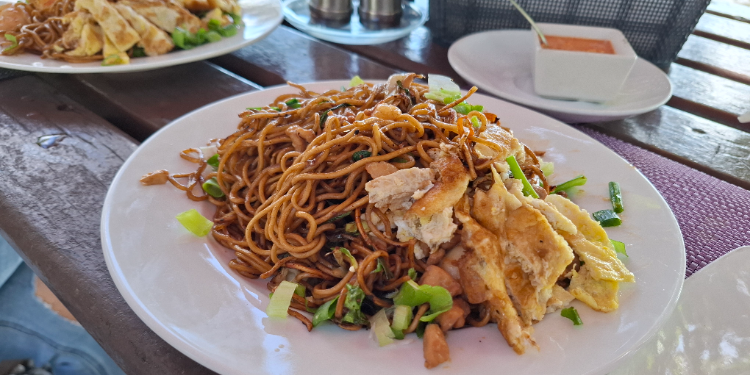
Mine frit: Stir-fried noodles with egg, vegetables, meat, fish, or seafood. Add sauces depending on your personal fire tolerance. Eat with chopsticks if you want to impress; eat with a fork if you don't want to risk embarrassment afterward. Bonus: order mine frit chicken-egg with a generous drizzle of garlic sauce—your life will change.
Mine bouilli: Same ingredients as mine frit, except everything is cooked in broth. That tiny detail changes everything. The noodles turn soft, soak up all the flavors, and create a comforting, warming bowl that gently wakes you up and gives instant reassurance.
Bol renversé is not just a dish—it's a performance. A mound of fried rice coated in smooth brown sauce, with crunchy vegetables, black mushrooms, meat or seafood, and a fried egg on top, all packed inside a bowl and flipped upside down onto your plate. Yes, flipped!
When the server arrives and lifts the bowl with a perfectly rehearsed flourish, the room falls silent. Your taste buds rise for a standing ovation.
Briani: your fast-track pass to an instant nap
Briani (or biryani, for the purists) is a caloric, emotional, and cultural bomb. Fragrant rice, soft potatoes, whole spices, meat (chicken, beef, or lamb), sometimes a hard-boiled egg — all slow-cooked with love and sweat. It's THE dish for big occasions: weddings, Sundays, and “viens lakaz mo mama” (“come to my mum's place”).
Tip: avoid eating it before an important appointment. This dish sends you directly into recovery mode.
Rougaille: the tomato-onion base that will change your life
Rougaille is the universal sauce. Tomatoes, onions, garlic, ginger, sometimes herbs, thyme, chili… It's ratatouille that took a flight, found its confidence, and got hired in a hotel kitchen. It goes with:
Sausages (rougaille saucisse).
Salted fish (prepare your nostrils).
Eggs (yes, and it's delicious).
Beef, chicken, tofu, prawns.
Everything tastes better with rougaille.
Vindaye: for adventurous stomachs
Vindaye is a tangy, mustardy marinated dish, often made with fish (or octopus). Mustard, mustard seeds, turmeric, onions, garlic, and oil—eaten cold, usually with plain rice. You'll feel like you've unlocked a higher level of flavor maturity. Prepare for an explosion of flavors and a post-apéritif breath you won't forget.
Kari ourite (octopus curry): the poetry of octopus
Octopus (ourite) is a star ingredient in Mauritius. You'll find it as:
Cari ourite: slow-cooked in a spicy sauce.
Vindaye ourite: the tangier version.
Grilled octopus: for purists.
A coastal classic, often eaten with your fingers, feet in the sand, and rum nearby.
Popular spots: Taste of Freedom in Mahébourg, Chez Varsha & Linley, or Chez Marie-Nöelle in Poste de Flacq
Veedushi Bissessur
Achards: the pickles that pack a punch
An essential side dish! Achards are vegetables—carrots, green beans, cabbage, green papaya, or mango—marinated in oil, vinegar, chili, and mustard seeds. Crunchy, spicy, and perfect to wake up a shy dholl puri or a too-plain rice.
Dangerous variant: mango achard. You've been warned.
You'll find achards in restaurants, markets, supermarkets, and, of course, in every Mauritian friend's fridge.
Local colorful pastries and snacks
We can't finish without the local sweets:
Gato coco: grated coconut, sugar, condensed milk.
Gato patate: traditional sweet potato pastry filled with coconut.
Poutou, ladoo, barfi, jalebi: Indian heritage, pure sugar overload.
Gato zinzli (black sesame), gato pistache: Chinese heritage.
Napolitain: a Mauritian shortbread with jam and a soft pink icing. New trend: pineapple-flavored napolitains sprinkled with salt and chili.
Puits d'amour: a crispy pastry shell filled with velvety cream and lightly caramelized on top.
Tip: Eat first, ask questions later.
Bonus: chili, the smiling weapon
People will often say, “It's not too spicy.” Never believe them. Mauritian chili tolerance is a superpower you were not born with. Not even if you trained in Mexico. Start with none. Add a microscopic drop. Run to get an alouda if you were too brave.
An empty restaurant with a “Authentic local cuisine” sign = flee
Forget TripAdvisor. Trust your eyes, your nose, and the queue.
If it smells good, it's good.
Speaking a bit of Mauritian Creole will open far more doors than a platinum credit card.
Just say “bonzour, mo oule enn dholl puri” and watch the vendor's smile. If you can't manage it, that's okay—they'll still serve you. But you'll miss the knowing wink and the free boulette offered “zis pou ou.”
In Mauritius, you don't just eat to eat. You eat to meet people, to discover, to laugh, to cry a little too, thanks to the chili. Learn to eat with your fingers, to use 17 napkins for one dholl puri, to say “mmm” with your mouth full, to order by the roadside without shame, to ask for seconds without regret. And above all, never forget: your real expat passport in Mauritius isn't your visa—it's your stomach.
As a globetrotter at heart, I love bringing ideas, stories and wildest dreams to life. Now based in Mauritius, I lend my pen to Expat.com and other inspiring projects.