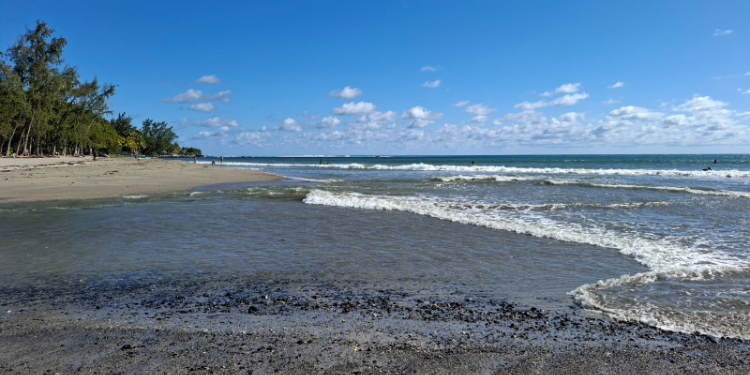
Within just a few days, a wide stretch of sand vanished along the west coast of Mauritius. A stark episode that lays bare a truth backed by data, even as authorities moved quickly to try to restore the situation: the island is among the most vulnerable in the world to rising sea levels and coastal erosion.
It took just a few days. In late April 2026, residents and regular visitors at Tamarin beach on the island's west coast witnessed a striking sight: where a wide stretch of sand had stood just days before, the sea had advanced almost to the foot of the trees and a nearby kiosk. Dozens of meters of beach were swallowed by the ocean within just a week.
For those who know Tamarin well, the shock was visceral. But beyond the emotional impact, what this episode reveals is far more troubling. And the scientific data backs up what the naked eye can already see.
The numbers tell a clear story. According to figures from the Mauritius Meteorological Service, sea levels around Mauritius are rising at 4.5 mm per year, a third faster than the global average of 3.3 mm per year. The United Nations Development Program estimates that 23% of the island's beaches are currently experiencing active erosion. According to the NGO Mru2025, around 75% of the corals in Mauritius's lagoons are dead or severely degraded.
Three indicators, three alarm bells. Around Mauritius, the sea is rising faster than elsewhere, beaches are eroding, and natural defenses are collapsing. This is not a projection; it is the documented reality of 2026.
Between 1987 and 2024, meteorological services recorded a sea-level rise of 4.5 mm per year at the Trou-Fanfaron station in Port Louis, a third higher than the global average. On the island of Rodrigues, the situation is even more critical, with a rise of 5.8 mm per year. These figures align with IPCC projections, which anticipate a global rise of between 28 cm and 1 meter by 2100.
Get regular tips and advice to make the most of your expat life
37 kilometers of coastline at risk
The MAURISCOT report, coordinated by BRGM and funded by the French Development Agency, presented in November 2025, paints an even more detailed picture. More than 37 kilometers of coastline are affected by erosion, with losses reaching up to 75% of beach width in the most exposed sections. According to the United Nations Development Program, approximately 23% of coastal beaches are currently undergoing active erosion.
The consequences are anything but abstract. Populated and tourist areas, such as Port Louis and Port Mathurin (Rodrigues), are directly exposed to flood risk. Underground, saltwater intrusion into freshwater aquifers threatens the island's drinking water supply. On the surface, roads, hotels, and residential properties built in coastal zones are becoming increasingly vulnerable. And offshore, the degradation of coral reefs is putting the fishing grounds that a significant portion of the local economy depends on at serious risk.
Dying reefs and defenseless beaches
The great silent tragedy of Mauritius's coastline is the gradual disappearance of its coral reefs. These living structures played a critical role: they absorbed wave energy and naturally replenished beach sand. According to the NGO Mru2025, around 75% of the corals in Mauritius's lagoons are now dead or severely degraded. Without reefs, there is no barrier against ocean swells. And without that barrier, beaches erode.
At Tamarin, the situation is made worse by the complete absence of protective coral reefs. The beach is fully exposed to the whims of the ocean. In late April, heavy rainfall abruptly reopened the mouth of the nearby river, altering coastal currents, while powerful swells struck the shore with nothing to absorb their force. Within days, the balance collapsed.
Mauritius ranked among the world's most disaster-prone countries
These local events are unfolding against a troubling global backdrop. The World Risk Report 2021 ranked Mauritius 51st among countries most exposed to natural hazards. The country concentrates the vulnerabilities typical of small island states: low elevation, coastal dependency, limited natural resources, and exposure to cyclones. In recent years, the island has also experienced prolonged droughts, flash flooding, and cyclones of unusual intensity.
Compounding this natural vulnerability is the constant pressure from development. The Mauritian coastline is one of the most intensively developed in the Indian Ocean, with hotel infrastructure, real estate projects, and modifications to river mouths. These developments disrupt sand circulation and reduce the beaches' ability to adapt naturally. At Tamarin, a recent human intervention is believed to have further destabilized the site in an already fragile environment.
A warning signal, not an inevitable outcome
For expats who chose Mauritius for its exceptional quality of life, this reality is far from abstract. The island's economic model depends on an attractive and accessible coastline. If beaches become unstable, the cost of protection rises, coastal infrastructure is put at risk, and the island's appeal could suffer in the long run. The good news is that solutions exist and are beginning to be taken seriously. The Ministry of Environment is considering creating a dedicated body to coordinate coastal policy. Initiatives such as mangrove restoration and reef protection are already underway. Civil society, driven by NGOs such as Mru2025 and Reef Conservation, is also gaining momentum.
What happened at Tamarin is a warning. Mauritius still has the means to act, but only if it fully acknowledges the urgency.
A journalist, holder of the DALF C1 and C2 and a diploma from the University of Mauritius, I have nearly twenty years of writing experience. After six years in the Mauritian press, I joined Expat.com, where I have been working for over a decade, including five years as editorial assistant, and now as editorial manager.