Cycling in Belgium
There are excellent facilities for cycling in Belgium. Many people commute to work this way.
In principle, cyclists must follow the same traffic rules as cars. However, you must always use bike lanes when they are available.
You can ride against the flow on one-way streets when signs display a bicycle pictogram with the mention "sauf cyclistes" in French or "uitgezonderd" in Dutch.
Make sure to invest in a good lock, as bike theft is an issue here as elsewhere. It is essential to lock your bike to an immovable structure.
It is also recommended to register your bike with an official service. Some municipalities or associations (like Pro Velo) still offer bike marking, but this is increasingly being replaced by registration in databases like mybike.brussels or Velopass, which makes recovery easier in case of theft.
Driving in Belgium
We discuss driving in Belgium in detail in another article. If you are already accustomed to driving in Europe, driving in Belgium will be easy as most (if not all) EU rules are followed here.
Read alsoBuying a car in Belgium
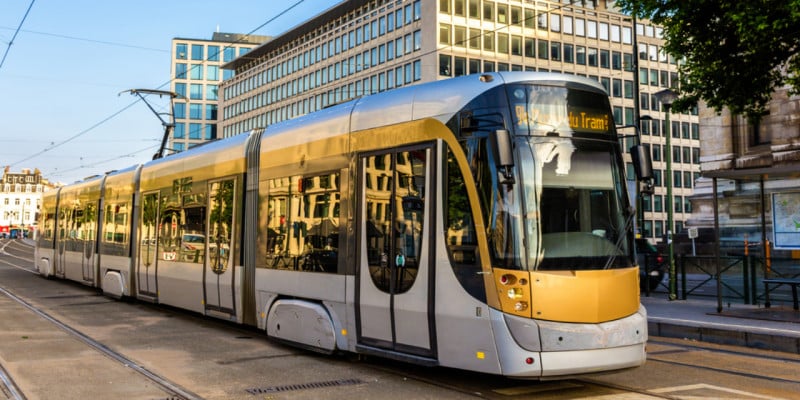
Trams in Belgium
The tram has long been a very popular mode of transport in Belgium.
In Flanders, the company De Lijn manages the networks of Antwerp, Ghent, and the Belgian Coast.
In Brussels, the service is provided by the STIB/MIVB.
In Wallonia, the networks of Charleroi and Liège are served by TEC.
Each company manages the deployment of its transport means. Thus, there are different subscriptions and passes that may interest you depending on your destinations and how often you will take the tram. You can ask for more information directly at the tram station or on board.
The minimum price for a tram ticket ranges from €2.50 to €3.20. You can buy your ticket on board, online, or at vending machines at the tram station.
Trains in Belgium
The Belgian railway network offers the most comprehensive service in Europe. If you need more information on traveling to and from Belgium, we recommend visiting the official railway website (SNCB, National Rail Belgium).
Young travelers benefit from certain free services. Children from 0 to 11 years old (up to 4 children) can travel for free if they are accompanied by someone with a valid ticket.
A train ticket is valid for a one-way trip between two stations on the date indicated on the ticket. It does not function like a time-limited metro/tram/bus ticket: you must complete your journey on the same day and on the chosen route.
For international connections, Brussels-Midi/Zuid station is the main departure point:
- To Paris: The Eurostar connects Brussels to Paris in about 1 hour 22 minutes.
- To London: The Eurostar connects Brussels to London in about 2 hours.
Read alsoGetting around Brussels
Buses in Belgium
Belgium has several bus companies operating in different linguistic regions of the country. For the French-speaking region, TEC manages public transport, including buses. For the Flemish region, the responsible company is De Lijn, and for the Brussels-Capital region, the STIB (Société des Transports Intercommunaux de Bruxelles) provides bus and metro services.
If you need to travel frequently in different regions, you will likely need specific subscriptions for each transport company.
Children under 6 years old generally travel for free on public transport, including buses, as long as they are accompanied by an adult. For people over 65, there are often reduced fares or specific benefits, but these can vary depending on the region and transport company. It is not mandatory to have a specific subscription issued by TEC to benefit from these advantages.
Purchasing a single-use bus ticket in Belgium generally does not allow unlimited transfers within a 60-minute period, as is the case for trains and metros. However, some transport companies offer tickets with included transfers or propose special rates for multiple trips.
For long-distance or international trips, private companies like FlixBus offer low-cost connections to other Belgian or European cities (France, Germany, Netherlands, etc.).
The MoBIB card
The MoBIB card (Mobility in Belgium) is a smart card used to store your public transport subscriptions and tickets. It is accepted by STIB/MIVB, De Lijn, TEC, and SNCB, allowing easy travel across multiple regions with a single medium.
There are two types of cards:
- Personal: nominative, it provides access to monthly or annual subscriptions at a reduced rate.
- Anonymous: ideal for visitors or occasional use.
You can purchase these cards at various locations, online or in stores. If you live in Belgium long-term, it is worth getting a personal card. You will benefit from discounts on your journeys by subscribing to monthly or annual subscriptions. Anonymous cards are more suited for short-term visitors.
You can use your MoBIB card for trams and buses. Additionally, the MoBIB card works with many car and bike-sharing platforms.
Read alsoTraveling in Belgium
Taxis in Belgium
Taxis in Belgium are operated by private companies. They have a "TAXI" sign on the roof of the cars and you can generally find taxi stands near train stations, ports, and popular tourist attractions.
The fares are set according to the region where the taxi company is based:
- Starting fare: on average from €2.40 to €5 depending on the city.
- Price per kilometer: generally between €1.80 and €3.20, with a higher rate at night or outside the pick-up zone.
- Additional fees may apply for booking or waiting.
In Brussels, you can book via Taxis Verts. In Flanders and Wallonia, each city also has its own companies and platforms.
It is not customary to tip, but rounding up to the nearest euro is common.
Carpooling in Belgium
Carpooling is an economical and ecological alternative to taxis and public transport. Several platforms operate in Belgium:
- Uber: available in Brussels, Antwerp, Ghent, and other major cities.
- Bolt and Heetch: present in Brussels and expanding to other urban areas.
- BlaBlaCar: popular for long-distance trips to other cities and countries. Also offers BlaBlaCar Daily for regular home-to-work carpooling.
- Local platforms: like Covevent (for sharing rides to events) or Comon (shared mobility network in Wallonia and Flanders).
Some apps allow direct payment through the application and trip planning in advance.
Useful links:
De Lijn
Brussels - Interurban Transport
Belgian Train
Federal Police Belgium
Autolive