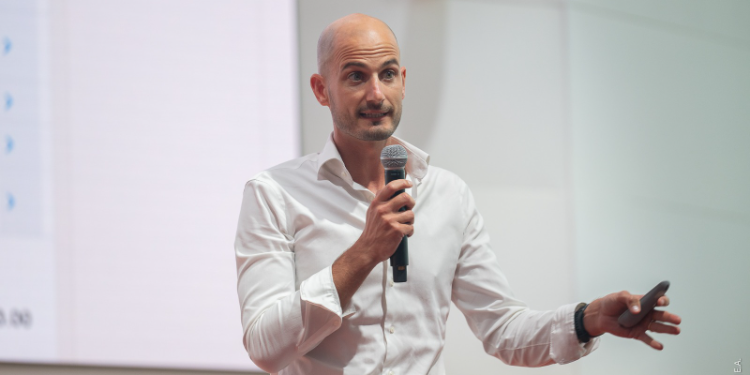
From opening a startup's first international office in Dubai to scaling and selling a successful events-tech company before launching a new AI venture from Mauritius, Aymeric de Guerre has built his career around identifying opportunities and taking calculated risks. As the co-founder of Duodeal, he is rethinking how businesses create and deliver commercial proposals through artificial intelligence and interactive customer experiences. In this interview, he reflects on the milestones that shaped his entrepreneurial journey, the lessons he has drawn from working across international markets, and why he believes Mauritius has the potential to become a leading hub for innovation and startups.
I think I've always had it in me. My very first entrepreneurial experience was at 16. I started a small photography agency and began posting photos online. This was 2004, back when the internet was still the Wild West. It showed me that with a varied set of skills, you can build something profitable. My friend Clément Seifert handled the tech side; I handled sales and marketing. Neither of us knew anything about photography, but digital SLRs were just taking off, and we learned everything as we went. That experience gave me the bug.
Then my first real job sent me to Dubai on a VIE program: I was tasked with opening the first international office for a French startup. It was a genuinely entrepreneurial experience, building something from the ground up in a new market, but with a safety net: an existing product and a team behind me. I arrived at a time when Dubai's startup ecosystem was still in its infancy. In the coworking space where I worked, we rubbed shoulders with companies that would go on to explode, like Deliveroo and Fresha, back when they were just getting started. That energy is contagious.
At the same time, I was watching a lot of The Family videos and immersing myself in startup culture. That's when a Berlin-based startup that was disrupting the moving industry came looking for me to open their French office. And that's when it really clicked: if I'm capable of launching offices for other people, why not build something of my own? I found a great co-founder in Maxime, someone I'd met in Dubai. We shared a passion for kitesurfing and used to head off on weekends to Oman for these incredible adventures combining kite and bivouac camping. And then we took the plunge.
What lessons did you take away from your international experience?
I joined Daxium, a French no-code platform, on a VIE contract to open their very first overseas office in Dubai. Over three years, I grew their presence across the Middle East, Africa, and Asia. The first lesson was humility. You arrive with your product and your French assumptions, and you quickly realize that every market has its own codes, its own rhythms, its own way of doing business. What works in Paris doesn't necessarily work in Dubai or Doha. The second was the importance of adaptability. You learn to listen before you speak and to genuinely understand what local clients actually need. And the third was more personal: working internationally so early in my career gave me a reflex I've kept ever since, which is to think about a product for multiple markets from day one, not as an afterthought. That's exactly what we're doing today with Duodeal.
Join the Mauritius community
Get regular tips and advice to make the most of your expat life
What did you learn from the Atawa adventure and its acquisition?
Atawa is the experience that taught me the most. Maxime and I took a concept that was working really well at the time: identify a traditional market and build a platform to connect clients with service providers while handling all the operational side. Essentially, the Uber model applied to the events industry. We co-founded the company in 2016, specializing in the rental of event infrastructure and equipment, and grew it from zero to €12 million in annual revenue. We were managing around 1,000 events a year, of all sizes. It's a very hands-on, operational business.
When we sold Atawa to a major European group in the sector in 2024, I discovered what it really means to integrate into a large organization. The acquisition was a success; we had senior positions, comfort, and stability. But Maxime and I quickly realized that what had truly excited us was the beginning. The first hires, the rollercoaster, the moments when you push yourself because you have no choice. You don't get that feeling inside a large corporation. So we chose to walk away from that comfort and step back into the uncertainty of entrepreneurship. That's how Duodeal was born.
Duodeal came out of a problem you experienced firsthand. Tell us about it.
It really grew out of day-to-day frustration at Atawa. We were producing hundreds of quotes a year, and the process was always the same: build the pricing in Excel, export to PDF, and when there were product photos, the file would balloon in size. So we'd compress it, send it by email... and then? Silence. No idea whether the client had opened the quote, read it, or got stuck on something. We had struggled with this so much that we eventually built an internal tool to try to solve it. That's when it hit me: if we have this problem, thousands of other companies do too. That's how Duodeal was born, from the conviction that the way companies send and track their commercial proposals needed to be completely rethought.
How does Duodeal concretely change the experience for businesses and their clients?
Essentially, we replace the classic Excel-PDF-email trifecta with an interactive, branded online page. In practice, the salesperson shares their client's brief with our AI, which generates a first draft of the proposal. That alone saves a significant amount of time. They then refine it, personalize it, and send a link. The client opens that link and gets a much richer experience: they can see the products or options with visuals, accept or decline an option, comment directly on the quote, ask questions, and sign online. On the sales side, it's a radical shift: you know exactly when the client viewed the quote, how long they spent on it, and which sections caught their attention. It transforms a passive document into a genuine sales and conversation tool.
Because we're in 2026, and most companies are still sending their commercial proposals the same way they did twenty years ago. A PDF attachment. When you buy a product online, you get photos, descriptions, reviews, and a seamless experience. But when a company sends you a €50,000 quote, you receive a static file, often ugly and impossible to read on mobile. There's a massive gap between the online shopping experience we all know and the traditional quoting experience that hasn't moved with the times. Every Duodeal proposal is a dedicated web page: responsive, visual, and interactive. Clients deserve the same quality of experience when they receive a quote as when they shop on any e-commerce site.
How much can the presentation of an offer influence a business decision?
Far more than people realize. We've all been there: you receive two equivalent proposals, one as a plain PDF and one as a polished, visual, well-structured presentation. Instinctively, you trust the second one more. Form says something about substance. It reflects a company's professionalism, attention to detail, and credibility. In a B2B context where amounts are significant and decisions are often made by a committee, a clear presentation also makes it easier to share internally and move things forward. A quote you actually want to show your director is a quote that's far more likely to get signed.
What first drew you to Mauritius?
Three things, mainly. First, the quality of life, which is hard to ignore once you've experienced it. Then the geography: Mauritius is a genuine hub, connected to Africa, Asia, and Europe. And crucially, the time difference with Europe is minimal, just two to three hours depending on the season. When you're building a SaaS product with European clients, that's a huge advantage. You can live in an exceptional setting while staying perfectly in sync with your main markets. It's a balance that's hard to find anywhere else.
How would you describe the Mauritian entrepreneurial ecosystem compared to Dubai or France?
It's a younger ecosystem, and a more intimate one. In Dubai, when I was there between 2013 and 2016, everything was bubbling. There was raw energy, serious money, and a constant influx of international talent. In France, the ecosystem is mature and well-structured, with incubators, funds, and a dense network. Mauritius is different: it's smaller, everyone knows each other, and that's actually part of its charm. Connections happen naturally. The ecosystem is still being built, which means you can still contribute to it and leave a real mark. It's not Station F yet, but there's genuine momentum and a political will to turn the island into a tech hub.
What opportunities does Mauritius offer foreign entrepreneurs and startups?
Mauritius has a real positioning as a hub between Africa, Asia, and Europe. For an entrepreneur looking to serve the African market, it's an ideal base: political stability, a solid legal framework, French-English bilingualism, and a quality of life that helps attract talent. The cost of living remains reasonable compared to Dubai or major European cities, and setting up a business is relatively straightforward.
Have you faced any challenges or surprises while building your business in Mauritius?
The main challenge is recruiting qualified profiles, especially in tech. The local talent pool is limited, and competition from offshore companies is real. But there's a positive flip side to that constraint: because the local market is small, you're forced to think internationally from day one. At Duodeal, it pushed us to build the product to work seamlessly across different languages, currencies, and markets right out of the gate. What could have been a limitation became a genuine strength. Our product was tested in real conditions across multiple markets from the start, not retrofitted later.
Can Mauritius become a hub for innovation and startups?
I genuinely believe so. Mauritius has the fundamentals: stability, bilingualism, a favorable time zone, and an attractive lifestyle. What it still needs is a critical mass. More startups, more visible success stories, stronger connections with regional and international ecosystems. But the ingredients are there. And the lifestyle, far from being a distraction, is actually an asset for attracting founders and talent who are looking for a better balance. I also see AI as an accelerator: with a small team, you can build a successful product. That's a real opportunity for Mauritius if the island can develop, support, and attract the right talent.
Which sectors or opportunities in Mauritius do you think are still underrated?
Tech and SaaS targeting the African market. Africa is a continent in the middle of a digital transformation, with enormous demand for well-adapted software tools. Mauritius, with its geography, bilingualism, and stability, is ideally positioned to serve as a base for startups wanting to tackle that market. Right now, many of the solutions come from Lagos or Cape Town. But Mauritius could play a bridging role between European expertise and African needs. It's a unique positioning that remains largely untapped.
What advice would you give to entrepreneurs considering a move to Mauritius?
First, spend some real time there before you decide. Mauritius is not just about the beach photos. You need to understand the pace, the culture, and the realities of doing business locally. Second, think internationally from day one. The Mauritian market alone is too small to scale a startup, but that's precisely what will push you to build something universal. And finally, invest in the local network. The island is small, everyone knows each other, and human connections make a real difference here, far more so than in Paris or Dubai.
One piece of advice you wish you'd received before moving to Mauritius?
Do not underestimate the adjustment period. You arrive with your Dubai or Paris mindset, expecting to find the same speed of execution. Mauritius has its own pace. It's not better or worse, just different. Once you accept that and adapt to it, everything flows much more easily. And above all: make the most of the setting. As entrepreneurs, we tend to stay glued to our screens. But one of Mauritius's greatest luxuries is being able to step away in five minutes and find yourself standing in front of the ocean. It would be a shame not to take advantage of that.
A journalist, holder of the DALF C1 and C2 and a diploma from the University of Mauritius, I have nearly twenty years of writing experience. After six years in the Mauritian press, I joined Expat.com, where I have been working for over a decade, including five years as editorial assistant, and now as editorial manager.