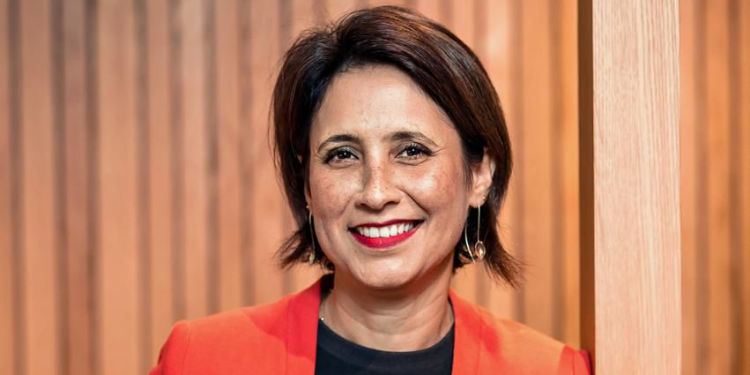
Shirin Gunny leads the Association of Mauritian Manufacturers (AMM) and has been steering the Made in Moris label since 2013, shaping it into a true driver of national pride and economic transformation. Under her leadership, Made in Moris now brings together more than 300 companies and stands as a strong, unified brand across eight key sectors. A graduate of HEC Montréal, she began her career at Cossette, where her work for international brands earned her major distinctions, including Cannes Lions and the Grand Prix Stratégies. Visionary and strategic, Shirin Gunny has repositioned the AMM as a central force for innovation, responsible production and sustainable industrial development, cultivating partnerships aligned with SDG 17. She is also a visual artist, creating pieces using natural materials.
Can you tell us about the origins of the Made in Moris label? What inspired you to launch this initiative, and what role did the AMM play?
The project was born of the will of the manufacturers within the Association of Mauritian Manufacturers (AMM). When I returned to Mauritius after several years in Canada, the Council recruited me to lead a major reflection: how to create a credible, modern and unifying tool capable of elevating local production and reshaping the image of Mauritian industry.
My background in strategic consulting, spanning business development, brand strategy and economic transformation, gave me a holistic perspective that I now apply to building structural tools for the country.
In the early stages, we worked with ADIR in Réunion Island to analyse the experience of their label “Nou La Fé.” Their approach fed into our regional thinking and helped us build a model tailored to Mauritian realities and our own ambitions. We then designed the label's architecture, which would become Made in Moris, working closely with our manufacturers and with our quality partner SGS to ensure independence, rigour and credibility throughout the process.
Thirteen years later, what started as a strategic project has become a national movement. I remain inspired by the innovation, resilience and solidarity of our entrepreneurs. Made in Moris reflects that energy and pride, and it is now fully embedded in Mauritius' industrial strategies. This momentum is carried every day by a team of young Mauritian professionals who chose to come back home after studying abroad, and who work with talent, enthusiasm and professionalism to advance our mission.
What core values does Made in Moris aim to embody?
Made in Moris is built around one fundamental principle: responsibility. Responsibility from companies that produce locally and innovate, and responsibility from consumers who choose to anchor their purchasing power in the real economy. This vision is widely shared today. At the 2025 Brand Summit, Made in Moris ranked as the second “Most Preferred Brand” and third in the “Most Sustainable Brand” category. This recognition highlights the Mauritian public's attachment to local know-how and to the positive impact of Mauritian production.
Join the Mauritius community
Get regular tips and advice to make the most of your expat life
You often mention innovation, sustainability and the circular economy. How do these priorities guide your actions?
Made in Moris aligns closely with today's global challenges: climate urgency, economic sovereignty, and responsible resource management. Our specifications include demanding criteria linked to the Sustainable Development Goals, and we support our members through structured programmes such as Sustainability for Local Brands and Lindistri Dime. These initiatives help businesses adopt eco-design, move toward Industry 4.0, manage supply chains more efficiently and leverage artificial intelligence. We work with the conviction that sustainability is not a constraint but a driver of competitiveness and value creation.
The label now covers a wide range of sectors. What is the strategic purpose of this diversification?
Made in Moris encompasses eight sectors, from agrifood to digital technology, including services, textiles, agriculture, manufacturing, hospitality, and the cultural and creative industries. This diversity reflects the evolution of Mauritius' economy, as well as our ambition to position local production as a strategic pillar of national development. The manufacturing sector plays a central role: food self-sufficiency, energy sovereignty, reduced import reliance, quality upgrades, low-carbon transitions, etc. For each major challenge, local production is part of the solution.
More and more foreign entrepreneurs are settling in Mauritius. How does the AMM engage with this dynamic?
We are open to dialogue with any entrepreneur who wishes to contribute to the country's economic development. Collective intelligence grows when different visions, expertise and experiences come together. Foreign entrepreneurs often bring valuable perspectives, and we always welcome them with interest.
Which sectors perform best in the local market? What makes a business competitive?
Agrifood remains a cornerstone, but services, digital technology, artificial intelligence and the cultural and creative industries are showing remarkable dynamism. To be competitive, a company must focus on quality, innovation, reliability, customer experience and transparency. In a market that is both open and small like Mauritius, trust makes the real difference.
What challenges do local companies face in the current international context?
International competition remains a significant challenge. Mauritian businesses invest locally, create jobs and operate within a structured regulatory framework, while imports do not always comply with the same standards. Our advocacy work aims to ensure fair competition and highlight the strategic role of local industries.
Another major challenge is food sovereignty. According to a recent Kantar study, Mauritius imports between 75% and 82% of its total food consumption. For entrepreneurs interested in these issues, there is a real opportunity here: contributing to the country's resilience by building sustainable, innovative and competitive local value chains. The AMM and Made in Moris are natural partners to support such initiatives.
How can a company founded by a foreign national join the AMM and obtain the label?
The Made in Moris label is awarded to products and services, not to companies. The conditions are straightforward: produce locally, own a brand, ensure at least 25% Mauritian added value, and achieve 80% of the brand's revenue in Mauritius (for products).
How would you describe Mauritius' economic and cultural identity?
Mauritius has been built on resilience, hard work and innovation. From the sugar industry to the export processing zones, from textiles to tourism, and today to financial and digital services, our economy has constantly reinvented itself. The country also benefits from a unique geostrategic position: an island crossroads between East Africa (COMESA, SADC) and Asia, with a strong historical and economic connection to India. For foreign investors, Mauritius is a natural hub offering access to a market of more than 600 million consumers. Culturally, we are a plural nation, enriched by our influences and our creative spirit.
How does the label position Mauritius as a producer of quality goods and services?
Made in Moris helps build a narrative we believe is essential: Mauritius is not just a tourist destination—it is an industrial nation. We have been producing locally for almost 90 years, with rigour, innovation and commitment. The label shines a light on that excellence and celebrates Mauritius' diverse know-how.
Do you have any message to share with expats who wish to contribute to local development?
Get involved in the ecosystem. Choosing Made in Moris means directly supporting the economy, employment and sustainability. For entrepreneurs, our Made in Moris Pledge programme is an excellent tool for structuring a locally anchored supply chain. We also organize company visits and Rendez-vous Experts, which offer opportunities to discover Mauritian expertise and meet key industry players.
Expats have a vital role to play: their international perspective, skills and purchasing decisions help shape the next chapter of Mauritius' development. And those who wish to explore the Made in Moris ecosystem further, whether through our updates, factory visits, or new initiatives, can join us on our social media channels. It's an easy way to become part of the community and better understand the dynamism behind Mauritian production.
A journalist, holder of the DALF C1 and C2 and a diploma from the University of Mauritius, I have nearly twenty years of writing experience. After six years in the Mauritian press, I joined Expat.com, where I have been working for over a decade, including five years as editorial assistant, and now as editorial manager.