

International Relations



Budapest and Vienna Turn a New Page in Bilateral Relations
On Thursday, Austrian Chancellor Christian Stocker welcomed new Hungarian Prime Minister Péter Magyar to Vienna’s Ballhausplatz with full military honors for Magyar’s second official visit abroad. The meeting marks the declared intention of both sides to place bilateral relations on new, constructive footing.
The Hungarian head of government was accompanied by a high-level delegation, including Foreign Minister Anita Orbán, Living Environment Minister László Gajdos, Transport and Investment Minister Dávid Vitézy, and Economy and Energy Minister István Kapitány. A one-on-one meeting between the heads of government and a subsequent plenary session of the delegations were followed by a working lunch with representatives of the Austrian business community, a courtesy call on Federal President Alexander Van der Bellen, and talks with Lower Austrian Governor Johanna Mikl-Leitner.
“There is now an opportunity for a fresh start,” Péter Magyar emphasized at the joint press conference with Christian Stocker. Hungary would once again act as a constructive member of the European Council and the Council of Ministers. While this does not mean that the new government will not consistently advocate for domestic interests, the prime minister noted that anyone who is a member of a club must abide by its rules and keep the common good in mind.
"The Austrian chancellor expressed his delight at the visit and congratulated Magyar on his election victory, which he described as having “symbolic significance.”
The overwhelming majority of the Hungarian population had rejected the politics of obstruction and isolation and opted for European, civic, and cosmopolitan values. “Our region is closely intertwined politically, economically, culturally, and historically. If we join forces, we can achieve more—including in representing our interests in Brussels,” explained Stocker.
To turn words into action, the heads of government agreed to hold a joint cabinet meeting this September at Grassalkovich Castle in Gödöllő, Hungary. In addition, Magyar intends to deepen cooperation in the Central European region.
"He is planning a V4 summit in Budapest for late June, to which—subject to the agreement of the other members—Austria and, in the future, other neighboring countries such as Croatia, Romania, or Slovenia could also be invited."
Both politicians were in agreement on migration and foreign policy. Thanks to close cooperation, the number of asylum seekers is already falling steadily, it was stated at the press conference. In addition, both countries are calling for rapid EU expansion to include the Western Balkans. In the area of energy supply, Hungary and Austria advocate for the expansion of cross-border capacities and greater diversification. Europe has “shot itself in the foot” in the past with overly rigid climate limits that fueled the exodus of industry, according to Magyar.
The stagnation of recent years is also set to end in the transportation sector. As specific projects, the parties cited the extension of the M85 expressway between the western Hungarian cities of Győr and Sopron all the way to Eisenstadt (Burgenland, Austria), as well as the acceleration of the Budapest–Vienna rail line, which is also expected to benefit tens of thousands of commuters.
"However, there are points of friction regarding Hungary’s special taxes, which, according to Stocker, disadvantage Austrian companies—after all, Austria is the second-largest investor in Hungary."
Magyar pointed to the “bleak state” of the Hungarian budget and a projected high deficit for 2026. The primary goal is a transparent budget that stimulates growth. In the medium term, however, the aim is to reform the tax system to guarantee equal conditions for Hungarian and foreign investors, the prime minister explained. Foreign investment is welcome, but higher value-added and investment in research and development are expected, he added.
The talks were overshadowed by a serious environmental problem. For years, stones containing asbestos from Austrian quarries have been making their way to western Hungary. In some municipalities, air pollution levels are 300 times the limit.
"Magyar announced that a joint Hungarian-Austrian commission would begin work next Monday."
Four of the quarries in question have already been closed. “There is no room for excuses here,” the Hungarian prime minister made clear. The cleanup will cost tens of billions of forints. Whoever is ultimately responsible—whether companies or politicians—Hungary will consistently enforce the polluter-pays principle, he explained. Stocker expressed full understanding for the concerns of the Hungarian people and assured them of the Austrian authorities’ full support.
Budapest and Vienna Turn a New Page in Bilateral Relations


Budapest and Vienna Turn a New Page in Bilateral Relations
On Thursday, Austrian Chancellor Christian Stocker welcomed new Hungarian Prime Minister Péter Magyar to Vienna’s Ballhausplatz with full military honors for Magyar’s second official visit abroad. The meeting marks the declared intention of both sides to place bilateral relations on new, constructive footing.
.... - @SimCityAT
All I can say is thank god we're moving past all that division and Russian stuff.
I cannot see MP going to Washington anytime soon.
Meanwhile, here, we hear absolutely nothing from the former regime members.
Nada. Zilch. Big fat zero.
No apologies, no spin, null.
Kind of weird.


The European Commission has presented its plan to allow passengers to book multi-operator rail journeys with a single ticket, a single contract, and unified passenger rights. How can the EU simplify rail travel? Watch the video. #EuXl
The European Commission has presented its plan to allow passengers to book multi-operator rail journeys with a single ticket, a single contract, and unified passenger rights. How can the EU simplify rail travel? Watch the video. #EuXl
➡️ https://l.euronews.com/q0c0 - @SimCityAT
I saw that article and wondered how it will work.
I never travel by train in Europe but I do regularly now in the UK and mostly it's all being re-nationalised and consolidated. There's a lot of duplication - like every train company has its own app.
Maybe a single European operator will emerge in the future.
UK (BBC):
Best moments from 2026 Cooper's Hill cheese rolling races
Thousands of people gathered in the baking heat to watch competitors from all over the world chase a 7lb (3kg) wheel of Double Gloucester cheese down a 1:2 gradient slope. YouTuber Tom Kopke won the first race of the annual event on Cooper's Hill in Brockworth, while Alix Heugas from France was first on the women's race. Before the races began, 23-time champion Chris Anderson was named a Guinness World Record holder for winning the most races between 2002 and 2022. He came out of retirement to compete against Kopke, but finished second.
You've got to admire a place where people will dangerously race each other downhill to be first over a line and win a round cheese.
Donald Trump lashes out after judge orders removal of his name from Kennedy Center
US District Judge Christopher Cooper also ruled that the a vote to close the Washington DC venue was "ill-informed and seemingly pre-ordained".
President Donald Trump has lashed out after a judge ordered the removal of his name from the Kennedy Center.
US District Judge Christopher Cooper ruled that Mr Trump's name had been added illegally, and that the Kennedy Center board's 16 March vote to close the facility was "ill-informed and seemingly preordained", with no regard for its legal obligations.
He concluded that the board had "overstepped its statutory bounds" by unilaterally adding Mr Trump's name to the centre, saying that it could only be changed with congressional approval.
Judge Cooper wrote: "Congress gave the Kennedy Center its name, and only Congress can change it."
The Trump administration has been ordered to take down all physical signage bearing Mr Trump's name, and to eliminate any references to a "Trump Kennedy Center" from official materials, within 14 days.
Responding to the ruling in a post on Truth Social, Mr Trump accused the judge and political opponents of preferring to the venue "DIE than have President Trump transform it".
President Trump's plan to renovate the centre is part of a broader push by the Republican leader to reshape Washington's monuments.
He also intends to erect a 250ft (76m) arch, and to build a 90,000-square-foot ballroom at the site of the demolished East Wing of the White House.
Those efforts also face court challenges.
The administration's planned two-year closure of the building has also been halted by the judge, who said his order does not prevent the Kennedy Center from moving forward with planned repair work.
However, the board could still close the centre, Cooper wrote, "should it come to this decision anew after independently balancing its multiple obligations to the Center in a prudent fashion".
Ohio Democratic US Representative Joyce Beatty, a member of the Kennedy Center's board by virtue of her position in Congress, had brought the lawsuit.
Rep Beatty said in a statement after the ruling that the "Kennedy Center is an institution that belongs to the American people, not to Donald Trump".
The politician sued the Trump administration in December, calling the renaming of the building "a flagrant violation of the rule of law" that "flies in the face of our constitutional order".
And the setback comes as the administration's plans to mark the 250th anniversary of the US have also run into trouble.
Anniversary celebration setback
A number of musical artists have cancelled their appearances at a Donald Trump-linked US celebration in Washington DC.
Martina McBride, Bret Michaels and the Commodores and are among those who have dropped out of the celebrations, which are designed to celebrate the US's 250th birthday.
This summer's The Great American State Fair shows on Washington's National Mall are being organised by Freedom 250.
It is described as a "non-partisan" organisation, but was launched last year by President Trump and is headed by Keith Krach, a first-term Trump appointee for the State Department.
The organisation had only announced the appearances of McBride, Michaelson and the Commodores on Wednesday.
Why are artists cancelling?
Some of those cancelling their appearances said they were misled about the theme of the shows, or were wary of being affiliated with a political party.
In an Instagram post, Michaels wrote that he had thought his show would be a chance to "honour our veterans, active military, first responders, teachers and hardworking Americans from all walks of life".
But he concluded that the event had "evolved into something much more divisive".
McBride also issued an Instagram statement, saying she had been "presented with an opportunity to perform at a non-partisan event, but that turned out to be misleading".
Young MC, another artist scheduled to perform, expressed similar sentiments in an Instagram post, while the Commodores released a brief statement saying they chose "not to publicly affiliate with any single political party".
Some of those who are still set to perform at the events as of Friday morning include Flo Rida, Vanilla Ice and Fab Morvan of Milli Vanilli, the Grammy-winning duo who were discredited after reports that he and fellow frontman Rob Pilatus did not sing on the records and lip-synced on stage.
Morvan told the AP news agency in an emailed statement that he was "here to entertain and unite people, not divide them".
A representative for Vanilla Ice said that the "Ice Ice Baby" rapper was "proud to help celebrate America's 250th Anniversary!".
A rocky relationship
Despite gathering some high-profile entertainment industry figures, such as Sylvester Stallone and Nicki Minaj, Mr Trump has had a rocky relationship with many others.
Taylor Swift, Robert De Niro, Billie Eilish and Bruce Springsteen are among those who have endorsed Democrats and or condemned Mr Trump, while Elton John, Kenny Loggins and others have objected to their music being used in Trump rallies or videos.
It's not the only time that President Trump-related plans for the country's 250th birthday have caused headlines.
US Treasury officials said on Thursday that they are preparing to print a new $250 bill depicting the president, pending legislation changes.
Under current mandates, no living person can be depicted on banknotes.
Treasury Secretary Scott Bessent said on Thursday that his department designed the bill because "we have to be prepared" in case lawmakers decide to pass the stalled bill that would change that.
Source: Sky News
Donald Trump lashes out after judge orders removal of his name from Kennedy CenterUS District Judge Christopher Cooper also ruled that the a vote to close the Washington DC venue was "ill-informed and seemingly pre-ordained".President Donald Trump has lashed out after a judge ordered the removal of his name from the Kennedy Center.....Under current mandates, no living person can be depicted on banknotes.Treasury Secretary Scott Bessent said on Thursday that his department designed the bill because "we have to be prepared" in case lawmakers decide to pass the stalled bill that would change that.Source: Sky News - @SimCityAT
It's a all a bit obvious Trump is thinking of his legacy. At 80, he's faced with the reality his life is finite. His achievements are nothing to be proud of. I expect anything currently being Trumpified will be back to what it was as soon as Trump has left the building. The politics of division seem to have had their day. And he'll be remembered as the chief clown amongst the rest of the circus.
That thing about the $250 note. I know from working in government, that there's no mandate to work on anything in anticipation of something happening. Unless the funding and direction are established by law (i.e. parliament), it's all just pi**ing into the wind by windbags. In fact, I'd even say, putting resources into planning stuff like illegal notes is utterly unauthorised and should be stopped. Treasury officials should have to pay back the costs from their own pockets.
We're all getting bored with the Madman Theory of Presidential behaviour. We all know he's TACO man and the Iranians are far too sophisticated to fall for his nonsense. Maybe the Madman Theory is just BS and he's just irrational, a poor chess player with the attention span of a gnat.
HU (Euronews):
Tisza government to amend constitution to allow removal of president
At a press conference outside the Sándor Palace, Prime Minister Péter Magyar outlined Tamás Sulyok’s failings and announced plans to amend Hungary's Fundamental Law to allow for his removal.
This has to happen otherwise it'll be like the Polish situation with the President vetoing all sorts of legislation. PM^2 has the numbers and majority, so the current HU President - known to be a Fidesz stooge/shill - should resign and smooth the way for the sake of the country. PM^2 is saying direct elections for President as a potential alternative.
Péter Magyar threatens to impeach President Tamás Sulyok (sorry its in German)
Source: DIE ZEIT
Péter Magyar threatens to impeach President Tamás Sulyok (sorry its in German)
Source: DIE ZEIT
https://share.google/AydKvdq2qlKuOdCTe - @SimCityAT
Same really as the Euronews version.
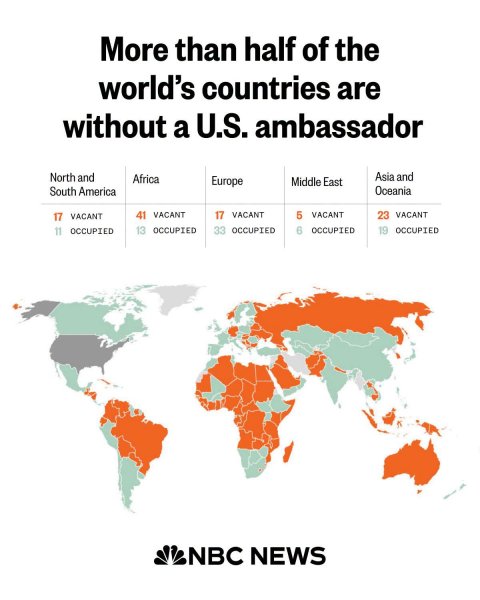
Around 2,000 U.S. diplomats have left the Foreign Service over the last year, either through layoffs or forced retirements, taking with them decades of institutional knowledge, experience in crisis response, and highly specialized language skills.
Their departure from a workforce that was estimated to be more than 13,000 in 2024 leaves the U.S. at a critical disadvantage, current and former State Department officials say, at a time when the nation is facing an escalating number of foreign policy crises.
Learn more: nbcnews.to/4eeWNsB
Around 2,000 U.S. diplomats have left the Foreign Service over the last year, either through layoffs or forced retirements, taking with them decades of institutional knowledge, experience in crisis response, and highly specialized language skills.
Their departure from a workforce that was estimated to be more than 13,000 in 2024 leaves the U.S. at a critical disadvantage, current and former State Department officials say, at a time when the nation is facing an escalating number of foreign policy crises.
Learn more: nbcnews.to/4eeWNsB - @SimCityAT
Makes one wonder what the plan is. I think they haven't got a scooby.
HU (Euronews):
What Germany expects from Hungary now: Magyar visits Merz
Hungarian Prime Minister Magyar is paying his first official visit to Berlin. Germany will discuss Hungary's new role in the EU, expecting Budapest to not cause political headaches.
When Péter Magyar won Hungary’s parliamentary elections in March 2026, bringing an end to Viktor Orbán’s 16 years in power, there was palpable relief in many European capitals. His inaugural visit to Berlin to meet Chancellor Friedrich Merz (CDU) is set to be the next major test for his new government.
Good relations with Germany and France are vital to get EU support for Hungary's reform. We had the 1989 fall of the wall and change of system and now in 2026, we're probably facing something not quite of the same level but rather similar.
I think PM^2 has at least been seen in the right places - and that does NOT mean Washington DC.
I almost fell off my chair laughing over this one posted by Donny T.
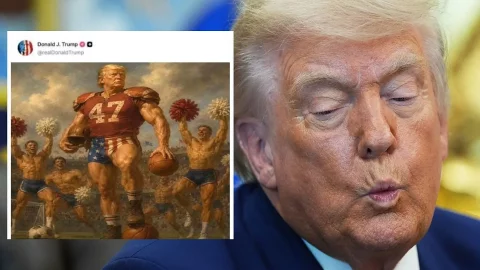
Headline was: Trump ‘oil painting’ football image goes viral and sparks Pride Month jokes



I almost fell off my chair laughing over this one posted by Donny T.
I've never seen anything more gay!
Okay, that's a lie.
But why is he holding, and have his foot on, a basketball?
I almost fell off my chair laughing over this one posted by Donny T.
It's all utterly gay. But which gay people fancy Donald Trump a geriatric overweight golfer? Another question.
But not the big question. Why basketball? I am not sure that game has gay icons in it but the US game of "football" is peppered with gay people. I wonder if Donny will remove that post when he realises he's endorsing Pride.
Too late, the Internet never forgets.
His pouting I find amusing. Ooohhh....big muscles and ripped bodies.
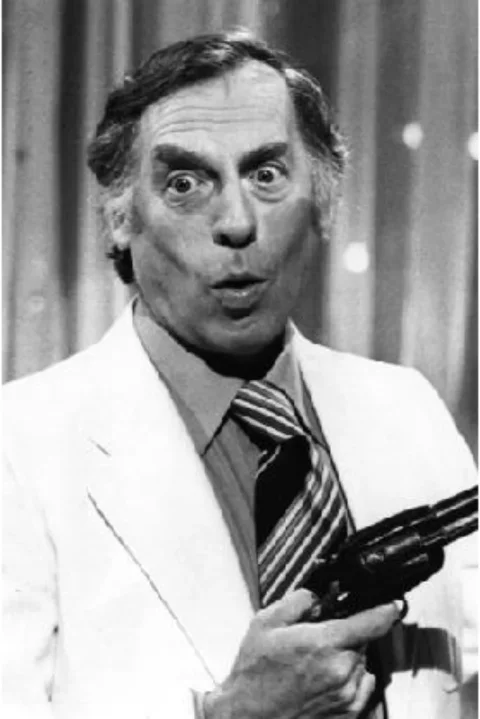
We had a gay comedian in the UK called Larry Grayson. Reminds me very much of him (don't know why he's holding a revolver, but I'm thankful I'm not James Comey, former head of the FBI):
And why is there a soccer ball and net in the pic?
Trump's fishing for the athletic type.
Kennedy Center lawyers tell staff to remove references to Trump in signage
Attorneys for the center said the signage must revert to previous names like the John F. Kennedy Center for the Performing Arts by June 12.
CNN (UKR):
House approves Ukraine aid and Russian sanctions, defying Trump and GOP leaders
More than a dozen GOP lawmakers defied their own leadership — and President Donald Trump — by voting with Democrats to approve a major bill to deliver billions of dollars in aid to Ukraine while imposing steep sanctions on Russia.
About time they got real on UKR. It's hard to know what the foreign policy of the USA is. As we're in a neighbouring country to UKR, anything that keeps Putin on the back foot has to be good news. USA and lend lease though - seen that before and we know how long that took to resolve from WW2.
@Aidan in HCMC
The man is not well. - @SimCityAT
He's more like an old guy way out of touch with all the symbolism of the modern world.
@Aidan in HCMC
The man is not well. - @SimCityAT
He's more like an old guy way out of touch with all the symbolism of the modern world. - @fluffy2560
That too.
Kennedy Center lawyers tell staff to remove references to Trump in signageAttorneys for the center said the signage must revert to previous names like the John F. Kennedy Center for the Performing Arts by June 12.https://www.nbcnews.com/politics/trump- … rcna348512 - @SimCityAT
There's also an injunction on the ballroom. There's no appropriation (budget) for it. And he doesn't have permission from Congress. He's pushing the security part under the ballroom as a reason to continue with the upper part. But it could just be 6 stories or whatever of underground windowless offices, with no ballroom. It doesn't have to be there. There are plenty of alternative venues in Washington according to reports.
There's more of a problem with the guy nodding off - Trump appears to fall asleep at Oval Office meeting
One of the commentators says, over 65, it's time to retire for airline pilots and park rangers. I'm 65, soon to be 66 and I am 100% behind that view. I know for sure, it's not easy to keep awake all the time and on form. Not without decent nights sleeping. My view is that no President (of the USA) should be over the age of 75 at the END of their terms. This would mean they could not be elected past 68.
We see it here - we've got a new dynamic PM here in HU who is in his 40s and jeez, did the previous incumbent in his 60s look tired and knackered. If he was a donkey, people would have been taking him to the donkey sanctuary. That level of responsibility does people in. Orban looked almost like a cast member of the Walking Dead at the end.
USA (MSNOW):
In an explosive interview with NBC aired on Sunday, President Donald Trump cut the grilling short and left the set after peppering “Meet the Press” moderator Kristen Welker with insults.
“You’re either crooked or you’re stupid,” Trump told Welker, who kept a cool demeanor despite the president’s barrage of disparaging slurs.
Moments before he attacked her, Trump — without providing any evidence — said he believes elections in the U.S. are rigged. Then he lambasted television news networks, singling out NBC, CBS and ABC.
As usual Donny reaches a point of cognitive dissonance and then starts saying everyone in the media is crooked. It happens to him when he believes (sort of) his own BS. And it's TACO again when pressed on real (not alternative) facts. The guy is so rude and obviously a misogynist or suffering from dementia or just all of them. Dementia quite often makes people angry. We know from experience of elderly relatives.
USA (MSNOW):
The president walked off the set mid-interview with moderator Kristen Welker after hurling insults at her.
In an explosive interview with NBC aired on Sunday, President Donald Trump cut the grilling short and left the set after peppering “Meet the Press” moderator Kristen Welker with insults.
“You’re either crooked or you’re stupid,” Trump told Welker, who kept a cool demeanor despite the president’s barrage of disparaging slurs.
Moments before he attacked her, Trump — without providing any evidence — said he believes elections in the U.S. are rigged. Then he lambasted television news networks, singling out NBC, CBS and ABC.
As usual Donny reaches a point of cognitive dissonance and then starts saying everyone in the media is crooked. It happens to him when he believes (sort of) his own BS. And it's TACO again when pressed on real (not alternative) facts. The guy is so rude and obviously a misogynist or suffering from dementia or just all of them. Dementia quite often makes people angry. We know from experience of elderly relatives. - @fluffy2560
I did watch it and it was highly entertaining, first time I've seen him change colour to a red tinted colour. He was just like spoilt child not getting his way.
I did watch it and it was highly entertaining, first time I've seen him change colour to a red tinted colour. He was just like spoilt child not getting his way. - @SimCityAT
He's so full of nonsense, it's just ludicrous that guy ever got elected. But that's what one gets when people elect a grifter. He was also incredibly patronising calling her Darling at the end and apparently he touched her. Like she was a child or worse, an object! When will people wake up to who he really is?
@fluffy2560
Congress is turning on him now, more and more Republicans are backing the Democrats. The war is illegeal as they didnt give the backing so they have to pull out, they have voted to give Ukraine money.
He is getting upset because he knows he is losing power.
Hete we go again- @SimCityAT
Makes one wonder what he's been smoking. Another Venezuela. Makes it look like robbery or a land grab. And of course, how does the oil get to Kharg island? From the mainland. And he's not going to invade there. So what's he got? Not actually that much. And he'll loose a lot of people.
This morning I read that he likes inflation. Yeah, right, if it serves his own bank account. Anyone who believes it's a good thing and their cash should be worth less and prices will be higher in one year while wages inevitably stagnate has to have a screw loose. He's going to put pressure on the Federal Reserve chairman to reduce interest rates. Don't see that happening.
I would not be surprised if the Maduro Venezuelans are covertly organising resistance groups out in the countryside ready to take back control.
Trump's chickened out again with some BS story about having an agreement ready to go. TACO man does it again. Iranians deny knowledge of an agreement. From here, it looks like Iran knows what they are doing - however how distasteful they are, they are playing him like a fiddle. He's got to go, he's got no credibility whatsoever.
Trump's chickened out again with some BS story about having an agreement ready to go. TACO man does it again. Iranians deny knowledge of an agreement. From here, it looks like Iran knows what they are doing - however how distasteful they are, they are playing him like a fiddle. He's got to go, he's got no credibility whatsoever. - @fluffy2560
How many deals is this now?
Trump's chickened out again with some BS story about having an agreement ready to go. TACO man does it again. Iranians deny knowledge of an agreement. From here, it looks like Iran knows what they are doing - however how distasteful they are, they are playing him like a fiddle. He's got to go, he's got no credibility whatsoever. - @fluffy2560How many deals is this now? - @SimCityAT
Yes, good point
I think actual peace has broken out 0 times but claims of peace are apparently now at 39 (source: CNN).
If it's a negotiating tactic it's a poor one. Iranians have got his number, see exactly where he's coming from and are bizarrely winning the PR war. And they are an absolutely reprehensible government.
IMHO anyway.
USA (CNN):
Huge ‘8647’ etched into grass on the National Mall, aerial images show
Washington — The numbers “8647” — a phrase generally used to signal opposition to President Donald Trump — appeared etched into the grass on the National Mall on Thursday, days before massive crowds are expected in the area for a UFC match on Trump’s birthday on Sunday.
Live webcam images from the top of the Washington Monument show the numbers appearing as dead grass along a large portion of the Mall, east of the World War II Memorial. It’s not clear when the markings first appeared. The numbers were not visible in photos from Getty Images of the National Mall taken on June 5.
Someone there has a sense of humour and knows longer term planning too. I wonder how they did it? Different grass? Weedkiller?
US (CNN)
Trump says US-Iran peace deal 'complete,' to be signed on Friday
Tehran has since confirmed that the "text of the memorandum of understanding" has been agreed on and is to be signed in Switzerland, opening the door to 60-day negotiations "following verification of US commitments," including the lifting of the US blockade. The US-Iran deal is now "complete," US President Donald Trump announced on Sunday night.
I wonder how long this "peace" is going to last. Trump was keen to make it about him and make it on his birthday. Just weird behaviour.
There are approximately $120 billion in Iranian assets held due to sanctions. Iranians apparently want that back so one has to wonder what is in this Memorandum of Understanding cum Heads of Agreement. I am sure releasing assets will be a win for Iran. Usually an MoU is just a series of subject areas. They've deferred the most
Let's hope Trump brings the Ukraine-Russia war to an end in Ukraine's favour which is back to the original border with Russian reparations. Trump has woefully misunderstood the situation there. And what's he going to do about China's encroachment in the South (of) China Seas. He seems to be sitting on his hands regarding that one.
US/UK (ITN News on YT):
ITN news reports from 1972 over Viet Nam peace negotiations in Paris.
Interesting to compare to the Iran situation. Something of deja-vu.
Vietnam '72 | Dramatic Footage Captures Final Months Before Paris Agreement (1972)
I remember the end of the Viet Nam war and the last helicopter taking off.
BY (Euronews):
Lukashenka apologises to Zelenskyy, calls him 'young and inexperienced'
Belarus leader Aliaksandr Lukashenka said his country poses no military threat to Ukraine and claimed his earlier statements were only in response to what Lukashenka said were threats from Kyiv to Minsk.....At the same time, he argued that Zelenskyy should be more careful in his statements and avoid provoking Belarus..... "No military action should be expected from Belarus, and especially from me," Lukashenka said as he called Zelenskyy “young and inexperienced,” and "not a military man”.....Kyiv officials have been expressing a growing concern that Belarus may be pulled deeper into Russia's all-out war against Ukraine.
This is off the wall WTF nonsense from Lukashenka. He's concerned he'll be hit by UKR's increasing excellent long range drone capability. They've got no chance of defending Belarus and Lukashenka would be an easier target than Putin. If Lukashenka was bumped off, Putin would probably take Belarus on some spurious grounds.

@SimCityAT
Begs the question: what sort of staff exist in those embassies?
Ambassador can be less important than dedicated specialists (like: military, economy (my guess dedicated oil related can exist in Gulf States)).
In recent decades there is an increasing trend in consular-focus rather than traditional embassy work - probably the US choose that direction as well, or experimenting with it.
@fluffy2560
Hehe, jut today seen a military analyst mentioned that:
US: rented a floor in a hotel.
Vietnam: buy a property for the negotiations.
Slight disparity in the expected time till reach a treaty.
Similar can be expected with Iran.
@fluffy2560
Well Lukasenko may have more military knowledge than Zelensky, but his country far behind Ukraine in military capabilities, all around, not just drones. Maybe the only one where Belarus have an advantage would be heavy vehicle repair (with some modification at the tractor factories). Even that is just a maybe.
@fluffy2560 Well Lukasenko may have more military knowledge than Zelensky, but his country far behind Ukraine in military capabilities, all around, not just drones. Maybe the only one where Belarus have an advantage would be heavy vehicle repair (with some modification at the tractor factories). Even that is just a maybe. - @sjbabilon5
Yup, nature of warfare is quite different now. Drones have changed everything. UKR is now exporting its expertise to other countries. Indeed, Belarus is of course known for its heavy vehicles for mining. Doesn't help one bit.
Last attack by UKR on Moscow was something else. If the Russian population wonder what is going on in the war, they certainly know now how it's going. And Putin has apparently remained silent while on a jaunt to Central Asia and some conference.
Meanwhile, it looks like the Trump peace agreement for Iran has already fallen apart.
Essential services for your expat journey




- Quality of customer service in Hungary
- Budaörsi AirShow 8 - 20 June 2026 (FREE event!)
- Gardening tips for Hungarian soil and climate?
- English Public schools
- finding an address with a name
- Funeral Advice
- Has anyone gone through the simplified naturalization precedure?
- Ben Fogle Return To The Wild - Hungary
- Retire to Lake Balaton?
- Denied Hungarian Simplified Naturalization
- Help please! Im a Filipina and is engaged to a Hungarian.
- Cheapest cities in Hungary
- Dark side of Hungary
- Dating and finding love as an expat in Hungary
- Pet Parrots?
- Being LGBT in Budapest.
- Szex in Budapest
- Electric Wiring