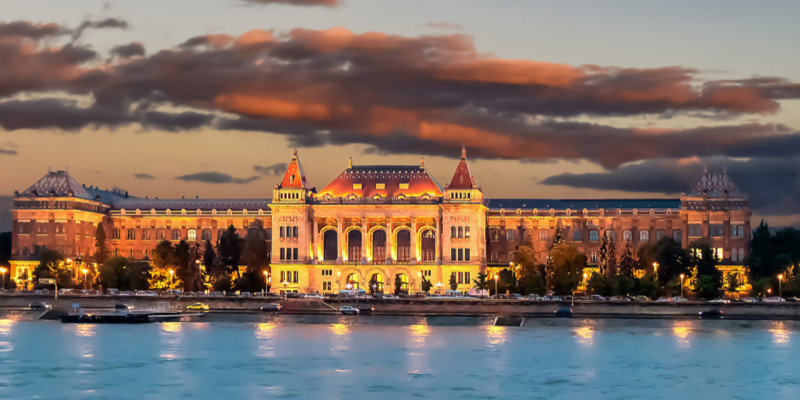
Hungary has been called The Crossroads of Europe, and it is definitely a central and cosmopolitan destination, both culturally and geographically. With prestigious higher education establishments, many university towns and exciting opportunities for scholarships, Hungary can be a great choice for furthering your studies.
Once you're enrolled at an educational institution that's offering accredited programmes in Hungary, you're entitled to extend your original 90-day stay. You just need to register at the regional directorate of the National Directorate-General for Aliens Policing (formerly the Office of Immigration and Nationality) by your 93rd day in Hungary. When registering, you should provide them with your admission papers to verify your student status. You will receive a registration certificate that you can use together with a valid travel document or personal ID. There is no expiration date on the certificate, so you don't have to worry about renewing it.
Good to know:
If you were successfully issued your certificate, your spouse or children can also stay in Hungary for longer than the original three-month period.
If you're a third-country national
As your visa to enter Hungary will only be valid for 90 days maximum, you should apply for a residence permit right away. There are several types of residence permits, but the one that applies to your case is the 'Residence Permit for the Purpose of Study'. Regulations have tightened since January 2024, and you must now strictly adhere to the "social coexistence" conditions and provide proof of valid accommodation. See more information about this permit here.
Good to know:
If your studies in Hungary are part of a cooperation program, you are allowed to work for thirty hours per week during your term-time and sixty-six working days, meaning 90 days total, after your term-time.
An overview of the Hungarian higher education system
Hungary has a great history of higher education. The country's first university was founded in 1367 in Pécs, which remains one of Hungary's university towns to this day. The main strategies behind higher education in Hungary today are to pass on the knowledge that will be relevant on the labour market, focus on research that's beneficial for the national economy and turn universities into catalysts for their region.
Hungary follows the Bologna model with a three-cycle degree structure: BA/BSc, MA/MSc, PhD/DLA. The country's institutions always rank high, and a Hungarian degree is considered of an internationally recognised quality. Lately, there's a focus on the increase of international mobility and academic networks, with many institutions offering joint (or double) degree programmes and projects. International students are welcome in Hungary, and the government has made it its explicit goal to attract them to the higher education institutions.
The cost for studying varies depending on your programme, university of choice and study level, but also on your nationality. In general, the various medicine fields (along with dentistry and pharmacy) are the most expensive ones and can reach up to 10-15,000 euros per semester at top institutions, whereas humanitarian fields like International Relations are on the less costly end of the scale at 1,500-2,500 euros per semester. Fields like Engineering Programmes and Computer Sciences fall somewhere in the middle, averaging around 3,500 euros per semester, still maintaining a competitive advantage over Western European university costs, albeit a little less so than in the past.
There are currently 64 accredited institutions of higher education in Hungary, from top research universities to universities of applied sciences, both public and private. The university towns are Budapest, Debrecen, Miskolc, Szeged, Pécs and Győr.
Join the Hungary community
Get regular tips and advice to make the most of your expat life
The most popular universities in Hungary
The oldest and largest university of Hungary, Eötvös Loránd University (ELTE) is located in Budapest, with strong options in science and humanities alike. Best-known for its Applied Mathematics program, its English and American Studies is also a popular choice, both among expats and locals looking for a global outlook in their future career. Per-semester rates for these programs come in at around 3200-3500 EUR
For medical specialization, Semmelweis University (SOTE), also in Budapest, is a key institution in Eastern Europe, and both its General Medicine and Dentistry programs are strong options for expats looking to make a mark in medical work on the continent. SOTE's English Track tuition fees are fairly expensive, though, with the undergraduate General Medicine program costing over 10000 USD per semester, making it by far the most expensive in Hungary.
For technical education, the Budapest University of Technology and Economics (BME) is a key choice for everything engineering, with architectural and vehicle engineering courses both coming in at 3500-3800 EUR per semester.
The aforementionedUniversity of Pécs offers a wide range of hard and human science study programs, too, with its pharma-biotech focus being the standout offer as of 2026. The university's Architectural Engineering program is also well-regarded across Europe. These programs are in the 4-5000 EUR per semester range.
The University of Debrecen deserves attention for its diverse international community, with a specialization in agriculture programs and a noted Classical Music Performance BA, and per-semester fees in the 4-5000 USD region. Other standouts at the university include its engineering programs (with key battery manufacturing institutions in and around the city) and a global health management-focused Public Health MSc program.
If you are looking for cutting-edge research, the University of Szeged might be the choice for you, with the ELI-ALPS Laser Research Institute serving as an access point to elite physics and informatics programmes. Specialized legal programmes related to IP and international trade also put Szeged on the map, and the Bartók Béla Faculty of Arts is a regional leader in classical performance degrees.
Returning to the capital, Corvinus University of Budapest has aggressively turned towards courting international students since its transition to a foundation-run model, with notable CEMS and fintech programs available, and fees ranging between 3-5000 EUR per semester and generous scholarship grants for top-performing students..
It is important to note that the European Union has suspended Erasmus+ and Horizon Europe funding for a set of Hungarian universities as of 2026. This is because many of the major state institutions (including Corvinus, Semmelweis, Debrecen, and Szeged) have transitioned to a "foundation-run" model and are managed by public interest trusts. Due to rule-of-law disputes regarding this model, you may not have access to standard Erasmus+ grants. As a replacement, the state-funded “Pannonia Program” offers similar mobility scholarships on a global basis.
Good to know:
If you haven't mastered the Hungarian language yet, you don't have to worry, as there are over 700 courses available in English (as well as German, French, and other languages).
Hungarian universities use dedicated platforms to manage expat applications via DreamApply, with no need for Hungarian language knowledge to use these platforms. You will have to complete an online entrance exam, with both a written test and an oral interview component, for eligibility. Beyond the tuition fees, you'll also need to pay fees for applying, for exams and for registering. These differ for every institution but average between 150 and 300 euros.
You will also have to provide official translations of your high school diplomaor existing university degrees, depending on the institution and your home country, so be sure to ask about your specific program before finalizing your application.
Scholarships for international students in Hungary
Hungary also has a robust scholarship programme called 'Stipendium Hungaricum Scholarship Programme' launched in 2013, with thousands of applications each year from international students. Thankfully, the number of available scholarships increases as well, with over 5,000 awarded each year. If you enroll at one of the foundation-run universities, the aforementioned "Pannonia Program" will be the primary funding source for short-term international study trips. Learn more about the scholarships programme here.
We do our best to provide accurate and up to date information. However, if you have noticed any inaccuracies in this article, please let us know in the comments section below.
I am a writer and editor with over a decade of multi-niche experience in content creation. With an international background, I have a strong understanding of expat culture and its associated needs and pain points. I currently reside in Budapest but there is still so much of the world left to explore.