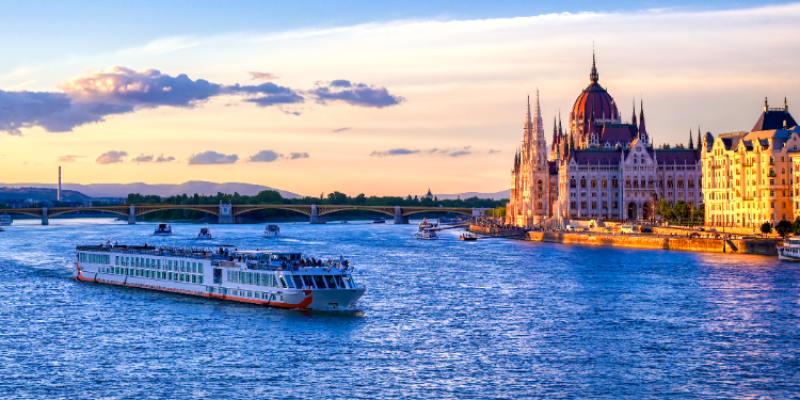
A beautiful bridge between West and East Europe, Hungary's idyllic scenery is dotted with spectacular history and remarkable landmarks, with the capital city of Budapest known as one of the hottest destinations for digital nomads and expats. The country has a wealth of natural hot springs, renowned for their healing and restorative ability, as well as developed urban areas with an affordable cost of living. Here's everything you need to know about Hungary.
Hungary's history as a country goes back to the turn of the first millennium, and it is one of the few European countries with unbroken independent nationhood ever since its founding. Previously, the land had been part of the Roman Empire, and later, it served as a battleground for the Mongols, the Ottoman Empire, and both World Wars. The nation was occupied by Germany and then ended up as a Soviet Union client state as part of the Warsaw Pact until 1989.
But Hungary is not all about war. It is also the country that, when all other European nations were busy crusading in the Holy Lands, introduced the first constitution in continental Europe: the Golden Bull, issued by Andrew II in 1222. During the rule of Matthias Corvinus (1458-1490), Hungary was the only non-Italian nation to embrace the values of the Renaissance and Humanism. This complicated and sometimes tumultuous past is celebrated and commemorated in different ways throughout the country, from museums documenting life under Nazi and Soviet rule to castles and palaces celebrating Hungary's roots.
Hungary was proclaimed a republic in 1989, with Hungarian as its official language and Budapest as its capital city. Budapest is home to a fifth of the country's population. With Buda to the west and Pest to the east of the river Danube, the conjoined parts of the city are connected by fifteen different bridges. The city's economy is developing at a fast rate and is home to many large multinationals, with notable big names in the finance and biotech sectors, which is good news for expats looking for a job in Budapest.
Hungary is divided into three regions by its two main rivers: the Danube and the Tisza. The region 'beyond the Danube' – the Western side of the country – is mountainous, containing the easternmost part of the Alps, whereas the northern part of the country is at the foothills of the Carpathians. Hungary is also home to the world's largest thermal water cave system and the second-largest thermal lake. Because of the combined influence of the Roman and Ottoman rule, it played a big part in the strong 'bath' culture of the country, with spas and Turkish baths at almost every turn.
The country also has large rural spaces, with forest-covered hills that are perfect for nature-lovers, whereas its mild, continental climate makes it ideal to visit in the spring and summer.
Join the Hungary community
Get regular tips and advice to make the most of your expat life
The Hungarian economy
Hungary joined the European Union in 2004, but it has still kept its own currency, the Hungarian Forint (HUF). The forint is quite a weak currency, with 1,000 HUF equating to about 3 euros. As is the case with most former members of what was known as the Soviet bloc, there is a struggle to transition from a centrally planned economy to a market-driven one, but the post-1956 “Goulash communism” system and its looser-than-usual economic controls meant that Hungary had a more straightforward transition than most nations in the region.
Budapest serves as a burgeoning hub of international business activity, with a growing population of expats and English-speaking natives.While challenges remain in fully closing the gap with Western Europe, the country continues to attract international business and remote workers drawn by the high quality of life.
The government's aggressive push to position the country as the "battery colony" of Europe has materialized with massive foreign direct investments from Asian manufacturing giants. By early 2026, major EV battery plants (the CATL facility in Debrecen and the BYD plant in Szeged) are ramping up operations, creating many job opportunities for expats in engineering, project management, and logistics. This, alongside the longstanding demand for IT professionals in Budapest's mature SSC sector, makes for a good range of opportunities.
While the currency gap remains real and there are definite advantages to making a living in EUR or USD, the utility and service costs have risen significantly enough in the past few years that Hungary's stereotype as an ultra-cheap Eastern European destination is no longer entirely accurate. However, it remains an attractive destination with good opportunities for expats.
ℹ️
We do our best to provide accurate and up to date information. However, if you have noticed any inaccuracies in this article, please let us know in the comments section below.
I am a writer and editor with over a decade of multi-niche experience in content creation. With an international background, I have a strong understanding of expat culture and its associated needs and pain points. I currently reside in Budapest but there is still so much of the world left to explore.