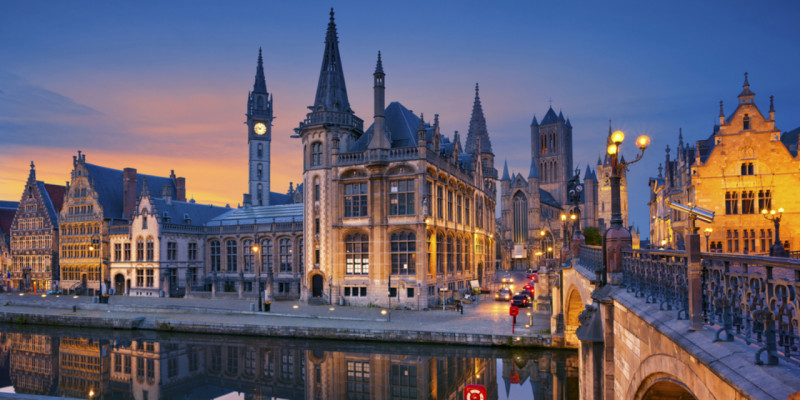
Every year, Belgium attracts thousands of students thanks to its high-quality educational system, affordable fees, and central location in Europe. Whether you aim for a French-speaking, Flemish, or English-speaking university, this guide explains how to move to Belgium for your studies.
In Belgium, there are three official spoken languages : French, Dutch, and German. This multilingualism is also reflected in the universities, which offer courses in these languages, as well as in English, especially at the master's level. Even if you only speak one of these languages, you will certainly find a suitable program, particularly in international schools.
The European Union has a dedicated website for studying within the EU called PLOTEUS. This will help you choose the best option for continuing your studies in Belgium according to your needs.
Keep in mind that most graduate schools and universities in Belgium use English as the primary language.
The capital of Belgium is home to several major European institutions, such as the Council of the European Union, the European Commission, and the European Parliament. Belgium is also at the center of several other global organizations, being a founding member of Benelux, NATO, the Organisation for Economic Co-operation and Development (OECD), the World Trade Organization (WTO), and the Eurozone. It is one of the six founding countries of the EU.
Therefore, attending university in Belgium will be an excellent choice if you are considering working for a European Union institution. Overall, all this makes the country attractively appealing to international students, especially if you are interested in international relations and/or diplomacy.
If you wish to improve your English or Dutch, each university has its own Language Center where you can practice these languages. Some institutions also offer language courses with flexible schedules.
If you are from one of the European Union (EU) member states, no visa is required. The same applies if you are from a country in the European Economic Area (EEA) or if you are from Switzerland.
The EU member states are listed below:
Austria, Belgium, Bulgaria, Croatia, Cyprus, Czech Republic, Denmark, Estonia, Finland, France, Germany, Greece, Hungary, Ireland, Italy, Latvia, Lithuania, Luxembourg, Malta, Netherlands, Poland, Portugal, Romania, Slovakia, Slovenia, Spain, Sweden
The EEA countries are listed below:
All EU countries, Iceland, Liechtenstein, Norway
If you are from a country outside the EU or EEA, a visa will be required to study in Belgium, especially if you stay in the country for more than three months. To obtain a student visa, university studies must be the primary purpose of your stay in Belgium, and these studies must be full-time. For more information on this, contact the Belgian embassy or consulate in your home country.
If a visa is required, you will need to contact a university well before submitting your visa application. The following documents will be required when you apply for a visa at the Belgian consulate or embassy in your home country:
Copy of your passport, valid for at least one year;
Certificate of enrollment, pre-enrollment, or admission at one of the Belgian educational institutions recognized by public authorities;
Proof of sufficient funding;
Medical certificate;
Copy of your criminal record.
Once in Belgium, foreign students, including Europeans, must register with the municipal administration (gemeentehuis in Dutch) of their place of residence to change their status. The administration will then issue a residence card valid for one year, renewable. To register, students must present a certificate of enrollment at the university of their choice. This registration must be done within eight days of the student's arrival in Belgium.
The Belgian administration requires you to prove that you have sufficient financial resources to support yourself during your studies. In 2025, this amount is estimated at around €800 net per month, transferred to a Belgian bank account in the student's name, in the form of a monthly allowance. Here are the main ways to demonstrate this financial capacity:
Certificate proving that the student receives a scholarship or a student loan;
A person over 18 years old (Belgian or a foreign national, but with a right of residence for more than three months) guaranteeing to cover the student's financial needs for one year or the entire duration of the studies. The guarantor must themselves have sufficient and stable funding;
Proof of personal income (students can work up to 20 hours a week with a "C" work permit).
The amount of funding required varies each year. The Immigration Office is responsible for reviewing it.
Join the Belgium community
Get regular tips and advice to make the most of your expat life
Higher education in Belgium
In Belgium, higher education is organized by the two main linguistic communities: the Flemish Community and the French Community. Each has its own network of institutions, regulations, and degrees.
For the Flemish Community, there are two types of higher education: universities (universiteiten) and university colleges (hogescholen). There are a total of five universities in the Flemish Community.
As for the French Community, it also has the same distinctions, with a total of six universities. However, there are two additional subcategories for university colleges: Hautes Écoles and Écoles Supérieures des Arts.
The universities and hautes écoles award bachelor's degrees (equivalent to a license). The training follows the Bologna process scheme (180 ECTS credits for a bachelor's, 60 or 120 credits for a master's).
After obtaining their bachelor's degree, students can pursue a Master's (called Specialization Masters in French and Manama's in Dutch). This is usually awarded after one or two years of study, or after 60 or 120 ECTS credits. For students wishing to continue their studies, universities offer doctorates or specialized masters, while Hautes Écoles also offer specialized licenses.
Student exchange programs in Belgium
If you do not plan to live in Belgium long-term but still want to take advantage of the fantastic Belgian educational system, you can do so by enrolling in a exchange program.
There are two ways to do this: by applying through an organization or program. If you choose the latter, there are two good programs to consider: WEP and AFS. In addition to the visa to participate in any exchange program, you will need the following:
Proof that the exchange program funds your stay in the country;
Information about the exchange program itinerary;
Parental authorization form (if you are a minor in your home country).
Here are some of the country's most prestigious institutions if you are looking for academic excellence and an international environment.
Université Libre de Bruxelles (ULB)
For an international atmosphere, head to the Université Libre de Bruxelles (ULB). Not only is it located in the heart of Brussels, but nearly 33% of its student population is foreign. It is an excellent university to attend if you want to engage in scientific research, as four of its graduates are Nobel Prize laureates.
Katholieke Universiteit (KU) Leuven
The Katholieke Universiteit (KU) Leuven is the largest university in Belgium and is also the oldest existing Catholic university. You can take courses in 11 cities, although most are offered near Brussels. The specialty of this university is scientific research, and about 16% of its students are international.
Université de Liège
The Université de Liège is a public university with nine faculties, and about one-fifth of its student population is of foreign origin. It has an excellent training program and focuses on multidisciplinary pedagogies.
Université de Gand
The Université de Gand is the first Dutch-speaking university in Belgium. It has excellent science and engineering programs. And like ULB, the Université de Gand also has several Nobel Prize laureates.
Enrolling in a Belgian university
Each institution has its own admission and enrollment service. It is recommended to contact the various schools in advance to obtain more details.
However, the following documents are required to complete your application:
Copy of your identity card;
Copy of your passport with the stamp of your temporary residence permit if you are from a third country (non-EU members);
Identity photographs (black and white and in color);
Any document related to the enrollment process;
Proof of any scholarship or financial aid.
Exceptions to enrollment in Belgium
It is true that if you have a high school diploma, you can go to almost any university. However, there are 4 exceptions that have additional requirements.
Medicine and dentistry: an entrance exam is mandatory, in Flanders as well as in the Wallonia-Brussels Federation. It assesses scientific knowledge, logical abilities, and understanding of public health. This competition is very selective.
Arts: whether for higher art schools or certain programs in visual, audiovisual, or performing arts, an admission test is required. It may include a practical test, a portfolio, and/or an interview.
Engineering sciences: an entrance test is now only required in the Wallonia-Brussels Federation. It mainly focuses on mathematics.
Degrees in management sciences: some universities require taking an entrance test to access master's programs, especially in financial management, auditing, or strategic management.
Tuition fees at Belgian universities
How much does higher education cost in Belgium? This is one of the most important questions asked when researching potential studies in Belgium.
The answer to this question will depend on the community in which the university is located, your financial situation, and your country of origin. There are three categories of students:
Scholarship students;
Almost scholarship students;
Non-scholarship students.
Scholarship students are those eligible for financial aid. This means they can enroll for free in universities of the French Community. They will still have to pay between €80 and €100 in universities of the Dutch Community.
Low-income students (almost scholarship students): if the family income is below a threshold set each year (around €1,400 net/month in 2025), you can benefit from a fee reduction. In Flanders, expect between €340 and €380. In the Wallonia-Brussels Federation, the reduction can go up to 50%.
Non-scholarship students: above this threshold, the annual fees amount to €890–910 in Flanders, and about €830 in the Wallonia-Brussels Federation.
In general, the cap on student financial aid is €5,000 per year. Although financial aid is not granted based on grades, it can be withdrawn if you fail too many courses. Therefore, make sure to do your best in university, not only to secure a better future but also to obtain financial aid in the medium term.
If you obtained your degree abroad, you will likely need to have its equivalence recognized in Belgium, especially to access certain courses or competitions. In the Wallonia-Brussels Federation, this request is made through the Equivalence Service, which examines each file according to the type of degree, the country of origin, and the intended studies. In Flanders, NARIC-Vlaanderen handles this. Procedures vary slightly between communities, so it is better to check with the concerned university. Note that for certain courses (medicine, teaching, etc.), equivalence is imperative from the time of enrollment.
The Bologna process
Belgium fully applies the Bologna Process, which aims to harmonize higher education systems in Europe. The standard path is based on two cycles: the bachelor's in 3 years (180 ECTS credits), followed by a master's in 1 or 2 years (60 or 120 credits).
This system facilitates the recognition of degrees between European countries. If you have already studied in a country that is a signatory to the Bologna Process, your credits or degrees will, in principle, be recognized by Belgian universities.
Until the 2000s, Belgium used an old system with three or four cycles: diploma, candidate, license, DEA… now replaced for greater international readability.
Most Belgian students live in kots, rooms, or studios generally located near universities.
In general, most Belgian schools and universities have rooms for rent in their respective regions. Do not hesitate to contact the dedicated professionals of the university establishment upon your arrival, or once on Belgian soil.
ℹ️
We do our best to provide accurate and up to date information. However, if you have noticed any inaccuracies in this article, please let us know in the comments section below.
Nina Potentier is an independent consultant with over three years of experience working with both French and international clients. She studied Business Management at IÉSEG in Lille, specializing in digital marketing, and spent a semester abroad on a university exchange in Valencia. She also gained professional experience in Belgium during a placement in Brussels. In her free time, she enjoys photography, sports, and spending time by the sea.