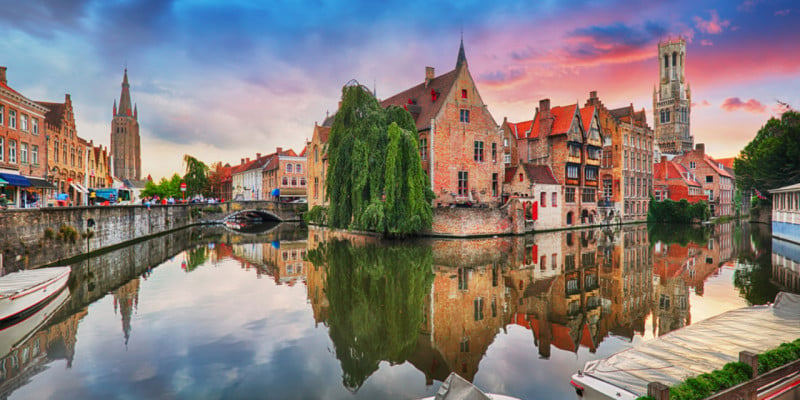
Every year, the Flemish city of Bruges attracts nearly 8 million visitors, affirming its status as a UNESCO-listed medieval gem. Other travelers explore different regions of Belgium, and some fall in love with the country so much that they choose to settle there permanently.
No matter which category you fall into, there are certain things you need to ensure before traveling to Belgium legally.
Like any country, Belgium requires its visitors to comply with local laws. Therefore, it is recommended to do some research before your trip to avoid any unpleasant surprises. It is also advisable to have a valid travel insurance policy.
Do I need a visa to enter Belgium?
You might think you can just pack your bags and fly to Belgium on a whim, especially if you believe you hold a so-called "strong" passport. Unfortunately, this is a common misconception that surprises foreigners when they arrive in Belgium.
The entry requirements for Belgium primarily depend on your nationality and length of stay. Citizens of the European Union (EU) and the European Economic Area have easier access, while nationals from other countries are subject to specific rules depending on the nature of their stay.
For European Union nationals
Citizens of the European Union (EU), the European Economic Area (EEA), and Switzerland can enter Belgium without a visa, simply carrying a national identity card or a valid passport.
However, for any stay longer than 90 days, even without a visa, these nationals must register with the local municipality within 8 days of their arrival and obtain a European residence card (K Card) in accordance with Belgian regulations.
For other country nationals
Nationals from other countries may need to obtain a visa to enter Belgium, depending on their nationality and the intended length of stay.
- For a short stay (maximum 90 days within a 180-day period) for tourism or business, many nationalities (e.g., United States, Canada, United Kingdom, Australia, Japan, etc.) benefit from a Schengen visa waiver.
- For any stay longer than 90 days (work, study, family reunification, etc.), a national visa (type D) is mandatory and must be obtained before entering Belgium, through the competent Belgian consulate in the country of residence.
Visa rules may change based on your nationality, the nature of your stay, and any bilateral agreements between Belgium and your country of origin. It is recommended to check the current requirements with the Belgian federal public service for foreign affairs or the competent Belgian embassy before any departure.
Read alsoVisas for Belgium
How to get to Belgium
Now that we've covered the visa issue, you might be wondering how to get to Belgium after handling all the formalities. Fortunately, there are several ways to get there: by car, by plane, by train, or by ferry.
Getting to Belgium by car
If you're going to Belgium by car, you'll need to ensure you have the right travel documents in order. In addition to your driver's license and identity documents, you'll need the vehicle's papers and insurance documents. If you're not the owner, you'll need to provide written proof of authorization from the actual owner.
If you're traveling from the United Kingdom, remember that, like in most European countries, driving is on the right in Belgium.
To reach Belgium via the Eurotunnel, head to the Folkestone terminal (Kent) by following the M20 from London. After the Channel crossing (35 minutes), you'll arrive in Calais (France).
From Calais, continue on the A16 motorway then the E40, which runs along the northern coast of France before reaching Belgium. Following this route, you'll reach Bruges in about 1.5 hours. If your destination is Antwerp, expect about a 2-hour drive from Calais.
From neighboring countries, here are the main routes to Belgium:
- From Germany: A44 or A4 motorways depending on your starting point.
- From Luxembourg: E411 and/or E25 motorways.
- From the Netherlands: A27 and E19 or A2 motorways, depending on your route.
Read alsoDriving in Belgium
Getting to Belgium by train
Belgium's central location in Europe greatly facilitates train travel from neighboring countries.
From the Netherlands:
- Intercity Brussels offers about 16 daily connections linking Amsterdam to Antwerp in 1.5 hours, via The Hague HS (4 departures), Rotterdam Central, Breda, and Noorderkempen stations. You can board from any of these stations with a flexible ticket.
- Eurostar (formerly Thalys) also operates a high-speed link from Amsterdam Schiphol and Rotterdam to Brussels in about 1.5 hours. It's advisable to book in advance to get the best fares.
From Germany:
- ICE high-speed trains connect Cologne to Brussels in 2 hours 15 minutes, and Frankfurt to Brussels in under 3 hours.
From France:
- From Paris Gare du Nord, Eurostar offers up to 21 daily departures to Brussels-Midi, in about 1 hour 22 minutes.
- The TGV InOui service complements these links by also connecting Brussels to several major French cities, with mandatory seat reservation.
Taking the ferry to Belgium
Since January 1, 2021, no direct passenger ferry connects the United Kingdom to Belgium: the Hull–Zeebrugge line was closed by P&O Ferries.
From England, you can still take the following crossings:
- Dover → Calais (three companies: DFDS Seaways, P&O Ferries, Irish Ferries), with up to 15 crossings/day and a journey time of about 1.5 hours, suitable for both foot and car passengers.
- Hull → Rotterdam (P&O Ferries), up to 7 departures/week, with overnight crossing (~11 hours) and cabin included. Upon arrival in Rotterdam, expect about a 2-hour drive or 1-hour train ride to reach Belgium.
Good to know:
While the overnight ferry is pleasant for sleeping at sea, it is more expensive. You can also disembark in Calais (or Rotterdam) to continue your journey to Belgium by train or car.
Getting to Belgium by plane
Belgium boasts excellent air connectivity, making it easy to arrive from numerous destinations worldwide.
Brussels Airport (BRU), located just 12 kilometers from central Brussels, is the country's main international gateway. Ranked among the top European hubs, it welcomed nearly 24 million passengers in 2024, confirming its dynamism on the European aviation scene.
Many airlines operate direct flights to Europe, North America, the Middle East, and beyond. For instance, you can reach Brussels with British Airways (London), Aer Lingus (Dublin), Air Canada (Montreal), Icelandair (Reykjavik), and many other major carriers.
Upon arrival, getting to the city center is quick and easy. The train connects the airport directly to Brussels Central Station in less than 20 minutes from the Airport Station (located at level -1 of the terminal). For more flexibility, bus shuttles, taxis, the A201 highway, and a safe cycling path also provide easy access. Finally, the Ring Tram Bus, operational since 2020, is gradually expanding the public transport network around the airport.
Brussels South Charleroi Airport (CRL) is an interesting alternative, especially if your final destination is in the south of Belgium. Although smaller, it recorded over 10 million passengers in 2024. The airport is mainly served by low-cost airlines like Ryanair, Wizz Air, TUI Fly, Pegasus Airlines, but also offers flights to Algeria, Istanbul, Hungary, and several European cities.
Charleroi is only 7.4 kilometers from the city center, with frequent shuttles to Charleroi-South station and quick connections via the A54/E420 highway. Travelers appreciate its easy access and efficiency.