"I felt useless"
Clémence, 31, left her teaching job in Aix-en-Provence, France, to follow her husband to Thailand. "At first, I was on cloud nine. Everything was new: the climate, the landscapes, the feeling of finally turning a page. It felt like a dream. But after a few weeks, reality started to set in. My visa didn't allow me to work. The kids were at school all day, and my husband left early every morning. So I took care of the shopping, the house, all the little everyday things. At first, that was fine. There was so much to sort out: leaving the French system behind, finding a car, figuring out the paperwork. It kept me busy. I felt useful, like I had a real role to play in the transition. But once everything settled down, I felt this emptiness creep in. The days seemed endless. I'm a high-energy person, always on the go. And suddenly I was just going around in circles. Eventually, I started to feel useless. The hardest part was that from the outside, everything looked perfect. But inside, I felt completely hollow."
It's a feeling shared by many expat women who, for the first time in their lives, are no longer defined by their job or their professional role.
When your CV fades, and people see you differently
Élodie, 38, followed her husband to Mexico five years ago. "Back in Belgium, I was a project manager. It was stimulating, rewarding. I had a crazy schedule, deadlines, back-to-back meetings, loads of colleagues, projects to deliver. The whole package! I loved it, genuinely. It was my adrenaline. In a way, it was my identity too. Then we left for Mexico. My husband had a golden opportunity, so we went for it. I was incredibly excited. I packed away my blazers, and we did a complete 180. At first, since everything was new and I needed to decompress a little, I really enjoyed slowing down. Then one morning, I remember lying in bed wondering what the point was of even getting up. I burst into tears. That's when I realized how much I missed my old life. I missed my work. I missed my colleagues. I started to sink into depression. Whenever we met new people, the same dreaded question would come up: 'So, what do you do?' I used to dread it. I felt like I was becoming invisible to people. I'm not sure whether that was just my perception or whether it was real. When my husband came home from work, I had nothing to tell him. It started to affect our relationship, because deep down I envied him for being out in the world, seeing people, working, having things to talk about. One evening we had a real conversation about it. He said, 'Honey, you need to find things to do, or you're going to fall apart.' I listened. I tried starting a blog, but gave up after four posts. Then I got into baking, but that didn't last either. The worst of it, I think, was the boredom and the days blurring into each other with no real purpose. And I was ashamed to admit I had 'nothing to do.' So I'd say I was looking after the family and managing the household logistics, which is true. But honestly, that doesn't fill an entire day. Everyone knows it doesn't, especially when you're alone, far from everything familiar, and you've always been someone who needs to be active."
This shift in how others see you, and how you see yourself, is a real challenge. For some women, it means learning to exist without immediate external validation. "I definitely had to build a structure for my days. A real routine, like before," says Marie-Alice, a mother of two living in Lisbon. "I got back into sport and set myself a schedule for learning Portuguese. I did everything I could to give my days a rhythm: sport on Monday, errands on Tuesday, activities with the kids on Wednesday, volunteering on Thursday. You have to be careful not to use it as an escape, but for me, I know I need to get out of the house a little every day. Otherwise, life starts to feel monotonous."
Structuring your days is a recurring theme in these stories: without a framework, time dissolves and motivation fades.
Rediscovering passions and building a social life
Loneliness is one of the most destabilizing feelings, even in a sunny country, even surrounded by family. "My husband would go to work, the kids would go to school, and I'd be left with the dishes and the laundry," says Marion, who lives in Madagascar. "I needed to talk to people. So I joined a group that organizes activities for expats to meet each other. The first time, we went for drinks at sunset. It was really lovely. I was lucky enough to meet two wonderful women in exactly the same situation as me. Now the three of us organize all sorts of things together: yoga, shopping, the beach. It gets me out of the house, and I have my little routine with my friends."
Facebook groups, WhatsApp chats, and local associations are often the first way in for women trying to rebuild a social network. Some even become pillars of the expat community, organizing outings and events.
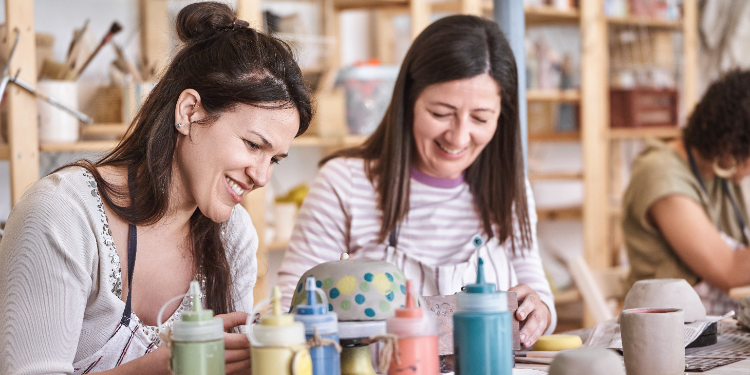
Élodie recalls: "One day, picking up the kids from school, I ran into another mum. We chatted for five minutes, and she suggested grabbing a coffee the next morning after drop-off. She's really the reason I started to come back to life. I opened up to her. She'd been a stay-at-home mum for a while and gave me loads of ideas for keeping busy and meeting people. She took me to a pottery class, and I discovered I absolutely love it. I even have a kiln at home now. I'm also writing a novel, and it does me the world of good. There are still the occasional empty mornings, but they're rare now. I've come to understand that not ticking the usual boxes doesn't mean you stop existing. I've learned to live with the quiet. And in the end, it helped me find myself again. With writing and pottery, I have a real reason to get up in the morning. They even keep me up some nights!"
Learning to own your choice
"What do you do all day?" "Don't you get bored?" "Aren't you worried you won't be able to find work again?"
These seemingly harmless questions sting, especially when they come from friends and family back home. Some women admit it took time to fully own their identity as a stay-at-home spouse, sometimes even in their own eyes.
"It might sound silly, but I felt like I was betraying feminism. Then I realized that my choice was actually feminist, because I got to choose. So now I'm at peace with it. And honestly, I don't know if I'll ever want to go back to work," says Marie-Alice.
Some expat stay-at-home wives do eventually return to work, whether as employees or entrepreneurs, but not always right away. "There's pressure to find something to keep yourself busy, but sometimes you just need to process the change, take time for yourself, and above all, get your energy back. I went through a pretty lethargic phase. And I think I actually needed to go through it to recharge," explains Clémence.
Those who do return to some kind of activity often approach it differently: with more freedom, flexibility, and a sense of purpose. "I started a small organic soap brand. Every now and then I rent a stall at the market to sell them. I'm not going to become a millionaire, that's for sure. But it's something that's mine, and it makes me happy. That's enough," says Marie-Alice.
Becoming a stay-at-home spouse during an expat posting isn't just a change of pace or legal status. It's a genuine identity crisis, an inner journey that can be brutal at times, where everything you thought was settled (your place, your role, your sense of purpose) is suddenly up for question. But it's also a period of profound redefinition, a space between two lives where you can get lost, feel bored, discover yourself, and ultimately reinvent who you are. Leaving your country also means coming face to face with yourself. And sometimes, that's where the greatest adventure begins.