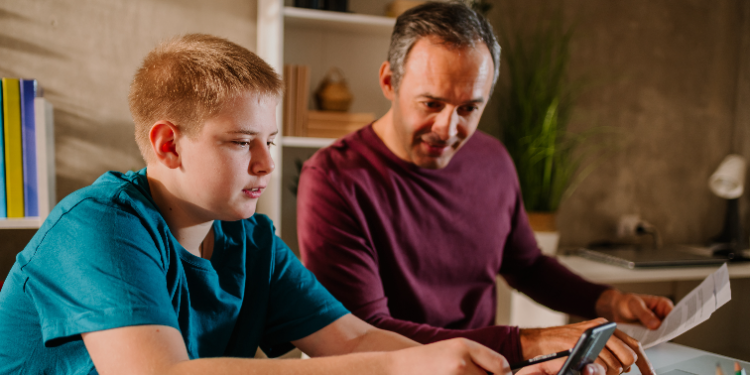
What if living abroad could also teach your children how to be smart with money? From navigating different currencies and comparing living costs to discovering new spending habits, expat life offers plenty of opportunities to develop essential financial skills. Learning to budget, save, make informed decisions, and understand the value of money can help children become more confident and independent as they grow. So how can you turn everyday experiences abroad into valuable money lessons? Here are some practical tips to help your child build good financial habits.
What the OECD reveals about young people's financial literacy
An OECD PISA report on financial literacy found that more than two-thirds of 15-year-olds actively use financial products and services. "More than 60% have a bank account and/or a payment card, and nearly 90% have made an online purchase in the past 12 months."
Yet as another study points out, familiarity with digital tools does not mean young people actually understand basic financial concepts. Around 20% of 15-year-olds fall below the baseline level of financial literacy, meaning they struggle with fairly elementary ideas such as interest or budgeting principles.
Against this backdrop, the OECD highlights the importance of the family environment and the role schools must play in building financial literacy among young people. Some countries, including the United States, have developed a comprehensive curriculum on the subject, designed to be delivered throughout a child's schooling.
Get regular tips and advice to make the most of your expat life
Why living overseas is a great opportunity to learn about money
Living abroad exposes children to realities they would rarely encounter at home. A different currency, a different cost of living, new payment methods, unfamiliar spending habits, and stark differences in living standards are concrete situations that naturally prompt children to think about money and what it's worth.
This new environment gives parents plenty of opportunities to introduce concepts like budgeting, purchasing power, exchange rates, and spending choices in a hands-on way that's directly rooted in the reality of the country you're living in.
In this context, as the studies mentioned above make clear, financial education helps children develop skills that serve them well into adulthood: thinking critically about advertising and commercial pressure, learning to delay gratification, making considered choices, planning ahead, and taking responsibility for their spending.
Four key benefits of giving your child a financial education
Protecting them from scams and manipulation
Learning to manage money is also learning to protect yourself: financial education provides a layer of security, much like media literacy and digital awareness do.
Scams today go far beyond counterfeit notes or dodgy cold calls. They take many forms: get-rich-quick schemes promoted by social media influencers, buy-now-pay-later offers, fake cryptocurrency investments, and more.
A young person who has never learned to spot these tactics is more likely to make impulsive decisions or trust the wrong people. As an expat, they may be navigating a new bank, unfamiliar payment methods, or apps in a foreign language, making that vulnerability even greater.
Understanding the value of money
Between contactless payments and mobile apps, spending can start to feel abstract.
In some countries, such as China, virtually all everyday financial transactions are digital, primarily through WeChat and Alipay. Even children as young as 5 or 6 show some comfort with digital payments, as this study on financial literacy among young children in Shanghai illustrates.
When money becomes "invisible," it's harder to grasp its real value.
A good financial education should help children connect the numbers on a screen to the actual cost of something, and to the effort required to earn it.
Building a healthy relationship with spending
Adolescence is a formative period for spending habits. As expat kids, young people may find themselves in a lifestyle that looks very different from what they knew before: more frequent travel, restaurants, international schools, quality housing, and employer-covered perks. Without any context, they can easily come to see this comfort as the norm, with no real sense of what makes it possible.
Financial education helps put these experiences in perspective. By connecting spending to the family budget, to priorities, and to everyday trade-offs, you can help your child develop a more thoughtful approach to money.
Building the skills to live independently
Budgeting, saving toward a goal, comparing prices, setting priorities, and thinking before you buy are all skills that make the transition to adult life much smoother.
Developed gradually over time, these habits give young people greater confidence and peace of mind when they head off to university and eventually enter the workforce.
Everyday situations that naturally introduce children to money
Making money meaningful
Grocery shopping as a family
This is a simple but effective method. Comparing prices, spotting deals, working out the cost of a basket or a full trolley: the market and the supermarket are still some of the best classrooms for understanding the value of what you buy.
Playing with currencies
Converting prices between the local currency and your home currency is a great way to understand exchange rates and start thinking about purchasing power and cost-of-living differences between countries.
Learning to make choices
Managing pocket money
Pocket money has always been a great learning tool. Whether it's given weekly or monthly, it teaches children to plan their spending, pass on certain purchases, and save up for something bigger.
Planning a trip budget or helping with a major purchase
Why not give your child the task of putting together a budget for a family weekend away, a day trip, or an excursion? They'll quickly discover what choices need to be made to stay within the planned spend. Get them involved in comparing options, reading reviews, and calculating the total cost before making any decision.
Hands-on experience toward independence
Encouraging a first paid activity
Babysitting, tutoring, pet sitting, odd jobs, or seasonal work where local laws allow: earning their first money fundamentally changes the way young people think about spending. They get a real, concrete sense of the connection between time, effort, and pay.
Introducing financial simulations
Hands-on experience is often a better teacher than a long explanation. Board games, budgeting apps, and stock market simulators let children explore key financial principles without risking a single cent.
Plenty of platforms let you invest in a virtual stock market, giving children a concrete feel for concepts like risk, portfolio diversification, and returns.
Opening a personal bank account
Opening a bank account for your teenager is an excellent way to gradually build their sense of responsibility. With a payment card and a tracking app, they learn to manage their budget, check their balance, plan ahead, and avoid spending it all in a few days. They also learn how transfers work, how to save, and what online payment security looks like. With the right guidance, this first experience is a key step toward financial independence.
Note that in some countries, such as France, children aged 12 and over can open a youth savings account or a withdrawal account. From age 16, they can access a full current account, including a payment card.
Holder of a degree from the French Ministry of Education and a Master II in Language Policy, I have had the opportunity to live in Japan and China, and am currently based in Germany. My activities revolve around writing, teaching and managing programs.