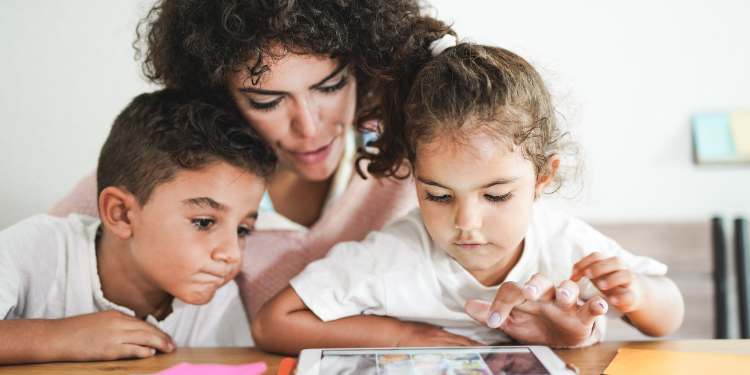
A translation app can help you find the right words, but it cannot make friendships happen overnight or give your child an immediate sense of belonging at a new school. Moving abroad brings frustrations that even our most useful tools cannot resolve. Drawing on her experience supporting international families, Daniela Blanchet reflects on what those uncomfortable moments may teach parents and children about adapting, asking for help and discovering what they can handle.
Remember when you had to wait an entire week for the next episode of your favorite television show? Or when you suddenly remembered an actor but couldn't remember his name, and instead of pulling out your phone, everyone around the table spent the next twenty minutes trying to figure it out? Eventually someone remembered—or nobody did, and you went home still wondering.
My children barely know this experience. They have grown up in a world where answers appear in seconds. Entertainment is available on demand. Something forgotten for a school project can sometimes be ordered online and delivered before the project is due. A boring wait at a restaurant can be filled with a screen. We don't even necessarily have to sit through commercials anymore.
I had a moment when all of this hit me when I realized that even water balloons have become frictionless. I remember having to fill them and tie them individually. Now you can connect a contraption to a hose and produce an entire bunch at once. It's ingenious. And I'm pretty sure very few of us are arguing for a return to individually tying water balloons.
This isn't an argument against technology or convenience. I'm extremely grateful that I can video call family thousands of miles away, translate a sentence instantly when I'm stuck, navigate an unfamiliar city without unfolding a paper map, and order something my family needs without spending half a day looking for it. But lately I've been wondering: What happens when we become accustomed to having so much friction removed from everyday life? What is the tradeoff of a more frictionless world?
I wonder whether part of the tradeoff lies in the everyday opportunities we no longer get as often: waiting, working toward something, staying with frustration, trying again when something doesn't work. These are small moments, but perhaps they function a little like reps at the gym. No single one builds resilience. But repeated experiences of encountering discomfort, staying with it, adapting and discovering I can handle this may matter.
And in my work supporting international families through the enormous transition of moving abroad, this is where I see one of expatriation's unexpected gifts. Moving abroad makes you a beginner again. When you don't yet understand the language, culture, systems or social codes, friction is unavoidable. And perhaps those are exactly the kinds of reps many of us are getting less practice with elsewhere.
We have become very good at eliminating the wait
Technology hasn't just changed what we can do. It has changed how quickly we expect to be able to do it. We stream rather than wait for programming. We text rather than wait until someone is home to call. We order online rather than go searching from store to store. We swipe through potential partners. We binge an entire television series rather than spend the next week wondering what happens next. And when we don't know something, we search.
There is enormous value in all of this. Access to information, communication and services has transformed our lives in ways I would not want to reverse. But convenience also means that many of the small frustrations that used to be built into ordinary life have become optional: waiting, being bored, not knowing, figuring something out without immediately getting the answer, sitting with the discomfort of wanting something that isn't available yet.
We haven't eliminated frustration, of course. In some ways, modern life has created entirely new forms of it. We may wait less for information but feel more pressure to respond to it. Work can follow us home. Messages arrive constantly. Being reachable can become being expected to be available. The paradox is interesting: we have more tools than ever for eliminating inconvenience while simultaneously living in a culture that often feels impatient.
And our children are growing up inside that culture without ever having known the alternative. Perhaps nowhere is this tension more visible than in the smartphone: an incredibly useful tool that many parents eventually feel their children need for communication, safety, school, and social life, but one that also puts entertainment, information, connection, and relief from boredom in their pockets at all times. Smartphones didn't create our discomfort with waiting, but they offer an almost constant way to escape it.
Get regular tips and advice to make the most of your expat life
Schools are seeing part of this struggle
One place where this tension becomes particularly visible is the classroom. In a 2024 Pew Research Center survey of U.S. public-school teachers, 72% of high-school teachers said cellphone distraction was a major problem in their classroom. Across K–12 teachers, 47% said students showing little or no interest in learning was a major problem.
International data tells a similar story about distraction. In the OECD's PISA 2022 assessment (Programme for International Student Assessment, run by the Organisation for Economic Co-operation and Development), around 30% of students across OECD countries reported becoming distracted by digital devices in most or every mathematics lesson, while roughly a quarter reported being distracted by other students using devices. Students reporting frequent digital distraction scored 15 points lower in mathematics than students who said it almost never happened, even after accounting for the socioeconomic profiles of students and schools.
The response from education systems has been significant. By March 2026, UNESCO reported that 114 education systems—representing 58% of countries worldwide—had national policies banning mobile phones in schools, compared with 24% of countries when UNESCO first tracked the issue in June 2023.
But the research doesn't tell us that technology is simply “bad for attention.” In fact, PISA found that students who spent up to an hour a day using digital devices for learning activities at school scored higher in mathematics, on average, than students who reported no such use. That's an important distinction. The question isn't whether we should raise children in a technological world. They already live in one. The question is whether, alongside all that convenience, they are getting enough opportunities to practice what happens when life doesn't immediately accommodate them.
And perhaps we parents struggle with their frustration too
This is the part that makes me uncomfortable, because I don't think this is simply a problem with children. Sometimes we adults have difficulty tolerating our children's discomfort. They're bored at dinner, so we hand over the phone. They're struggling with something, so we step in. They forgot something for school, so we rush to solve it. They're nervous about an uncomfortable situation, so we're tempted to remove the situation. Often this comes from love. We have the ability to make things easier for our children, so why wouldn't we?
Psychologists have studied a related phenomenon, particularly in the context of childhood anxiety, called parental accommodation: parents changing their behavior or routines to avoid or alleviate a child's distress. Research involving 295 parents of children aged 4 to 10 found that lower parental distress tolerance was associated with greater accommodation. In other words, our own ability to sit with distress may play a role in how quickly we try to remove it for our children.
That research comes from a specific clinical context and shouldn't be generalized to every parenting situation. But I think it raises an interesting question for the rest of us: When my child is uncomfortable, whose discomfort am I trying to eliminate—theirs or mine?
Sometimes helping is exactly what our children need. And sometimes perhaps they need us to communicate something different: Yes, this is frustrating. And I believe you can handle being frustrated.
For expat families, this can feel like the training ground at level three of the game. The expat parent is already going through their own cycle of adaptation and discomfort while simultaneously accompanying the very real discomfort of their children.
This is where I think we need to be careful with the popular language around resilience. Resilience doesn't mean enjoying hardship. It doesn't mean leaving children alone with overwhelming experiences. And it certainly doesn't mean deliberately making their lives difficult because “struggle builds character.”
Resilience is much closer to developing the capacity to encounter difficulty, adapt and recover. Even the famous research around delayed gratification is more nuanced than popular culture sometimes suggests. The “marshmallow test” became shorthand for the idea that children who could wait would become more successful adults. But a later conceptual replication found that the relationship between preschool waiting and later achievement became substantially smaller once researchers accounted for factors including family background, early cognitive ability and the home environment. Associations with later behavioral outcomes were smaller still.
In other words, we shouldn't reduce resilience to “kids need to learn to wait.” Context matters. Support matters. Resources matter. Relationships matter. But so does having experiences in which something feels difficult and discovering: I can stay with this. I can learn. I can adapt.
And this is where living abroad becomes particularly interesting.
Moving abroad puts friction back into life
Nothing has made me feel simultaneously more capable and more incompetent than moving countries. Things I have known how to do for decades suddenly require thought. How do I pay this bill? Why is everyone doing something different at this roundabout from what I thought the traffic laws said? Why did everyone else know that? When will this paperwork finally be finished?
You become a beginner again. Technology helps enormously. I can translate. Search. Ask WhatsApp groups. Navigate. Research. But it cannot remove all of the friction. Language takes time. Friendship takes time. Belonging takes time. Understanding a culture takes time. Bureaucracy sometimes takes a lot of time. And no app can completely spare you the experience of getting something wrong.
For adults accustomed to competence, that can be maddening. But perhaps it is also practice.
Children who move internationally experience their own version of this. They may walk into a school where everyone else understands social rules they haven't learned yet. Humor may work differently. Friendships may form differently. The language spoken on the playground may not be the language spoken at home. Even children attending international schools can find themselves navigating multiple cultural identities simultaneously.
Research on Third Culture Kids suggests that international mobility brings both opportunities and genuine stress. A 2022 systematic review of internationally mobile children and adolescents found that adjustment is complex and influenced by a range of factors, including family support and functioning, friendships, language, school, identity, stress and characteristics of the international move itself. Importantly, only 14 studies met the review's criteria—a reminder that this remains an under-researched population.
So we can't simply claim that moving abroad automatically makes children resilient. But it does give them experiences that require adaptation. What develops from those experiences depends, at least in part, on the resources and support available as they navigate them.
The goal isn't to eliminate frustration. It's to help children learn what to do with it.
As parents, our instinct is often to smooth the road. And sometimes we absolutely should. A child overwhelmed by a new language needs support. A lonely teenager needs connection. A child struggling socially needs adults paying attention. But support and rescue aren't always the same thing.
Imagine your child comes home and says: “Nobody played with me today. I hate this school.” Our instinct may be to solve. I'll email the teacher. Let's invite someone over. Maybe we chose the wrong school. Sometimes one of those responses will eventually be appropriate.
But perhaps the first response can simply be: “That sounds really hard. What happened?” And then stay there. Let them tell the story. Let the disappointment exist. Let them experience that an uncomfortable emotion does not require an immediate escape route.
That is also where my work as an ontological coach shapes how I think about these moments. I become interested not only in what happened, but in the interpretation we attach to what happened. “I didn't understand what they were saying today” is an observation about an experience. “I'll never belong here” is an interpretation. “I don't know how to do this yet” creates a very different relationship with difficulty than “I can't handle living here.”
The circumstances may be identical. The possibilities we can see from inside it may not be.
Maybe we don't need to remove every little friction
There are small ways expatriate families can consciously resist the impulse to solve everything immediately. Let children wrestle with the language before translating every word. Let them order their own food, even if it takes longer. Let them ask the shopkeeper the question. Let them wait sometimes without immediately producing entertainment. When they don't know something, occasionally wonder together before Googling it. When something works differently in your host country, resist immediately labeling the local way as inefficient, ridiculous or wrong.
And perhaps most importantly, let your children see you struggle.
Let them hear: “I have no idea how this works. Let's figure it out.” “I misunderstood that.” “I've been waiting forever and I'm getting frustrated.” “This isn't how I would do it—but maybe there's something I don't understand yet.”
Our children don't only learn resilience from the difficulties they encounter. They learn it from watching who we become when we encounter ours.
Expat life may be giving us something we didn't know we needed
I don't want my water balloons to go back to being individually tied. I don't want to surrender Google Maps. I definitely don't want to wait a week between television episodes just to build character. Convenience isn't the enemy. Technology isn't the enemy. And frustration isn't inherently virtuous.
But perhaps there is something worth noticing about living abroad in this particular moment in history. At a time when much of the world is being designed to anticipate what we want, answer us immediately and remove obstacles before we encounter them, expatriate life keeps handing us experiences that can't fully be optimized away. You will misunderstand. You will wait. You will get something wrong. You will occasionally feel incompetent. Your children will sometimes be uncomfortable. You will not always be able to fix it. And then, slowly, something happens.
The language that once exhausted you becomes easier. The route you needed GPS to navigate becomes automatic. The cultural behavior that confused you begins to make sense a little more. The person who was once a stranger becomes the friend you call when something goes wrong. Your child stops being the new kid. You learn. You adjust.
And perhaps, eventually, you begin to recognize frustration differently. It isn't always evidence that something has gone wrong. Sometimes it is simply evidence that you haven't learned how to do this yet.
And perhaps that's one of the unexpected gifts of building a life somewhere new. In a world increasingly designed to remove friction from our lives, living abroad may give us—and our children—something increasingly valuable: the opportunity to discover that we can handle it.
Daniela Blanchet is a Certified Ontological Coach, facilitator, and expat mom passionate about belonging, identity, emotional resilience, and the human side of life transitions. Born in Switzerland to Argentine diplomats and raised across multiple countries and cultures, her work explores what it means to rebuild a sense of home, self, and groundedness while living between worlds. Daniela supports globally mobile women and families navigating major life changes through coaching, workshops, writing, and community conversations centered on growth mindset, emotional awareness, and ontological coaching.
Take my free quiz: "Why Do You Feel So “Off” Since Moving Abroad?" https://tally.so/r/zxZ5PE