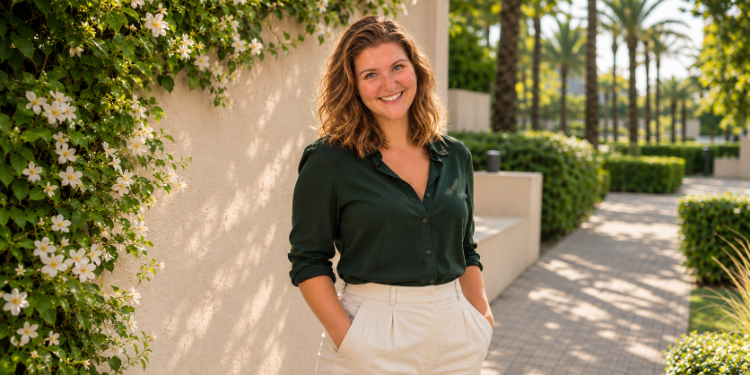
Moving abroad often feels like a fresh start, an opportunity to explore new cultures, embrace new experiences, and reinvent yourself. But once the initial excitement fades, expat life can bring unexpected emotional challenges. Loneliness, missing loved ones, relationship struggles, or feeling like you no longer belong anywhere… These are sides of living abroad that rarely make it into the picture. Coraline Bourdageau, a psychologist who moved from France to Dubai with her husband, knows these challenges firsthand. Today, she supports French-speaking adults navigating personal difficulties and life transitions. In this interview with Expat.com, she explores the emotional complexities of living abroad, how living overseas can reshape our sense of identity, and a question many expats quietly struggle with: Can you thrive abroad and still feel unhappy?
Could you please introduce yourself and tell us about your journey?
My name is Coraline Bourdageau. I live in Dubai with my husband. I've always been fascinated by why people experience the same situation so differently.
I studied psychology at the University of Strasbourg, completing a master's degree, then spent three years on doctoral research exploring the connection between body and mind. Alongside that, I trained in couples therapy, somatic and systemic approaches, hypnosis, and art-based therapies. That taught me that no person can be reduced to a single theory, and that it's better to adapt your perspective than to fit everyone into the same method.
I then worked in private practice in France. My personal history matters too. I went through some difficult periods of illness that forced me to slow down and reassess my priorities. Those experiences taught me to respect each person's pace, and not to mistake apparent stillness for a lack of progress.
Today, I work online with adults who want to find their way back to a life that feels like their own.
Tell us about your experience living abroad and what led you to build your life in a multicultural environment.
Our story with Dubai began on our honeymoon. My husband and I discovered a city very different from what we'd imagined: beyond the towers and the sunshine, there was a genuine quality of life, safety, diversity, and a simpler day-to-day focused on what matters most to us.
Two years later, we took the leap. In less than three months, we sold our cars, our furniture, and most of our belongings. We left with three suitcases and our cat.
We had to relearn the ordinary things: routes, the language, even our palates had to adjust to new flavors.
People picture Dubai as flashy and relentlessly fast-paced, all skyscrapers and luxury. What I love is the contrast: you move from the spectacular to neighborhoods where you run into the same people, fall into familiar routines, almost like a village. You can enjoy the energy without being swept up in it. And I feel safe here, particularly as a woman.
When I mention a project, people ask me how I plan to make it happen, rather than why I'm not satisfied with what I already do. That has meant a great deal to me.
Join the community
Get regular tips and advice to make the most of your expat life
How has living among different cultures changed the way you see human relationships, identity, and the sense of belonging?
Above all, it reminded me how relative our assumptions really are.
Silence can read as coldness when it's actually just a different way of communicating. Many misunderstandings come from two sets of assumptions passing each other without recognition.
It reinforced a rule I set for myself: never assume I've understood too quickly. Two people can live through the same event and come away with completely different experiences. What matters is what it means to each of them. Sometimes a single question opens up a perspective that neither the person nor I had considered.
You can stay deeply connected to your home country while genuinely feeling at home somewhere else. Living abroad also helps you tell your own choices apart from the habits you simply inherited.
What drew you to focus specifically on people living abroad and the challenges they face?
My own experience as an expat, and the stories of the people I work with. There's a common assumption that once you're settled, the hard part is over. But the move also touches on your place in your relationship, your professional identity, your sense of independence.
I think of people who followed their partner abroad. Those around them talk about how lucky they are, while they may have left behind a career or their financial independence.
With me, nothing is off-limits: you can say anything. When someone feels stuck, I'd rather explore with them what hasn't been considered yet. Finding the courage to talk about it is already half the work.
My job is to help people zoom out, to look at a situation from several angles, without losing sight of the fact that we're talking about a person, not a problem to be solved.
Expat life is often portrayed as an enriching adventure and a chance to reinvent yourself. What psychological and emotional challenges still don't get enough attention?
Distance from loved ones, especially as parents get older. People rarely anticipate how much they'll miss the small, ordinary moments.
My husband and I keep a weekly video call, stay in touch by message, and try to meet in person twice a year when we can. A screen can't replace a shared meal or a hug. But when someone close to me needed me, I was by their side the next day, almost as quickly as if I'd been living in Brittany.
There's also loneliness. You can meet a lot of people without immediately finding the kind of friendships that take years to build.
A beautiful setting doesn't shield you from the full range of human difficulties. I love our life in Dubai deeply, and the people we miss are no less important because of it. There's no contradiction in being happy somewhere and still feeling the ache of certain absences.
Why do some people start to struggle months or even years after settling abroad, when their expat life seemed to be going well?
In the first few months, all your energy goes into getting settled. Then, once daily life finds its rhythm again, questions that were set aside start to resurface.
I see a pattern repeat itself. People who have ticked every box expected of them: the studies, the job, the relationship, the enviable life abroad. From the outside, it looks like success. And yet they feel an emptiness.
We learn very early to recognize the outward signs of achievement, but far less to ask ourselves what we actually want. Those milestones can be wonderful when they genuinely reflect our desires, but they don't automatically make us happy.
Expat life can bring that unease to the surface, though isolation and exhaustion can also play a part.
Many expats feel guilty about not being happy in a country they chose to move to. How can they work through that feeling?
I'd start by telling them they have every right to feel what they feel.
You often hear: "But you have everything you need to be happy!" People who say it mean well. But when you have a good job, a relationship, and a beautiful life in the sun, that phrase can quietly breed shame about not feeling okay. As though happiness were the automatic result of the right conditions being in place.
I have no regrets about leaving, but I miss the people I love. There were times I wanted to reassure them by keeping that to myself. Now I tell them: "I'm happy here, and I miss you." Both things are true.
After that, it's worth asking what's actually weighing on you: the distance, the loneliness, a sense of losing your place in your relationship? One unmet need doesn't mean your whole life needs rebuilding.
Can living between cultures shift our identity and the way we see ourselves? Can you reach a point where you no longer feel fully at home anywhere?
Yes, that can happen. But expat life can also reveal sides of ourselves we never gave space to before.
I remember an expat I spoke with who, when I mentioned my many interests, simply encouraged me to develop them.
That might sound like a small thing. For me, it wasn't. From childhood, we're told to find a career, commit to it, and not spread ourselves too thin. I love the work I do and never wanted to give it up. But that conversation helped me understand that loving one thing doesn't mean giving up everything else. Since then, I've developed other entrepreneurial projects.
As for the feeling of not being fully at home anywhere, it's real: back home, you become "the one who lives far away"; here, you remain the foreigner. I don't experience it as a loss. You can love more than one place, and feeling at home is also about the relationships you build there.
How do you rebuild your sense of self and rediscover your identity when you've left your job, your family, and your friends to follow your partner abroad?
You can leave out of love and still grieve your career, your friendships, your independence. That doesn't mean you love your partner any less.
Filling your diary answers "what do I do with my days?" It doesn't answer "who am I here?"
The question I find more useful is: what gave you, before, a sense of having a place, of being useful, of existing beyond your roles? And what would you like to explore now: going back to work, retraining, starting a business, a creative project? There's no single right answer.
It's also a conversation to have as a couple. One person is continuing their career while the other is still finding their footing. You can have decided together to move abroad and still be living two very different expat experiences.
How do you tell the difference between a difficult adjustment period and a deeper unhappiness that might call the whole expat project into question?
There's no universal timeline for adjustment. If the distress persists, intensifies, or starts affecting your sleep and your relationships, speaking with a qualified professional can help. In a crisis, the emergency services in your country of residence are always the first call to make.
Mental health deserves the same attention as physical health. Many people are afraid that talking will set off a chain reaction, that they'll be told to upend everything. If someone pushes you to make sweeping changes without really listening, seek another opinion. The connection with the person supporting you matters too.
I tend to think of it more as an update. We hold on to habits that served us at one point in our lives but that we no longer need in the same way. The work is about sorting through and improving, not tearing everything down.
Some expats spend years torn between staying in their adopted country and going home. How do you make that decision without feeling like you've failed or given up?
I'd start with a question: why would going home be a failure?
An expat experience can have been genuinely wonderful. Our needs change over time, without erasing what we've lived.
Every decision involves giving something up. Staying means living far from the people you love; going home means leaving an environment where you feel good. Which sacrifice would be harder to live with in a few years' time?
My husband and I are both only children. We've asked our parents what they would want if they became less independent. They'd prefer to join us, perhaps splitting their time between France and Dubai. I hope that question never arises. But if it does, the decision will be theirs.
A decision that feels right today can be revisited tomorrow. That's not a sign of failure; it's a way of keeping up with life.
If there's one last thought I'd want to leave people with, it's this: we sometimes spend so much time building a successful life that we forget to ask whether it actually makes us happy.
A journalist, holder of the DALF C1 and C2 and a diploma from the University of Mauritius, I have nearly twenty years of writing experience. After six years in the Mauritian press, I joined Expat.com, where I have been working for over a decade, including five years as editorial assistant, and now as editorial manager.