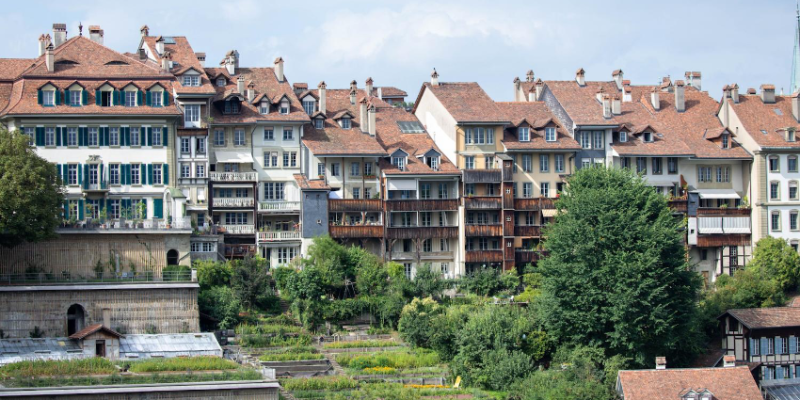
Buying property in Bern is not open to all foreign nationals on equal terms. Switzerland's Lex Koller legislation restricts who can purchase residential real estate, and eligibility depends on nationality and the type of Swiss residence permit held: EU and EFTA nationals with Swiss residency buy freely, while others may need cantonal authorization before any transaction can proceed. The city is also a high-cost market by international standards, with prices averaging around CHF 9,157 per m² (USD 11,328) city-wide and rising to nearly double that in the center.
Your eligibility to buy property in Bern depends on two factors above all others: your nationality and the type of residence permit you currently hold in Switzerland. The central piece of legislation is the Federal Act on the Acquisition of Immovable Property by Foreign Non-Residents, commonly known as Lex Koller, which restricts property purchases by foreign buyers who do not meet specific residency criteria.
EU and EFTA nationals who hold a right of residence and have their main residence in Switzerland have exactly the same property-acquisition rights as Swiss citizens. They do not require Lex Koller authorization. For nationals of countries outside the EU and EFTA area, Swiss residency alone is not sufficient: you need to hold a valid C settlement permit, or you will require cantonal authorization before any purchase can proceed. Nationals from non-EU/EFTA countries who moved to Switzerland and hold a B permit or another non-C permit should confirm their exact position with the competent authority before making any commitment. This distinction matters practically: the cantonal authorization process takes time and is not guaranteed, so checking eligibility belongs at the very start of your property search, not at the end.
In Bern specifically, Lex Koller decisions are handled by the Regierungsstatthalteramt for the municipality concerned. That authority decides both whether a transaction requires authorization and whether it can be granted. One practical carve-out exists: main residences can be acquired without authorization where the buyer or their family has legal and effective domicile in Bern, which means buyers intending to live in the property full-time have a clearer path than those buying as a second home or investment.
Foreign companies seeking to purchase residential property in Bern face a further constraint. Acquiring Swiss residential apartments through a foreign company structure is generally not possible except in very limited cases, even though companies buying property for genuine business operations are treated differently under Lex Koller.
Before opening a Swiss bank account to transfer purchase funds, newly arrived foreign nationals should register with the City of Bern. The International Bern Welcome Desk advises that city registration is a prerequisite for opening a Swiss bank account, a necessary practical step before any property purchase can proceed.
Good to know:
The Swiss Federal Council has opened a consultation on tightening Lex Koller, including a proposal requiring third-country nationals buying a main residence to obtain authorization along with an obligation to sell within two years of moving away. These proposals were not law when this article was written; buyers from non-EU/EFTA countries should monitor the outcome before committing to a purchase.
Bern is a compact city organized into six official districts plus one emerging development zone. Each has a distinct character and a different price range, so identifying which district fits your priorities before you start searching will save time in a market where city-level stock is thin and moves quickly.
The Innere Stadt (Old Town) offers maximum centrality in a UNESCO World Heritage setting, but the housing stock is tightly constrained by the historic fabric. Properties here sit at the upscale end of the market, and buyers should check building condition, renovation restrictions, elevator access, and noise levels carefully before committing. The architectural prestige comes with real limits on what can be altered or added.
Kirchenfeld-Schosshalde, Bern's established central-eastern residential district, draws professionals and retirees who want quieter streets close to institutional and cultural life. It is classified as an upscale district within the city boundary, offering a calmer alternative to the Old Town without giving up central access.
Newcomers to Bern often find Länggasse-Felsenau a practical starting point. The University of Bern's Welcome Center highlights it as a district with good urban amenities, cafes, bistros, and strong public-transport connections, sitting at the mid-range to upscale end of the market. It suits buyers who want city life without the premium of the historic core.
Breitenrain-Lorraine is a mid-range district recognized for its local restaurants, bars, and neighborhood character. It draws residents who want a lively but genuinely residential atmosphere rather than a prestige address. Mattenhof-Weissenbühl, by contrast, is a quieter mid-range option that the Welcome Center describes as well-placed relative to the city center, the Aare river, and the Gurten, making it a natural first-choice search area for families and retirees who prioritize calm surroundings with easy central access.
Buyers for whom relative affordability and a larger residential stock matter more than a historic-center location should look at Bümpliz-Oberbottigen, Bern's western district. It is large and varied enough that the experience differs significantly across sub-areas, so research the specific street, tram and S-Bahn access, and immediate surroundings carefully before committing to any particular location within it.
Outside the established six districts, Viererfeld/Mittelfeld is a phased urban development project rather than an existing neighborhood. The City of Bern's project information confirms it will include family gardens, a large public park, a new school, and sports facilities, making it worth monitoring for family buyers. Because delivery is phased, verify completion timing and available units carefully before any reservation.
Join the Bern community
Get regular tips and advice to make the most of your expat life
Property prices in Bern
Bern is an expensive city by any international measure, and the gap between districts is substantial enough to affect what you can realistically buy. The city-wide average runs at around CHF 9,157 per m² (USD 11,328), but that figure masks wide variation. In the city center, apartments average approximately CHF 15,475/m² (USD 19,150), while properties outside the center average CHF 12,344/m² (USD 15,276) (Numbeo). Even outside the center, these figures place Bern at a level comparable to prime urban markets in major global cities.
For houses, the market shows a typical 4-room house priced at a median of CHF 1,290,000 (USD 1,596,000), with the general range running from CHF 895,000 to CHF 1,850,000 (USD 1,107,000 to USD 2,289,000) (ImmoScout24). Property prices in Bern are trending upward, with year-on-year increases of about 2.2% for houses and 2.3% for apartments (RealAdvisor). Bern sits below Zurich and Geneva in overall price terms but remains firmly in the high-cost tier of Swiss cities.
The practical implication for buyers is that a budget below CHF 800,000 (USD 998,320) will limit options significantly within the city boundary. Setting up price alerts on the main search platforms as soon as you start looking is worth doing: well-priced properties at city level do not stay available long.
Types of property in Bern
The Bern property market is dominated by apartments in multi-family buildings. Most are sold as Stockwerkeigentum (condominium ownership within a shared building), covering a range of formats: renovated period flats, Attika and Attika-Duplex roof-level units, duplex and maisonette configurations, and standard apartments across residential buildings of varying ages. Standalone detached houses appear in city-level searches too, but the stock is much thinner; buyers targeting houses should expect limited choice and be prepared to act quickly or widen their search beyond the city boundary.
A feature specific to some Bern listings is Baurecht (building right) tenure. Some apartments sit on city-owned land where the buyer owns the unit, but not the land beneath it, and the right expires on a stated date. Current listings include examples with Baurecht extending to 2086. Always ask for the Heimfall date and the conditions attached to it before any reservation; an approaching expiry date can significantly affect both resale value and financing options.
Parking spaces are frequently sold separately from apartments, and in some developments they are a mandatory purchase. One recent listing included an underground parking space with EV-charger installation that had to be bought for an additional CHF 35,000 (USD 43,505) on top of the apartment price. Factor this into your total budget when comparing listings, since it is not always visible in the headline asking figure.
Good to know:
Swiss listings describe properties by total room count rather than bedroom count. A "4.5-Zimmer" apartment typically contains 3 bedrooms, a living room, and a half-room (usually a study or box room), not 4 bedrooms. Always ask for the floor plan and net living area in m² before comparing properties.
New-build supply within the city boundary is limited. The City of Bern publishes a map of apartments currently being planned, projected, or under construction, including the phased Viererfeld/Mittelfeld development. For any off-plan purchase, verify the completion date, the land tenure structure (freehold or Baurecht), the final specifications, and whether any parking purchase is obligatory before signing.
Finding property in Bern
Setting up saved search alerts on multiple platforms from day one is a practical first step for anyone looking to buy property in Bern. ImmoScout24 carries the largest active apartment-for-sale inventory at city level and allows filtering by district; it is the primary platform to search first and monitor continuously, since well-priced city properties do not stay available long.
Immobilier.ch offers city-level filtering for Bern with recent listings ranging from CHF 490,000 to CHF 999,000 (approximately USD 606,000 to USD 1,236,000). Comparis and Lookmove both aggregate listings from multiple sources and are useful for cross-checking prices and finding properties that don't appear on a single portal. Running searches across at least two platforms simultaneously is the surest way to avoid missing listings.
The International Bern Welcome Desk maintains a real estate network and can connect newly arrived international residents with agents and contacts for property-purchase guidance. It is a practical first stop for expatriates unfamiliar with the market before approaching agencies directly.
Some Bern listings include virtual tours, which help with initial screening from abroad. Before signing any contract, verify the listing agent's identity and confirm the property exists through the land register. Fake listings and phantom agents are known risks in online property searches, and Bern is not exempt.
Before signing any reservation or purchase contract, confirm whether Lex Koller authorization applies to your buyer status. Do this check at the start of your search, not when you find a property you want to buy.
The property buying process in Bern
No informal offer or handshake agreement is legally binding in Switzerland. The operative transaction is the publicly notarized purchase contract, and ownership only passes when the buyer's name is entered in the Grundbuch (land register). This single fact changes how the entire buying process works: there is no staged exchange-and-completion structure. The notarized deed is the binding commitment, and the land-register entry is when you legally own the property.
Before any formal step, check your Lex Koller eligibility. If the land-registry office cannot rule out an authorization requirement after a summary review, it refers the matter to the competent cantonal authority. This check should happen before, not after, any commercial commitment. Building the check into the early stage of your search avoids the risk of finding a property, agreeing terms, and then discovering a legal obstacle to completing the purchase.
Once you've identified a property and agreed terms, thorough due diligence is the next step. Obtain and review the current land-register extract before signing anything. It records ownership, easements (Dienstbarkeiten), mortgage liens (Grundpfandrechte), land charges, priority notices, and public-law annotations. Separately, check the City of Bern's Nutzungsplanung (zoning plan) and the ÖREB/PLR Cadastre (the cadastre of public-law restrictions), which records hazard zones, easements of public interest, and building restrictions that sit entirely outside the private-law land register.
All legal transactions that create or change property rights in Canton Bern must be publicly notarized by a notary registered in Canton Bern. Appointing a notary from another canton is not valid for Bernse real estate. The notary prepares the public deed, checks the land-register details, and must identify the property exactly using the full land-register description. Bernse notaries are required to carry professional liability insurance for claims arising from their activity, which makes their appointment a material buyer protection built into the system.
Buyer and seller then sign the publicly notarized purchase contract, which must specify the agreed date for the transfer of benefits and risks. That date cannot be set earlier than the signing date and determines which party declares rental income and costs for tax purposes from that point onward. The notary files the registration application with the competent Grundbuchamt (land-registry office), which also assesses Bern's cantonal transfer tax on the transaction. Civil ownership of the property transfers only when the buyer's entry is made in the land register, not at contract signature.
Remote representation is possible: written powers of attorney are accepted in Swiss administrative dealings, and buyers who cannot be present for the signing can authorize another person in writing. Arrange the power of attorney directly with your chosen Bernse notary before any step requiring a signature.
Five common pitfalls for foreign buyers in Bern:
Assuming property ownership creates a Swiss residence permit, which it does not.
Using a notary not admitted in Canton Bern, which renders the transaction legally invalid.
Treating contract signature as the moment of ownership, when ownership only passes at land-register entry.
Budgeting only the purchase price while forgetting the 1.8% cantonal transfer tax.
Assuming all foreign residents have identical purchase rights, when eligibility depends on both nationality and permit type.
Costs of buying property in Bern
The dominant transaction cost for the buyer is the Händänderungssteuer (real-estate transfer tax), levied by Canton Bern at 1.8% of the total consideration paid for the property. The tax base covers the purchase price plus any other asset-value benefits provided by the buyer for the property; it is assessed by the land-registry office and is payable when the transaction is filed for registration.
A meaningful exemption applies if the property will be the buyer's main residence. Under the Bern transfer tax rules, the first CHF 800,000 (USD 998,320) of the purchase price may be exempt, subject to stated conditions. On a CHF 1,290,000 purchase (USD 1,596,000), this exemption could reduce the transfer tax from CHF 23,220 (USD 28,700) to CHF 8,820 (USD 10,900), a saving worth confirming with the notary before signing.
Notary fees apply to every purchase and are set by tariff rather than negotiation. The Bern Notarial Fees Ordinance sets fees by contract value using a sliding scale; ask your chosen Bernse notary for a written estimate based on the anticipated purchase price before proceeding. These fees are unavoidable and should appear in your transaction budget from the outset.
Two costs that do not apply: there is no Swiss VAT on the sale or transfer of rights in rem in residential real estate, which the Federal Tax Administration explicitly excludes from VAT; and there is no separate surcharge on foreign buyers. The 1.8% transfer tax applies equally to all buyers, and Lex Koller authorization (where required) is a process step, not an additional levy.
Financing property purchase and mortgages in Bern
Access to a Swiss mortgage starts with a legal prerequisite: lenders will not finance a purchase that cannot be registered in the land register. Lex Koller eligibility must be confirmed before approaching banks for pre-approval. Once legal eligibility is settled, the key numbers are straightforward. Swiss lenders require a minimum of 20% own funds, meaning the maximum loan-to-value ratio is 80%. At least half of that 20% must come from "hard" equity: savings, bank accounts, or Pillar 3a pension assets, not from borrowed funds. For buyers accustomed to lower-deposit lending markets, this represents a substantially larger upfront cash commitment than they may have planned for, and it should be confirmed before any property search begins in earnest.
Mortgage rates in Switzerland currently range from approximately 1.25% to 2.75% per year, depending on product, term, and lender. PostFinance lists fixed-rate mortgages for 2 to 15 years at 1.25% to 1.97% for owner-occupied new business at best creditworthiness, alongside a 3-year SARON mortgage at compounded SARON plus a margin from 1.00%. Migros Bank lists a variable rate at 2.75% and standard fixed rates from 1.40% for 2 years to 1.97% for 10 years. Main lenders with products relevant to the Bern market include UBS, PostFinance, Migros Bank, and PVK Bern, which grants mortgages to insured persons, pension recipients, and third parties for residential properties.
For a mortgage application as a foreign national, UBS explicitly lists a copy of your residence permit as a required document. Every lender also requires a Schuldbetreibungsregisterauszug (debt-enforcement register extract) no more than six months old, which documents local credit history. Newly arrived expatriates should obtain this extract as early as possible; it is a standard document in every Swiss mortgage application alongside identification, account statements, tax returns, and pension statements. Without a local credit record, the application process can be slower, and some lenders may be less willing to lend.
Buyers with income in a currency other than CHF carry an additional risk that deserves specific attention in any affordability calculation. Swiss mortgage costs are charged in Swiss francs; if your income currency weakens against CHF, the same mortgage becomes harder to service. FINMA's guidance on mortgage risks in Swiss lending highlights affordability and credit-default risk as ongoing concerns. For buyers earning in EUR, GBP, or USD, currency mismatch should be a named and quantified item in your affordability planning, not an afterthought.
Legal considerations for property buyers in Bern
Engage your own independent Bern-qualified lawyer before signing any contract. Do not rely solely on the seller's notary, the developer's agent, or a professional recommended by the other party. The notary's role is to notarize the transaction correctly; it is not to advise you independently on whether the deal suits your interests, whether the price is fair, or whether there are hidden encumbrances. For expatriate buyers, title, easements, mortgage liens, Lex Koller eligibility, zoning, and transfer timing all require transaction-specific professional review from someone working solely for you.
The Grundbuch (land register) is the definitive source of title for any property in Bern. It records ownership, easements (Dienstbarkeiten), mortgage liens (Grundpfandrechte), land charges, priority notices, and public-law annotations. Key information, including owner identity, acquisition date, easements, and land charges, is accessible to anyone who can show a legitimate interest. Verify the extract before signing, and verify it again before completion, since entries can change during the transaction period.
Zoning and public-law restrictions form a risk layer that sits entirely outside the private-law land register and is easy to overlook. The City of Bern's Nutzungsplanung (land-use plan) governs what can be built and how, while the ÖREB-Kataster (cadastre of public-law restrictions on land ownership) records hazard zones, easements of public interest, and building restrictions that will not appear in the standard land-register extract. In red hazard zones, Bernse building law prohibits constructing or extending buildings intended for human or animal occupancy. Any buyer planning construction or renovation should confirm the zone designation and any annotations on building restrictions before committing.
Every legal transaction that creates or changes rights over Bernse land must be publicly notarized by a notary admitted in Canton Bern. This covers the purchase deed, easement contracts, and the creation or increase of mortgage notes. Bernse notaries carry professional liability insurance for claims arising from their activity. The Regierungsstatthalteramt administers Lex Koller decisions for the relevant municipality; foreign non-resident buyers should approach this authority, or ask their Bernse notary to confirm their position, before making any binding commitment.
Real-estate disputes in Bern can be pursued through the civil court system (the Regionalgericht Bern-Mittelland serves the area), through court-suspended mediation under the Swiss Civil Procedure Code, or through arbitration. For most expatriate buyers, the far more practical priority is prevention through thorough due diligence and independent legal advice rather than reliance on dispute mechanisms after problems have already arisen.
Owning property in Bern
Beyond the purchase, owningproperty in Bern involves recurring costs that should appear in any long-term budget. The City of Bern levies an annual Liegenschaftssteuer (property tax) of 1.5‰ (1.5 per thousand) of the property's amtlicher Wert (official assessed value). Cantonal authorities set the official value, which typically runs below market price, so the annual tax bill is not directly proportional to what you paid. Check the current assessed value for any specific property you are considering before purchase, as it varies by property and affects your ongoing cost base.
For apartments held as Stockwerkeigentum, monthly building administration fees add another recurring cost on top of property tax. Published tariff examples in the Bern area show typical fees of CHF 60 to CHF 96 per apartment per month (approximately USD 74 to USD 119), depending on building size and service package. These cover building management, maintenance reserves, and associated services, and should be confirmed for any specific property before purchase.
Rental income from property in Bern is taxable as real-estate income under cantonal tax law. Non-residents who own property in Bern are taxable by economic connection, regardless of where they live. The applicable rate depends on the individual's ordinary income and wealth tax assessment; there is no single flat-rate figure. If you plan to rent out your property, obtain a specific tax calculation from a Bern-qualified tax adviser. Professional rental property management is available in the Bern market, with fees charged as a percentage of net target rental income and services typically covering rent collection, service-charge accounting, tenant support, and vacancy re-letting. If your purchase was originally authorized for main-residence use under Lex Koller, confirm whether the authorization conditions permit rental before changing the property's use.
Selling in Bern follows the same publicly notarized deed structure as buying: a notary admitted in Canton Bern must notarize the transaction, and the Grundbuchamt processes the land-register entry that formally transfers ownership to the buyer. From July 1, 2025, Bernse notaries apply a provisional-invoice practice for the real-estate gains tax at the time of filing for registration, so sellers should be aware this cost is assessed at that point in the process.
For most owners, the financially significant aspect of selling is the Grundstückgewinnsteuer (real-estate gains tax). The seller must file a tax return within 30 days of receiving it from the Bern cantonal tax administration. The tax is progressive, running from 1.44% on the first CHF 2,700 (USD 3,340) of taxable gain up to 8.10% on gains above CHF 325,800 (USD 403,000). The taxable gain is the difference between the sale price and the documented acquisition cost, including value-enhancing expenditure. This means the invoices you keep throughout your ownership period directly reduce what you owe at the time of sale; the Bern cantonal tax administration explicitly advises owners to keep all invoices in date order throughout ownership, since missing documentation directly increases the taxable gain.
Short holding periods attract significant surcharges on top of the base tax rate. If you sell within five years of buying, the gains tax is increased by 70% for a holding period of under one year, 50% for one to under two years, 35% for two to under three years, 20% for three to under four years, and 10% for four to under five years. Selling quickly after buying is a material financial decision in Bern, not just a logistical one.
There is no outright capital gains tax exemption for a main residence. Bern provides a tax deferral: if you lived in the property yourself and use the sale proceeds within an appropriate period to acquire a replacement main residence, the gains tax is deferred rather than eliminated. Sellers who do not reinvest in a replacement home remain liable for the full gains tax without deferral.
Foreign sellers should factor in one additional process consideration: the notary or land-registry authority will check whether Lex Koller issues arise on the buyer's side. Where the buyer is a non-EU/EFTA national who requires cantonal authorization, this adds time to the completion schedule. Build this into your timeline if you are selling to an international buyer. Sale proceeds may be freely repatriated outside Switzerland; no general capital-control approval is required for lawful property-sale proceeds, though standard Swiss anti-money-laundering rules and any applicable asset-freezing measures under sanctions legislation apply to international transfers.
Frequently asked questions
Residency status and permit type both determine eligibility. EU/EFTA nationals with a right of residence and their main residence in Switzerland can buy freely, with the same rights as Swiss citizens. Other foreign nationals, including non-EU/EFTA nationals and those living abroad, generally need authorization from the competent cantonal authority under the Lex Koller framework; holders of a C settlement permit are also exempt from that requirement. Owning property in Bern does not itself grant a Swiss residence permit, and Switzerland has no property-linked visa program.
Bern is a supply-constrained market with a consistent upward price trend, and its status as the Swiss federal capital lends long-term stability. That said, high transaction costs (1.8% cantonal transfer tax plus notary fees) and steep short-holding-period surcharges on capital gains tax make early resale financially punishing. Lex Koller restrictions also limit the buyer pool for some sellers. The market suits a long-term owner-occupier or patient investor more than a short-term speculative position.
Prices are rising, with year-on-year increases of approximately 2.2% for houses and 2.3% for apartments. The city-wide average sits at roughly CHF 9,157 per square meter, with central locations reaching around CHF 15,475 per square meter. Bern sits below Zurich and Geneva but in the high-cost tier of Swiss cities overall. This sustained upward trend makes entry costs meaningful, particularly given the additional transaction expenses buyers must budget for.
New-build supply within the city is limited, with most units coming through phased development projects. Resale properties offer more immediate comparability: the location, condition, room count, and ancillary costs are known before you commit. New builds can offer better energy performance and layout flexibility, but buyers must verify completion timing, land tenure structure (including any Baurecht, or building-right, arrangements), and whether mandatory extras such as parking are included in the price. For buyers unfamiliar with the market, completed resale properties are generally more straightforward to assess.
Confirm Lex Koller eligibility before approaching lenders, since banks cannot finance a purchase that cannot be registered. EU/EFTA nationals with Swiss residence and holders of a C settlement permit are treated like Swiss nationals for both the purchase and the financing. All buyers need at least 20% own funds, with at least half coming from savings or pension assets rather than borrowed funds, for a maximum loan-to-value ratio of 80%. Applications also require a Swiss debt-enforcement register extract (Schuldbetreibungsregisterauszug) no more than six months old, a copy of the residence permit if applicable, and supporting income and asset documentation.
No single standard timeline applies, since the process depends on financing approval, notarial deed preparation, and land-register processing. Where Lex Koller cantonal authorization is required, you must allow additional time before making any binding commitment. The two legally critical moments are signing the publicly notarized purchase contract and the subsequent land-register entry, when ownership actually transfers. Confirm the expected timeline with your chosen Bern-admitted notary early in the process.
If you are entitled to own the property, renting it out is primarily a tax and financing question. Rental income from property in Bern is taxable there as real-estate income regardless of where the owner lives. Mortgage lenders may also impose conditions on rental use, so check your loan terms before listing a property for rent. If your original purchase was authorized under Lex Koller specifically for main-residence use, confirm with the cantonal authority whether that authorization permits a change of use to rental before proceeding.
The seller pays the Grundstückgewinnsteuer (real-estate gains tax) on any profit realized. The tax is progressive, running from 1.44% on the first CHF 2,700 of gain up to 8.10% on gains above CHF 325,800, and is significantly increased by surcharges for short holding periods: up to 70% extra for a sale within one year of acquisition, reducing to 10% extra for a sale in the fourth to fifth year. A tax deferral, not an exemption, applies if the proceeds are reinvested in a replacement main residence within an appropriate period; sellers who do not reinvest owe the full gains tax. The buyer separately pays the 1.8% cantonal transfer tax, with a potential exemption on the first CHF 800,000 for a main-residence purchase.
ℹ️
We do our best to provide accurate and up to date information. However, if you have noticed any inaccuracies in this article, please let us know in the comments section below.
I fell in love with words at an early age After a break to focus on my studies, I rediscovered the joy of writing while keeping a blog during my years between London and Madrid. This passion for storytelling and for exploring new cultures naturally inspired me to create Expat.com, a space for my own reflections as well as for anyone wishing to share their experiences and journeys abroad.