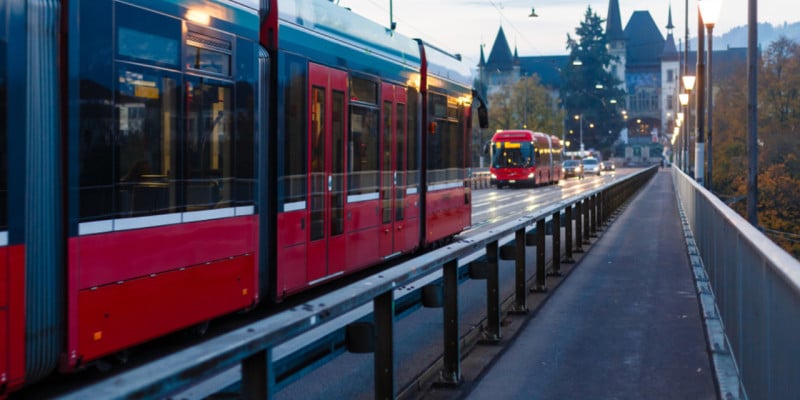
In your first week in Bern, you will notice something that takes a moment to register: the streets are quiet. Private cars account for less than 9% of commutes within the city; trams, buses, and trains handle roughly half of all journeys, and walking and cycling cover most of the rest. That split is not incidental; the city has built its mobility infrastructure around non-car travel for decades, and the results are visible from the moment you step off the train at Bern Bahnhof. All city buses, trams, regional trains, and PostBus services operate under a single integrated fare system called Libero, so one ticket or subscription covers every mode within your chosen zones. For most newcomers, a car is simply unnecessary from day one.
Private cars account for less than 9% of commutes within Bern; public transport handles roughly 50%, and walking and cycling together cover the remaining 41% (City of Bern). That breakdown is not an accident: the city has built its mobility infrastructure around non-car options for decades, and the results are visible from day one. Trams run through the historic center, cycle lanes connect most residential neighborhoods, and Bern Bahnhof (Bern main station) ties the entire network together in a single interchange point that every newcomer will pass through regularly.
All city buses, trams, regional trains, and PostBus services in the Bern area are unified under Libero, the region's integrated fare association. One Libero ticket or subscription, valid for the zones and time period you select, works across all participating operators. Newcomers do not need separate bus, tram, and train tickets: one Libero product covers everything within the purchased zones. For daily city life, Libero zones 100 and 101 cover Bern's urban area and form the basis for all single tickets, day passes, multi-ride cards, and monthly or annual subscriptions. You can explore the full network structure on the SBB Libero page.
Before your first commute, the two apps worth installing are the ÖV Plus app and the SBB Mobile app. The ÖV Plus app is specifically promoted by BERNMOBIL for use in Bern and covers journey planning, real-time departures, and ticket purchase; it accepts credit and debit cards, TWINT, Apple Pay, Samsung Pay, and Swisscom Pay. SBB Mobile covers the same Libero tickets and is familiar to anyone who already uses it for intercity rail. BERNMOBIL's website operates in English, so the digital setup is accessible from arrival.
BERNMOBIL operates Bern's city bus, trolleybus, and tram network, with all routes fully integrated under the Libero fare system. A single Libero ticket for zones 100/101 covers any combination of bus, tram, and regional train travel within the same journey: no extra ticket is needed when switching modes at Bern Bahnhof or any other stop.
The standard adult single ticket for a bus journey within the city (zones 100/101) costs CHF 4.10 (approximately EUR 4.39). For regular commuters, this adds up quickly: a monthly or annual subscription brings the per-journey cost down significantly, and those options are covered in the How to pay section below. The 6-journey multi-ride card is a practical middle option for anyone who commutes a few days a week but does not yet need a full monthly pass.
Among Bern's busiest bus routes, Line 10 runs west and southwest from Bern Bahnhof toward Köniz and Schliern; BERNMOBIL has announced new articulated trolleybuses for this route to increase capacity. Night bus services do exist in Bern but run at limited frequency and with reduced coverage. For late-evening travel, check the ÖV Plus app or BERNMOBIL's network map before assuming your usual route is running after midnight, and budget for a taxi or ride-hailing app as a fallback.
You can buy tickets before boarding at ticket machines at stops (newer machines accept contactless bank card payment), through the ÖV Plus or SBB Mobile apps, via the BERNMOBIL tickets page, or in person at the BERNMOBIL Info & Tickets counter at Bubenbergplatz 5. You must have a valid ticket before or at boarding; inspectors check regularly across the network.
Join the Bern community
Get regular tips and advice to make the most of your expat life
Trams in Bern
Tram lines 6, 7, 8, and 9 serve the main central corridors in Bern, including Bern Bahnhof, Helvetiaplatz, Luisenstrasse, Egghölzli, and Worb Dorf. For most newcomers living in or near the city center, a tram connection is the most practical option for daily commuting, school runs, and routine errands. The network is operated by BERNMOBIL and fully integrated with city buses, regional trains, and PostBus under the Libero fare system: a single Libero ticket or travelcard valid for zones 100/101 covers trams and buses within the same trip, with no need to buy a separate ticket when switching between modes.
For fare details and pass options, see the How to pay section below; Libero single-ticket and subscription prices apply equally to tram and bus travel within the zone pair. Trams are reliable for day-to-day use, and BERNMOBIL organizes replacement buses during planned track works. If your commute depends on a specific tram route, it's worth checking the BERNMOBIL website or ÖV Plus app during periods of active road construction in the city.
How to pay for transport in Bern
Bern's Libero ticketing system is built around a simple logic: choose your zones and your time horizon, and one product covers all modes. The starting point for most newcomers is zones 100/101, which together cover the urban area. Within that zone pair, there are four main options depending on how often you travel.
The Libero single ticket for adult 2nd class in zones 100/101 costs CHF 4.10 (approximately EUR 4.39) and covers all buses, trams, and trains within those zones for the ticket's validity period. For a day with multiple trips, the Libero day pass at CHF 10.40 (approximately EUR 11.10) is valid until 05:00 the following morning and gives unlimited travel across all modes within the purchased zones. Anyone taking more than two or three single journeys in a day will find the day pass more economical.
For those who travel several times a week but not daily, Bern uses a 6-journey multi-ride card (Mehrfahrtenkarte) rather than a 10-trip book: six adult 2nd-class journeys in zones 100/101 cost CHF 24.60 (approximately EUR 26.27). That works out to CHF 4.10 per trip, the same as a single ticket, but with the convenience of having five journeys pre-loaded. You can buy one through the Libero webshop.
Regular commuters save considerably by switching to a subscription. A Libero monthly subscription for adult 2nd class in zones 100/101 costs CHF 82 (approximately EUR 87.55); an annual subscription costs CHF 738 (approximately EUR 787.96), equivalent to roughly nine monthly payments for twelve months of travel. Both are loaded onto a SwissPass (the personal Swiss transit smart card linked to an individual account). The SwissPass is your physical subscription carrier: subscriptions and passes are purchased and renewed through it, not by tapping at a vehicle or platform validator with a bank card. Buy or renew your Libero subscription through the BLS travel centers, BLS ticket machines, the ÖV Plus app, or the SBB Mobile app.
Reduced fares apply to children, young people, and seniors: the 2nd-class Libero monthly subscription for these groups costs CHF 62 (approximately EUR 66.22) in zones 100/101. Bern residents receiving AHV supplementary benefits can apply for a further discounted Libero subscription at the BERNMOBIL service center; a valid AHV-EL certificate and Bern residence confirmation are required.
Beyond subscriptions, two additional tools are worth knowing. The FAIRTIQ app works as an automatic check-in/check-out system: activate it when you board, and it calculates and charges the correct Libero fare for your actual journey, billed to your account. This is useful for irregular travel where a subscription is overkill but buying individual tickets each time is inconvenient. Separately, when arriving by SBB train from another Swiss city, ask for a City-Ticket at the point of purchase: this option extends Libero zones 100/101 coverage to your rail ticket, so the onward tram or bus from Bern Bahnhof is included in the same fare. Details are on the SBB City-Ticket page.
Taxis and ride-hailing in Bern
For most daily journeys in Bern, public transport, cycling, or walking will be faster and cheaper than a taxi. Where taxis and ride-hailing apps genuinely earn their place is in situations public transport handles less well: late-night travel when bus frequency drops, trips with heavy luggage, or point-to-point routes that require multiple transfers.
Licensed taxis in Bern start at around CHF 5.00 (approximately EUR 5.35) as a base fare, with a per-kilometer rate of approximately CHF 3.90 (approximately EUR 4.17); a typical 5 km city trip costs around CHF 24.50 (approximately EUR 26.22). Taxis can be hailed on the street, picked up at ranks including the stand at Bern Bahnhof, or booked by phone or app. To identify a licensed taxi, look for a numbered sign on the roof and a green driver authorization permit visibly displayed at the front of the vehicle. The City of Bern does not fix taxi tariffs but requires them to be clearly displayed on the vehicle: if no tariff is visible, do not take the ride. More information on licensed taxi services is published by the City of Bern transport authority.
Uber and Bolt both operate in Bern and are useful for the same scenarios as taxis: late evenings, luggage-heavy trips, or off-grid destinations. The Canton of Bern proposed clearer regulatory rules for platform-based ride services, so service conditions for these apps may evolve; keep them as a backup option rather than a daily default. Cashless payment is available from many licensed taxis but is not guaranteed across all vehicles: confirm before the journey if paying by card matters. Tipping is optional; rounding up the fare is the common practice when a tip is given.
Cycling and walking in Bern
Bern has declared itself a cycling capital city (Velohauptstadt) and the numbers bear that out: cycling reached a 20% share of total city traffic in 2022-2024, already hitting the municipal target set for 2030. The city's long-term goal is for two-thirds of all trips to be made by bike or on foot by 2035. For a newcomer, that ambition translates into real infrastructure: dedicated lanes on main routes, formal bike storage near major stations, and a well-developed public bike-sharing network.
The best-maintained cycling routes for daily commuting are the Velohauptrouten (Bern's primary cycle corridors), where the city targets 2.5-meter lane widths and traffic-light management to reduce waiting times for cyclists. Some projects along these corridors are still under construction, so it's worth checking current conditions on routes through Kornhausplatz, major bridges, or areas with active road works before relying on them for a daily commute. Infrastructure quality varies by corridor: main routes are well-maintained, but some shared walking-and-cycling paths in secondary areas are still being upgraded.
The public bike-sharing network, PubliBike Velospot, covers more than 300 stations across the city and region. Around 70% of the available bikes are e-bikes with assistance up to 25 km/h, which makes Bern's hilly terrain manageable for most riders. The network is managed through the PubliBike Velospot system. An annual subscription costs CHF 69 (approximately EUR 73.62) and is the most economical option for regular users; a day pass costs CHF 29 (approximately EUR 30.94) for 24 hours. For e-bike trips, the first 30 minutes cost CHF 3.50 (approximately EUR 3.74), with additional time billed at CHF 0.20 (approximately EUR 0.21) per minute. Bikes can be picked up and returned at any station in the network.
For newcomers who want to try cycling before buying their own bike, local rental shops offer flexible arrangements. City Cycles Bern rents gravel bikes, touring bikes, and cargo bikes, with the rental cost creditable toward a purchase made within one year; details are on the City Cycles Bern rental page. VeloCittà Bern at Wylerfeldstrasse 7 offers test-bike rentals with part of the test fee credited toward a purchase within three months. For longer-term rentals, Rent a Bike is the national platform, with standard bikes available from CHF 27 (approximately EUR 28.85) per day.
For secure bike storage near the center, the city manages around 2,240 secure stands near the main station, including facilities at Welle7, PostParc, Bollwerk, Schanzenbücke, and Hochschulzentrum vonRoll. Using these official bike stations rather than improvised locking points reduces the risk of theft on a busy city corridor.
Walking is equally practical for shorter journeys. The historic Old Town, the Bern Bahnhof area, the Bärenpark, and the Aare riverside paths are all pedestrian-friendly. A 2025 pedestrian master plan is expanding continuous, barrier-free walking routes across the city. Practical caution points include: some shared walking and cycling paths where separation is still being improved, tram and bus corridors at major squares that require attention, and Aare-side paths that can be slippery in winter. These are route-specific conditions rather than city-wide risks; the walking experience on dedicated pedestrian paths and in the Old Town is comfortable and safe.
Good to know:
The City of Bern manages approximately 2,240 secure bike storage stands near Bern Bahnhof. If you commute daily by bike, registering your bicycle reduces insurance complications in the event of theft: several Swiss insurers offer standalone bike cover, and some home contents policies include it as an add-on.
Driving in Bern
The city's own advice to new arrivals is direct: start without a car. The International Bern Welcome Desk recommends testing daily routines using public transport, cycling, walking, and occasional car-sharing or rental before committing to car ownership. For most newcomers living and working within the city, that advice holds: the tram and bus network covers most daily needs, and driving into the center for routine errands adds parking costs and time rather than saving them.
A car becomes more worthwhile in specific situations, such as regular trips to destinations beyond the tram, bus, and rail network; motorway access toward Zurich, Basel, Geneva, or the Bernse Oberland; carrying bulky loads; or family logistics where public transport connections are genuinely inadequate. Avoid driving into Bern's city center for routine commuting: car traffic is restricted in the center, parking is tightly regulated and expensive, and the city's policy direction is actively reducing public-space parking.
Driving on Swiss motorways and expressways requires the annual Swiss motorway vignette (Autobahnvignette): CHF 40 (approximately EUR 42.80) for the current cycle, available at border crossings, petrol stations, and post offices. There is no daily, weekly, or monthly vignette option. Bern has no city-specific congestion charge and no low-emission zone access restriction for ordinary private cars, which simplifies things compared to some other European capitals. Details on the vignette are on the official Swiss vignette page.
Parking in Bern is tightly regulated and expensive, particularly near the center. On-street metered parking in the Lower Old Town and Matte costs CHF 2.20 per hour (approximately EUR 2.36). Public car parks range from CHF 19 to CHF 85 (approximately EUR 20.33 to EUR 90.95) for a 24-hour maximum depending on location and facility. Residents can apply for a neighborhood parking card at CHF 264 per year (approximately EUR 282.55), valid only in their authorized zone, with a minimum validity of three months.
Petrol costs approximately CHF 1.93 per liter (approximately EUR 2.07). Car rental for a small economy car starts from around CHF 31 per day (approximately EUR 33.18) for short bookings, rising to CHF 59 (approximately EUR 63.13) or more depending on vehicle class and platform. For residents who only occasionally need a vehicle, car-sharing is a practical alternative to ownership, particularly given Bern's regulated parking environment.
The Marzilibahn funicular in Bern
The Marzilibahn is a short funicular railway linking the Marzili district along the Aare River to the Bundesterrasse level near Bern's Old Town. Anyone living in or visiting the Marzili area will find it a practical daily connection that avoids a steep climb on foot. A single ride costs CHF 1.50 (approximately EUR 1.61) for adults; a return ticket costs CHF 2.90 (approximately EUR 3.10). Prams and shopping trolleys travel free. Full pricing is on the Marzilibahn fares page.
One important detail for pass holders: Libero subscriptions, Libero day tickets, the City-Ticket Bern, the Swiss GA (general abonnement), and the Swiss Travel Pass are all accepted on the Marzilibahn. However, standard Libero single tickets and multi-ride cards (Mehrfahrtenkarten) are not accepted. If you are unsure which pass you hold, check the fare conditions before boarding.
Most international arrivals to Bern do not land at Bern's own airport. Bern Airport (BRN / Bern-Belp), located in Belp south of the city, primarily serves leisure and charter routes rather than major scheduled international flights. For most expats arriving from abroad, the practical choice is one of three larger airports served by direct SBB trains to Bern Bahnhof.
Zurich Airport is the most frequently used gateway: SBB trains run every 30 minutes to Bern Bahnhof, and the journey takes about 1 hour 15 minutes. Rail is the default for budget and convenience from Zurich, and connections are frequent enough that you don't need to book ahead for flexibility. Geneva Airport offers a direct rail link to Bern in just under 2 hours, a practical option for arrivals from destinations well served by Geneva. EuroAirport Basel Mulhouse Freiburg connects to Bern by public transport in approximately 1 hour 15 minutes. You can find timetables and buy tickets through the Bern tourism arrival page or the SBB Mobile app.
From Bern Airport (BRN), the public transport journey to Bern Bahnhof takes approximately 30 minutes. Tickets are available at machines at the bus stop, at the BLS travel center at Belp station, via the ÖV Plus app, or on the bus itself, and the connection is integrated into the Libero fare network. For very early morning flights from Zurich, SBB operates a special pre-dawn weekend service; confirm the current timetable on the SBB early-morning Zurich Airport train page before travel, as schedules may change.
For families with heavy luggage, young children, or very early or late arrivals, a licensed taxi or pre-booked ride is the practical alternative. The City Taxi Bern Bahnhof-rank tariff starts at approximately CHF 7.90 (approximately EUR 8.45) base fare plus CHF 5.90 (approximately EUR 6.31) per km for up to 4 passengers. Uber and Bolt also operate in Bern and can be pre-booked via app. To identify a licensed taxi, look for a numbered roof sign and a green driver authorization permit at the front of the vehicle; the City of Bern requires tariffs to be clearly displayed on the vehicle, so check before entering if the rate is not visible.
Frequently asked questions
The BERNMOBIL tram and bus network, covered by Libero zone 100/101 tickets, is the simplest starting point. One ticket type covers all city buses, trams, and regional trains within those zones. Downloading the ÖV Plus app or SBB Mobile before your first trip gives you journey planning and ticket purchase in one place. The city center is also compact enough that many shorter trips can be made on foot.
Yes. Bern has a dense tram, bus, and regional rail network with good frequency on main routes. BERNMOBIL publishes live service alerts and organizes replacement buses during planned construction work. Checking the BERNMOBIL website or app before traveling an unfamiliar route is a good habit, particularly during active roadwork periods.
You don't need a card for a first ride, but you must have a valid ticket before boarding. For regular commuting, a Libero subscription on SwissPass is the most practical setup. For occasional travel, single tickets, the 6-journey multi-ride card, and day passes are all available through the ÖV Plus app, SBB Mobile, the Libero webshop, or ticket machines at stops.
Bern has no metro. Daily commuting relies on trams, buses, regional rail (S-Bahn), walking, and cycling. If a journey-planning app labels a connection as a metro, it is referring to a tram or rail line; use the BERNMOBIL or SBB app rather than searching for a separate metro map.
Uber and Bolt both operate in Bern and are useful late at night, with luggage, or for point-to-point trips where public transport is inconvenient. Treat them as a supplement rather than a daily default: public transport is faster and cheaper for most city routes. The Canton of Bern was reviewing ride-hailing regulations, so service terms may evolve.
Yes. The city center is compact and walkable, and Bern has a dedicated cycling program called Velohauptstadt. Bicycles make up 20% of all traffic, and around 70% of the public PubliBike fleet is e-bikes, which makes hilly corridors manageable for most riders. Some infrastructure upgrades are still ongoing, so it's worth checking route conditions for specific corridors before relying on them.
Walking is free for central trips. For cycling, the PubliBike annual subscription at CHF 69 (approximately EUR 74) is the most economical regular option. For public transport, compare your journey frequency against a Libero monthly pass at CHF 82 (approximately EUR 88) versus single tickets at CHF 4.10 (approximately EUR 4.40) each; more than 20 single journeys per month makes the monthly pass cheaper.
Around 50% of internal commuters use public transport and about 41% walk or cycle; private car use accounts for under 9% of internal commutes. In practice, most residents combine trams or buses for cross-city routes with walking or cycling for short central journeys. Living within reach of a tram or bus stop matters more for daily life in Bern than owning a car.
For most newcomers living and working inside the city, a car is optional. Public transport, cycling, and bike-sharing cover most daily needs. A car becomes more useful for regular trips beyond the public transport network, family logistics in underserved areas, or frequent weekend travel to outlying regions. Factor in regulated parking, the annual motorway vignette at CHF 40 (approximately EUR 43), and the city's policy direction of reducing car traffic when deciding.
Most international arrivals use Zurich Airport (approximately 1 hour 15 minutes by SBB train, with trains every 30 minutes), Geneva Airport (just under 2 hours by train), or EuroAirport Basel Mulhouse Freiburg (approximately 1 hour 15 minutes). Rail is the standard option for budget and convenience. From Bern Airport (BRN), a 30-minute bus and train connection reaches Bern main station using the Libero network. For heavy luggage or very early or late arrivals, a licensed taxi or pre-booked ride-hailing service is the practical alternative.
ℹ️
We do our best to provide accurate and up to date information. However, if you have noticed any inaccuracies in this article, please let us know in the comments section below.
I fell in love with words at an early age After a break to focus on my studies, I rediscovered the joy of writing while keeping a blog during my years between London and Madrid. This passion for storytelling and for exploring new cultures naturally inspired me to create Expat.com, a space for my own reflections as well as for anyone wishing to share their experiences and journeys abroad.