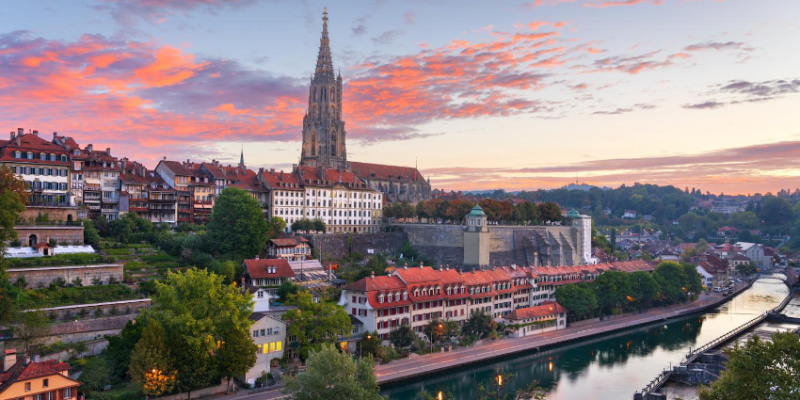
Living costs, the German language, and a reserved social culture are the three factors that most shape whether Bern works for a given newcomer. The city itself offers a compelling package: a compact, walkable area built around a UNESCO-listed medieval core, the Aare river, and a federal-capital employment base in healthcare, IT, communications, and public administration. Safety is strong, public transport is reliable, and nature access from the center is immediate. But the Swiss price level applies across every budget line, health insurance is mandatory and not employer-provided, the rental market is competitive and document-intensive, and social integration in a city of this size and this character takes deliberate, patient effort over months rather than weeks.
Switzerland'sfederal capital surprises almost every newcomer. With a resident population of around 147,000, Bern operates at the scale of a mid-sized regional city comparable to Edinburgh in civic tone, rather than a large European capital. Its significance within Switzerland is primarily political rather than financial or industrial, and that shapes everything from the employment landscape to the rhythm of daily life. The city's identity rests on three things: its UNESCO-listed medieval Old City (recognized since 1983), the Aare river that loops around the historic peninsula, and the federal institutions that give Bern a stable, professional character without the corporate intensity of Zurich or Geneva. The Bern business area employs more than 200,000 people, with the leading sectors being federal government and public administration, healthcare, IT, communications, and transport, a profile that suits professionals seeking stable, service-oriented careers over a fast-paced corporate environment.
The city's urban form is the first practical thing newcomers notice: the historic peninsula core is entirely walkable, distances between neighborhoods are short, and green space along the river and into the surrounding countryside is accessible on foot or by bike from the center. This compact scale is one of the main reasons people choose Bern over Switzerland's larger cities. Daily life involves short distances, reliable public transport, and quick access to nature, and the pace consistently feels measured rather than rushed.
Most newcomers arrive expecting something larger and busier. Positive first impressions typically focus on the preserved medieval Altstadt (Old City), the river setting, the dense tram and rail connections, and the absence of urban disorder. The main adjustment challenges arrive a few weeks later: high living costs, a competitive housing market that demands thorough documentation, German-speaking administration, and a social culture that can feel reserved to those used to more spontaneous contact. Integration tends to reward patience and structured participation, such as joining clubs, language courses, and neighborhood activities, rather than expecting immediate informal friendships. Newcomers who allow six to twelve months for social roots to form consistently report more positive experiences than those who expected quicker warmth.
Everyday life in Bern has a moderate, structured rhythm. Public transport runs reliably, most errands are handled on foot or by tram, shops and services follow predictable opening hours (with Sunday closures for most retail), and outdoor life along the Aare and in the city's parks anchors leisure routines from spring through autumn. Work-life balance is considered good by Swiss standards, and the city's walkable scale keeps commuting stress low for most residents living within the municipal boundary.
Bern divides into a small number of clearly distinct residential areas, each with its own character, price level, and practical profile. Understanding those differences before starting a housing search saves significant time.
The Innere Stadt (Old Town) is Bern's historic and most walkable district: the UNESCO-listed arcaded streets, federal institutions, shops, and cafés are all here, and Bern railway station gives direct access to the city tram and bus network and to national rail connections. Rents sit at the higher end of the Bern market. It suits professionals, retirees, short-stay arrivals, and culture-focused newcomers who want to handle most daily life on foot without relying on any other transport.
Länggasse-Felsenau, commonly called Länggasse, lies just northwest of the center and is shaped by student and academic life, cafés, and a comparatively international atmosphere. It is one of the most popular areas among expats, students, academics, young professionals, and remote workers. Rents are medium to higher. Close proximity to the University of Bern and Inselspital hospital makes it the natural base for anyone connected to the university or health sector, and it is practical for car-free daily life.
Breitenrain-Lorraine, locally called "Breitsch," is the most socially active of Bern's north-of-center districts, with cafés, local shops, schools, kindergartens, Aare access, and good cycling and public transport links toward the station. It is popular with young professionals, young families, and newcomers who want neighborhood life rather than tourist-center prices, and it is the city's most up-and-coming district for expats. Rents are medium to higher.
Kirchenfeld-Schosshalde is a leafier, more established eastern residential district associated with embassies, museums, and a quieter pace. Rents are at the higher end of the market. It attracts families, diplomats, senior professionals, and retirees looking for calm, green surroundings and proximity to parks, the Aare, and cultural institutions including the Kunstmuseum Bern and Bern Historical Museum. Tram and bus connections to the center are reliable.
Mattenhof-Weissenbühl is a quiet, residential, green-leaning district between the city center and the Gurten. It is one of the more affordable options within Bern and consistently recommended for families, cost-conscious professionals, and newcomers who want calmer residential streets without committing to the most suburban district. City center access by tram and bus is practical.
Bümphliz-Oberbottigen is the most suburban and comparatively affordable district within the Bern municipality, offering more space for money than the central quarters. It suits families needing larger apartments, cost-conscious renters, and long-term residents comfortable with a quieter outer-city setting. Rail and bus connections link it to the center, though it works better for those happy to live outside the inner-city ring.
Newcomers with school-age children should also evaluate areas just outside the municipal boundary. The Muri bei Bern area, which hosts the International School of Bern, and other suburban communes connected to Bern by regional rail and bus can offer more space at somewhat lower rents, making them worth considering before committing to the city's inner districts.
Join the Bern community
Get regular tips and advice to make the most of your expat life
Cost of living in Bern
Bern is expensive relative to most European cities of comparable size. Everyday cost pressure is felt most directly through rent, restaurant prices, utilities, and service-heavy spending. That said, it is somewhat more moderate than Switzerland's largest international hubs, which can make it attractive to expats who want Swiss quality of life without the most extreme price environment.
Rental costs set the largest budget item for most newcomers. A studio on the Bern rental market averages around CHF 948 (USD 1,161) per month, while a one-bedroom apartment ranges from CHF 1,000 to CHF 2,400 (USD 1,225 to USD 2,940) depending on location, condition, and included amenities. The rental market is competitive: landlords expect complete application dossiers including proof of income, employment contracts, and credit check results. Starting a search several months before a planned move date and having all documents ready significantly improves the chances of securing a place.
Beyond rent, the next most predictable fixed cost is public transport. The Libero travelcard covering Bern's urban zones costs CHF 82 (USD 100) monthly, giving unlimited access to trams, buses, and regional rail within the subscribed zones. Utility bills for a standard apartment run from approximately CHF 149 to CHF 350 (USD 182 to USD 429) per month, covering electricity, heating, and water; monthly broadband internet adds approximately CHF 45 to CHF 46 (USD 55 to USD 56). Both figures vary with apartment size and provider.
Eating out is a significant and ongoing expense. A single inexpensive restaurant meal costs around CHF 25 (USD 31), while a mid-range dinner for two runs around CHF 120 (USD 147). A cappuccino at a café is typically around CHF 5 (USD 6). Cooking at home from Swiss supermarkets is considerably cheaper than eating out, but grocery prices are also higher than in most of Western Europe, so a weekly shop for one person typically costs more than newcomers from North America or comparable markets expect. A gym membership runs around CHF 78 (USD 95) monthly; cinema tickets, sports events, and cultural admissions are priced at Swiss levels throughout.
A realistic single-person monthly budget covering rent for a studio or one-bedroom apartment, utilities, transport, food, and leisure starts from approximately CHF 3,100 to CHF 3,500 (USD 3,800 to USD 4,300). Families, those renting larger apartments, or anyone with children in international schooling will budget substantially more. A strong Swiss-level salary or equivalent remote income is required to live comfortably without financial strain.
All costs in Bern are in Swiss francs (CHF). Mandatory health insurancein Switzerland is not provided by employers and represents a significant additional monthly cost that must be factored into any budget calculation alongside rent and utilities. Expats paid in USD, EUR, GBP, or other currencies also carry exchange-rate risk on every fixed expense: building a buffer of at least 10 to 15% above projected monthly costs is advisable for those earning in foreign currencies.
Climate and weather in Bern
Bern sits on the Swiss Plateau and has a temperate continental climate with four clearly marked seasons. July average daily maximum temperatures reach around 24.6 °C, while January nights drop to an average minimum of around -3.9 °C. Annual precipitation totals around 1,040 mm, with a summer peak driven by warm-air thunderstorms and heavy convective showers. Annual sunshine averages around 1,797 hours, which is relatively good for the German-speaking Swiss Plateau (MeteoSwiss).
The most comfortable periods for outdoor daily life are late spring (May through June) and early autumn (September), when temperatures are pleasant, and neither the coldest winter conditions nor the peak summer thunderstorm pattern applies. Summer is warm and lively but punctuated by heavy afternoon thunderstorms that can arrive quickly. Winter brings the Swiss Plateau's characteristic Hochnebel (valley fog): grey, low-cloud conditions that persist for days or weeks during the colder months. The limited winter sunshine is a common adjustment challenge for newcomers, though one practical counterpoint is that driving or taking the train up to the Jura or the pre-Alpine foothills often puts you above the fog layer into clear skies.
Urban heat is an increasingly practical concern when choosing an apartment. The city center recorded twice as many heat days as the 1991-2020 norm in recent summers, and central streets logged up to 5 tropical nights (nights above 20 °C) per year between 2018 and 2024, while surrounding areas recorded almost none. Air conditioning is not standard in most residential buildings in Bern, so top-floor apartments and poorly shaded buildings in dense central areas can become genuinely uncomfortable during heatwaves. Ventilation options and external shading are worth checking when viewing apartments during warmer months.
Flood risk along the Aare is a concrete housing-search consideration. The Dalmazi, Marzili, Matte, and Altenberg quarters are densely populated riverside areas targeted by the city's active flood-protection project. Before signing a lease near the river or in a low-lying area, check whether the address falls within a mapped hazard zone using the city's Geoportal, which includes flood-risk layer data. Properties on higher ground or farther from the river face no meaningful flood exposure.
Pack for a genuine four-season wardrobe: a warm winter coat, waterproof boots, and gloves for the cold months; light breathable clothing for warm summer days; and a compact rain jacket or umbrella year-round for sudden afternoon thunderstorms. Because daily life in Bern involves walking, cycling, and public transport rather than door-to-door car travel, comfortable waterproof footwear is more useful than it may seem at first.
Getting around Bern
Bern is built for car-free living. The city is compact, walkability is high across the historic center and most residential districts, and the tram, bus, and regional rail network covers the city and wider metropolitan area reliably. A car is rarely needed for daily life within the municipality, and parking costs make ownership an active financial choice rather than a practical necessity. Most newcomers settle into a routine combining walking, cycling, and the Libero travelcard within their first weeks.
Cycling is increasingly the daily choice for many residents. The city's network is expanding under its Velohauptstadt (cycling capital) program and cycle traffic has continued to grow. Most central and inner-residential trips are practical by bike year-round for those comfortable cycling in mixed urban traffic, and the city's flat-to-moderate topography makes it accessible for regular commuting. One practical note: bicycle theft is the most commonly reported property offense in Bern, so a quality lock and a record of your bike's frame number are essential from day one.
Three apps cover everyday mobility in Bern. SBB Mobile handles national journey planning, ticket purchase, SwissPass travelcards, and EasyRide (automatic fare calculation) for trains, trams, buses, and boats across Switzerland: it functions as a single interface for urban and national travel, similar in scope to a combined urban transit and national rail app. The ÖV Plus App provides real-time timetables for BERNMOBIL, PostAuto Region Bern, and RBS bus lines. The BERNMOBIL website and app provide timetables, Libero ticket purchase, and network information for Bern's urban network. Uber is also available in Bern for on-demand rides outside public transport hours or for specific trips.
Language and communication in Bern
German is the official administrative language of the City of Bern. The Canton of Bern is officially bilingual in German and French, but the city administration operates entirely in German, and German is the language of all official correspondence, housing contracts, school communications, and local bureaucracy.
English is widely understood in professional, university, international, and many service settings, and it can carry a newcomer through the first weeks comfortably. Its reach narrows considerably in neighborhood life, older-generation interactions, local bureaucracy, and any job requiring close integration with Swiss colleagues. Newcomers who rely only on English often find housing searches slower, social integration more limited, and local friendships harder to build. German, even at a basic level, materially improves daily life quality in Bern beyond the first few months.
The local spoken variety is Bärndütsch (Bernse German dialect), used in casual social settings, shops, neighborhood life, and among friends. Newcomers who study Standard German may still need time to follow local speech, because the two forms differ significantly in pronunciation, vocabulary, and rhythm. In writing, formal settings, and with learners, residents reliably switch to Standard German. The phrase "Entschuldigung, sprechen Sie Hochdeutsch? (Excuse me, do you speak Standard German?) is a practical and well-received request; most residents will either switch to Standard German or offer English if you ask.
Practical resources for German learning in Bern: ILS-Bern offers German programs aimed at everyday communication. Holders of a City of Bern Deutsch-Bon (language learning voucher) can receive a CHF 400 (USD 499) contribution toward eligible German courses, so checking eligibility before enrolling is worth doing.
Good to know:
The gap between written Standard German learned in language classes and spoken Bernse German heard in daily life can feel significant at first. Residents are accustomed to this and generally patient with learners who make the effort. Using Standard German yourself signals willingness to integrate, even if local speech sounds different.
Culture and social norms in Bern
Bern combines federal-capital formality with strong neighborhood life and a compact UNESCO-listed Old City that has shaped everyday social architecture since its recognition in 1983. The city feels civic, orderly, and locally rooted rather than flashy or internationally competitive. It is generally open toward foreign residents and has a formal integration policy, but social warmth develops through structured participation over time rather than through spontaneous first contact. Swiss directness is not unfriendliness: conversations tend to be efficient and to the point, which reads as honest rather than cold once you adjust to the register.
The social code newcomers encounter first: greet people with Grüezi in shops and public settings; respect queue order; keep appointments on time; and plan to handle most shopping before Sundays, when Sonntagsruhe (Sunday rest) means most retail closes. The railway station is a practical exception, operating its shops every day of the year and typically later than standard city shops, making it the most reliable Sunday shopping option in central Bern. Public transport tickets must be valid at all times: inspections are regular, and fines for traveling without a valid ticket are substantial.
Bern observes 10 public holidays during which shops reduce hours or close: January 1, January 2, Good Friday, Easter Monday, Ascension Day, Whit Monday, August 1 (Swiss National Day), December 25, and December 26 are the main dates. Stock up on essentials before major holidays, or rely on the railway station for last-minute needs. Dress code in everyday life is smart casual: Bern's professional-federal character rewards neat, understated clothing, though daily routines are relaxed rather than formally demanding.
Meeting people in Bern works best through structured settings: sports clubs, language courses, neighborhood events, volunteering, and university or parent networks consistently produce more social results than expecting informal warmth in shops or on the street. The city's neighborhood centers (Quartierzentren) and communal events are genuine starting points for building a local social life, supported by the city's official socio-cultural policy as practical integration tools. The Lauben (the covered arcaded walkways that line the Old City streets), the medieval street plan, museums, cinemas, theaters, and neighborhood cafés make cultural access feel integrated into daily life rather than concentrated in tourist venues.
Pace of life and work culture in Bern
Bern's daily rhythm is consistently slower and less intense than Switzerland's larger cities. Its federal-capital identity, compact scale, strong public transport, and walkability mean that work and leisure routines are shaped by predictability and access to nature rather than by corporate pressure or late-night social scenes. Work-life balance is considered good by Swiss standards, and the city rewards people who prefer reliability, short distances, and structured routines over constant stimulation.
Swiss employment law sets clear working-hours boundaries: day and evening work falls within a 06:00-23:00 window, breaks are required based on shift length, and weekly maximum hours apply. In practice, Bern office and public-sector roles follow a structured Monday-to-Friday pattern with punctual starts, planned meetings, and limited spill into evenings. A standard Bern office role runs around 42 to 45 hours per week. Lunch is typically a short break rather than a long social meal. Remote and hybrid working has grown significantly in Switzerland and is now an active norm in many Bern organizations, particularly in the IT, communications, and professional services sectors that employ large numbers of expat workers.
The seasonal shift is dramatic and defines how expat social life actually feels in Bern. Summer life moves outdoors to the Aare swimming areas, parks, the Gurten, street festivals, and public events on the Bundesplatz. From late autumn through winter, the Plateau's fog and shorter days push daily life indoors toward cultural venues, markets, and home routines. One practical note about social networking: the structured club and event culture replaces the after-work social scene common in some other countries. Joining a sports club, a language group, or a hobby association is genuinely the most effective way to build a regular social circle in Bern.
Food culture in Bern
The everyday food culture in Bern centers on Swiss-German comfort dishes, regional cheese traditions (Emmental and Gruyère are local staples), bakeries, and café life under the Lauben arcades. The city has strong market culture: the City of Bern's weekly food markets operate in the center and across neighborhoods throughout the year, covering fresh produce, flowers, meat, and seasonal goods. Cooking at home from the weekly market or from Migros and Coop, Switzerland's two main supermarket chains, is the most budget-conscious approach, though grocery prices are higher than in most of Western Europe.
The city's most distinctive culinary event is the Zibelemärit (Onion Market), held on the fourth Monday of November. Thousands of braided onion garlands are sold in the city center alongside regional food products, confectionery, and festive stalls. It is one of the best-known traditional market events in Switzerland and a genuine part of local identity rather than a tourist staging: attending it in the first autumn after arrival is a practical way to connect with Bernse neighborhood life and see the Old City at its most animated.
International dining options exist but are moderate in range. The restaurant scene is dominated by Swiss-German cuisine and European staples; some Asian, Middle Eastern, and other international options are available, particularly in the center and in Länggasse. At any level, eating out is expensive: a budget meal runs around CHF 25 (USD 31) per person, and a mid-range dinner for two is around CHF 120 (USD 147), so most residents treat restaurants as occasional rather than daily choices.
Leisure and social life in Bern
From spring through autumn, free time in Bern is strongly outdoor-oriented and centered on the Aare. Swimming and socializing at theMarzili outdoor baths and along the Aare riverbanks is the most popular warm-weather activity: free, central, and deeply embedded in local life. The Gurten, reached by funicular from Wabern, offers year-round walking and panoramic city views. The Rosengarten, the BärePark, the Dählhölzli Animal Park, and the Botanical Garden of the University of Bern extend the accessible green-space network across the city. Building a weekend routine around recurring activities, such as a hiking group, a regular swim, or a weekly market visit, is the most effective way to settle into Bern's pace and meet people organically.
The arts and cultural scene is genuinely strong for a city of Bern's size. Major institutions include the Kunstmuseum Bern, the Zentrum Paul Klee, the Bern Historical Museum, the City Theatre (Stadttheater Bern), and the Bern Symphony Orchestra, alongside smaller independent galleries, cinemas, and alternative cultural venues. The challenge for newcomers is not finding things to do but learning which events and venues match their taste: the city offers real cultural depth across classical, contemporary, and alternative formats.
Nightlife is moderate and relatively conservative. Bern has bars, clubs, summer pop-up bars on the Aare, and alternative cultural venues, but late-night options are more limited than in Switzerland's larger cities, and social life is more event-based and seasonal than all-night urban. Newcomers who focus on evening cultural events, live music, and local bars rather than expecting a large club scene will find enough to keep them engaged without disappointment. Weekend culture centered on hiking, swimming in the river, visiting museums, and attending evening concerts suits the city's measured rhythm well.
Family life in Bern
Bern is a practically family-friendly city: the municipality runs dedicated family and neighborhood services through its Famille & Quartier office, offers subsidized childcare through a voucher system, provides school social work with multilingual support, and has extensive green space and family leisure infrastructure. The main adaptation challenges for newcomer families are German-language integration for children entering the public school system, the lead time required to secure childcare places, and the cost of full-time childcare before vouchers are applied.
Full-time care at Kitas Stadt Bern (the city's municipal nurseries) costs CHF 183 (USD 226) per full day, including meals, for children aged 3 to 18 months, and CHF 156 (USD 192) per full day, including meals, for children from 18 months until kindergarten entry. At 21.75 care days per month, unsubsidized full-time costs typically run between CHF 3,154 and CHF 3,741 (USD 3,911 to USD 4,639) monthly. These are gross figures before any voucher reduction.
The Betreuungsgutschein (childcare voucher) scheme reduces costs at licensed daycare centers and day-family organizations. The household income ceiling for receiving any voucher is CHF 170,000 (USD 212,000), and the ceiling for the maximum reduction is CHF 49,000 (USD 61,000). Applications must be submitted no later than the month before care starts, and the voucher period runs from August to July each year. The Canton of Bern's Familienportal provides a voucher calculator and contact points for families across the canton.
Public schooling in Bern follows the Lehrplan 21 curriculum in German. The city's Schulsozialarbeit (school social work) service supports families dealing with school-related personal, social, or family issues and provides multilingual materials including English-language PDFs, a practical resource for non-German-speaking parents in the early months. Children enter Kindergarten at around age 4 to 5, which is compulsory in Switzerland, making early German exposure important for children starting school within 12 to 18 months of arrival.
The International School of Bern (ISBern), located in Muri bei Bern just outside the city boundary, offers International Baccalaureate programs for ages 3 to 18, with English as the primary teaching language, French as a second language, and a Lehrplan 21 German pathway from Grade 1. Annual fees range from approximately CHF 10,000 to CHF 39,410 (USD 12,400 to USD 48,868) depending on year group. ISBern is the most directly relevant option for English-speaking families.
For families choosing neighborhoods, the most consistently recommended areas are Kirchenfeld-Schosshalde (quiet, green, near parks and museums), Breitenrain-Lorraine (lively neighborhood feel, local schools, Aare access), Mattenhof-Weissenbühl (more affordable, residential, good transport), and Länggasse (central, walkable, practical for university and hospital connections).
Safety in Bern
Bern is a safe city for everyday life. Cantonal police statistics recorded a 12% decrease in offenses in the municipality in a recent year, and authorities note that large-city figures are influenced by commuter populations that inflate per-resident ratios. In practice, the city feels orderly and low-risk across most hours and districts; violent street crime affecting newcomers is not a meaningful everyday concern.
The real risks are property crimes. Bicycle theft is the most commonly reported offense, followed by bag, phone, and wallet theft in busy public spaces, parcel theft from building entrances, and online fraud and phishing. Apply standard urban precautions around stations, transport hubs, and the main shopping streets during busy periods. No district in Bern should be labeled unsafe based on current official data; standard alertness applies city-wide rather than concentrating risk in specific areas.
Practical prevention habits: always lock bicycles with a quality lock and keep a record of the frame number, brand, and color; redirect deliveries to pickup points or lockers rather than leaving parcels in entrance halls; and stay alert to phishing attempts targeting new residents. Eligible stolen-property reports, covering bicycles, e-bikes, mopeds, electronic devices, skis, snowboards, and license plates, can be filed online 24 hours a day through Suisse ePolice, which also links to the cantonal police portal.
Key emergency contacts: police 117 (or 112 as the international emergency number); ambulance 144; fire brigade 118. Schutz und Rettung Bern operates the 118 and 144 call centers for the city. The national victim-support line 142 provides free, confidential 24-hour advice for people who have experienced physical, psychological, or sexual violence. The Fachstelle Häusliche Gewalt (domestic violence office) offers free support for victims in the Bern region, including crisis intervention and referral to professionals; contact: +41 31 321 63 02 or fhg@bern.ch.
Environment in Bern
Bern's environmental quality is a significant part of its everyday appeal. StadtGrün Bern manages approximately 4 million square meters of public green space, including 132 public parks, the Aare corridor, commons, and urban gardens, making green space genuinely integrated into daily city life rather than concentrated in a few large parks. Air quality is generally good: residents can track current conditions in real time at the World Air Quality Index tracker for Bern, and the Canton of Bern recommends the airCheck app for real-time Swiss air quality data. Traffic congestion is moderate, with peak-hour impact felt mainly on key road corridors while the dense public transport, walking, and cycling network keeps much of daily mobility off the roads.
Three environmental factors are practically relevant when choosing where to live in Bern. First, flood risk along the Aare is real and mapped: the Dalmazi, Marzili, Matte, and Altenberg quarters are identified by the city as targets of its active flood-protection program. Second, urban heat is increasing: the city center's heat island effect has produced significantly more heat days and tropical nights in recent summers, and top-floor apartments in dense central streets experience the most discomfort during heatwaves, compounded by the absence of standard air conditioning. Third, traffic noise varies sharply by street: areas near the motorway corridor to the east and major arterial roads experience significant day-and-night noise and air-quality exposure. Use the city's Geoportal to check the noise sensitivity map (Lärmempfindlichkeitsstufenplan) for any specific address before committing to a lease.
Bern has one of Switzerland's most explicit sustainability cultures in practical terms. The city operates a sustainability framework targeting a 17% reduction in motorized individual traffic by 2035 relative to 2021, alongside an active cycling infrastructure expansion under the Velohauptstadt program, a biodiversity strategy, and an energy and climate plan. In daily life, this translates into an extensive recycling system, well-maintained cycling infrastructure, strong public transport investment, and a visible policy direction toward greener urban living. Sustainable routines, from daily cycling to careful waste sorting to using public transport, are genuinely easy to adopt from the first week of residence.
Expat community in Bern
Foreign nationals make up a substantial share of Bern's population: 37,603 of the city's 146,259 residents hold non-Swiss nationality (City of Bern, 2025 data). The foreign-national community is genuinely diverse rather than dominated by a single expat group, which shapes social dynamics differently from heavily English-speaking Swiss hubs. This diversity means Bern has visible international communities but not the kind of self-sustaining expat bubble that exists in Geneva or parts of Zurich.
Expats most often settle in Länggasse-Felsenau (university and hospital proximity, international atmosphere), Kirchenfeld-Schosshalde (embassy area, quieter residential, families and senior professionals), Breitenrain-Lorraine (neighborhood feel, younger expat households), and the Innere Stadt (central convenience and walkability).
Integration in Bern is slower than in larger Swiss international hubs but generally positive over the medium term. Long-term residents consistently report high satisfaction with safety, quality of life, city scale, and access to nature, while noting that building local friendships takes patience and deliberate effort. The central practical divide is language: expats who invest in German, even at a functional level, report faster social integration and fewer administrative frustrations. Those who remain in English-only circles can function professionally but often describe feeling socially peripheral even after years of residence.
For practical community connection, Reddit r/bern hosts active English-language discussions on relocation, housing, and everyday life in Bern, with recent threads covering practical questions from newcomers. Reddit r/Switzerland provides broader Swiss context, including regular discussions on long-term expat integration and the role of language in career and social life. What's Up Switzerland, an English-speaking social group with roots in Canton Bern, organizes in-person meetups and activities and is a practical starting point for English speakers seeking informal social contact in and around the city.
Bern's strongest advantages for newcomers are specific rather than generic. The city offers a compact, entirely walkable urban area with exceptional access to nature from the center: the Aare, the Gurten, and 132 public parks are not weekend excursions but daily fixtures. The UNESCO-listed Old City makes cultural richness feel built into the environment rather than something you have to seek out. The safety record is strong by any European standard. Work-life balance is good, public transport is reliable and comprehensive, and the city's sustainability infrastructure is practical and well maintained.
The main challenges are equally specific. Swiss-level costs apply across the board: rent, restaurants, childcare, health insurance, and services are all expensive, and expats paid in foreign currencies face additional exchange-rate exposure on every fixed bill. The rental market is competitive and requires thorough preparation in advance. German is non-negotiable for deep integration, and Bärndütsch adds another layer, even for those who arrive with Standard German skills. The city's quieter, more reserved social culture means that building genuine friendships requires deliberate effort and time, more so than in larger or more internationally permissive cities.
Frequently asked questions
English covers professional, university, and many service interactions, making an initial soft landing possible. Over the longer term, German becomes important: housing searches, official correspondence, school communication, and neighborhood social life all work significantly better with at least functional German. Expats who remain in English-only circles often find the city polite but socially distant even after years of residence. See the Language and communication section for practical resources to get started.
A realistic monthly budget for one person renting a studio or one-bedroom apartment, covering rent, utilities, transport, food, and leisure, starts from approximately CHF 3,100 to CHF 3,500 (approximately USD 3,800 to USD 4,300). The monthly urban transport pass costs CHF 82 (approximately USD 100), and a single inexpensive restaurant meal runs around CHF 25 (approximately USD 31). Families with children in international schooling, or anyone renting a larger apartment, will budget substantially more. A strong Swiss-level salary or equivalent remote income is typically needed to live without financial strain.
Bern is a safe city, and official crime statistics don't indicate any district that needs to be avoided. The most practical approach is to choose a neighborhood based on your commute, transport connections, and noise levels, then visit at different times of day before signing a lease. Well-connected residential areas such as Kirchenfeld-Schosshalde, Langgasse, Mattenhof-Weissenbuhl, and Breitenrain-Lorraine all work well for most newcomers. Standard precautions apply everywhere: lock bicycles with a quality lock and stay alert in busy public spaces and around transport hubs.
Bern rewards long-term residents far more than short-stay visitors. Its strengths, including compact distances, reliable services, strong public transport, good work-life balance, and nature access, accumulate in value over months and years. The competitive housing market is also easier to navigate once established. Short-term visitors enjoy the historic Old City and the Aare, but the high costs and measured pace make Bern a better long-term home than a short rotation destination.
The most common surprise is how small and quiet the city feels for a national capital; with around 147,000 residents in the municipality, it has the scale of a mid-sized regional city rather than a European capital. Many newcomers are also struck by how quickly nature becomes part of daily life and how central the Aare is to summer social routines. High costs, particularly for restaurants, services, and childcare, are a frequent secondary surprise for those arriving without a clear budget.
Foreigners can rent in Bern, but the market is competitive, and landlords expect complete application dossiers: proof of income, an employment contract or equivalent, a Swiss credit check, and references. Prepare documents before starting the search. Starting several months before a planned move date is strongly advisable given high demand. Some German-language communication ability makes interactions with landlords and agencies considerably smoother.
The three most consistently reported downsides are high living costs across rent, restaurants, childcare, and services; a quieter, more reserved social scene than in larger cities, which can feel isolating without deliberate effort to join local activities; and the German-language barrier, which limits social integration and some employment pathways for newcomers who delay learning it. Expats paid in foreign currencies also carry exchange-rate risk, since all costs are denominated in Swiss francs (CHF).
ℹ️
We do our best to provide accurate and up to date information. However, if you have noticed any inaccuracies in this article, please let us know in the comments section below.
I fell in love with words at an early age After a break to focus on my studies, I rediscovered the joy of writing while keeping a blog during my years between London and Madrid. This passion for storytelling and for exploring new cultures naturally inspired me to create Expat.com, a space for my own reflections as well as for anyone wishing to share their experiences and journeys abroad.