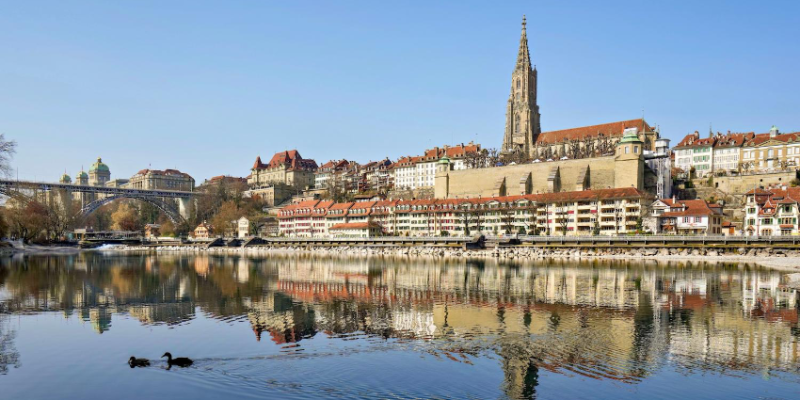
What surprises most professionals arriving in Bern is how little the city resembles a typical European commercial center. As Switzerland's federal capital, its job market is shaped by the concentrated weight of government: federal, cantonal, and municipal employers account for a substantial share of available roles, and their career portals matter as much as any private-sector platform. For expats, this has a direct practical consequence. German is the working language in most institutional environments, regardless of the canton's official bilingualism, and the stakes of getting the job search right are considerable.
Bern's role as the Swiss federal capital gives its job market a character unlike any other Swiss city. Public administration at the federal, cantonal, and municipal levels forms the backbone of local employment, making institutional and policy-adjacent work more prominent here than in commercially dominated cities. For a job seeker arriving from abroad, this concentration has a direct practical consequence: government career portals are as important to search as private-sector platforms, and in some sectors they are the primary source of vacancies.
Beyond administration, the sectors with the clearest hiring pathways for foreign professionals are healthcare and hospitals, insurance and financial services, universities and research, engineering and construction, and IT and business services. The city also concentrates activity in cleantech and energy, informatics and communications, and transport-linked services, so employer searches should extend to utilities, transport operators, and technology service providers rather than stopping at obvious government portals.
Three areas account for most employer activity. Wankdorf and the adjacent WankdorfCity development to the north of the city center concentrate office, infrastructure, and transport-linked workplaces, including SBB's Technology Infrastructure purchasing division. The Bern main station area handles central services, consulting, and administration-facing roles. Ausserholligen, to the west, is an actively redeveloping mixed-use zone with approved planning for new office and services space; it is a forward-looking search area rather than an established cluster, but one worth monitoring as development progresses.
Professionals with backgrounds in policy, regulatory affairs, or public administration will find this environment recognizable: the institutional weight of federal employers here is comparable to what you would find in a dedicated capital city. Those coming from purely private-sector backgrounds may need to widen their sector expectations to land the right opportunity.
A successful job search in Bern runs on at least three parallel tracks simultaneously. Relying on a single platform will almost certainly produce an incomplete picture, because employers spread vacancies across different channels depending on their sector and institutional type.
For private-sector roles, the five broadest Swiss job boards with strong inventory in the Bern region are jobs.ch, JobScout24, jobup.ch (particularly useful for roles posted in French as well as German), jobagent.ch, and Indeed Switzerland. The City of Bern's guidance for newcomers lists all five as standard starting points. Use them in parallel rather than sequentially, since employers often post exclusively on one platform. A complementary tool is Bernr-Stellen, a Bern-region-specific board that narrows your search geographically without requiring manual filtering on national platforms, making it a fast way to build a Bern-focused shortlist.
The second track covers public-sector vacancies, which deserve dedicated searches. The City of Bern jobs portal carries municipal administration, social services, engineering, IT, and construction roles. The Canton of Bern careers portal covers cantonal administration, education, and infrastructure positions. For federal roles, Stelle Adminis the entry point and is worth checking regularly, since federal department headquarters are concentrated in Bern. StellenPortal Bund, operated by the State Secretariat for Economic Affairs (SECO), is Switzerland's official public employment service and is free to use; it carries registered vacancies that do not always reach commercial boards.
Recruitment agencies form a third channel, particularly for specialist roles or positions that are filled before they appear publicly. Hays Bern covers construction and real estate, engineering, finance, IT, life sciences, and sales and marketing, and explicitly works with international candidates and freelancers. For office administration, logistics, production, transport, and industrial roles, Randstad Bern, Adecco Bern, and Manpower Bern provide broader access. Registering with more than one agency widens your reach considerably.
German is the default working language for local-facing and public-sector roles; treating it as optional closes most of the institutional job market. French is a genuine advantage because Canton Bern is officially bilingual and some employers recruit across the German- and French-speaking markets simultaneously. English opens doors in technical, international-facing, and specialist functions but alone is rarely enough for a Bern-based role. The language requirement is set at the team and role level, not at the cantonal level, so check the language of the specific role rather than assuming the canton's official bilingualism translates into flexibility at every employer.
Swiss application packages are more complete than a minimal CV submission. A targeted cover letter, a structured CV, and supporting documents such as diplomas and certificates of employment are standard expectations, particularly for public-sector and institutional applications. Adapting the cover letter to the employer's working language is practical.
Networking matters in Bern's compact institutional market. LinkedIn is the primary professional platform, but alumni networks, industry events, and community groups can open doors to roles filled before they are publicly advertised. The British-Swiss Chamber of Commerce has a Bern chapter and organizes networking events and business insights for UK-connected professionals. The Swiss-American Chamber of Commerce and the Australian Swiss Chamber of Commerce both run business networking, panel events, and annual business awards for professionals connected to those markets across Switzerland, including Bern. In a city this size, a well-placed introduction carries real weight.
Join the Bern community
Get regular tips and advice to make the most of your expat life
Salaries and benefits in Bern
Switzerland has no single statutory national minimum wage. Pay floors are set through sectoral collective labor agreements (conventions collectives de travail, CCT, or Gesamtarbeitsvertrag, GAV) that apply industry by industry. The SECO minimum-wage calculator directs you to the relevant sectoral check for your field rather than a single city-wide figure. This matters practically: before comparing two offers, confirm which collective agreement, if any, applies to each role, since the pay floor can vary significantly between sectors.
For public-sector roles, pay scales are published and transparent. The City of Bern's municipal salary structure covers a wide range depending on seniority, as shown in the table below. The Canton of Bern publishes equivalent tables for cantonal administration positions, and healthcare workers covered by the Bern Hospitals and Clinics collective agreement (CCT Hôpitaux et Cliniques Bernois) receive a distinct pay structure with the notable feature of a 13th monthly salary installment, meaning annual totals are higher than twelve months of gross pay would suggest.
Employer
Entry level (CHF/month)
Mid-level (CHF/month)
Senior level (CHF/month)
City of Bern (municipal)
CHF 4,187 – 5,225
CHF 5,989 – 8,057
CHF 9,531 – 13,153
Canton of Bern (cantonal administration)
CHF 4,056 – 5,265
CHF 6,254 – 8,262
CHF 9,390 – 12,588
Healthcare (CCT Hôpitaux et Cliniques Bernois, paid ×13)
CHF 3,939 – 4,797
CHF 5,299 – 6,823
CHF 7,333 – 9,135
All figures above are gross monthly amounts. The Canton of Bern salary tables are publicly available and worth consulting directly before any negotiation.
Salary negotiation is sector-dependent. In public administration and collective-agreement-covered roles, pay follows published scales with little room for individual adjustment at entry level. In private professional roles, the range is wider, but salary is rarely discussed as openly as in some other labor markets, so research the sectoral benchmark before entering any conversation about pay.
Pay is made monthly. A 13th-month payment is not required by Swiss law and is only payable if it is explicitly stipulated in the employment contract, the applicable standard employment contract, or the relevant collective agreement; always confirm whether it is included before comparing offers across employers.
Statutory annual leave is a minimum of 4 weeks for employees aged 20 and over; employees and apprentices under 20 are entitled to 5 weeks. Many public employers and collective agreements grant more. Bern observes 9 official public holidays per year: New Year's Day, Berchtold's Day, Good Friday, Easter Monday, Ascension Day, Whit Monday, Swiss National Day, Christmas Day, and St. Stephen's Day.
Sick leave is paid for a limited period that depends on years of service and the applicable scale, collective agreement, or daily sickness-benefit insurance arrangement in place. Once an employment relationship has lasted more than three months (or was concluded for a longer period), the employer must continue paying full salary during illness for the duration set by the applicable framework. Notice periods under the Swiss Code of Obligations are one month during the first year of service, two months from the second through ninth year, and three months from the tenth year onward, unless a written agreement, standard employment contract, or collective agreement sets different terms.
Two mandatory deductions appear on every payslip. Employees contribute 5.30% of gross salary to the Swiss first-pillar social insurance scheme (AHV/IV/EO), withheld at source. An additional 1.10% goes to unemployment insurance on the first CHF 148,200 of annual insured salary. Beyond these, a mandatory second-pillar occupational pension (LPP/BVG) applies once annual salary exceeds CHF 22,680. Minimum retirement credits on the coordinated salary are age-banded: 7% for ages 25 to 34, 10% for ages 35 to 44, 15% for ages 45 to 54, and 18% for ages 55 to 64 or 65, with the employer contribution required to be at least equal to the employee's total contribution.
Health insurance is not an employer benefit in Switzerland. Every resident must take out individual compulsory private health insurance covering illness, maternity, and accident (where accident is not already covered by employer accident insurance). This cost varies by insurer, canton, and coverage level and comes entirely out of the employee's pocket. Budget for it before relying on any gross salary figure, because the difference between gross and net in Switzerland is compounded by a health insurance premium that does not appear on the payslip. Statutory paternity leave is 10 working days (two weeks), to be taken within six months of the child's birth.
Common extras documented for Bern public employers include flexible and part-time working models, continuing education and training budgets, and public transport benefits. The City of Bern's employee benefits include the first 30 minutes of PubliBike bike-sharing free of charge and public transport discounts. BERNMOBIL provides a free second-class annual travel pass from 40% employment level alongside discounted meals and fitness-related benefits, which can meaningfully reduce monthly commuting costs.
Work culture in Bern
The standard full-time reference week for public and regulatory employers in Bern, including the Canton and the financial regulator FINMA, is 42 hours. Ordinary work is performed between 06:00 and 20:00, Monday to Friday; daily working time must not exceed 10 hours, and the weekly ceiling is 50 hours. Contractual overtime is compensated either by equivalent time off or by regular pay plus a 25% supplement. For professionals accustomed to a 37.5-hour week in other countries, this is a meaningful difference that affects how much of any given week is spent at the desk.
Punctuality carries real professional weight in a Bern institutional workplace. Arriving on time for meetings and meeting agreed deadlines are practical signals of reliability, not merely courtesy, and colleagues and managers use them when forming their first assessments of new arrivals. This is especially true in public-sector and regulated environments where structured processes govern most decision-making.
Working-time recording is a legal employer obligation in Switzerland, and most public and regulated employers in Bern implement it formally. Ask during interviews whether the role uses fixed hours, annualized working time (Jahresarbeitszeit), or trust-based time (Vertrauensarbeitszeit): these models differ significantly in day-to-day flexibility and reporting expectations, and the answer will affect how you manage your schedule from the first week.
Workplace culture in Bern's dominant institutional employers is semi-formal and process-driven. Salary scales are published, onboarding is structured, and HR frameworks are documented. Decision-making follows defined procedures rather than informal improvisation. For a newcomer, this makes the rules easier to learn; it also means that working outside established procedures requires explicit agreement, not just initiative. Communication is direct and document-oriented: expectations, working-time arrangements, overtime handling, and home-office conditions are best confirmed in writing rather than assumed from a casual conversation. Used proactively, this directness reduces ambiguity rather than creating it.
Remote and hybrid work is common in office-based public, regulatory, and professional roles but is not universal. FINMA, headquartered in Bern, states that mobile working is standard for its staff, with full laptop and remote access provided. The Canton of Bern promotes home office, job-sharing, and top-sharing as flexible working models. The practical rule for job seekers: ask role by role and confirm it in writing, as hybrid norms vary by employer, function, and probation period.
Business casual dress is a safe default for office and institutional workplaces. Client-facing and external roles, particularly in public administration or regulated finance, warrant smarter attire for first meetings and formal presentations. Trust with managers and colleagues is built through reliability and clarity rather than through high-volume socializing: following written processes, meeting deadlines, flagging problems before they escalate, and using scheduled team routines to stay visible are more effective integration tools than informal networking in this environment.
Even in a city that is officially bilingual, German is the working language in most workplaces in Bern. The canton's bilingual status does not remove individual employer language requirements: many teams, internal documents, and stakeholder communications operate exclusively in German. Confirm the language for the specific role rather than assuming the canton's official status translates into flexibility at your employer.
Getting to work in Bern
The average one-way commute in Bern is around 30 minutes for residents living within the city, which is a realistic baseline for planning where to live. The city rewards proximity to your workplace: short distances mean the question of which neighborhood suits you is not just about lifestyle but about keeping your commute genuinely manageable.
Public transport is by far the dominant commuting mode: 62% of workers commuting into the city use it. Among people who both live and work within Bern, the split is 60% public transport, 26% cycling, and 14% private motorized vehicles. Car commuting is a minority choice, not the default, and parking in and around the center makes driving an inconvenient option for most office roles.
The network runs on both S-Bahn regional rail, converging at Bern Hauptbahnhof and Wankdorf Bahnhof, and BERNMOBIL's tram, trolleybus, and bus lines. For Wankdorf-based jobs, six BLS S-Bahn lines pass through Wankdorf Bahnhof, making it one of the strongest rail nodes in the city. For central and main-station-area roles, tram and walking cover most practical needs. Rush hour is manageable rather than chaotic: crowded trams and S-Bahn carriages are the typical experience rather than severe delays or system breakdowns. BERNMOBIL has been increasing peak frequency on key lines to meet demand; allow a buffer of 5 to 10 minutes on tram-dependent routes during peak periods.
Choosing where to live based on your employer's location pays off in Bern. For Wankdorf roles, the most practical nearby neighborhoods are Wankdorf itself, Breitenrain, Spitalacker, and Lorraine. The first offers the shortest commute; the latter three add more everyday urban amenities at the cost of a slightly longer journey, and Wankdorf itself is well connected by transport but infrastructure-heavy in character. For main station and central Bern roles, Innere Stadt, Länggasse, Monbijou, Mattenhof, and Lorraine all offer strong access; living very close to the station gives maximum regional job-search flexibility but also more noise and higher competition for apartments. For Ausserholligen roles, Holligen, Stöckacker, Bümpliz, and Mattenhof are practical bases, with the trade-off of living through active construction and development activity as the district takes shape.
Cycling is a mainstream commuting option in Bern, not an edge case. Distances within the city are short, the terrain is manageable, and cycling accounts for 26% of all internal city commutes. Bern Welcome's newcomer guidance describes many distances as suitable for walking, and cycling as a standard everyday transport choice. PubliBike docked bike-sharing is available across the city, with the first 30 minutes free for City of Bern employees; for newcomers not yet ready to buy a bike, it is a practical way to test cycling commute routes before committing.
For navigating the network from day one, the SBB EasyRide app checks in automatically and charges the cheapest fare for each journey, removing the need to buy the right ticket type upfront. Once your commuting pattern is stable, compare the cost of an annual or monthly Libero zone pass against daily fares: the zone-based system rewards regular commuters on fixed routes. Before signing a lease, test your intended commute at actual start and end times rather than off-peak, and check whether large events near Wankdorf arena affect tram and bus availability on those evenings if your role involves late finishes.
Frequently asked questions
Bern's job market is competitive and structured, shaped by its role as Switzerland's federal capital. Public administration, healthcare, finance and insurance, IT, education, and construction are the most visible sectors for expat job seekers. German is a practical requirement for most local-facing roles. A multi-platform search is essential: national job boards alone are not enough, since the City of Bern, Canton of Bern, and federal administration each carry vacancies that do not appear elsewhere.
The most actionable sectors are federal, cantonal, and municipal public administration; healthcare and hospitals; banking and insurance; education and research; IT and business services; engineering and construction; and transport-linked services. Bern's status as the federal capital means policy-adjacent and institutional roles are unusually prominent compared to other Swiss cities. Private-sector opportunities in finance, IT, and specialist professional services also exist alongside the institutional employers.
Three areas concentrate most employer activity. The main station area covers central services, consulting, and administration. Wankdorf and WankdorfCity host offices, infrastructure functions, transport-linked roles, and large employer headquarters. Ausserholligen, on the western side of the city, is an emerging development zone with approved redevelopment projects underway. Before comparing offers, check the exact office address and public transport connection for each role, since commute time varies significantly depending on which zone your employer sits in.
The City of Bern, Canton of Bern, and the Swiss federal administration are the most prominent large employers, each with published career portals and documented employment conditions. Major sector employers include Inselspital (the university hospital), SBB and BERNMOBIL in transport, and the financial regulator FINMA. Private employers in finance, insurance, IT, and professional services round out the market. For private employers, check company career pages directly rather than relying on aggregated lists, as not all advertise through job boards.
Run a three-track search. For private-sector roles, use Swiss national job boards: jobs.ch, JobScout24, jobup.ch, jobagent.ch, and Indeed Switzerland. For public-sector vacancies, search the City of Bern jobs portal, the Canton of Bern jobs portal, and stelle.admin.ch for federal positions. For specialist tracks, register with Hays Bern, which works with international candidates across engineering, finance, IT, and life sciences; for broader access, Randstad, Adecco, and Manpower all have Bern offices. Tailor your cover letter and CV in German for local-facing and institutional roles, and include supporting documents such as diplomas and employment certificates.
Public-sector salaries are published and transparent. City of Bern municipal roles range from roughly CHF 4,187 to CHF 13,153 gross per month depending on level, and Canton of Bern positions are structured similarly, from CHF 4,056 to CHF 12,588. Healthcare staff covered by the Bern Hospitals and Clinics collective agreement earn CHF 3,939 to CHF 9,135, paid 13 times per year. Before assessing any offer, factor in mandatory private health insurance (which employers do not cover for ordinary resident employees), income tax, and housing costs, since the gross figure alone does not reflect your actual purchasing power.
Expect structured processes, strict punctuality, formally recorded working hours, and direct communication, especially in public administration and regulated sectors. The standard full-time week in many public and regulatory employers is 42 hours, and employers must keep working-time records. Hybrid and home-office arrangements are available in many roles but must be confirmed per employer and function rather than assumed. German is the dominant working language in most Bern workplaces, even though Canton Bern is officially bilingual.
The average one-way commute for residents in Bern is around 30 minutes. Public transport handles 62% of work trips into the city, with tram, S-Bahn, and bus lines providing frequent, reliable coverage. Cycling accounts for 26% of internal city commutes and is a practical everyday option given the city's short distances and manageable terrain. Rush hour is crowded but manageable. Living near a tram line or S-Bahn station makes a significant practical difference; check the exact workplace address and its nearest stop before choosing a neighborhood.
Remote and hybrid work is common in office-based public, regulatory, and professional roles but is not universal across all employers or functions. Public employers such as the Canton of Bern and FINMA document home office and flexible working as standard employment features. Arrangements vary by role, employer, and probation period, so confirm the situation for each position individually rather than assuming a hybrid model applies. For any cross-border or work-from-abroad situation, check the tax, social-security, and permit implications before relying on informal assurances.
Yes, particularly for specialists in healthcare, IT, engineering, research, and policy-adjacent roles. The City of Bern and Canton of Bern publish open vacancies on their career portals, and specialist positions in hospitals, universities, and international-facing public bodies are more accessible to foreign nationals than generalist administrative roles. Many positions require German and familiarity with Swiss administrative culture. Check each vacancy's language requirements and eligibility conditions individually, as no single blanket rule governs foreign access across all public-sector jobs.
ℹ️
We do our best to provide accurate and up to date information. However, if you have noticed any inaccuracies in this article, please let us know in the comments section below.
I fell in love with words at an early age After a break to focus on my studies, I rediscovered the joy of writing while keeping a blog during my years between London and Madrid. This passion for storytelling and for exploring new cultures naturally inspired me to create Expat.com, a space for my own reflections as well as for anyone wishing to share their experiences and journeys abroad.