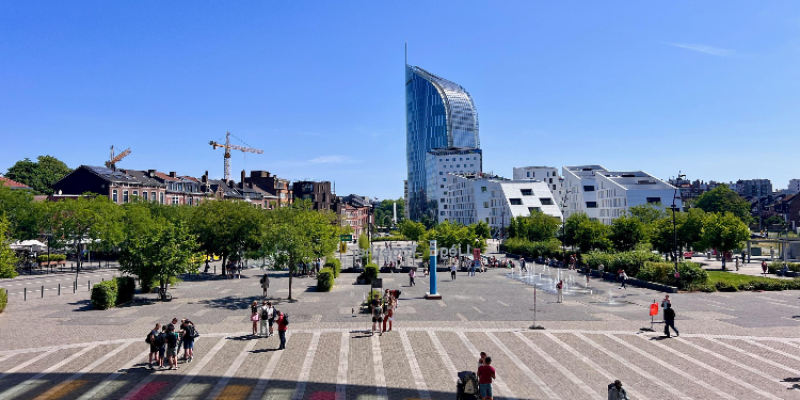
Liège draws residents from 153 nationalities, yet it operates almost entirely in French and makes no particular concession to international convenience. That contrast is the defining reality for anyone considering a move here: Wallonia's main city offers genuine affordability relative to Brussels, direct high-speed rail connections to four neighboring capitals, and a cultural and social life that punches well above its size, but it does so entirely on its own terms. The city's tram-anchored public transport network was restructured in 2025, its childcare places are under documented pressure, and its neighborhoods range from quiet residential streets on the hills to animated, sometimes rough central districts shaped by a large student population. For the right profile, Liège is a compact, affordable, and socially rewarding base; for those expecting a polished international-capital environment, its strong Walloon regional character is a genuine adjustment.
Built along the Meuse valley between wooded hills and industrial heritage, Liège is the main city of Wallonia and the reference point for French-speaking life in eastern Belgium. What strikes arrivals quickly is the contrast: grand cultural buildings and a dense, animated city center sitting alongside rougher post-industrial streets and a social atmosphere that is more convivial than curated. Those moving from larger, internationally oriented capitals will find a city with strong Walloon local identity and a French-speaking daily environment rather than a globalized professional hub, which is precisely what makes it interesting to many and demanding to others.
At its core, Liège is a compact, walkable, university-shaped city. The Université de Liège (ULiège) gives it a permanent international and student population, keeps rents and cultural life connected to everyday people, and provides one of the most direct entry points for newcomers into an otherwise locally rooted city. The Liège-Guillemins railway station connects residents to Brussels, Cologne, Paris, and Amsterdam by high-speed rail, making it a viable base for professionals who travel regularly without wanting to live in a capital.
Everyday life runs at a moderate, sociable pace. Mornings often start at local cafés or markets; evenings are animated by terraces, restaurants, and student-driven nightlife, particularly around Le Carré and Place du Marché. The rhythm is informal rather than corporate. Early adjustments most newcomers mention include navigating a predominantly French administrative and social environment, choosing carefully between very different neighborhood atmospheres, adapting to Belgium's wet and grey weather, and learning the public transport network, which was restructured around a new tram line as its backbone.
The city divides into distinct neighborhoods with genuinely different characters, price levels, and resident mixes. Choosing carefully at the start shapes nearly everything else about daily life.
The Centre historique area around Cathédrale and Saint-Lambert is the most central and walkable option, combining shopping streets, cultural venues, the main square, and nightlife in a compact area. It suits professionals and newcomers who want immediate access to restaurants, events, and daily services. Rents trend toward mid-to-high for the city. Tram stops at Saint-Lambert and Opéra serve this area directly.
Outremeuse is an island-like district east of the Meuse with a strong local identity, a mix of students and long-term residents, and an informal, neighborhood-oriented daily life. It is mid-range in price and particularly popular with students, young professionals, and expats who want character alongside easy access to the historic center. The tram passes through Outremeuse on its route between Opéra and Sart Tilman.
For frequent travelers and commuters, Guillemins/Fragnée is the most practical base. The tram runs directly through Guillemins on the main 11.7 km route, and onward connections to Brussels, Cologne, and Paris are straightforward from the station. The Parc de la Boverie is a short walk away. Rents are mid-to-high. Immediately above Guillemins, Cointe offers greener and quieter residential streets with park access and a calmer atmosphere. It suits families, professionals, and retirees who want calm while remaining close to the station.
Laveu, on the center-west side near Avroy and Guillemins, provides a neighborhood-based daily rhythm with good access to the historic center and main transport links. It is mid-range in price and suits families, professionals, and longer-stay expats who want central access without a tourist-facing atmosphere. Sainte-Marguerite, dense and central-adjacent, suits budget-conscious newcomers, students, and young professionals who want proximity to the center at lower-to-mid rents; the neighborhood is gaining attention following the planned opening of a new inclusive daycare center, Les 1000 mondes, with 28 places for children aged 0 to 3.
Saint-Léonard is an urban, mixed district in transition with a local commercial identity and some signs of regeneration. It is lower-to-mid-priced and appeals to students, budget-conscious professionals, and expats comfortable with a denser, less polished inner-city atmosphere. Longdoz/Médiacity/Vennes is more service-oriented, with shopping, student routes, and tram access; it suits students, interns, and young professionals who prioritize everyday convenience over atmosphere, at mid-range rents.
Angleur, on the southeastern side, is more residential and quieter, well placed for people whose daily life connects to the university, hospitals, or quieter neighborhood services. Mid-range in price, it suits students, families, and residents looking for a practical southern-commute base. Finally, Sclessin, at the western end of the tram corridor near the Standard de Liège stadium, is more functional and lower-to-mid in price, suited to budget-conscious residents who need tram access to the center and Guillemins rather than a central lifestyle district.
Join the Liège community
Get regular tips and advice to make the most of your expat life
Cost of living in Liège
Liège is measurably more affordable than Brussels, placing it among the most accessible urban bases in French-speaking Belgium for residents on a local or international salary. The gap with the Belgian capital is most visible in housing costs: a one-bedroom apartment in the city center runs around EUR 760 per month, while apartments outside the center average around EUR 628 per month. Actual rents vary significantly by neighborhood, floor, insulation quality, and whether utilities are included. Current listings on Immoweb are the standard reference for checking live market prices before committing to a budget.
For families with young children, the city's municipal childcare (crèches communales) uses an income-based fee scale set by ONE (Office de la Naissance et de l'Enfance): daily parental participation ranges from EUR 0 to EUR 45.57 per day, translating to a monthly range of approximately EUR 0 to EUR 1,002 across 22 care days. The rate depends entirely on household income, making public childcare genuinely free or very low-cost for lower-income families. Details and the current fee schedule are available through the Ville de Liège childcare downloads page.
Beyond rent and childcare, the TEC bus and tram network operates on a standard Wallonia fare structure, and children under 6 travel free without any pass or registration. Many residents in central neighborhoods combine walking and public transport rather than relying on a car, which meaningfully reduces monthly transport spending. By the standards of comparable Western European cities, Liège offers an accessible cost structure for professionals and students on realistic budgets.
Climate and weather in Liège
Liège has an oceanic (temperate maritime) climate: mild summers, cool winters, and rainfall spread across all months with no distinct dry season. Grey, damp weather is the baseline rather than the exception, and this is the adjustment that newcomers from sunnier parts of the world most consistently flag.
Summer daily highs reach 21-23°C in June through August, with overnight lows around 12-14°C. Occasional heatwaves push temperatures considerably higher; the station at Liège-Bierset recorded an all-time maximum of 39.5°C in July 2019. Winters are cool but not severe: daily highs stay between 5 and 6°C in December through February, with overnight lows around 1-2°C. Hard frosts are possible but not frequent.
Annual precipitation totals around 783 mm, spread across all months. August is the wettest month at 91.5 mm, followed by July and March. Expect rain in any season, along with occasional summer thunderstorms. The most comfortable months for newcomers settling in are May, June, and September, when temperatures are mild to warm and outdoor life is at its most accessible.
Flood risk is the most practically significant weather factor in Liège. The city sits at the confluence of the Meuse, Ourthe, and Vesdre rivers; the 2021 Walloon floods caused severe regional damage, and resilience works continued afterward. Before renting or buying any property near rivers, in a valley bottom, or with a cellar or ground-floor unit, check the property's flood history thoroughly.
For housing comfort, good heating and insulation matter more than air conditioning for most of the year, though increasingly intense summer heatwaves make shading and cross-ventilation increasingly useful. Prioritize properties with well-maintained central heating over those relying on electric panel heaters. For daily life: a hooded waterproof jacket handles wind better than a standard umbrella, waterproof footwear is practical year-round, and layered mid-season clothing covers much of the calendar. Keep lighter summer clothes available for hot spells.
Getting around Liège
Central neighborhoods are walkable, and the historic core has an extensive pedestrian zone. The natural circuit connecting the center, Outremeuse, Guillemins, and Parc de la Boverie on foot is how most residents orient themselves in their first weeks.
The Liège tram, launched in 2025, runs 11.7 km between Sclessin, Liège-Guillemins, the city center (Saint-Lambert, Opéra), Coronmeuse, and Bressoux. It became the backbone of the urban network after its first year of service, with bus lines reorganized around it. Newcomers should use current TEC maps rather than relying on pre-2025 knowledge of bus routes, as the network has changed substantially. The TEC app is the standard tool for planning routes and buying tickets before or after arrival.
Cycling is practical for short urban trips. The City of Liège's Vélocité program provides long-term bike rental, cycling infrastructure, secure bike boxes and shelters, and more than 5,000 bike parking spaces across the city. For on-demand rides, Uberoperates in Liège. A car is helpful for hilly neighborhoods, late nights, or less central destinations, but is not essential for central living.
Language and communication in Liège
French is the sole administrative and everyday language in Liège. The city's municipal services, including the Service des Étrangers at Potièrue 5 (the foreign residents' registration service), operate entirely in French.
English is usable in university and some international professional settings. ULiège and HEC Liège operate in a multilingual academic environment, and the university's language faculty works across English, Dutch, German, Spanish, and French. Outside these circles, however, English does not replace French for housing communication, municipal procedures, local shops, or neighborhood social life. Non-French speakers encounter a moderate to significant language barrier for everything beyond the university campus: landlords, tradespeople, local healthcare reception, and deeper social integration all default to French.
French courses available to newcomers in Liège include the Institut des Langues Modernes de Liège (ILM) at Boulevard d'Avroy 5; ISLV (Université de Liège) at Rue de Pitteurs 20, which runs evening courses once a week throughout the year with registration typically opening in August each year; SAM asbl at Quai des Ardennes 7, offering French as a Foreign Language courses; and conversation tables for non-francophones run by Laïcité Province de Liège. Le Forem Liège additionally offers professional communication modules in English, Dutch, and German for jobseekers and workers.
Communication style in Liège is generally direct and informal. Always open with bonjour when entering any shop, office, or even an elevator: this is non-negotiable social courtesy in Belgian French culture. In formal written or administrative contexts, French remains more structured. A few phrases that will immediately improve daily interactions: Excusez-moi, je ne parle pas bien français (excuse me, I don't speak French well); Est-ce que vous parlez anglais ? (do you speak English?); Je voudrais prendre rendez-vous (I would like to make an appointment); and Où se trouve le Service des Étrangers ? (where is the Foreigners' Service?).
Walloon is the regional language most associated with Liège's cultural identity. Newcomers don't need it for daily life, but they may encounter references to it at festivals, in cultural settings, and in local conversation, along with the city's distinct Liégeois accent in French.
Culture and social norms in Liège
Liège has a pronounced folklore and local celebration culture. The city's official identity is built around Tchantchès (the beloved local puppet figure), street art, the Georges Simenon literary trail, and major annual festivals including the Fêtes du 15 août, which typically runs for about 8 days centered on August 15th each year. The overall tone is convivial, informal, and festive rather than corporate or reserved.
Locals are generally open toward foreigners, but social relationships in Belgium develop through repeated contact rather than instant friendship. The most practical integration path is to build everyday French, engage with local cafés, markets, clubs, and cultural events, and allow friendships to develop over weeks and months. Social reserve in Liège operates similarly to many northern European cities: friendly but not immediately intimate, with relationships deepening through regular presence rather than first-night warmth.
In everyday settings, communication is informal and direct. Always open with bonjour; this greeting is expected in every transactional interaction. In professional and business contexts, punctuality is expected, appointments are respected, and dress tends toward smart casual rather than highly formal. When meeting someone for the first time in a professional context, lead with what you do and demonstrate competence before asking for anything; this reads better than an immediate request for favors or introductions.
Religion is present in Belgian life through the calendar but doesn't dominate daily social interaction. Belgium observes 10 statutory public holidays per year, including Easter Monday, May 1, July 21 (Belgian National Day), August 15, November 1, and December 25. Work is in principle prohibited on these days in the private sector, which affects opening hours, service availability, and the rhythm of the working week. The August 15 holiday falls within the Fêtes du 15 août and is a particularly distinctive moment in Liège's annual calendar.
Pace of life and work culture in Liège
Liège runs at a mixed rhythm: active and socially animated in the evenings and on weekends, structured and regulated during the working week. It is less corporate and internationally bureaucratic than Brussels, with a stronger Walloon and student-city identity that shapes everything from opening hours to social expectations.
Belgian working-time rules set the normal daily limit at 8 hours, with work in principle performed between 06:00 and 20:00. Liège office life generally follows a standard weekday structure: clear start and end times, a midday break, and a defined separation between work and personal time. Late-hours work culture is not the norm, and the concept of work-life balance is taken seriously by Western European standards. Remote work is a legally structured practice in Belgium, which makes Liège increasingly viable as a base for hybrid workers: shorter distances, lower rents, and direct rail access to Brussels reinforce that appeal.
Daily and seasonal life shifts visibly with the weather. Wetter and cloudier periods from autumn through early spring push social activity indoors to cafés and bars, while spring and summer bring outdoor terraces, river walks, cycling events, and festival programming. The annual Liège-Bastogne-Liège cycling race is a major marker of the spring calendar and a genuine point of local pride.
Liège takes its food seriously. The city's culinary identity is rooted in Walloon comfort food and street food: boulets à la liégeoise (meatballs in a distinctive sweet-sour sauce), Liège waffles sold warm from street stalls, local beers, microbreweries, and pèket (the local genièvre spirit) form the backbone of everyday eating and drinking culture. The Liège waffle, caramelized and sold warm at street stalls, is a completely different experience from the rectangular Brussels waffle typically seen abroad, and residents consider it a point of distinction worth knowing.
Restaurant service follows a Belgian pattern: a distinct midday lunch service and a separate evening dining service, with most kitchen closures between services. Arriving at 14:30 for lunch or at 18:00 for dinner may fall outside kitchen windows; adjusting meal timing to the local pattern is one of the small cultural adaptations that makes daily life noticeably easier.
Market culture is strong. La Batte, Liège's Sunday market running along the Meuse riverside, is one of the largest in Belgium and functions as a genuine weekly social event for residents rather than a tourist attraction, covering food, produce, clothing, and antiques. The city maintains a full calendar of weekly and seasonal markets across its neighborhoods.
Each May, the Épicuriales food festival in Parc de la Boverie brings together Liège restaurateurs, Belgian chefs, and international culinary guests for open-air dining with free entry, giving newcomers an accessible way to experience the breadth of local and regional food culture in a single event. Beyond this, the university population and the city's community of 153 nationalities support a wide range of international cuisines alongside the dominant Walloon offer.
Leisure and social life in Liège
Regular leisure in Liège centers on accessible, mostly free activities: walking the historic slopes and stairways of the Coteaux de la Citadelle (including the famous Montagne de Bueren stairway), riverside and park outings along the Meuse, Sunday market visits, food-and-drink festivals, cycling, museum visits, and café socializing. Entry barriers to most everyday leisure are low, making it straightforward for newcomers to begin participating from the first weeks.
The arts and cultural programming is unusually dense for a city of Liège's size. Liège Culture centralizes the city's theatre, festival, museum, music, and performance agenda. Major recurring events include the Week-end des Coteaux, the Festival de Promenade, the Summer BeerLovers' Festival, and the Fêtes du 15 août in August. The Orchestre Philharmonique Royal de Liège (OPRL) anchors a year-round classical music offer, and venues including La Boverie and the Grand Curtius cover visual arts and museum programming. The OPRL's SYMPHOKIDS program includes concerts for children from 6 months upward, which is a practical entry point into the city's cultural life for families settling in.
Nightlife is active and student-driven. The Carré district concentrates bars and clubs in the historic center; Thursday nights (known locally as jeudredis) are the traditional student night, and Place du Marché is a popular early-evening drinks area. The tone is convivial and informal rather than upscale; nightlife in Liège is part of the everyday social fabric, not a separate weekend event.
Spring and summer weekends are particularly active: residents combine markets, terraces, park events, museum visits, and riverside walks in a spontaneous mix. Parc de la Boverie serves as the city's main park venue for major festivals and outdoor programming. The Meuse quays and the Coteaux hillside become the primary social spaces during warmer months.
Family life in Liège
Liège is well-supported for everyday family life in practical terms: the city has municipal childcare for children aged 0-3, a dedicated Service Enfance, communal schools through the Enseignement communal liégeois (ECL), family-oriented cultural activities, and child-friendly public transport provisions. The main planning challenge is early-years childcare availability, which is under pressure across Wallonia.
Municipal public daycare centers (crèches communales) are open to children aged 0-3 and use the ONE income-based fee scale: EUR 0 to EUR 45.57 per day. Demand exceeds supply across the city: ULiège announced a new inclusive daycare center, Les 1000 mondes, opening in Sainte-Marguerite with 28 places, partly in response to documented city-wide shortages. Families with babies or toddlers should begin the childcare search before arriving, not after. The Service Enfance, Ville de Liègehandles municipal childcare coordination. Details and the current fee schedule are on the city's childcare downloads page.
The ECL network covers fundamental education and other school levels across the city, all in French. Non-French-speaking families will need to plan a language adaptation period for their children; language-learning and immersion support options exist in and around Liège.
Children under 6 travel free on all TEC buses and trams in Wallonia without any pass or registration, which is a meaningful daily benefit for families using public transport.
Beyond childcare and schools, family-oriented resources in the city include: La Ferme des Enfants de Liège (lafermedesenfantsdeliege.be), which runs nature and activity events including vacation-period programming; B3 Province de Liège at Place des Arts 1 (b3.provincedeliege.be), which programs story-time sessions and child-oriented events; and the OPRL's SYMPHOKIDS festival, which includes concerts for children from 6 months of age. For support services, the Service Appui 0-18 at CPAS de Liège (cpasdeliege.be) provides guidance for children and young people aged 0-18, including family insertion support, and Laïcité Province de Liège (laiciteliege.be) offers family workshops and children's activities across several neighborhoods.
Liège sits within normal Belgian urban safety parameters, with standard city precautions sufficient for most daily life. The city is not unusually dangerous by Belgian or Western European standards, but specific risk patterns are worth understanding before choosing a neighborhood or planning evening routines.
The main everyday risks are petty theft in busy central streets, markets, transport stops, and nightlife areas; fraudsters posing as plain-clothes police officers and demanding cash or bank card details (a documented Belgian trend that federal police statistics have flagged as rising); cybercrime and phishing; and drug-related nuisance in parts of the center, which was addressed by a national Plan Grandes Villes police operation in Liège. The city's own civic discussions in 2025-2026 explicitly included security and disorder in the center-city agenda, which reflects real local concern rather than sensationalism.
Daytime safety across most of Liège is manageable with normal urban awareness. After dark, risk becomes more situational: stay alert around nightlife concentrations, isolated streets, transport stops, and areas with visible public nuisance. Using the tram, official taxis, or Uber rather than walking alone through poorly lit streets late at night is a practical habit, not an exceptional precaution.
Useful practical habits: keep valuables out of sight in busy areas; never hand cash, bank cards, or PIN codes to anyone claiming to be a plain-clothes police officer without independently verifying the intervention through official channels; report cybercrime and phishing promptly; and assess prospective housing streets at different times of day and evening before signing a lease. Safety in Liège is highly street-by-street rather than neighborhood-wide, which makes personal reconnaissance more useful than general neighborhood rankings.
Emergency contacts: 112 is the pan-European emergency number for police, ambulance, and fire, free from any phone. 101 is the Belgian police direct line for urgent police assistance. The Police de Liège (policeliege.be) handles non-urgent matters within the city. Save both numbers before you need them.
Environment in Liège
Road traffic is the main air pollution source in Liège, and the city monitors air quality in real time through ISSeP fixed stations and municipal sensor campaigns. ISSeP opened a dedicated traffic-focused air quality station in Liège in May 2026. Residents can check current and annual air quality figures via the AwAC, ISSeP, and CELINE tools provided by the Walloon regional service: the Ville de Liège environment page links to these resources. For most residents in central neighborhoods, air quality is a background consideration rather than an immediate health issue, but it is worth checking when comparing specific street-level housing options.
Tap water is safe to drink throughout the city. CILE (Compagnie Intercommunale Liégeoise des Eaux) supplies drinking water to 24 communes in the Province of Liège, including the city, 24 hours a day, 7 days a week.
Noise levels vary significantly by neighborhood rather than being uniformly high or low. Main contributors are road and rail infrastructure and Liège-Bierset airport, a dedicated freight hub whose noise zones are officially mapped under Walloon regulation. The City of Liège prohibits outdoor noise disturbance between 22:00 and 06:00. Residents near major freight routes or under flight paths will notice the difference; checking strategic noise maps via the Service Public de Wallonie before committing to a specific address is worthwhile.
Flood risk is a serious and well-documented factor for property decisions in Liège. The 2021 Walloon floods caused severe regional damage, and Wallonia continued funding flood-resilience works in subsequent years. Always check the flood history of any riverside, valley-bottom, low-lying property, or any unit with a cellar or ground-floor level before signing a lease or purchase agreement. This is not a precaution to skip for convenience.
Green space is adequate and actively improving. The city's Plan Canopée targets 24,000 additional trees by 2032, one third in public space and two thirds on private land, with an explicit goal of reducing urban heat island effects during heatwaves. Existing green assets include Parc de la Boverie, the Coteaux de la Citadelle hillside, Parc de Cointe, and the Meuse riverside; hill and park-edge districts offer more shade and thermal comfort than heavily mineralized central streets during hot periods.
Expat community in Liège
Popular areas for internationally mobile residents include Outremeuse, the Centre historique, and the Guillemins/Boverie area for their transport links, walkability, and proximity to university and cultural circuits. Families and retirees more often look to Cointe, Laveu, and Angleur for quieter residential streets.
Service Social des Étrangers (SSE), Rue Lambert-le-Bègue 8, 4000 Liège: social and legal support, French-language and citizenship training, and intercultural activities. The SSE handled 1,929 social/legal requests in a recent year and delivered 1,287 hours of training.
Service des Étrangers, Ville de Liège, Potièrue 5: foreigner registration procedures, open Monday to Wednesday 08:30-12:30 and 13:30-16:00, Thursday and Friday 08:30-12:30.
ESN ULiège (Erasmus Student Network): city tours, cultural events, and social integration activities for international students.
APD Liège (fdss.be): specializes in asylum, family reunification, and regularization procedures, with French and citizenship training running from September to June each year.
For initial social connections beyond institutional services, the Liège Expats Facebook group is an active online community for international residents and is worth joining in the first weeks. The Meetup platform is also used by Belgium-based newcomers for weekend social events and activities. Integration in Liège tends to happen gradually and through French-language participation rather than through a ready-made expat circuit: those who invest in local presence consistently integrate faster than those waiting for an organized international scene to come to them.
The case for Liège rests on four genuine advantages. First, affordability: rent, everyday costs, and housing run measurably below Brussels, making it one of the most accessible urban bases in French-speaking Belgium for professionals and students on realistic budgets (Numbeo). Second, cultural density relative to its size: museums, festivals, the OPRL, theatre, nightlife, and year-round public events make social life build naturally without requiring expensive memberships or long commutes. Third, rail connectivity: the Liège-Guillemins station puts Brussels under 2 hours, with direct high-speed connections to Cologne, Paris, and Amsterdam, a significant practical advantage for frequent travelers. Fourth, a clear administrative infrastructure for foreign arrivals: the Service des Étrangers, the SSE, French-language courses, and the ONE childcare fee scale give international residents a clearer institutional pathway than many smaller Belgian cities offer.
The challenges are equally specific. French is non-negotiable: administration, housing, healthcare, and social integration all run on French. Non-French speakers face friction at every administrative step and slow social integration without language investment; this is the single largest barrier for non-francophone newcomers. The uneven urban environment is real: parts of central Liège, particularly around heavy nightlife concentrations and some transport nodes, have visible urban disorder and safety perceptions that are moderate rather than uniformly comfortable, making neighborhood and street choice significant. The city's oceanic climate brings rain in all seasons and persistent grey skies from autumn through spring, which is the most consistent environmental adjustment reported by newcomers from sunnier climates. Finally, the post-2025 transport transition means newcomers cannot rely on prior knowledge of the bus network; learning the tram-centered TEC system takes time and is a common early practical frustration.
Liège suits French-speaking professionals and self-employed newcomers who want a lively Walloon city at lower cost than Brussels; students and researchers linked to ULiège or HEC Liège; families and retirees who value cultural richness in a compact, manageable city; and people who enjoy local food identity, informal social life, and outdoor urban culture. It suits less well those who cannot or will not adapt to French-language administration and social life, people highly sensitive to visible urban disorder in central areas, commuters who need a simple fixed transit routine from day one, and those seeking a large, globally networked, international-capital environment.
Have questions about moving to Belgium? Join the Expat.com community to connect with expats who have been through the process.
Frequently asked questions
Liège suits self-sufficient independent workers who want an affordable, lively Walloon city rather than a polished international hub. Strengths include walkable central neighborhoods, cafés, excellent rail connections to Brussels, Cologne, Paris, and Amsterdam, a university atmosphere, and housing costs well below Brussels. The city has a smaller dedicated coworking ecosystem and a limited English-speaking professional scene, making basic French useful for daily errands outside work. It is better suited to workers who can operate independently than to those needing a large nomad-and-startup infrastructure.
Liège is an entirely French-speaking city. Municipal services, housing paperwork, local shops, healthcare, and neighborhood social life all operate in French. English is useful in academic and some international professional settings but is not sufficient for administration, renting, or genuine social integration. Spanish speakers do have a practical advantage when learning French, given the shared Latin roots between the two languages.
Liège is affordable by Western European standards but still requires a realistic Belgian-level budget. One-bedroom city-center apartments run around EUR 760 per month, while outside the center the figure drops to around EUR 628. Beyond rent, budget for utilities, food, TEC transport costs, Belgian health insurance, and heating bills, which can be significant during the long grey winters. Household size, neighborhood choice, and lifestyle are the biggest variables, and a family with childcare costs needs considerably more than a single person living centrally.
Safety in Liège is highly street-by-street rather than neighborhood-wide, so the name of a district alone is not a reliable guide. Cointe, Laveu, Guillemins and Fragnée, and the quieter parts of Outremeuse are consistently comfortable choices for newcomers. The most uncertain safety conditions concentrate around the central nightlife areas and some denser inner-city streets. Always visit your prospective street after dark before signing a lease, and assess building security, lighting, and street activity directly.
Liège is more convincing as a medium- or long-term base than as a short-stay destination. Its appeal builds through routine: markets, cafés, river walks, neighborhood habits, local friendships, and direct high-speed rail access to Brussels, Cologne, Paris, and Amsterdam. Short stays can feel gritty or uneven, while longer stays reveal its informal, sociable, and strongly local character alongside its genuine affordability advantage over Brussels.
The most common surprise is the contrast between Liège's warmth and spontaneity on one side and its rough post-industrial edges on the other. Many newcomers expect a smaller, quieter city and find instead a dense urban rhythm, a strong local Walloon identity, active student-driven nightlife, and an entirely French-speaking daily environment. The city's cultural calendar and food scene are also richer than most expect for a city of its size. It rewards people who value authenticity and local character over international gloss.
Foreigners can rent in Liège, but the process is smoother with proof of income, valid identity documents, access to a Belgian bank account, and the ability to communicate in French. The market is less expensive than Brussels, but well-priced apartments in central areas move quickly. Landlords prefer applicants with stable local income or a guarantor. Prepare your documents before viewings and never transfer money without seeing a legitimate lease and visiting the property in person.
The main downsides are the French-language requirement for all administration and daily life; uneven neighborhood quality, with some central areas showing visible urban disorder; persistent grey, damp weather for much of the year; a smaller international job market and professional network than Brussels; and the learning curve following the 2025 restructuring of the TEC bus and tram network. People expecting a polished expat environment or a large English-speaking bubble will struggle, while those who appreciate authentic local urban life adapt well.
Liège does not have a large self-contained expat bubble, so most foreigners integrate gradually through work, university, children's schools, sports clubs, neighbors, or local cafés rather than exclusively through expat networks. French speakers integrate fastest; non-French speakers often rely initially on international university or workplace contacts before branching out. Most longer-term residents describe integration as achievable but requiring deliberate effort to move beyond transient international circles. The city actively rewards consistent local presence.
ℹ️
We do our best to provide accurate and up to date information. However, if you have noticed any inaccuracies in this article, please let us know in the comments section below.
I fell in love with words at an early age After a break to focus on my studies, I rediscovered the joy of writing while keeping a blog during my years between London and Madrid. This passion for storytelling and for exploring new cultures naturally inspired me to create Expat.com, a space for my own reflections as well as for anyone wishing to share their experiences and journeys abroad.