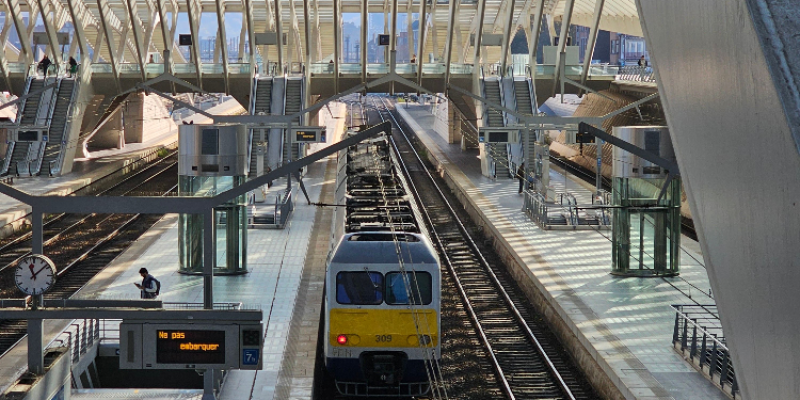
You've arrived at Liège-Guillemins and need to figure out how to get across the city. Belgium's newest urban tram line stops right outside the station, running every 5 minutes at peak hours along a single 11.7 km route that links the city's main transport, employment, and leisure nodes. What catches many newcomers off guard is the ticketing: on-board purchase is not available on the tram or the high-frequency bus lines, so you need a ticket activated before you board. Downloading the TEC app before your first journey is the single most practical first step. Liège's network combines that tram with a bus system covering the neighborhoods off the tram route, SNCB suburban trains, and, for anyone mixing both, a City Pass subscription that covers all of them within the urban zone.
Two systems cover the vast majority of daily journeys in Liège: the TEC tram and bus network, operated under the LETEC brand by the Opérateur de Transport de Wallonie, handles in-city trips, while SNCB trains connect the main stations for cross-city and suburban routes. The central interchange for both is Liège-Guillemins, where the main rail station, the tram stop, and the TEC bus terminal are all co-located. For a newcomer, that triangle at Guillemins is the single most useful reference point in the city.
Walking covers the dense city center well, and cycling is increasingly practical along the Meuse and Ourthe river paths. Drivers coming from outside the city have access to park-and-ride lots (P+R) at the periphery, where they can leave their car and continue into the center by tram, train, or bus.
Before your first commute, download the TEC app (available from the App Store, Google Play, or letec.be): it covers route planning, timetables, and ticket purchase for buses and the tram across the TEC network. If your routine also involves SNCB rail trips, set up the SNCB app or website in parallel. The two systems are not merged into a single app, so rail and local TEC trips require separate planning tools unless you hold a City Pass Liège subscription covering both. The core transport interfaces, including the TEC app, the SNCB website, and the City Pass, are usable in English; detailed municipal notices and disruption alerts are most complete in French, so a translation tool is worth having on hand.
Buses cover the parts of Liège not served by the tram: residential neighborhoods, hillside areas, and outer districts where the tram line does not reach. The network runs from 05:00 to 01:00, seven days a week, with no service after that window. Lines include standard routes alongside higher-frequency BUSWAY and Connect services.
Key destinations reachable by bus include Liège Airport and its adjacent industrial zone, the Hauts-Sarts industrial zone, the CHC hospital center, the University of Liège, and the Liège University Hospital (CHU). TEC line 41 extends to the Sart-Tilman university campus, supporting a rail-bus link from Guillemins for students and staff commuting between those two points.
Buses are fully integrated with SNCB trains through the City Pass Liège subscription, which covers unlimited travel on SNCB rail and TEC buses within a defined Liège urban zone. The stations in that zone include Liège-Guillemins, Liège-Carré, Liège Saint-Lambert, Angleur, Chênée, Bressoux, and Sclessin. A single TEC bus journey costs EUR 2.80 when pre-purchased; the ticket options and where to buy them are covered in full in the fares section below.
Good to know:
On-board ticket purchase is not available on BUSWAY lines, so pre-purchasing via the TEC app or a vending machine before boarding is essential on those routes.
Join the Liège community
Get regular tips and advice to make the most of your expat life
The Liège tram
Opened recently as the city's new urban backbone, the Liège tram runs a single 11.7 km route with 23 stations, linking Sclessin/Standard in the southwest to Bressoux/Liège Expo in the northeast. Along the way, it stops at Liège-Guillemins, the city center stations of Opéra/République Française and Saint-Lambert, and Coronmeuse. Think of it as a single modern corridor rather than a city-wide network: it is fast and frequent along that west-to-east spine, but buses are what you need for destinations off that line.
At peak hours, a tram runs every 5 minutes (the city's target is one every 4 minutes 30 seconds); off-peak the gap widens to 8 to 15 minutes. Service runs from 05:00 to 01:00, Monday through Sunday. Expect crowding at Saint-Lambert, Guillemins, Avroy, Leman, Standard, and Opéra during morning and evening rush hours: the line carries up to 5,000 passengers per hour at its busiest stations. Each vehicle holds up to 310 passengers, and all stations on the core corridor are step-free, making the tram the most accessible urban transport option in the city. Door-to-door accessibility beyond the tram itself depends on which connecting bus stop or route you use.
Regarding fares, the tram is fully integrated into the TEC system: a single journey costs EUR 2.80, and tram travel is included in all TEC multi-trip products, day passes, and monthly or annual subscriptions, as well as the City Pass Liège combined train and TEC product. Crucially, on-board emergency ticket purchase is not available on the Liège tram, unlike some other TEC routes where a EUR 3.30 on-board ticket is possible. Buy or activate your ticket before you board.
How to pay for transport in Liège
The current TEC fare structure applies network-wide: a single CLASSIC ticket costs EUR 2.80 and is valid for 90 minutes on any TEC service except Express lines. There is no longer an urban-zone surcharge specific to Liège. For occasional travel, that EUR 2.80 single ticket is the starting point; for anyone making more than a handful of weekly journeys, the Multi6 pack at EUR 13.40 for 6 trips brings the per-journey cost down to EUR 2.25. A day pass costs EUR 6.00 and covers unlimited TEC travel for 24 hours, making it worthwhile on any day when you plan 3 or more trips.
Regular commuters have a straightforward choice: a monthly TEC subscription costs EUR 42 for adults aged 25 to 64, and an annual subscription costs EUR 420. Buying the annual pass locks in the price for 12 months but saves nothing over paying monthly. For travelers aged 18 to 24, TEC's annual Express subscription is sharply discounted to EUR 12 per year; the City Pass Liège youth fare, which combines SNCB rail and TEC, costs EUR 15.70 monthly or EUR 157 annually for that same age group. Passengers aged 65 and over pay EUR 12 per year for the Express annual subscription; those holding BIM status (Belgium's low-income health insurance benefit) travel free.
The City Pass Liège is the most practical product for anyone whose daily routine mixes the tram with SNCB suburban trains: it covers unlimited travel on both systems within the Liège urban zone and is sold through the SNCB website and ticket offices, with renewals available at SNCB vending machines. Beyond the City Pass, all TEC tickets and subscriptions can be bought via the TEC app, the TEC e-shop at letec.be, ESPACES TEC customer offices, and self-service SELF vending machines. Some products require a MOBIB card, the Belgian transit smart card; a personalized MOBIB card costs EUR 6.00 to issue. An anonymous MOBIB basic version is also available at sales points. Bank-card contactless payment directly at TEC validators is not yet operational; pre-purchase remains the only reliable option until that feature launches.
Taxis and ride-hailing in Liège
Traditional taxis can be hailed at taxi ranks across the city, booked by phone through operators such as Taxis Bleus Liège, or requested via app. Uber operates in Liège and accepts cashless payment through its app. Both options work best as a backup: for late-night arrivals after the 01:00 TEC cutoff, heavy luggage, routes outside the tram and bus network, or disrupted service. If you expect to rely on app-based rides frequently from a specific address, test availability at your actual home and work address and times before committing to housing in a less central area.
Cycling and walking in Liège
The flat, riverside areas of central Liège are straightforward on foot. The city is actively redesigning streets to prioritize pedestrian infrastructure and has set a long-term target to reduce car traffic in the hyper-center by around 35%, so walking conditions in the center are set to improve progressively. Expect construction detours around ongoing mobility projects, and steeper terrain once you move away from the valley floor.
Cycling is realistic for commutes that follow the Meuse and Ourthe river paths, the mapped cycling zones (a downloadable plan is available at liege.be), and new cyclo-pedestrian links such as the footbridge near Fragnée. The off-road RAVeL network, Belgium's system of low-traffic and off-road routes mapped for both leisure and commuting use, offers the safest surface for regular riders. Away from those paths, cycling is more variable: the network is still expanding project by project rather than forming a fully continuous protected grid, and roads shared with heavy traffic or disrupted by construction require more caution. An e-bike makes a practical difference for hillside or cross-city routes outside the valley. For a first commute by bike, test the route outside peak hours and favor river paths and cycle-zone routes over main roads. Belgium's national Be Cyclist 2.0 plan also recommends registering your bicycle on the MyBike platform as a theft-prevention measure, comparable to registering a bike with a national theft registry at home.
For long-term bike rental, the city's Vélocité program (operated with Pro Vélo ASBL) offers a standard city bike for 6 months from EUR 50 and an electric-assist bike for 6 months at EUR 300. Both standard and e-bikes are available, making it a practical way to start cycling without buying immediately. Short-term rental is available through Point Vélo Liège, which rents equipped city bikes for adults and children by the half-day, day, or longer. Visitor bike rental is also available through Liège à Vélo at the Tourist Office, at the Point Vélo desk at Liège-Guillemins station, and at selected hotels, with day rental starting from around EUR 6. CycloLibre (Rue Saint-Pholien 12, 4020 Liège) sells second-hand and reconditioned bikes for those who prefer to buy outright.
Driving in Liège
A car makes the most sense in specific situations: residents in hillside or outer neighborhoods with weak transit links, shift workers traveling after 01:00 when TEC service ends, and families managing school runs or shopping across multiple stops. For central living near the tram or a frequent bus line, a car often creates more problems than it solves. Liège experiences moderate urban congestion at peak hours, and the city's own mobility plan frames central car access through alternatives rather than treating private driving as the default mode.
On-street paid parking costs EUR 1.50 per hour during charged periods; a flat EUR 6.00 day ticket ("sans souci") is available for a full day of on-street parking. The city uses resident-only spaces, paid zones, and scan-car enforcement: automated plate-reading vehicles patrol paid zones continuously, similar to ANPR systems used in many city centers abroad. Check the category of any space before leaving your vehicle to avoid a fine. Off-street car parks typically cost between EUR 6 and EUR 12 per day. Residents needing a street parking subscription can apply for one at the following rates: EUR 150 for 3 months, EUR 300 for 6 months, EUR 450 for 9 months, or EUR 600 annually.
For drivers making occasional trips downtown or commuting from outside the city, the most practical approach is to use one of the park-and-ride lots (P+R) at the city's periphery, then continue into the center by tram, train, or bus. Newcomers settling near the center, a tram stop, or a rail station are generally better off testing life without a car first; buying or keeping one becomes more justified once a specific commute or routine proves genuinely awkward by public transport.
The river shuttle in Liège
Running seasonally on the Meuse, La Navette Fluviale is a hop-on/hop-off river shuttle connecting 6 central stops: La Boverie, Liège-Guillemins, the pedestrian center, Place Saint-Lambert, Place du Marché, and Grand Curtius. Tickets start from EUR 1. It is practical for specific riverside trips, particularly crossing between the quays or reaching La Boverie from Guillemins, but operates seasonally and should be treated as a supplement to the TEC network rather than a commuting backbone.
Before planning your route, confirm which airport you are actually arriving at: Liège Airport (Bierset, LGG, west of the city), Brussels Airport-Zaventem (BRU, the national hub roughly 90 km away), and Brussels South Charleroi Airport are three distinct airports that are commonly confused by newcomers booking flights to the region. Each requires a different onward route.
From Liège Airport (Bierset), TEC bus line 53 connects the airport terminal to Liège-Guillemins station via Bierset and Mabotte, continuing into the city center TEC network. Buy a standard TEC CLASSIC ticket (EUR 2.80) before boarding.
From Brussels Airport-Zaventem, take an SNCB train directly toward Liège-Guillemins; the journey takes approximately 1 hour. An SNCB Brussels Airport Supplement of EUR 6.90 per journey applies when your ticket does not already include it; check at the time of purchase. Tickets are available via belgiantrain.be or at SNCB ticket machines and offices at the airport.
Frequently asked questions
Install the TEC app before your first trip and use the tram for the central west-to-east corridor, which runs from Sclessin through Liège-Guillemins and Saint-Lambert to Bressoux. For destinations off the tram route, TEC buses cover residential neighborhoods, hillside areas, and outer districts. If your commute combines local TEC trips with suburban rail, set up the SNCB app in parallel and consider a City Pass Liège subscription, which covers both networks within the Liège urban zone.
For central and corridor commutes, yes. The tram recorded over 12 million journeys in its first year of service, with peak-hour frequencies of every 5 minutes. Bus reliability varies by line, so check the TEC app before your first commute, particularly during strikes or engineering works, rather than assuming full service at all times.
Yes. On-board ticket purchase is not available on the tram or BUSWAY lines, so you must buy or activate a ticket before boarding. Download the TEC app to purchase tickets digitally, or visit a TEC SELF vending machine or ESPACES TEC customer office. Some TEC subscription products require a MOBIB card, which costs EUR 6.00 to issue if you do not already hold one.
Liège has no metro. Plan your commute around the TEC tram, which serves 23 stations on a west-to-east corridor, and TEC buses, complemented by SNCB trains for station-to-station trips. The term "metro" appears in Wallonia's general TEC communications but does not refer to a Liège underground line.
Uber operates in Liège but is not a reliable substitute for the TEC network. Use ride-hailing as a backup for late-night arrivals, luggage-heavy journeys, or routes outside TEC coverage. If you plan to rely on app-based rides from a specific address, test availability at your actual home and work locations and at the times you need them before finalizing your housing choice.
Walking in the flat city center and along the Meuse is comfortable, and the city is actively redesigning streets to prioritize pedestrians. Cycling is realistic on the RAVeL riverside paths and mapped cycle zones but more demanding on hillside routes; an e-bike makes a significant difference outside the valley. The cycling network is still expanding project by project, so conditions vary by route. Long-term bike rental through Vélocité starts from EUR 50 for 6 months for a standard bike.
Walking is free and often fastest for short central distances. For regular TEC users, the Multi6 pack at EUR 13.40 for 6 trips works out to EUR 2.25 per trip, which is cheaper than a single ticket at EUR 2.80. A monthly TEC pass at EUR 42 offers the best value for daily commuters, and the City Pass Liège starts at EUR 15.70 per month for those aged 18-24 who also use SNCB suburban trains.
Daily commuting typically combines the TEC tram or bus for in-city trips, SNCB trains for station-to-station journeys, and walking in the dense center. A car remains practical for hillside or suburban destinations with limited transit coverage. The most practical combination depends largely on whether your home and workplace sit near the tram corridor, Liège-Guillemins, Liège-Saint-Lambert, or a frequent TEC bus route.
Not immediately for central residents: try Liège without a car first if you live near the tram, a rail station, or a frequent bus line. A car becomes more useful once a specific commute, school run, or shift schedule proves genuinely difficult by public transport, particularly for hillside neighborhoods or travel after 01:00 when TEC service ends. On-street parking costs EUR 1.50 per hour or EUR 6.00 per day; a residential parking subscription runs EUR 600 per year.
From Liège Airport (Bierset): TEC bus line 53 runs to Liège-Guillemins station; a standard TEC CLASSIC ticket costs EUR 2.80. From Brussels Airport-Zaventem: take an SNCB train to Liège-Guillemins, a journey of approximately 1 hour; allow for the EUR 6.90 Brussels Airport Supplement if it is not already included in your ticket. Always confirm which airport you are arriving at before planning your route, as Liège Airport, Brussels Airport-Zaventem, and Brussels South Charleroi Airport are three distinct locations.
ℹ️
We do our best to provide accurate and up to date information. However, if you have noticed any inaccuracies in this article, please let us know in the comments section below.
I fell in love with words at an early age After a break to focus on my studies, I rediscovered the joy of writing while keeping a blog during my years between London and Madrid. This passion for storytelling and for exploring new cultures naturally inspired me to create Expat.com, a space for my own reflections as well as for anyone wishing to share their experiences and journeys abroad.