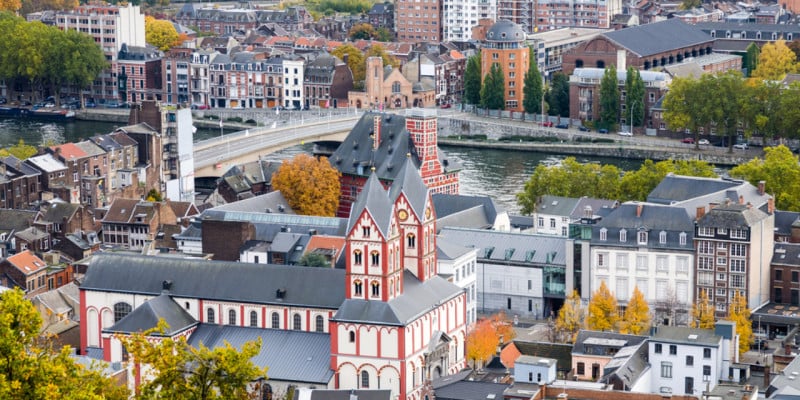
Liège sits within easy reach of Luxembourg, the Netherlands, and Germany, and its proximity to three language regions might suggest a multilingual labor market. In practice, French is the working language for the overwhelming majority of local employers. That said, the city's economic mix is broader than its industrial reputation implies: the University of Liège, CHU de Liège, a cargo airport that supports around 12,000 jobs in logistics and freight, and a cluster of international manufacturers including ArcelorMittal, FN Herstal, and Umicore all create real openings for foreign professionals with the right sector background. Salaries in Liège go further than comparable pay in Brussels or Antwerp because housing costs are meaningfully lower, which shifts the financial calculation for anyone weighing where in Belgium to build a career.
Services dominate the city's economy, but Liège's institutional and industrial employers are what create the most practical entry points for newcomers. The city hosts around 11,500 active companies, covering roughly one third of the active businesses across the wider Liège district. Professional employment, however, concentrates visibly around a set of large organizations and three distinct urban zones, which makes it easier to target a search from the outset.
The University of Liège (ULiège) and the CHU de Liège university hospital are two of the city's largest single-site employers, together covering academic research, clinical healthcare, administration, and technical support roles. The City of Liège itself employs around 3,000 staff across municipal services. On the private-sector side, the industrial presence includes internationally recognized names: AB InBev, ArcelorMittal, Umicore, FN Herstal, Techspace Aero, EVS Broadcast, AMOS, and Eurogentec all have operations in or around the city. For professionals in advanced manufacturing, aerospace, or life sciences, these companies represent the most direct corporate entry points.
Beyond manufacturing, the logistics sector is among the most active in the region. The cargo network around Liège Airport, located just outside the city boundary, supports around 12,000 jobs in freight and air operations and draws a wide range of operational, technical, and management profiles. For newcomers with a supply chain or logistics background, this cluster is worth targeting alongside central city employers.
The sectors most accessible to foreign professionals are industry and advanced manufacturing, logistics and supply chain, healthcare and hospital-linked roles, university research, energy and engineering, IT and software, and international business services. Professionals with experience in logistics, life sciences, fintech, or research tend to find entry easier through international-facing employers or ULiège research vacancies than through local SME channels, where roles are advertised almost exclusively in French and move quickly through established local networks.
Professional and office employment concentrates in three practical areas. Central Liège groups services, institutional headquarters, and public administration. The area around Liège-Guillemins station has attracted regional banking and professional services: BNP Paribas Fortis chose The Hub, directly beside the station, for its new regional headquarters. The Longdoz/Médiacité district houses audiovisual and broadcasting operations, centered on the RTBF facilities and the Pôle Image de Liège, making it the right area for professionals in media and creative industries. BluePoint Liège on the Quai des Vennes, on the banks of the Ourthe river, operates as a business and conference center used by consultants and companies looking for a first professional base in the city.
Professionals from outside the European Economic Area need their employer to obtain a work permit B before starting employment in Wallonia. Wallonia publishes salary thresholds that employers must meet for each permit category; these thresholds were revised from January 1, 2026. Non-EEA candidates should review those thresholds early in the process to confirm whether a specific salary offer qualifies before the permit application is initiated.
The first practical step for any job seeker in Liège is registering with Le Forem, the public employment service for Wallonia. Le Forem covers vacancies in Liège province, shortage-occupation listings, training pathways, and EURES-linked opportunities. For candidates targeting shortage occupations on Wallonia's official list, registering with Le Forem and applying through those channels tends to shorten the search considerably compared to general platform searches.
For roles within the City of Liège's institutional network, the municipal jobs portal lists vacancies from the city and its partners. Applications are handled in French, and this channel is the primary route for public-service and local-project roles within Liège.
EU and EEA candidates searching from another European country before relocating should start with EURES, which aggregates vacancies posted by public employment services across the EU, including Belgium. It is the most direct cross-border search tool available before arrival in the city.
For bilingual, corporate, IT, university, and international-company roles, LinkedIn Jobs is the most practical platform. It also provides direct access to recruiters and major Liège employers without going through an intermediary. Three generalist recruitment agencies operate locally and regularly post logistics, HR, administrative, electrical, and technical vacancies: Jobmatch Liège, Randstad Liège, and Tempo-Team Liège. None state nationality restrictions. Because many Liège job postings circulate through these intermediaries rather than appearing on direct employer pages, registering a profile with all three alongside Le Forem covers a significant share of the local market that would otherwise be missed.
Newcomers with a migrant background who have marketable skills but no established local network can turn to PrimoWork Liège, a digital matching platform that connects foreign-born candidates with Liège employers and provides intercultural support through the selection process and into employment.
In-person contact still carries real weight in Liège's hiring environment. The Cité des Métiers de Liège is a free career guidance and orientation service physically located in the city, connecting individuals with training providers, employers, and public employment partners. It is a useful first stop for first-time job seekers or career changers who need structured entry rather than only platform searches. Talentum Liège, an annual in-person job fair held in late November, offers direct contact with companies, on-site CV submissions, and the chance to move past the trust gap that purely online applications leave for newcomers without a local professional track record.
French is the practical working language for the vast majority of Liège employers, which shapes where a realistic search should begin. Bilingual French-English profiles carry a clear advantage in corporate, university, and customer-facing roles. English alone is sufficient mainly in research, some IT positions, logistics operations, and international-company environments. Preparing aFrench CV and a cover letter (lettre de motivation) is advisable even when targeting employers that operate in English, since HR administration and internal procedures almost always run in French. Belgian employers expect a standard international CV format. Larger institutional employers, including ULiège and CHU de Liège, use structured online application portals; smaller firms and agencies accept applications by email or through agency profiles.
Plan financially for a search lasting between 3 and 10 months unless you arrive with a signed contract or an internal company transfer in place. Candidates applying through shortage-occupation channels or sector-specific agencies typically move faster than those relying on general platforms alone.
Get regular tips and advice to make the most of your expat life
What salaries and benefits are like in Liège
Belgium'snational minimum wage stands at EUR 2,233.61 gross per month, applying to all workers regardless of nationality. In practice, most professional roles in Liège pay well above this floor because sectoral collective agreements (barèmes salariaux) set higher minimums for each industry. The national benchmark for full-time employees across all sectors runs to around EUR 4,420 gross, with higher-paying sectors such as chemicals and pharmaceuticals averaging around EUR 5,262 at mid-level. Salaries in Liège go further than equivalent pay in Brussels or Antwerp because housing costs in the city are lower, giving a Liège package more purchasing power than the gross figure alone suggests.
Belgian pay operates differently from what many professionals moving from the United Kingdom or the United States expect. Health insurance, most pension contributions, and sickness coverage are embedded in the mandatory social security system rather than negotiated as separate benefits. The employee social security contribution stands at 13.07% of gross salary, deducted before income tax. Take-home pay from a Liège salary involves two main deductions in sequence: social security first, then income tax on what remains. Comparing gross Belgian salaries against gross figures from countries where private health insurance and pension schemes are employer-negotiated separately will understate how the compensation structure differs in practice.
Pay is issued monthly, and wage levels across most sectors are governed by wage indexation: automatic adjustments tied to the national consumer price index. This means salary increases are largely rule-driven by the sector's collective agreement rather than purely at an employer's discretion. Understanding which sectoral barème applies to a given role is therefore as important as direct salary negotiation.
Non-EEA nationals should note that Wallonia's salary thresholds for work permit B eligibility apply from the employer's side: the offer must meet those thresholds for the permit to be granted. These thresholds were updated from January 1, 2026.
On top of base salary, a standard Belgian employment contract typically carries several extras, though these vary by sector and employer rather than being universally required by law. When evaluating an offer, confirming the presence or absence of each of these extras in writing can meaningfully affect total compensation. Common additions include:
Meal vouchers (chèques-repas)
A transport allowance
A remote-work allowance
A year-end or 13th-month bonus (set by sectoral collective agreement, not universal law)
A training budget
Hospitalization insurance
A role offering a lower base salary but strong meal vouchers, full hospitalization coverage, and a guaranteed sector bonus can compare favorably against a higher-headline contract that includes none of those elements. Confirming all extras in writing before signing is standard practice.
Classic expatriate packages covering housing allowances, school fees, and annual flights are not a standard feature of the Liège labor market. They occur mainly in senior intra-company transfers or specialist international assignments. Most newcomers arriving on a locally hired contract should focus negotiations on base salary, mobility budget, meal voucher rates, remote-work terms, and bonus structure rather than expecting an expat package.
Statutory leave entitlements apply to all employees regardless of nationality: 20 working days of paid annual leave plus 10 legal public holidays per year. From the first day of illness, employees with at least one month of service receive guaranteed salary paid by the employer. After that period, sickness benefits transition to the worker's mutualité (health fund) at 60% of capped gross salary. Maternity leave runs to 15 weeks; birth leave for fathers and co-parents stands at 20 days within four months of the birth, with the first 3 days paid in full by the employer and the remainder covered by the mutualité at 82% of gross salary.
Work culture in Liège
The standard working week in Belgium is 38 hours, and punctuality is a baseline expectation across all sectors in Liège. What varies significantly is the degree of formality: public bodies, universities, and large institutional employers run on structured, written decision-making processes, while smaller firms tend to be more direct and relationship-based. The difference matters for how agreements are confirmed, how quickly things move, and how you communicate day to day.
French is the dominant working language across local administration, most Liège companies, the healthcare system, and most service environments. Local SMEs expect working French from the first week. International employers, ULiège research teams, and some logistics or tech roles operate partly in English, but even in these settings French is necessary for HR procedures, colleagues, and everyday integration. English opens a door in international and research environments; it does not replace French for the administrative and social dimensions of the job.
Professionals accustomed to highly informal, first-name-from-day-one workplace cultures may find the written formality of Belgian institutional employers more structured than expected, particularly in public administration and academic settings. Smaller Liège firms often have a warmer, more direct style; even so, the habit of confirming decisions, schedules, pay arrangements, remote-work days, and reporting lines in writing remains important throughout. Belgian collective agreements and employer obligations carry legal force, and written records matter in any dispute.
Remote and hybrid work exists in Liège for office, administrative, IT, research, and consulting roles. Around 9 in 10 Belgian companies currently offer some form of remote work, though more employers are tightening office-presence requirements. Healthcare, logistics, retail, hospitality, and site-based roles are not remote-compatible. When evaluating an offer that includes remote work, ask explicitly how many days on site are required, whether the arrangement is contractual, and how after-hours availability is handled. Belgian workers have a legally protected right to disconnect outside working hours.
Business casual is a safe default for interviews and office roles across Liège. Technical, university, creative, and logistics environments tend to be more casual; client-facing, public-administration, and management roles lean toward more polished presentation. Err on the side of business casual until the specific workplace culture becomes clear from direct experience.
Good to know:
In-person networking through local institutions remains effective in Liège, particularly for newcomers without a Belgian professional history. The Cité des Métiers de Liège organizes contacts between companies, training bodies, schools, and employment partners and is open to anyone seeking professional guidance.
Getting to work in Liège
Liège's compact urban core makes car-free commuting genuinely viable for workers based in or near the city center, even though the private car remains the dominant mode for home-to-work travel in Belgium as a whole. For newcomers living near central Liège or Guillemins, the actual share of car-free commuters is meaningfully higher. The most practical decision on arrival is not whether to own a car eventually, but whether to commit to one before the exact workplace location and route are confirmed.
The city's tram line, now in its first full year of service, has become the main public-transport spine for daily commuters. TEC, the Walloon transit operator, reorganized its bus network to complement the tram, adding 11% more places per kilometer across the city and improving bus-tram connections. For workers based in or near the center, the tram and main TEC bus lines are the most reliable car-free option within Liège. Peak pressure on both public transit and the road network runs before 09:00 and between 16:00 and 18:00; building those windows into daily planning, and allowing extra time when crossing the city at those hours for interviews, avoids the most common arrival problems.
Liège-Guillemins station is the most practical base for newcomers. It is Liège's main rail gateway, with direct connections to Brussels in around one hour, as well as to Namur, Maastricht, and Luxembourg. Workers whose roles involve intercity travel or cross-border assignments should prioritize proximity to the station when choosing where to live. For those attending interviews across different parts of the city, the area around Saint-Lambert, Opéra, and Cathédrale offers the densest concentration of tram and bus stops and the most flexibility. The Fragnée/Blonden neighborhood offers a useful balance: it sits close to Guillemins, has access to the Meuse riverfront and Parc de la Boverie, and provides a quieter residential feel suited to hybrid workers who value both outdoor access and rail connectivity.
Cycling and walking are realistic for short central trips and routes along the Meuse riverside, but are less dependable as a complete commuting strategy for the whole city. Liège's hills, the distance between some major employer zones (notably the university campus at Sart Tilman and the industrial areas outside the center), and variable cycling infrastructure mean the actual terrain of the route determines whether cycling is practical. The most reliable approach is to settle near a tram, rail, or main bus corridor first, then test the cycling route once the exact workplace and schedule are known.
Avoid committing to a car in the first month unless the confirmed job is in an industrial zone, a logistics park, or an out-of-city location. For roles in the center, the Guillemins area, or at ULiège's central buildings, public transit is simpler and removes parking costs from the equation.
Good to know:
A monthly or annual SNCB rail pass can reduce commuting costs significantly for anyone traveling by train more than a few days a week. TEC and SNCB each operate their own apps and ticketing systems, with different validation rules per mode; familiarizing yourself with both before the first day avoids common first-week errors at the gate.
Have questions about working in Liège and want to connect with expats who have navigated the local job market? Join the Expat.com community to share experiences and get firsthand advice.
Frequently asked questions
The Liège job market is active but competitive. Demand is strongest in logistics, healthcare, technical trades, research, and public services. French is the working language for the vast majority of roles; English opens doors mainly in research, logistics operations, international companies, and some tech or life-sciences positions. Candidates targeting shortage occupations listed by Wallonia's public employment service tend to move through the hiring process faster than those applying to general roles.
The strongest sectors are logistics and transport, anchored by the Liège Airport cargo operations, which support around 12,000 jobs in the wider metropolitan area. Healthcare and life sciences, higher education and research, advanced manufacturing and engineering, public services, and audiovisual and creative industries are also significant. Energy and aerospace have major employers in the region, including Techspace Aero and AMOS.
Liège does not have a single central business district. The practical employment zones are central Liège for services and public administration; the Liège-Guillemins station area for banking, headquarters, and professional services; Longdoz/Médiacité for audiovisual and media; and the Quai des Vennes area for meetings, events, and flexible workspace. The Liège Airport cargo operations sit outside the city boundary but constitute a major regional employment base.
The largest employment concentrations are the University of Liège (ULiège), CHU de Liège university hospital, the City of Liège with around 3,000 municipal staff, and the Liège Airport cargo ecosystem with around 12,000 jobs in logistics and freight. Major private-sector employers with a Liège presence include AB InBev, ArcelorMittal, Umicore, FN Herstal, Techspace Aero, EVS Broadcast, and Eurogentec.
Register with Le Forem, Wallonia's public employment service portal, as a first step: it covers local vacancies, training pathways, and shortage-occupation guidance for the province of Liège. Apply directly through employer portals at ULiège, CHU de Liège, and the City of Liège for institutional and public roles. LinkedIn is the main channel for bilingual, corporate, and international-company positions. If you have a migrant background, PrimoWork Liège provides structured entry and employer mediation. Prepare both a French and an English CV, and attend in-person events like the annual Talentum Liège job fair to meet recruiters directly.
Belgium's national minimum wage stands at EUR 2,233.61 gross per month, but most professional roles pay above this floor because sectoral collective agreements set higher minimums by industry. The national average for full-time employees across all sectors is around EUR 4,420 gross per month, with the chemical and pharmaceutical sector averaging around EUR 5,262 at mid-level. Salaries go further in Liège than in Brussels or Antwerp because housing costs are lower. Meal vouchers, transport allowances, and year-end bonuses are common extras that add meaningful value on top of the base salary.
French is the dominant working language, and written confirmation of schedules, pay, and working arrangements is standard practice even in smaller firms. Larger and public employers are more formally structured; smaller businesses are more direct but still expect formal written records for key agreements. Punctuality matters across all sectors, and the standard full-time week runs 38 hours. Networking through in-person events and career-guidance services remains important alongside online applications, particularly for newcomers without a local professional track record.
Liège is a compact city, and the tram line that launched in 2025 has become the main urban public-transport spine, complemented by a reorganized TEC bus network that added 11% more places per kilometer across the city. Peak pressure is heaviest before 09:00 and between 16:00 and 18:00 on both public transport and roads. Workers based near the city center or the Liège-Guillemins station area can commute car-free without difficulty; those working in industrial zones or logistics parks outside the city will find a car more practical. Allow at least 10-15 extra minutes for cross-city trips at peak times when attending interviews.
Remote and hybrid work exists in office, administrative, IT, research, and consulting roles, but is not the norm for healthcare, logistics, education, retail, or technical work. Around nine in ten Belgian companies currently offer some form of remote work, though more employers are tightening office-presence requirements. Belgian workers have a legally protected right to disconnect outside working hours. Confirm the specific remote-work arrangement in writing before accepting an offer, covering how many days on site are expected, whether the arrangement is contractual, and how after-hours availability is handled.
ℹ️
We do our best to provide accurate and up to date information. However, if you have noticed any inaccuracies in this article, please let us know in the comments section below.
I fell in love with words at an early age After a break to focus on my studies, I rediscovered the joy of writing while keeping a blog during my years between London and Madrid. This passion for storytelling and for exploring new cultures naturally inspired me to create Expat.com, a space for my own reflections as well as for anyone wishing to share their experiences and journeys abroad.