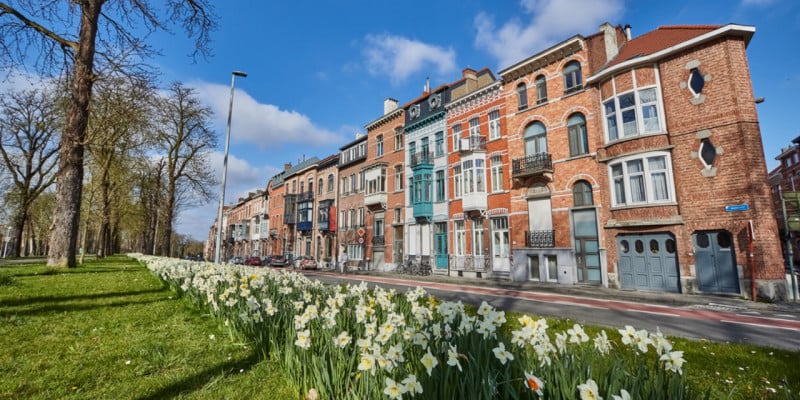
Leuven draws researchers, students, and professionals from across the world, all competing for housing in a city of more than 100,000 residents that also accommodates 50,000 students. The rental market in Leuven spans managed university residences, private apartments, and shared houses across five distinct districts, each with its own character and price point. For international newcomers, the practical challenge is twofold: the market moves quickly, particularly during the student-housing season, and Belgian tenancy rules around deposits and lease types follow a specific framework that many arrivals do not anticipate. The deposit, for instance, must be held in a blocked bank account in the tenant's name rather than paid to the landlord directly, a rule that catches many first-time renters in Belgium off guard.
Leuven is organized around a historic center enclosed by a ring road, with four residential districts spreading outward beyond it. The city is compact enough that the entire municipality fits within a short cycling distance, but each area has a distinct character, price level, and practical profile that shapes daily life in different ways. Choosing a neighborhood is really a question of trade-offs: walkability and student energy in the center, or more space and quiet in the outer districts.
The city center is the most urban and walkable option. Cafes, shops, and university buildings overlap in a tight area, and Leuven station connects directly to Brussels in under half an hour. Everything you need is within cycling or walking distance, which makes the center a natural fit for singles, students, and anyone working in or near the historic core. The costs are higher than elsewhere in the municipality, and the student-dense atmosphere persists well into the evening and on weekends.
Heverlee, to the south, is campus-oriented. People attached to KU Leuven's research facilities, the UZ Leuven Gasthuisberg hospital, or the imec technology institute will find Heverlee saves a meaningful amount of daily travel time. The neighborhood is greener and quieter than the center, with solid cycling and public-transport links to both campuses and the historic core. Rents sit in the mid-range for Leuven.
Kessel-Lo is the most naturally family-oriented district, with a local residential feel while staying close to Leuven station. Its housing stock mixes apartments with standalone houses, making it practical for both families who need space and professionals who want easy train access. Pricing is mid-range, and the proximity to the station makes it one of the more versatile locations for people commuting by rail.
Further out, Wilsele and Wijgmaal are the most affordable options within Leuven municipality. Wilsele is quieter and more suburban, with open space nearby and good station access. Wijgmaal sits at Leuven's northern edge and has its own railway station, so commuters can live with a village atmosphere without giving up direct train connections. Both districts suit families or professionals who want more room at a lower price; Wijgmaal in particular offers the strongest sense of a self-contained community.
For most newcomers, the practical starting point is to identify where your daily anchor is: the city center, a specific campus, or the station. Families wanting outdoor space and quieter streets should compare Heverlee, Kessel-Lo, Wilsele, and Wijgmaal before committing to the center.
Good to know:
Leuven is a safe city; the local police serve over 100,000 residents and 50,000 students, maintaining neighborhood-level contacts through wijkinspecteurs (neighborhood officers). Comparing individual streets and building quality is more useful than treating any whole district as an area to avoid.
Four main accommodation types cover the Leuven rental market, and knowing the difference between them before you start searching will save significant time. Each type carries its own contract structure, deposit rules, and permitted use, so mixing them up is a common source of confusion for newcomers.
A full apartment is the most common option on Leuven's private rental market. It includes a self-contained kitchen, bathroom, living area, and at least one separate bedroom. Apartments are the standard choice for working professionals, couples, and families who need an independent residence rather than a shared arrangement. They are available across all five districts, with the widest selection in the center and Heverlee. Furnished apartments are available at a rent premium; unfurnished lets are more common on longer-term private leases.
A kot is a student room: a private bedroom, usually within a shared house or building, with a communal kitchen and, in most cases, shared bathroom facilities. It is the standard living arrangement for university students in Belgium and is distinct from a self-contained studio flat. Kots are abundant in Leuven because of the city's student population, and the majority of student-focused platforms list primarily this type of accommodation.
A studio is self-contained, with its own private kitchen and bathroom. Flemish regulations set a minimum floor area of 18 to 25 square meters for a single person and at least 27 square meters (excluding the bathroom) for a couple. Studios in Leuven are in shorter supply than kots, and demand from students and young professionals keeps them competitive.
Flatsharing (samenhuizen, or cohousing) is also available but subject to specific city rules. Residents in a shared property may not have separate doorbells, mailboxes, entry systems, or independent room facilities such as a kitchenette or private refrigerator. If you are entering a cohousing arrangement, check the lease carefully against the Leuven city cohousing rules before signing.
KU Leuven Stuvo residence halls are a distinct category: university-managed furnished rooms, studios, and apartments available exclusively to enrolled students on academic-year contracts. Contract terms, deposit rules, and utility inclusions are standardized and university-supervised, which removes much of the uncertainty that comes with private rentals. For enrolled students, the KU Leuven Stuvo residences page is the first place to look.
For non-students needing flexible or short-stay accommodation, GETROOM (Craenendonck 4, Leuven) offers coliving rooms on 6- or 12-month contracts, suited to professionals and researchers who need a furnished base without committing to a long private lease.
Join the Leuven community
Get regular tips and advice to make the most of your expat life
Rental prices in Leuven
The clearest price reference in Leuven's student housing sector comes from KU Leuven's managed residences, which publish standardized, all-inclusive monthly rates. KU Leuven Stuvo managed residences offer all-in rents between EUR 248 and EUR 494 on 10-month academic-year contracts, covering room or studio accommodation with utilities included. These figures are the most transparent pricing benchmark available for the Leuven student housing market.
On the private market, prices follow a clear district pattern: the city center commands the highest rents, Heverlee and Kessel-Lo occupy the mid-range, and Wilsele and Wijgmaal offer the most affordable options within the municipality. For current asking prices by accommodation type and location, use Immoweb or Kotwijs to search active listings; both platforms reflect real-time private-market availability.
A critical point before comparing any private listings: advertised rents do not always include utilities, common building charges, or internet. The difference between an all-in rent and a base rent that excludes energy, water, and building costs can add EUR 100 to EUR 200 or more to the monthly figure. Always establish what is and is not covered before making any price comparison.
Finding accommodation in Leuven
The accommodation search process in Leuven divides cleanly between the student market and the general private market, and the platforms best suited to each are different. Starting with the right one saves time and reduces exposure to unsuitable listings.
For students, the first step is the KU Leuven Stuvo student housing portal, which covers both university-managed residences and the Kotwijs platform. Kotwijs is the specialist listing site for student rooms in Leuven; its listings meet KU Leuven Stuvo criteria for contract quality and student-friendliness, making it the lowest-risk starting point for anyone looking for a kot. University-managed residences are the most structured option of all: standardized contracts, supervised deposit processes, and known utility inclusions. Application windows for KU Leuven-managed residences typically open in spring each year for the following academic year; missing the window means relying entirely on the private market. Apply as early as possible.
A useful supplement to Kotwijs is kot.be, a Belgian student-housing directory covering rooms, studios, and apartments in Leuven. It broadens your search without leaving the student-oriented market.
For apartments, houses, or any longer-term non-student rental, Immoweb is the main platform carrying private-market inventory. Estate agents handle a significant share of private rentals in Leuven as well, particularly for unfurnished longer-term leases sought by families or professionals. Using an agent adds cost, but it can speed up access to properties that are not publicly listed.
Facebook groups such as Te huur: kot in Leuven and Leuven Housing are used as supplementary search channels. Treat them as a secondary source only. Before paying anything, verify the landlord's identity, the property address, the contract terms, and the deposit method independently. Fake ads are a known issue in Leuven's student rental market. Red flags include pressure to pay before a viewing, requests for money before receiving keys, and deposit requests in cash. If you encounter a suspected fraudulent listing, Leuven's police student-affairs officers can assist with filing a formal declaration.
Two fundamentally different contract frameworks operate in Leuven's rental market, and the rules around deposits, notice periods, and termination differ sharply between them. Identifying which type you are being offered before you sign is the single most important step in the rental process.
Student housing contracts in Belgium are fixed-term, tied to the academic year, and end automatically on the agreed date with no notice required from either party. They carry a deposit cap of two months' rent. Main-residence leases, the standard framework for non-student residential tenancies in Flanders, default to a nine-year term, though shorter fixed-term leases of three years or less are legally recognized. Main-residence leases carry a deposit cap of three months' rent and require three months' written notice from the tenant to terminate; if the notice is given during the first three years of the tenancy, a compensation payment is also due to the landlord. A landlord wishing to end a main-residence lease for their own occupation must give six months' notice.
The rental deposit (huurwaarborg) must be paid into a blocked bank account (geblokkeerde rekening) in the tenant's name. A landlord cannot legally request it in cash, nor can the deposit be used to cover the final month's rent. For student housing specifically, a landlord may not request the deposit more than three months before the tenancy start date; if the tenant cancels before the contract begins, any advance payment made must be refunded. At the end of the tenancy, the landlord must provide documentary evidence for each deduction claimed against the deposit, which may only be used to cover unpaid rent, tenant-caused damage, late key returns, insufficient cleaning, or final utility settlements where actual consumption exceeded advance payments.
If the deposit is unaffordable, Stad Leuven and OCMW Leuven (contactable at huurhuis@leuven.be) can check eligibility for an interest-free loan from the Vlaams Woningfonds (Flemish Housing Fund) or direct OCMW assistance. Keep your Belgian bank account open until the deposit has been fully returned after your contract ends.
Registering the lease with the Belgian tax authorities (FPS Finance) provides legal protection and helps prevent disputes. The FPS Finance lease registration page explains the process; check that your landlord has registered the contract before relying on it in any dispute.
At the start of every tenancy, carry out and document a plaatsbeschrijving (move-in condition report). This written record of the property's condition at handover is your primary protection against unfair deductions when the deposit is returned. The KU Leuven tenant and landlord obligations page provides a useful explanation of what this report should cover, applicable to private tenants as well as students.
Housing challenges for expats in Leuven
International newcomers face a specific set of practical obstacles in Leuven's rental market that go beyond the standard complexity of renting in an unfamiliar city. Each is manageable with the right preparation, but underestimating any of them is a common source of delay and frustration.
The first hurdle is demonstrating financial reliability to a landlord before you have Belgian payslips or a local rental history. Prepare a complete documentation pack before you start contacting landlords: proof of identity, an employment contract or university enrollment letter, and evidence of income. Having these documents ready to send immediately when a listing appears makes a real difference in a market where good properties attract multiple inquiries quickly.
Deposit handling is a frequent risk area. The legally correct method is a blocked account in the tenant's name, not a cash payment and not a direct transfer to the landlord's personal account. Any landlord requesting a cash deposit is operating outside what Leuven city guidance permits. If you are unsure about the process, the Stad Leuven deposit help page explains the correct procedure and sets out what the city can do if a landlord does not comply.
Contract type confusion is another recurring issue. Student kot contracts and main-residence leases carry different deposit caps, termination rules, and notice requirements. Signing a student contract for a property you intend to live in as your main address, or a main-residence lease for what is effectively student accommodation, creates legal ambiguities that are difficult to resolve later. Identify the contract type clearly before agreeing to any terms.
Administrative documents in Leuven, including city housing-help pages, condition-report templates, and dispute procedures, are primarily in Dutch. Key terms to recognize: huurwaarborg (deposit), huurovereenkomst (lease), plaatsbeschrijving (condition report), and huurconflict (rental dispute). KU Leuven provides English-language housing guidance for students and university staff, but private-market tenants without that affiliation should be prepared to work with Dutch documents.
Three support routes are available depending on your situation. Enrolled KU Leuven students can contact KU Leuven Stuvo housing advisers, who mediate and advise on student housing conflicts including landlord disputes, contract issues, and deposit problems (see the KU Leuven student housing conflict page). All private tenants, regardless of university affiliation, can turn to Huurdersbond, the main independent tenant organization in Flanders, for information on lease registration, rental guarantees, and navigating disputes. For deposit difficulties or broader housing-rights questions, Stad Leuven and OCMW Leuven remain the direct public contact.
The first thing to check when reviewing a Leuven rental contract is whether utilities are included. Furnished and student accommodation frequently quotes an all-in monthly rent that covers electricity, gas, water, and common building charges; private unfurnished rentals much more often bill these separately, either as monthly advance payments (provisies) reconciled annually against actual consumption, or as fixed lump-sum charges. Getting this wrong at the comparison stage can make a cheaper-looking listing considerably more expensive in practice.
Electricity and natural gas are supplied by competing commercial providers on Flanders' open energy market. There is no price cap in Belgium, so the rate you pay depends on the contract you choose. When taking over a property or registering for energy, record the meter readings and use the Leuven city energy comparison page, which links to the official VREG V-test tool for comparing current supplier offers. The infrastructure network operator serving Leuven is Fluvius Zenne-Dijle, which manages the distribution grid; your commercial supplier is a separate entity that you choose and contract with directly.
Electricity costs for a typical household in Leuven run approximately EUR 125 to EUR 300 monthly, depending on consumption, property size, and the energy contract chosen. If affording a standard energy contract is difficult, prepaid electricity and gas options are available through Fluvius. Residents can pay online or by bank card at OCMW Leuven or a Fluvius customer office.
Drinking water in Leuven is supplied by De Watergroep. The water bill is modest: the current tariff works out to approximately EUR 20 monthly for a typical household (De Watergroep).
Fixed broadband is available from several providers in Leuven. Proximus offers fiber where coverage applies, with installation typically taking 2 to 4 hours once an appointment is scheduled; the service is usable immediately after equipment setup. Other providers include Telenet/BASE (cable and fiber-network services), Orange, Scarlet, EDPnet, and DIGI where coverage applies. Monthly broadband costs range from approximately EUR 32 to EUR 60 depending on speed and provider. Proximus publishes Leuven-specific fiber availability at its Leuven fiber coverage page.
Mobile plans are available from Proximus, Orange, Telenet/BASE, and DIGI. Budget plans start from around EUR 10 monthly, with typical plans running EUR 10 to EUR 30 depending on data allowances and call inclusions.
Frequently asked questions
KU Leuven's managed residences offer all-in rents between EUR 248 and EUR 494 per month on 10-month academic-year contracts, with utilities included. On the private market, prices vary by district: the city center commands the highest rents, while Wilsele and Wijgmaal are the most affordable within the municipality. Always check whether a quoted rent is all-in or excludes energy, water, internet, and building charges, since these extras can add EUR 100 to EUR 200 or more to the base figure. Search current listings on Immoweb or Kotwijs for live price comparisons by property type and location.
The right district depends on your lifestyle and work location. The city center suits people who want to walk everywhere and enjoy the dense urban atmosphere, while Heverlee is the practical choice for those connected to KU Leuven campuses, UZ Leuven Gasthuisberg hospital, or research employers such as imec. Kessel-Lo is family-friendly and well-placed for commuters using Leuven station. Wilsele and Wijgmaal offer more space and lower rents for those comfortable with a quieter, more suburban setting, with both retaining manageable public-transport links to the center.
Students should start with KU Leuven's managed residences and Kotwijs, the specialist student-room platform, supplemented by kot.be for a broader search. For apartments and longer-term rentals, Immoweb is the main private-market portal; estate agents cover a significant share of unfurnished family leases. Facebook groups can supplement your search but carry higher scam risk: never pay before viewing and verifying the property, the contract terms, and the deposit method. Start searching months before your planned arrival and secure accommodation before coming to Belgium where possible.
Landlords ask for proof of identity and evidence of your ability to pay rent, such as an employment contract, university enrollment letter, or recent payslips. International students should also have their university admission confirmation on hand. If you plan to stay longer than 90 days, you will need to register your address with Leuven city after arrival, so confirm with the landlord before signing that the property supports administrative registration.
Leuven's rental market is very competitive: student, university-staff, and general residential demand all overlap in a compact city, so good listings disappear quickly, especially during the student-housing season. Prepare all documents before contacting landlords and respond to listings promptly. If you cannot secure a long-term place before arriving, short-term or coliving options such as GETROOM can serve as a bridge while you search.
Student housing contracts are fixed-term and end automatically on the agreed date, with no notice required from either party. For private residential leases under Flemish law, the default framework is nine years, though short-term leases of three years or less are also legally recognized. The rules on notice periods, deposit amounts, and permitted use differ significantly between the two contract types, so identify which type you are signing before agreeing to any terms.
The deposit is capped by law at two months' rent for student housing contracts and three months' rent for all other residential leases. It must be held in a blocked bank account in the tenant's name; a landlord cannot legally request it in cash. If the full deposit is unaffordable, Leuven city and OCMW Leuven can check eligibility for an interest-free loan from the Vlaams Woningfonds (Flemish Housing Fund) or direct financial assistance.
It depends on the contract. Furnished and student accommodation often quotes an all-in rent covering utilities and common charges. In private rentals, utilities are frequently billed separately, either as monthly advance payments reconciled at year-end or as fixed lump-sum charges. Always confirm before signing whether electricity, gas, water, internet, and building costs are included, and ask for documentation showing how advance payments are calculated and settled.
The most common hurdles are demonstrating financial reliability without Belgian payslips or local rental history, navigating Dutch-language lease documents and city guidance, confusing student housing contracts with standard residential leases, and ensuring the deposit is held correctly in a blocked bank account rather than paid in cash. Support is available from KU Leuven Stuvo housing advisers for enrolled students, from Stad Leuven and OCMW Leuven for deposit assistance, and from Huurdersbond for independent tenant advice on private leases.
For students, KU Leuven's managed residences and the Kotwijs platform list rooms on fixed academic-year contracts. For non-students needing flexible or bridge accommodation, GETROOM at Craenendonck 4 in Leuven offers coliving rooms on 6- or 12-month leases. Apart-hotels and serviced apartments also operate in the city. Before booking any short-stay option, confirm the end date, extension possibilities, and whether the address supports Belgian administrative registration if your stay exceeds 90 days.
ℹ️
We do our best to provide accurate and up to date information. However, if you have noticed any inaccuracies in this article, please let us know in the comments section below.
I fell in love with words at an early age After a break to focus on my studies, I rediscovered the joy of writing while keeping a blog during my years between London and Madrid. This passion for storytelling and for exploring new cultures naturally inspired me to create Expat.com, a space for my own reflections as well as for anyone wishing to share their experiences and journeys abroad.