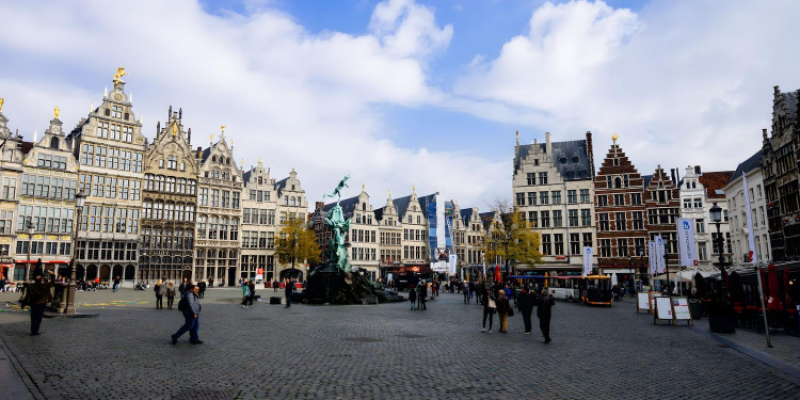
Many newcomers assume that Antwerp's compact size and English-friendly professional environment make it one of the more straightforward Western European cities to settle into. The reality is more layered. Dutch is the administrative language of Antwerp and of Flanders, and while English gets most people through the working day without difficulty, it stops being sufficient the moment a lease renewal, a GP appointment, or a school enrollment form arrives. Beyond language, housing competition in desirable districts is real, and arriving without a Belgian income history adds friction to a market that already ranks as Belgium's second most expensive. What Antwerp offers in exchange is a genuinely walkable, culturally rich city with a large-economy job base, distinct neighborhoods, and a social calendar dense enough to fill every weekend year-round.
Port cities tend to carry a distinctive energy, and Antwerp is no exception. Belgium's second-largest city sits on the Scheldt River in the heart of Dutch-speaking Flanders, and its identity is shaped as much by fashion, design, and a packed cultural calendar as by the commercial weight of one of Europe's busiest ports. For newcomers, the first surprise is often scale: the city is compact enough to cycle across in under half an hour, yet it holds an economic and cultural footprint that considerably exceeds what its physical size might suggest.
Daily life here is organized around walkable neighborhoods, café culture, and a public transport network that makes a private car unnecessary for most central residents. The port and logistics economy draw professionals in transport, engineering, trade, diamonds, fashion, and higher education; the University of Antwerp adds a steady international student and research community on top. That combination produces a resident mix that is genuinely international while remaining firmly rooted in a Flemish civic identity. Newcomers are often pleasantly caught off guard by how much richness fits into a small footprint: museums, fashion venues, Art Nouveau architecture, and Scheldt waterfront spaces all sit within easy reach of one another.
The adjustment curve, however, is real. Dutch is the language of administration, healthcare, and neighborhood life, and relying solely on English creates friction over time even for those who manage well from day one. Housing competition in desirable central districts is stiff for arrivals without a Belgian income history. Antwerp is also Belgium's most expensive city after Brussels, which places it well above low-cost relocation destinations; a comfortable lifestyle in a sought-after neighborhood requires a stable professional income. Ongoing urban construction and roadworks add a layer of disruption that longtime residents treat as background noise but that newcomers can find jarring. None of these challenges are insurmountable, but they are worth planning for before arrival rather than discovering afterward.
A single block can separate a quiet residential street from a lively bar zone in Antwerp, which is why neighborhood choice matters more here than in many comparable cities. Each district has a distinct character, price point, and resident profile, and choosing the right one for your lifestyle and commute pays off over the long term.
Zurenborg is one of the city's most visually distinctive residential neighborhoods, known for its Art Nouveau and late-19th-century townhouses along Cogels-Osylei and Waterloostraat. It draws families, professionals, and architecture-minded newcomers who want quieter streets and strong neighborhood café culture while staying connected to the center via tram line 10. Rents here sit at the upper end of the Antwerp market, reaching EUR 2,400 per month and above for larger apartments. Parking is limited and regulated, so residents who rely on cycling or public transport adapt more easily.
Het Zuid, the city's southern district, attracts a different profile: professionals, couples, and culturally active residents who want restaurants, nightlife, and walkable access to the Scheldt and the historic center. Furnished short-stay apartments in the area start from around EUR 1,400 per month all-in, making it one of the pricier options for new arrivals who want flexibility.
Het Eilandje (the Little Island), the regenerated waterfront quarter around the MAS museum and former docklands, suits professionals and newcomers who want contemporary apartments, water views, and a restaurant scene without straying far from the center. Entry-level one-bedroom apartments here start from around EUR 895 per month, making it more accessible than Het Zuid for those willing to commit to a longer lease.
Across the Scheldt, Linkeroever (the left bank) offers more space and greenery than inner right-bank neighborhoods, with riverside views and new-build apartments available from around EUR 1,050 per month. It suits residents who want to stretch their budget while staying within the city, but there is a live practical constraint: tram connections between the two riverbanks are out of service during ongoing infrastructure engineering works, with temporary rail provision and ferry alternatives in place. Residents of the left bank should factor extra commute time into any housing decision until normal service resumes.
Berchem and its adjacent Oud-Berchem offer a well-connected residential base near Antwerp-Berchem rail station, with good access to Zurenborg, the Groen Kwartier, and university campuses. Local families consistently recommend it for practical nursery and primary school access.
Nearby, the 't Groen Kwartier / Harmonie quarter is built around sustainability, green space, and community living, with restaurants and cycle routes close by; it suits families and remote workers who want quieter streets and newer housing rather than the density of the historic center. Both areas command rents toward the higher end of the market.
For a more affordable entry point, Borgerhout offers lower average rents, dense multicultural street life, and good access to Antwerp-Central station and the city tram and bus network; it is widely considered one of Antwerp's up-and-coming areas and suits students, younger professionals, and budget-conscious renters. Further out, Deurne and Merksem are quieter outer districts with lower rents and more residential character, suited to residents comfortable with a slightly longer commute. The three main rental search platforms in Antwerp are Immoweb, Zimmo, and ERA.
Students and visiting researchers should note that the University of Antwerp operates across multiple campuses: Stadscampus (S) in the city center, Middelheim, Drie Eiken, and Groenenborger are separate locations, so housing choice should follow the specific campus assigned rather than defaulting to the historic center.
Join the Antwerp community
Get regular tips and advice to make the most of your expat life
Cost of living in Antwerp
Rents are the biggest variable in Antwerp's cost picture, and they vary sharply by district, property type, and whether the apartment is furnished. As Belgium's second most expensive city, Antwerp is affordable by some Western European standards but sits well above low-cost relocation destinations; maintaining a central lifestyle on a tight budget is genuinely difficult. Entry-level one-bedroom apartments in waterfront districts start around EUR 895 per month, mid-range new-build options on the left bank run around EUR 1,050, and furnished short-stay apartments in trendy southern neighborhoods start from around EUR 1,400 all-in. Premium apartments in high-demand areas such as Zurenborg start at EUR 2,400 and up. Outer districts such as Borgerhout, Deurne, and Merksem offer more affordable options for those willing to accept a longer commute.
Beyond rent, childcare is the other significant fixed cost for families: the City of Antwerp's stated daily rate range of EUR 30 to EUR 38 across 20 to 22 childcare days produces a monthly cost of roughly EUR 600 to EUR 836 for fixed-price places. Some providers offer income-related tariffs through the Flemish childcare authority Opgroeien, and a municipal childcare allowance can reduce monthly bills for eligible families at participating providers. For everyday costs beyond housing and childcare, Antwerp broadly aligns with mid-range northern European city living: groceries, transport, and eating out are not bargain-priced but are manageable on a professional salary.
Newcomers without Belgian payslips or a local rental history face more friction at the start of their housing search. Landlords and agencies typically want proof of income, identity documents, and a clear move-in date. Arriving with temporary housing already arranged gives considerably more time to find a stable long-term lease without the pressure of a ticking clock.
Climate and weather in Antwerp
Expect changeability rather than extremes. Antwerp's oceanic climate brings mild summers, cool winters, and frequent cloud cover, with precipitation possible in any month. July and August average highs reach around 23°C; January averages highs of around 6 to 7°C with lows dropping to 0°C. Annual precipitation stands at around 853 mm, spread across the year, with November and December among the wetter and darker months. The city receives approximately 1,630 sunshine hours per year, and mid-May through mid-September is the most comfortable period for outdoor life, with longer daylight and more settled temperatures.
Most newcomers find the variability harder to adjust to than the temperature itself: grey skies, sudden showers, damp wind, short winter daylight hours, and humid warm spells can all occur within the same season. Residents arriving from warmer or sunnier climates should plan for the psychological effect of persistent winter cloud cover rather than treating it as a minor inconvenience. A layered wardrobe, a waterproof hooded jacket, and water-resistant shoes serve everyday Antwerp life far better than a standard umbrella, especially for cycling and commuting.
Flooding and heatwaves are the two practical weather risks that matter most for residents. The Royal Meteorological Institute (RMI) issues official weather alerts for storms, heavy rain, heat, and winter conditions; checking the RMI site during severe weather is standard practice among Antwerp residents. For housing, reliable heating, good insulation, and ventilation against damp matter more than built-in air conditioning in most homes. Top-floor apartments and poorly shaded urban flats can become uncomfortable during heatwaves; waterside or low-lying housing benefits from flood-risk awareness before signing a lease.
Getting around Antwerp
A private car is rarely needed for daily errands in central Antwerp. Most residents in the inner districts combine walking, cycling, De Lijn trams and buses, and shared mobility for everything from commuting to weekend shopping.
Cycling is a normal part of daily life. The Velo Antwerpen shared-bike system covers the city and is widely used by residents for short trips, commutes, and errands. Wind and rain make a hooded rainproof jacket more practical than an umbrella for regular cyclists. For taxis and ride-hailing, Bolt operates across the city; local taxi companies listed by the municipality include Antwerp Tax, A-taxi, Gele Taxi, and Antwerpen Taxi Centrale. Late-night travel from entertainment areas is most reliably handled by pre-booked taxi or Bolt.
The Smart Ways to Antwerp route planner covers walking, cycling, public transport, shared mobility, car, Park and Ride, and accessibility options in one tool, making it the most practical starting point for planning routes across the city. Antwerp-Berchem is also a national rail interchange connecting the city to the wider Belgian rail network.
Good to know: Antwerp operates a low-emission zone (LEZ) with updated conditions in effect since January 2026. Residents who drive into the city should check their vehicle's eligibility before arriving, as non-compliant vehicles are subject to fines.
Language and communication in Antwerp
Dutch is the administrative language of Antwerp and of Flanders. The City of Antwerp's official portal operates primarily in Dutch, with a selected English-language entry point for newcomers and residents at antwerpen.be/.
English is widely usable in professional, university, hospitality, and central-city service contexts. In practice, most Antwerpenaars switch to English as soon as they hear a foreign accent, which makes daily life manageable at first but can slow Dutch acquisition over time; the switch helps in the short term but creates a real temptation to stay in English indefinitely. Newcomers who want to integrate fully, navigate administration independently, and build relationships beyond the international bubble treat Dutch as a medium-term priority rather than an optional extra. The local Flemish Dutch dialect and the Antwerp city accent also differ noticeably from standard classroom Dutch, so conversations in everyday neighborhood settings can feel harder than expected even for those with formal language training.
A few Dutch phrases are practically useful from day one: Goeiedag (hello/good day), Dank u wel (thank you), Spreekt u Engels? (do you speak English?), Ik leer Nederlands (I am learning Dutch), and Kunt u dat herhalen? (Could you repeat that?) are all recognized and appreciated in neighborhood and service interactions.
Several Dutch-language programs serve newcomers in Antwerp. Linguapolis at the University of Antwerp offers Dutch courses for adult learners, including a full-time Postgraduate of Dutch as a Foreign Language in an Academic Context: a September-to-June program with 480 contact hours, 60 credits, and 15 daytime class hours per week, targeting B2 proficiency for use in Flemish higher education. For group and private tuition, Languages and Travel (LABS) runs group courses throughout the year at EUR 620 per week, with private tuition at EUR 65 per hour and optional host-family accommodation available from EUR 125 to EUR 150 per week. Newcomer integration support, including pathways to Dutch-language learning, is also coordinated through Atlas Antwerpen, the city's integration support body.
Culture and social norms in Antwerp
Antwerp's civic culture is locally rooted, Dutch-speaking, and organized around a strong events calendar. Using Dutch greetings where possible, being direct but polite, and respecting cycling and pedestrian space are the baseline social expectations. The practical rhythm of neighborhood life runs through cafés, public squares, local markets, and seasonal city events, all of which function as normal parts of daily urban life rather than tourist-facing extras. Communication style in offices, universities, and service settings is direct, efficient, and matter-of-fact: small talk exists but efficiency is valued, and getting to the point is appreciated.
The city's identity is strongly cultural. Antwerp presents itself around fashion, design, architecture, art, and events, and this is visible in everyday life: dress standards tend toward smart casual, and fashion-consciousness is noticeably higher than in many comparable European cities of similar size. The ten statutory Belgian public holidays affect work, administration, and many services; shops in the city center also follow local Koopzondagen (shopping Sundays) arrangements. Tracking the Belgian holiday calendar early helps avoid surprises with administrative appointments and service availability.
Integration into Antwerp social life takes time and deliberate effort rather than happening automatically. Local cafés, neighborhood markets, festivals such as Bollekesfeest, and cultural events offer low-pressure ways to meet residents. The city's events calendar shapes the social rhythm of the year: participating in it rather than watching from a distance makes the difference between Antwerp feeling lived-in and feeling transient.
Pace of life and work culture in Antwerp
Weekdays in Antwerp run on a commercially driven daytime rhythm shaped by the port, university, and fashion economy, but the city is more human-scale and less crowded than Brussels: compact streets, walkable commutes, and neighborhood cafés give professional life here a texture that large-capital working environments rarely match. Office work follows a standard weekday daytime pattern, and work-life balance is widely described as good across most professional roles. Remote and hybrid working arrangements are common across university, professional, and international-employer settings.
The city's rhythm shifts noticeably with the seasons. From late spring through summer, outdoor culture takes over: café terraces, riverside event areas, park programming, and open-air festivals fill the weekend calendar. Winter life, by contrast, is anchored by organized city events such as Christmas market activity and cultural programming across Antwerp's museum and theater network. Antwerp's cultural programming includes fashion-themed events, museum anniversaries, nightlife activity, and a full public events calendar that residents plan their weekends around rather than discovering spontaneously.
Belgian beer and brasserie culture form the backbone of Antwerp's food identity, but the city's restaurant landscape is wider than any single tradition. Local sweets such as Antwerp Handjes (hand-shaped chocolate and marzipan confections), a multicultural street-food scene, active food markets, and a gastronomy offer spanning traditional Belgian to international dining all coexist in a city where eating well is treated as a normal part of daily life rather than an occasion. Meal timing in central Antwerp is flexible by northern European standards: all-day cafés, food halls, and gastropubs make eating at varied hours practical, and the city's port-city history and international resident and student population are visible in the breadth of cuisines available across its neighborhoods.
Food market culture is a genuine part of the Antwerp weekend routine, with markets forming normal social infrastructure rather than purely tourist-facing attractions. The city's official event calendar at Explore Antwerp covers culinary events alongside cultural, music, and seasonal programming, making it a practical tool for tracking what is happening in any given week.
The city's cultural offer is dense enough that residents rarely need to travel far for entertainment. Antwerp's arts and events scene includes major venues such as Lotto Arena, Stadsschouwburg Antwerpen, Trix, De Roma, AMUZ, and the fashion museum MoMu, alongside a full calendar of street-level festivals and outdoor programming. The annual Museumnacht (Museum Night) brings together 31 museums and cultural institutions with guest locations for performances, exhibitions, tastings, concerts, workshops, and theater, continuing at selected venues until 04:00 after hours: it is one of the clearest illustrations of how Antwerp organizes social life around cultural programming rather than conventional nightlife alone.
Outdoor social spaces anchor weekend life throughout the warmer months. Park Spoor Noord, Groenplaats, Park Den Brandt, and the Scheldt riverside event areas all serve as organized social infrastructure: Park Spoor Noord in particular is programmed by the city as a play and discovery space during summer, with activities including martial arts, gaming, urban culture, and creative disciplines for younger residents. Bollekesfeest, one of Antwerp's signature events, uses Groenplaats and surrounding central spaces for artists, DJs, and food and drink, illustrating the city's preference for event-led outdoor social culture over purely nightclub-focused alternatives.
The practical reality of Antwerp's social calendar is that it rewards short-notice planning. Residents check the city's official events agenda on exploreantwerp.be, which allows filtering by culture, music, shopping, culinary, sport, family, and seasonal categories, rather than maintaining fixed weekly routines. The city feels quiet on ordinary weekday evenings but comes alive around programmed weekends, warm-weather squares, and cultural nights: leaning into that rhythm is the fastest way to build a social life here.
Family life in Antwerp
Childcare availability pressure is real in Antwerp, and families do better by starting their search before arrival than after landing. The city operates a dedicated childcare search system, Zoek Kinderopvang, which sends a registration request simultaneously to childcare locations across the city; support is available from the Contactpunt Kinderopvang by email at contactpuntkinderopvang@antwerpen.be, by phone at 03 338 64 64, or in person at 10 local contact points around Antwerp. After receiving an offer from a municipal place, parents have 14 calendar days to accept by signing the contract.
Income-related tariffs are available at some providers through Opgroeien, the Flemish childcare authority. Separately, the city operates a kinderopvangtoelage (childcare allowance) that can reduce the monthly bill for eligible families at participating fixed-price providers: the city pays the allowance directly to the provider, so families do not need to claim it separately after paying.
Local school access is good for families prepared to navigate Dutch-language administration. The city operates a school search and registration tool at meldjeaanbubao.antwerpen.be covering nursery, primary, and special-needs school pathways. Non-Dutch-speaking parents may need support from school offices or integration services when navigating enrollment for the first time.
For English-language international education, Antwerp International School (AIS) at Veltwijcklaan 180 offers the International Baccalaureate PYP, MYP, and Diploma programs. Annual tuition ranges from EUR 13,580 to EUR 39,530 depending on level, with a one-time EUR 1,000 application fee per family and an annual capital building fee of EUR 525 per student, capped at EUR 1,050 per family. Some employers with relocation packages cover school fees, particularly for international transfers; checking an employment contract before assuming tuition is self-funded is worth doing early.
In terms of neighborhoods, Berchem and Oud-Berchem are consistently recommended by local families for practical nursery and primary school access, while 't Groen Kwartier and Linkeroever suit families who prioritize green space and quieter streets. Zurenborg draws families who want architectural character and café culture within a calmer residential environment than the historic center.
Safety in Antwerp
Petty theft and property crime are the risks newcomers encounter most in everyday Antwerp life. Pickpocketing, bag theft, and fraud are the offense categories most likely to affect residents, particularly in crowded public places, transport hubs, and busy market areas. Keeping phones, wallets, and bags secured in those environments is the main practical precaution.
Drug-related organized crime is a specific Antwerp concern connected to the city's major port and is identified as a strategic policing priority in Belgium's National Security Plan. This context has limited impact on day-to-day residential life but explains the city's ongoing security investment and occasional high-profile police operations. For the vast majority of residents, awareness of standard urban precautions is sufficient.
Daytime safety is broadly manageable with standard urban awareness. After dark, the practical risk profile shifts toward theft, intoxication-related nuisance, and discomfort around busy nightlife zones, transport hubs, and poorly lit areas. Using well-used routes and official transport late at night is the practical approach. For non-urgent police matters such as noise complaints, minor incidents, and crime reports, the Antwerp Police contact page lists the appropriate channels, keeping the emergency line clear for urgent situations. Emergency numbers in Belgium are 112 for urgent medical emergencies and fire, and 101 for urgent police assistance.
Environment in Antwerp
Tap water in Antwerp is safe to drink. Public drinking water is strictly regulated in Belgium; Antwerp's supply is managed by Water-link, which operates a 24/7 contact service for water-quality issues.
Air quality in Antwerp is moderate. The Flemish Environment Agency (VMM) identifies transport and wood heating as the main sources of nitrogen oxides and particulate matter in the Antwerp agglomeration. Ongoing ring-road construction at the Oosterweel project adds another particulate-monitoring dimension, and PFAS monitoring near the industrial port area remains active. Residents who choose housing away from ring-road feeder routes, port corridors, and heavily trafficked streets experience considerably less noise and air-quality pressure than those in exposed locations; factoring traffic proximity into any housing search is a practical step.
Road congestion in Antwerp is severe. The city consistently ranks among European congestion hotspots during rush hour and around major events, generating noise levels that are moderate to high along transport and event corridors. Urban heat, heavy-rain water management, and drought-linked climate stress are Antwerp's live climate adaptation challenges. The city offers financial support through its klimaatrobuuste ingrepen (climate-robust home renovation) scheme for residents who remove hard surfaces, add permeable ground cover, greenery, or rainwater management to their property; details and eligibility are on the city's renovation support page. The municipal EcoHuis is Antwerp's public center for climate, sustainable renovation, energy, greening, and depaving advice. Antwerp'slow-emission zone (LEZ) and active cycling infrastructure investment reflect a city that takes sustainability seriously in policy terms even as congestion and industrial activity keep air quality below the cleaner end of the European urban spectrum.
Expat community in Antwerp
AWC Antwerp, an English-speaking women's club affiliated with the international FAWCO network, is the most structured Anglophone social community in the city. It offers both full-term and non-resident membership options, with a connected social program and links to other FAWCO clubs in Europe. For newcomers who want an immediate point of entry into English-speaking social life, it is a practical first step regardless of professional or family background.
The francophone community is served by two well-established organizations. Amitiés françaises Anvers has promoted French culture and language in Antwerp since 1945; current activities include a Saturday café, running club, Scrabble, reading club, walking club, and cinema outings, providing a varied weekly program for French-speaking and francophile residents. Accueil Français d'Anvers, a volunteer association and member of the FIAFE network, supports francophones settling in the Antwerp region through cultural, social, and solidarity activities.
Antwerp's wider international resident community reflects the city's port, university, diamond trade, and fashion economy, bringing together port and logistics professionals, academic researchers, international students, and families relocated by multinational employers. Two integration patterns coexist: some newcomers build their social life primarily within expat and English-speaking circles, particularly in international workplaces and student environments; others integrate more deeply into Antwerp life through Dutch learning, local sports clubs, neighborhood participation, and cultural events. The city's scale makes both approaches viable, but deeper integration in Antwerp tends to follow deliberate effort rather than happening passively.
Antwerp rewards a specific type of resident and creates real friction for others, and being honest about which category you fall into before signing a lease saves significant adjustment pain. The city's advantages are concentrated and concrete: a compact, walkable footprint with a large-city economy; strong professional sectors in port, logistics, diamonds, fashion, design, and higher education that recruit internationally mobile professionals; genuine cultural richness in a small area; excellent cycling infrastructure and a public transport network that makes car-free daily life practical; and English widely usable in professional and central-city contexts. The municipal English portal and the presence of established international community organizations lower the initial administrative barrier noticeably compared with many comparable Flemish cities.
The challenges are equally specific. Dutch is the dominant administrative language, and relying only on English creates growing friction in municipal administration, healthcare, housing renewals, and neighborhood life over time. Housing is competitive in desirable inner districts, especially for arrivals without Belgian income proof; the city is Belgium's second most expensive; and climate adaptation is a live quality-of-life concern, with summer heat, flooding risk, severe road congestion, and urban construction all identified as ongoing factors. Ongoing infrastructure works cause periodic transport disruption, particularly for left-bank residents during the current riverbank tram engineering project.
Frequently asked questions
Antwerp suits remote workers who want a compact, walkable city with strong cafés, culture, and reliable urban transport. The trade-off is cost: centrally located furnished apartments start around EUR 1,400 per month all-in, so the city works best for those with a stable professional income rather than a tight budget. English is widely usable in expat and professional settings, but Dutch becomes necessary for municipal registration and other administrative matters over time.
English is widely usable in professional, university, hospitality, and central-city contexts, so daily life is manageable from day one. Dutch is the administrative language of Antwerp and Flanders, however, and relying only on English creates friction in municipal procedures, healthcare, lease renewals, and school communication over time. Building basic Dutch makes long-term life considerably smoother, even if locals often switch to English when they hear a foreign accent.
Antwerp is Belgium's second most expensive city, so a comfortable lifestyle in a desirable neighborhood requires a stable professional income. Rents vary sharply by district: entry-level one-bedroom apartments in waterfront areas start around EUR 895 per month, mid-range new-builds on Linkeroever run around EUR 1,050, and furnished apartments in Het Zuid start from around EUR 1,400 all-in. Premium apartments in areas like Zurenborg reach EUR 2,400 and above, while outer districts such as Borgerhout, Deurne, and Merksem offer more affordable options.
Expats looking for a calm landing often focus on Zurenborg, Berchem, Het Zuid, Het Eilandje, and parts of Linkeroever, depending on budget and commute needs. In practical terms, safety means good street lighting, easy access to transport, less late-night noise, and solid housing quality. Conditions in Antwerp change quickly from one street to the next, so visiting a potential neighborhood at different times of day before signing a lease is strongly recommended.
Antwerp works well for both, but differently. Short-term residents benefit from the compact center, a furnished apartment market, excellent cultural programming, and easy rail connections. Long-term residents get more value from learning Dutch, choosing a neighborhood carefully based on daily life rather than prestige, and building local routines. Long-term comfort depends heavily on housing quality, commute tolerance, and willingness to engage with Belgian administration.
Newcomers are often positively surprised by how compact, stylish, and culturally rich the city feels: strong design, food, fashion, port-city energy, and distinct neighborhood characters are all packed into a relatively small area. Common practical surprises include the weight of Dutch-language administration, the frequency of construction and roadworks, limited parking in central areas, and how sharply housing quality and noise levels can vary from one street to the next.
Antwerp is generally less stressful than a large capital because of its compact scale and car-optional daily life in the inner districts. The main friction points are housing competition in desirable areas, Dutch administrative requirements, ongoing roadworks, traffic congestion at peak hours, and noise in denser neighborhoods. Residents who choose housing based on actual commute and lifestyle needs, rather than neighborhood prestige alone, tend to settle in more comfortably.
Foreigners can rent in Antwerp, but landlords and agencies typically expect stable income proof, identity documents, and a clear move-in date. Newcomers without Belgian payslips often face more friction at the start and benefit from arranging temporary housing first, which allows more time to search for a stable long-term lease. Flexibility on district, furnishing level, and commute distance significantly improves available options. The main rental search platforms are Immoweb, Zimmo, and ERA.
The most consistent complaints from residents are housing pressure in attractive central neighborhoods, Dutch-language bureaucracy across municipal and administrative matters, roadworks and traffic disruption, limited parking, and significant variation in noise and housing quality from street to street. Antwerp is not the cheapest Belgian city for central living, and social integration can feel slow if daily life stays primarily within English-speaking or international circles without deliberate effort to engage locally.
Both patterns coexist. Antwerp has enough international residents, port and logistics professionals, university staff, and English-speaking workplaces that staying within expat circles is feasible, particularly at the start. Those who learn Dutch, live outside short-stay or transient housing, join local sports clubs or cultural events, and engage with neighborhood life are more likely to build connections within Antwerp's Belgian social networks over time. The city's scale makes both approaches viable, but deeper integration tends to follow deliberate effort.
ℹ️
We do our best to provide accurate and up to date information. However, if you have noticed any inaccuracies in this article, please let us know in the comments section below.
I fell in love with words at an early age After a break to focus on my studies, I rediscovered the joy of writing while keeping a blog during my years between London and Madrid. This passion for storytelling and for exploring new cultures naturally inspired me to create Expat.com, a space for my own reflections as well as for anyone wishing to share their experiences and journeys abroad.