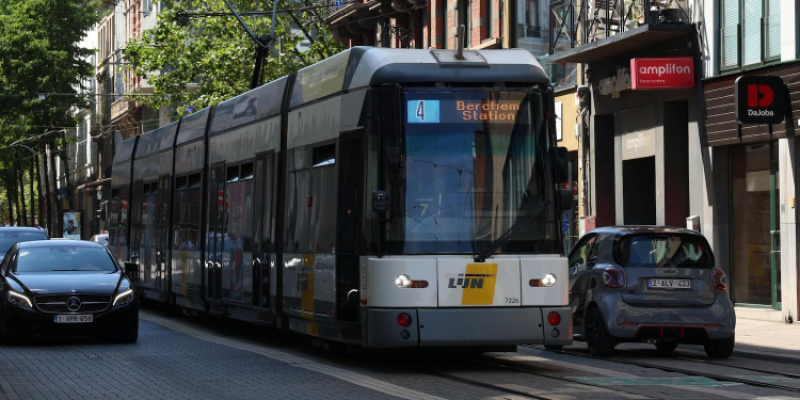
Do you really need a car to get around Antwerp? For most newcomers settling in the city center, the honest answer is no. A single operator, De Lijn, runs buses, surface trams, and the underground premetro network under one ticketing system, covering most cross-city journeys. The center is actively designed to limit routine car use: a Low Emission Zone restricts older vehicles, parking in the historic heart is reserved almost entirely for residents, and cycling is treated as a normal daily mode with more than 300 bike-share stations and priority cycling streets throughout the city. What Antwerp calls a metro is not a conventional subway but a network of trams that dip underground through the center: a distinction worth knowing before planning your first commute.
Every tram, bus, and underground tram journey you take as a newcomer in Antwerp falls under a single operator: De Lijn, the Flemish public transport company. That means one ticketing system, one app, and one fare structure covering the entire urban network. A single De Lijn ticket buys access to buses, surface trams, and the premetro tunnels alike, with no zonal surcharges between modes.
Antwerp's city center is actively designed to limit routine car use. A Low Emission Zone, restricted parking across central districts, and a dense tram network mean most newcomers living centrally can manage daily life without a car from day one. Cycling sits alongside trams and buses as a normal commuting mode: dedicated cycle lanes, priority cycling streets called fietsstraten, and a city-wide bike-share network make two wheels a practical first choice for short and medium trips. Walking covers most errands within the historic center, which contains formal pedestrian zones and car-restricted, low-traffic areas.
For journeys beyond Antwerp, SNCB/NMBS national trains take over. The De Lijn app integrates De Lijn, SNCB, and other regional operators into a single route planner, making it the most practical planning tool for newcomers. Install it before your first commute: it handles real-time stop information, route planning, and ticket purchase in one place. The app and website are fully available in English, and Google Maps integrates De Lijn timetables reliably for multimodal planning as well.
What Antwerp calls a metro is, in practice, a network of trams that run underground through key city-center tunnels and continue at street level on either side. There is no separate heavy-rail subway system. The premetro is operated by De Lijn and forms part of the same tram network used for surface routes, which means the same ticket types and payment methods apply throughout.
The premetro comprises 8 lines (numbered 2, 3, 5, 6, 8, 9, 10, and 15) serving 12 underground stations. Key interchange points include Astrid, Opera, Diamant, Meir, Groenplaats, and Sportpaleis, covering the main cross-city corridor through central Antwerp. Peak-hour service runs every 8 minutes; off-peak frequency is every 10 minutes. There is no dedicated night service on the premetro: evening and late-night options fall to limited De Lijn bus and tram services, which you should check through the route planner for your specific route before relying on them.
One disruption to plan around: Scheldt tunnel renovation works have closed the underground section between Van Eeden on Linkeroever and the Opera/Stadsschouwburg area from May 4, 2026 through the end of March 2027. Journeys between the Left Bank and the city center require surface alternatives during this period. If your commute crosses the Scheldt or uses the underground section of this corridor, check live routing before your first timed trip.
Station accessibility varies across the premetro network. De Lijn publishes the accessibility status of each stop, so checking individual stations before travel is worthwhile if mobility is a factor.
Join the Antwerp community
Get regular tips and advice to make the most of your expat life
Buses in Antwerp
De Lijn buses fill the gaps where trams do not run, extending coverage to outer districts and providing regional connections into the city. The ticketing system is fully shared: a De Lijn ticket bought for a bus journey is valid across the entire network for the same 60-minute window, so there is no zonal surcharge or mode-specific fare to worry about.
Newcomers commuting from surrounding municipalities will find theAntwerp X-lines particularly useful. These express regional bus services connect towns including Rumst and Kontich directly into Antwerp, with Sunday service also available, making them a practical option for those living in the wider province.
Park and Ride sites on the city edge, including P+R Olympiade and P+R Luchtbal, are served by De Lijn trams and buses providing direct connections into the center. If you are driving in from outside, it is highly recommended that you leave the car at a P+R site and continue by public transport, as this is the most practical way to reach the center. This combination is often faster and cheaper than driving all the way in and searching for parking.
Evening bus services exist on some lines, but the network is not extensive after dark. Use the De Lijn route planner to check actual evening availability for your specific route rather than assuming daytime frequency continues. For newcomers who also commute by national train, a City Pass Antwerpen product from SNCB combines rail access at Antwerp stations with De Lijn travel within the urban area, giving a single integrated product across both operators.
Trams in Antwerp
For most residents, trams are the go-to mode for cross-city travel. De Lijn's surface tram network covers key destinations including Antwerpen-Centraal, the premetro underground sections, Linkeroever, Zuid, Luchtbal, Merksem, Hoboken, and the major Park and Ride sites on the city edge. Frequencies on central corridors are dense enough for routine commuting.
Tram and bus tickets are fully interchangeable under the De Lijn fare system: the same ticket types, passes, and payment methods cover both modes with no tram supplement. The practical implication is that you can plan a trip combining a tram leg and a bus leg without buying separate tickets or worrying about transfer costs within the 60-minute validity window.
Paying for transport in Antwerp
A single De Lijn ticket costs EUR 3 and is valid for 60 minutes after activation, covering unlimited transfers between buses, trams, and the premetro within that window. A return ticket costs EUR 6. You can buy individual tickets through the De Lijn app, the De Lijn website, a Lijnwinkel sales point, or via contactless bank card at validators on board; you don't need to buy in advance as long as you activate before boarding.
For the first few weeks while learning your routes, multi-ride options offer a better per-trip rate without locking you into a subscription. A 10-trip ticket costs EUR 22, bringing the per-journey cost to EUR 2.20. A day ticket costs EUR 9 and a 3-day ticket costs EUR 18, both covering unlimited De Lijn travel for their respective periods. These are the most flexible entry points before you know which pass suits your actual commute.
Frequent commuters should compare the subscription options. A monthly Omnipas costs EUR 62, and an annual Omnipas costs EUR 499, both for adults aged 25 to 64. At roughly EUR 2.06 per day on the annual pass, regular commuters recover the cost quickly compared to daily single-ticket use. Both subscription products require a MOBIB card, a reusable smart card that carries your subscription. The MOBIB card works on a similar principle to transit smart cards used in other European cities: it is loaded with your subscription and validated on entry. There is a one-time EUR 10 administrative fee to obtain one.
Young passengers travel on the Buzzy Pazz, an age-banded youth pass. Annual prices are EUR 68 for ages 6 to 11, EUR 165 for ages 18 to 24, and EUR 262 for ages 12 to 17. A monthly option at EUR 40 covers ages 12 to 24. All Buzzy Pazz subscriptions also require the EUR 10 MOBIB administrative fee. Passengers aged 65 and over have their own product: the Omnipas 65+ annual subscription at EUR 71 per year plus the EUR 10 MOBIB fee, working out to roughly EUR 0.25 per day for unlimited De Lijn travel.
Good to know:
Contactless bank card payment is accepted at validators on board, so a physical MOBIB card is only strictly necessary if you want to load a subscription pass. For occasional use or during your first weeks, your regular bank card is sufficient.
Taxis and ride-hailing in Antwerp
Official taxis in Antwerp operate with a base fare of EUR 12 and a rate of EUR 2.70 per kilometer. A typical 10-kilometer trip costs around EUR 34. You can book taxis by phone, hail one at a rank, or order through an app.
Both Uber and Bolt operate in Antwerp, offering app-based booking with in-app fare estimates before you confirm. Pricing across app-based services is broadly similar to licensed taxis. Surge pricing applies occasionally during peak demand, so check the estimate in the app before confirming late-night or event-peak rides. Payment for app-based rides is cashless by default; licensed taxis offer mixed payment options, so confirm the accepted method before setting off if you prefer to pay by card.
Taxis and ride-hailing services are most cost-effective for late-night trips, airport transfers, journeys with large luggage, or group travel where costs are split across passengers. For solo daily commuting anywhere in central Antwerp, De Lijn is significantly cheaper and often faster during peak hours.
Cycling and walking in Antwerp
Antwerp's historic center and central districts are highly walkable. The city maintains designated pedestrian zones and autoluwe zones (car-restricted, low-traffic areas) that make on-foot errands and short trips practical and safe for daily use. One specific rule to know before crossing side streets: cyclists may legally travel in both directions on some one-way streets, so always look both ways even where car traffic is one-directional, and watch for red cycle-path markings on the road surface.
Antwerp's cycling infrastructure is more developed than many newcomers expect. Dedicated cycle paths cover key corridors, and the city runs an active program of fietsstraten: streets where cyclists hold right of way in mixed traffic, and cars are not permitted to overtake. The distinction matters in practice because the riding style on a fietsstraat is more assertive than on an ordinary road. Understanding these rules before your first commute prevents confusion and near-misses. The infrastructure reflects a broader national priority: Belgium's federal action plan for cycling frames two wheels as a priority mobility mode and Antwerp's own program continues adding new fietsstraten and renewing cycle paths.
For newcomers who want to cycle without buying a bike immediately, Velo Antwerpen is the city's public bike-share scheme, with more than 300 stations across the city. A day pass costs EUR 5; an annual subscription costs EUR 58. Each ride includes 30 minutes at no extra charge, so short hops between tram stops or across the center are effectively free under an annual subscription. The Velo Antwerpen app manages subscriptions and shows live station availability.
Before settling on a cycling commute, check the city's current street and cycle-path works. Antwerp publishes ongoing local works with start dates and durations, and cycle-path renewals on routes such as Atomiumlaan are listed as active. A route that works in week one may be disrupted weeks later, so a quick check at the start of a new commuting pattern avoids unexpected detours.
Driving in Antwerp
For newcomers living centrally, owning a car in Antwerp often creates more friction than it solves for daily life. The Low Emission Zone covers the city center and parts of Linkeroever: any driver, including those with foreign-registered vehicles, must check whether their vehicle meets the entry standard before driving into the zone. A daily pass is available for vehicles that do not qualify for permanent access. Check eligibility at the LEZ portal before your first drive into the center; entering without checking is the most common and costly mistake for newcomers with older or foreign-registered vehicles.
Parking in central Antwerp is severely restricted. The historic center has no ordinary visitor street parking: only residents holding a permit, certain professional permit holders, and registered persons with reduced mobility may park there. Outside the most restricted streets, paid parking zonesapply, with on-street rates ranging from EUR 0.90 to EUR 6.40 per hour depending on zone color. Residents living in a paid or disc-parking zone can apply for a free residential parking permit valid in their home zone.
Antwerp has no toll roads and no congestion charge; the LEZ is the main practical driving restriction for most newcomers. Petrol (Benzine 95 E10) costs about EUR 1.96 per liter, and the Belgian government regulates maximum pump prices, so costs don't vary as widely as in some other countries.
A car makes sense in specific situations: peripheral workplaces or port and industrial areas not well served by trams, school runs outside dense tram corridors, large shopping trips, late-night travel when public transport is limited, or destinations beyond Antwerp with indirect train connections. For reaching the city center by car, using a Park and Ride site on the city edge and continuing by tram or bus is usually faster and cheaper than driving all the way in and paying central parking rates.
The DeWaterbus in Antwerp
The Scheldt river runs through Antwerp, and the DeWaterbus offers a public passenger ferry service that is part of the city's everyday transport mix rather than a tourist attraction. The city-zone crossing connects Steenplein on the east bank with Sint Anna on Linkeroever for EUR 1 per single journey, making it one of the cheapest cross-river options available. This connection is particularly practical while the premetro Scheldt tunnel section is under renovation.
Longer DeWaterbus routes serving stops further north and south of the city cost EUR 4 for a single journey or EUR 6 return. A day ticket costs EUR 15, a city monthly subscription costs EUR 15, and a city annual subscription costs EUR 125. Bicycles and scooters can be taken on board at no extra charge. On-board payment accepts bank cards or banking apps; cash is accepted at the Steenplein counter.
Antwerp is served by two airports with significantly different access logistics. The smaller city airport, Antwerp International Airport (ANR), also known as Deurne Airport, sits within the city limits. De Lijn bus line 31 connects the terminal to Antwerpen-Berchem station in approximately 5 minutes, where onward tram, bus, and national train connections are available. For most newcomers arriving at ANR, this is the easiest and cheapest route into the city.
Brussels Airport (BRU) at Zaventem handles most international flights serving Antwerp. SNCB/NMBS trains connect Brussels Airport directly to Antwerp with departures every 10 minutes. The fare includes a Brussels Airport Supplement of EUR 6.90 on top of the standard train ticket; check the SNCB planner for the total fare from your specific departure point. An Airport Express coach service between Antwerp and Brussels Airport also operates seven days a week, providing a direct coach alternative to the train for those who prefer it.
For families arriving with children and significant luggage, or for late-night arrivals when public transport frequency drops, a taxi is the most straightforward option from either airport. At Brussels Airport, official taxis wait directly outside the arrivals hall; at Antwerp Airport, taxis are available at the terminal exit. Always use the signed official taxi rank or a pre-booked licensed operator: do not accept unsolicited offers inside or around the terminal, and confirm the destination and fare basis before departure.
Frequently asked questions
For most newcomers, a combination of walking, trams, and buses covers daily life in central Antwerp. Install the De Lijn app before your first trip: it handles route planning, real-time stop information, and ticket purchase in one place. Use single tickets while learning the network, then switch to a multi-ride card or pass once your routine is established. Some tram routes between Linkeroever and the city center are disrupted by ongoing premetro tunnel renovation works, so check live routing before a timed commute on affected corridors.
Antwerp's De Lijn tram and bus network provides practical coverage for daily life, with good frequency on central corridors. Ongoing premetro tunnel renovation works are disrupting some tram routes, particularly between Linkeroever and the Opera/Stadsschouwburg area, so always check live routing before commuting on those corridors. Evening service across the network is more limited than daytime, so verify your specific route and time of day in the De Lijn route planner rather than assuming daytime frequencies continue.
You do not need a physical card to start traveling in Antwerp. De Lijn sells tickets through its app, on its website, at Lijnwinkel sales points, and via contactless bank card payment at validators on board. The app is the most convenient option for newcomers because it combines route planning with ticket purchase. A MOBIB card, which carries a one-time EUR 10 administrative fee, is only required if you want to load a subscription pass such as the monthly or annual Omnipas.
Antwerp has no conventional metro; the premetro is a network of trams that run underground through key city-center tunnels and continue at street level elsewhere, forming part of the same De Lijn tram network. It is useful for fast cross-city travel on covered corridors, but ongoing renovation works have closed the Scheldt tunnel section between Linkeroever and the Opera/Stadsschouwburg area. Check your specific route before relying on the underground section for a timed commute. Treat the premetro as an integrated part of the tram network rather than a separate system.
Both Uber and Bolt operate in Antwerp and are reliable for situational use: late nights, airport transfers, group travel, or journeys with heavy luggage. Pricing is broadly similar to licensed taxis, and surge pricing applies during peak demand, so check the in-app fare estimate before confirming a ride. For routine daily commuting in central Antwerp, De Lijn trams and buses are significantly cheaper than either option.
Yes, both are practical daily options for most residents. The historic center has formal pedestrian zones and car-restricted areas that make short on-foot trips straightforward, though cyclists can legally travel in both directions on some one-way streets, so always look both ways before crossing side streets. Cycling is supported by dedicated infrastructure, a network of fietsstraten (cycling-priority streets), and the Velo Antwerpen bike-share scheme with more than 300 stations across the city. Learn the fietsstraat rules before commuting by bike, particularly around tram-track crossings.
Walking is free and covers most errands within the central districts. For motorized travel, the Velo Antwerpen bike-share scheme offers an annual subscription at EUR 58, with rides under 30 minutes included at no extra charge, making it the cheapest recurring option for short trips. De Lijn single tickets cost EUR 3, while a 10-trip card brings the per-journey cost to EUR 2.20. Frequent commuters should compare the monthly Omnipas at EUR 62 and the annual Omnipas at EUR 499 against regular single-ticket use to identify the point at which the pass pays off.
Daily commuting in Antwerp is typically multimodal: walking or cycling for short distances, De Lijn trams and buses for cross-city journeys, and SNCB/NMBS national trains for destinations beyond the city. The premetro underground tram routes carry a significant share of central commuter traffic, making them a key part of many residents' daily routine. Test your actual commute route at the time of day you plan to travel during your first week, before depending on tight connections.
For newcomers living centrally, a car is often less practical than public transport and cycling for daily life. The Low Emission Zone covers the city center and parts of Linkeroever; any vehicle entering must meet the entry standard or purchase a daily pass, and central parking is severely restricted, with on-street paid rates ranging from EUR 0.90 to EUR 6.40 per hour depending on zone. A car becomes more useful for suburban housing, school runs outside tram corridors, port or industrial-area commutes, late-night travel, or destinations with limited train connections. The practical advice is to delay the purchase decision until you fully understand your actual commute and neighborhood parking situation.
It depends on which airport. From Antwerp Airport (ANR) at Deurne, De Lijn bus line 31 connects the terminal to Antwerpen-Berchem station in approximately 5 minutes, where tram, bus, and national train connections are available. From Brussels Airport (BRU) at Zaventem, a direct SNCB train runs every 10 minutes to Antwerp, with a Brussels Airport Supplement of EUR 6.90 added to the standard ticket price; an Airport Express coach also runs seven days a week as an alternative. For late arrivals or families with luggage, an official taxi from the signed rank at either terminal is the most straightforward option.
ℹ️
We do our best to provide accurate and up to date information. However, if you have noticed any inaccuracies in this article, please let us know in the comments section below.
I fell in love with words at an early age After a break to focus on my studies, I rediscovered the joy of writing while keeping a blog during my years between London and Madrid. This passion for storytelling and for exploring new cultures naturally inspired me to create Expat.com, a space for my own reflections as well as for anyone wishing to share their experiences and journeys abroad.