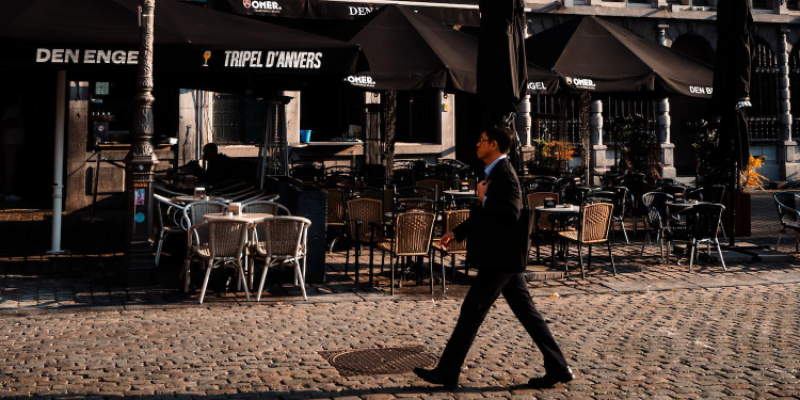
You've arrived in Antwerp and need to find your footing at the table. The city's food culture layers Flemish-Belgian comfort cooking, a deeply rooted beer-café tradition, and a walkable center where Michelin-recognized restaurants sit minutes from a frituur selling a large portion of fries for EUR 3.50. What catches many expats off guard is less the variety than the rhythm: restaurant kitchens typically close by 21:30, and many venues shut one or two days per week. The café, whether a traditional bruine kroeg (neighborhood pub-café) or a rooftop bar, functions as an all-day social anchor here, not just a place for a quick coffee.
Port history runs through Antwerp's food identity in visible, practical ways: a waterfront district rebuilt around restaurants and a street-food hall, a Chinatown opposite the main train station, and a café culture in which one beer order can anchor an entire evening. The city layers Flemish-Belgian comfort cooking, a deep beer café tradition, and a contemporary restaurant landscape that draws attention from international dining guides, all concentrated in a compact, walkable center.
The traditional bruine kroeg (neighborhood pub-café) remains one of the most distinctive social formats you will encounter in Antwerp. Unlike a bar focused purely on drink, these venues are all-day anchors where residents linger over Belgian beer and casual food from mid-afternoon into the evening. Rooftop bars, brasserie terraces, and cafés with outdoor seating extend the same unhurried social rhythm whenever the weather allows. Antwerp cafés play a role comparable to the pub as a neighborhood meeting place, but the emphasis falls on beer variety and long, seated sessions rather than quick rounds at a counter.
Dining is organized around specific districts and recurring city events rather than a single central strip. The offer spans brasseries, street-food halls, fine-casual venues, and Michelin-recognized gastronomy, with each neighborhood carrying a distinct character. For newcomers looking to explore multiple areas quickly, Smaakmeesters, Antwerp's annual city-wide food weekend, covers the historic center, Eilandje, Zuid, and Noord, with participating venues offering a house-specialty tasting for EUR 7 per dish. It runs typically in early October each year and gives new residents a structured way to sample several restaurants and neighborhoods in one weekend.
The dish most closely associated with Antwerp is stoofvlees, a Flemish beef stew slow-cooked in local beer until tender, then served with Belgian fries and often a chicory salad. Antwerp breweries localize the recipe by using De Koninck amber ale; Brasserie Antigoon (Oude Koornmarkt 22) keeps a version on its menu at around EUR 26, making it a useful first reference point for the classic preparation. The result is roughly comparable to a British beef-and-ale stew, but it arrives as a full main course alongside proper fries rather than with bread.
Belgian fries from a frituur (dedicated fry shop) are a separate category from any fast-food version, freshly fried in batches and served with a wide range of sauces. A large portion at a central outlet such as Frituur No. 1 costs around EUR 3.50. For something more filling, a mitraillette is the standard frituur sandwich: a large roll stuffed with a fried meat patty and a full portion of fries inside the bun, priced at around EUR 6.80 at neighborhood frituurs such as Frituur 't Half Kieke. Both options work well as a budget lunch or a late-night snack.
Antwerp's most distinctive confection is the Antwerpse Handjes: hand-shaped biscuits and chocolates tied to the city's founding legend of the giant Druon Antigoon. The designation has carried official Flemish regional product recognition since 2006; shops selling the authentic version include SJOKOLAT (Hoogstraat 33) and Château Blanc (Torfbrug 1). For the city's iconic beer, ordering een bolleke at any café means a glass of Bolleke De Koninck, the 5.2% amber ale brewed by Antwerp City Brewery De Koninck (Mechelsesteenweg 291) and available in virtually every café across the city. The phrase een bolleke is the standard local shorthand; using it signals that you know what you are ordering.
Join the Antwerp community
Get regular tips and advice to make the most of your expat life
Types of dining in Antwerp
Antwerp's restaurant range covers the full spectrum without significant gaps. At the everyday end, bakeries and cafés are open throughout the day for coffee, pastries, a light lunch, or a beer; these feed into the brewery format, a full café-restaurant serving cooked meals alongside drinks for most of the day. The Belgian brasserie has no close equivalent in many dining cultures: it sits somewhere between a gastro-pub and a casual restaurant, open across meal services and comfortable for both a quick plate and a longer evening. At the top of the range, Michelin-recognized restaurants and Bib Gourmand venues give the city a genuinely competitive fine-dining offer within a compact area.
For groups or anyone wanting to sample several cuisines without committing to a single restaurant, WOLF Sharing Food Market at Felix Pakhuis in the Eilandje district is the main option: ten curated street-food restaurants, three bars, and an event space occupy a restored historic warehouse, making it practical for evenings out where preferences differ. Open-air markets add a further dimension: the Falconplein Sunday organic market and CRU Groenplaats at Groenplaats, a covered premium fresh-food market, both cater to shopping for cooking at home rather than eating on site. Fast food and international casual chains sit alongside frituurs as the quickest and cheapest option across the city, with a fast-food combo meal running around EUR 12, and food delivery platforms extending all of this to home and office.
Neighborhoods for food in Antwerp
The Historisch centrum (historic center) around Grote Markt and Oude Koornmarkt gives first arrivals the easiest entry point: Belgian brasseries, beer cafés, Antwerpse Handjes shops, and a broad mix of international restaurants are all within walking distance of each other and the main landmarks. The area works well for exploring on foot before you know the rest of the city.
Just south of the Meir shopping street, the Theaterbuurt (also referred to as the Quartier Latin) carries a local rather than tourist character: traditional pubs, neighborhood cafés, and casual restaurants give it the feel of an everyday residential quarter, making it a practical choice for regular eating and drinking rather than one-off occasions. Het Zuid (Antwerp South) is where many food-focused residents gravitate for contemporary dining, with modern restaurants in a relaxed setting away from the busiest tourist routes; the neighborhood rewards a deliberate visit rather than a passing walk.
The Eilandje waterfront around the MAS museum offers restaurants and bars in a regenerated former harbor setting, with the WOLF food market at Felix Pakhuis adding a street-food-hall dimension well suited to group evenings. For destination dining, Groen Kwartier is the address to know: this car-free redeveloped quarter is home to upscale restaurants including the gastronomic restaurant of Michelin-starred chef Frédéric Chabbert at De Aarde. The Diamond District, near Centraal Station, has a distinct culinary identity of its own: traditional Ashkenazi Jewish restaurants and certified kosher dining are concentrated here, a combination that is internationally uncommon and worth knowing about before you start exploring the city's full restaurant range.
Antwerp's port history and successive waves of immigration have produced a genuinely diverse international restaurant scene with real community roots, not one built primarily for tourists. Asian, Latin American, Italian, Jewish, African, and Middle Eastern food are all represented in restaurants, specialist shops, and community businesses across the city.
The most concentrated international food district is Chinatown on and around Van Wesenbekestraat, directly opposite Centraal Station: Chinese restaurants, Asian bakeries, and grocery shops line the street, and the area also draws Vietnamese, Thai, and broader Asian dining. Sun Wah (Van Wesenbekestraat 16-18) is the main Asian supermarket serving the community, stocking rice, noodles, sauces, fresh produce, and Korean and Japanese specialties. For a broader Asian grocery selection in the city center, Amazing Oriental Antwerpen at the Stadsfeestzaal carries ingredients from across the region, including Japanese, Thai, Chinese, and Indian cooking essentials.
Latin American food has a dedicated presence through Almacén Store (Reyndersstraat 8) in the historic center, which sells dry and frozen Latin American products and offers home delivery. Italian-influenced dining appears at FOUR, a modern Italian-American restaurant by the water. East African ingredients and cultural goods are available through Habesha Store, which stocks Ethiopian and Eritrean food, spices, and drinks with European shipping. On the creative Asian-fusion side, Mico & Jon, now on Kloosterstraat after relocating from near Antwerp South, operates as a full-scale restaurant and represents the city's appetite for Asian-influenced cooking well beyond the traditional Chinatown formats.
Grocery shopping in Antwerp
Antwerp has a well-layered supermarket landscape across all price levels. For cost-conscious weekly shops, the budget end is covered by Colruyt, ALDI, and Lidl, all focused on low prices and straightforward assortments. Albert Heijn's own-brand Prijsfavorieten range and its Bonus promotions offer competitive pricing within a mid-market selection. One step up, Delhaize carries a strong fresh-food and branded-product range, while Carrefour operates city-format Carrefour Express stores across Antwerp, with fresh, organic, local, and ethnic ranges available with seven-day opening. Colruyt Group's urban convenience format, Okay City, has seven stores across the city, covering drinks, household products, fruit and vegetables, meat, fish, bread, and pastries for everyday top-up shopping.
For premium shopping, CRU Groenplaats at Groenplaats is a covered fresh-food market suited to quality produce and special-occasion ingredients rather than routine budgeting. Antwerp's network of weekly outdoor markets adds a further option for fresh food with a market atmosphere. The most central are Theaterplein/Oudevaartplaats (Saturdays 08:00-16:00 and Sundays 09:00-14:00, with themed Exotic and Bird market editions), Dageraadplaats in Zurenborg (Thursdays 08:00-13:00), and Sint-Jansplein (Wednesdays and Fridays 08:00-13:00). The Falconplein market (Sundays 08:00-16:00) runs specifically as an organic food market, offering a practical alternative to premium supermarket organic ranges.
Specialist international grocery shopping is well covered across the city. Sun Wah in Chinatown and Amazing Oriental at the Stadsfeestzaal together cover the main Asian grocery needs. For South Asian ingredients specifically, Euro Superstore (Lange Kievitstraat 14) specializes in Indian groceries: dry fruits, snacks, spices, chutneys, sauces, dairy, fresh vegetables, ice cream, and frozen products.
Online grocery delivery covers the Antwerp region. Albert Heijn thuislevering delivers across Greater Antwerp with a EUR 60 minimum order and 30-minute delivery-slot precision. Carrefour offers Drive, Delivery, and Fast Delivery options via its website or app. A realistic monthly grocery budget for one person in Antwerp runs EUR 240-EUR 400, with budget supermarkets bringing costs toward the lower end and premium or specialist shopping pushing toward the higher end.
Eating out costs in Antwerp
Street food from a frituur is the most affordable regular eating option: a large portion of Belgian fries costs around EUR 3.50, and a filling mitraillette sandwich runs around EUR 6.80. Both work as a practical budget lunch or a late evening snack without any commitment to a sit-down table.
At a traditional brasserie, a main course such as stoofvlees with fries costs around EUR 26. Adding a Bolleke De Koninck at EUR 3-4 brings a typical brasserie lunch or dinner for one to roughly EUR 30-35 before dessert. A fast-food combo meal runs around EUR 12, a useful mid-tier reference point for anyone calibrating daily spending. Eating-out costs in Antwerp are broadly comparable to those in a mid-range UK city, for example: cheaper than London for sit-down dining, but not dramatically inexpensive overall.
For day-to-day meals, most expats use bakeries, lunch cafés, frituurs, and delivery for routine meals and reserve full-service restaurants for social occasions. Antwerp's Smaakmeesters food weekend, held annually in early October, offers a structured way to try multiple restaurants at EUR 7 per tasting portion across participating venues in the historic center, Eilandje, Zuid, and Noord, making it a good early tool for orienting yourself across the city's dining landscape.
Vegetarian and vegan dining is easy to find across the city. De Broers van Julienne is a fully vegetarian restaurant with vegan options available on request, and NaNoi Thai restaurant offers many dishes adaptable to vegan on request. Mixed restaurants across the city label vegetarian options on their menus, and fine-dining venues can accommodate vegetarian menus with advance notice.
Halal options require venue-by-venue checking rather than assuming broad availability. Bar Chapel states that all its finger-food items are halal-sourced, and a number of casual venues across Antwerp serve halal chicken. Formal halal certification is not always displayed, so diners who require certified halal should ask directly before booking rather than relying on menu descriptions alone.
Kosher dining is concentrated near the Diamond District. Restaurant Eighteen offers kosher fine dining and events, with food and drinks certified by the rabbinate Shomre Hadas and supervised at all times by a mashgiach. Hoffy's kosher restaurant in the 2018 postcode is a further certified option. The offer is narrower than vegetarian dining and limited to specific certified venues, so planning ahead is necessary.
Gluten-free options exist but are uneven across the city. Satay labels gluten-free dishes on its menu; De Broers van Julienne can provide gluten-free catering on request. Cross-contamination controls vary by kitchen, so diners with coeliac disease should ask specifically about preparation practices when booking, not just whether a dish appears on the menu without certain ingredients.
Belgian law requires food businesses, including restaurants, to make allergen information for non-prepacked food clearly and immediately accessible. Practice varies by venue, so for serious allergies, always book ahead and confirm that the kitchen can manage cross-contamination at the preparation level.
When communicating dietary needs in Dutch, the following phrases cover the most common situations: Ik ben allergisch voor … ("I am allergic to …"); Is dit gerecht vegetarisch/veganistisch? ("Is this dish vegetarian/vegan?"); Bevat dit gluten/noten/melk/ei? ("Does this contain gluten/nuts/milk/egg?"); and Kunt u kruisbesmetting vermijden? ("Can you avoid cross-contamination?"). Restaurant staff in Antwerp widely speak English and French, so switching languages is generally straightforward.
Food delivery in Antwerp
Three main platforms cover food deliveryin Antwerp. Takeaway.com has the broadest city coverage, serving central streets and multiple neighborhoods. Uber Eats and Deliveroo are both active in named Antwerp areas. Coverage is strongest in central and densely populated districts; addresses on the outer edge or on Linkeroever should check platform availability for their specific postcode before counting on reliable delivery.
Delivery fees on Takeaway.com range from EUR 0 to EUR 5.99 depending on the restaurant and order value; a Takeaway.com+ subscription removes the per-order delivery fee on an unlimited basis. Uber Eats applies a EUR 2 small-order surcharge on restaurant orders below EUR 8 rather than a universal minimum order threshold. For grocery top-ups without a supermarket trip, Uber Eats has a dedicated grocery category for Antwerp, and Deliveroo includes groceries alongside restaurant food in its Belgium service. Tipping delivery riders is optional; you can add it via the app at checkout on platforms such as Deliveroo, and there is no fixed expectation comparable to North American practice.
Reservations are recommended for sit-down restaurants in Antwerp, especially in the evenings, on weekends, or for groups. Most restaurants handle direct online booking through their own websites; look for a Reserveer een tafel button rather than assuming a centralized booking platform covers all venues. Restaurant Nebo's reservations page illustrates the standard approach: book directly, arrive on time, and confirm your headcount in advance.
Punctuality matters more than in some dining cultures. Many Antwerp restaurants hold a reservation for only 15 minutes before releasing the table; some casual venues during busy periods also impose a maximum sitting time of one to two hours. Arriving at your booked time avoids both outcomes. One practical surprise for newcomers is that many restaurants close one or two days per week and do not serve every meal service: Monday and Tuesday are the most common closing days, and it's worth checking kitchen hours before you travel across the city.
Card and contactless payment are standard across established restaurants and cafés. Accepted cards include VISA, Mastercard, Maestro, and American Express; Payconiq, a Belgian mobile-payment app, is also widely accepted and worth setting up once you have a Belgian bank account. Bill splitting is common in informal settings.
Tipping carries none of the fixed-percentage expectation that is standard in North American dining: the local norm is to round up the bill or leave a few euros in cash when service has been good. Service costs are generally included in Belgian restaurant pricing, so leaving no tip is not read as an insult.
Dinner in Antwerp restaurants typically starts between 18:30 and 21:30, with the most popular booking slots clustering around 19:00-20:00; kitchens close within that window, so arriving after 21:30 risks limited options or a closed kitchen entirely.
Frequently asked questions
Antwerp is best known for stoofvlees (Flemish beef stew slow-cooked in De Koninck amber beer) served with fries, Belgian fries from the frituur, Antwerpse Handjes (hand-shaped biscuits and chocolates tied to the city's founding legend), and Bolleke De Koninck beer. Beyond these classics, the city has a strong Michelin-listed fine-dining scene, a vibrant street-food and food-hall culture, and an internationally diverse restaurant offer shaped by its port-city history, including Chinatown, kosher dining in the Diamond District, and Latin American and African food businesses.
Antwerp cafés function as all-day social hubs rather than simple daytime coffee stops. Traditional bruine kroegen (neighborhood pub-cafés), terraces, beer-specialist venues, and rooftop bars all form part of the landscape. Beer menus and outdoor terraces are central to café culture whenever the weather allows, and it is common to spend a long evening at a single table over several rounds rather than moving on quickly. The format sits closer to a relaxed continental café-bar than to a purely food-focused restaurant.
Dinner in Antwerp restaurants typically starts between 18:30 and 21:30, with the most popular booking slots clustering around 19:00 to 20:00. Arriving at 21:30 or later may mean a kitchen is already closing down. If you are coming from a culture where dinner starts later, treat 19:00 to 20:00 as the practical default and book in advance rather than arriving without a reservation.
It depends on the format. A brasserie main course runs around EUR 26, and a fast-food combo around EUR 12, so daily restaurant meals add up quickly. The sustainable everyday approach is to use frituren (fries and snacks from around EUR 3.50), bakeries, lunch cafés, and delivery for routine meals, and reserve sit-down restaurants for social occasions. Food halls such as WOLF at Felix Pakhuis and outdoor markets also offer affordable variety without full restaurant prices.
Yes, card and contactless payment are standard in established Antwerp restaurants and cafés. Accepted cards typically include Visa, Mastercard, Maestro, and American Express, and Payconiq, a Belgian mobile-payment app, is also widely accepted and worth setting up once you have a Belgian bank account. Small food vendors, market stalls, and very informal frituren may still prefer cash, so keeping a small amount of euros on hand remains practical.
Tipping is appreciated but not mandatory and carries no fixed percentage. The local norm is to round up the bill or leave a few euros in cash when service has been good; service costs are generally included in Belgian restaurant pricing. A North American-style 15 to 20 percent tip is not expected and would seem unusual. For food delivery, tipping riders is optional and can be added through the app at checkout.
Delivery is well established across the city, with Takeaway.com, Uber Eats, and Deliveroo all active. Coverage and speed are strongest in central and densely populated neighborhoods; addresses on the outer edge of the city or on Linkeroever should check platform availability for their postcode before relying on delivery. For time-sensitive meals or group occasions, ordering early or collecting directly is safer than depending on peak-hour delivery windows.
The most common surprises are: dinner starts earlier than in Southern Europe, with kitchens typically open from 18:30 to 21:30; many restaurants close one or two days per week and do not serve every meal service, with Mondays and Tuesdays being the most frequent closing days; free tap water at the table is not automatic even though tap water is perfectly safe to drink; and Belgian cafés double as social hubs for long beer-and-food sessions rather than quick stops. Cards are accepted nearly everywhere, but tipping is modest by North American standards.
Full-service restaurant kitchens in Antwerp commonly close by 21:30, so late-night sit-down dining is not the standard pattern. Some bars, cafés, and nightlife-oriented venues stay open later, but their kitchen hours are often more limited than their bar service. For arrivals after peak dinner hours, frituren, casual bars, street food, and food-delivery platforms are the most reliable options.
ℹ️
We do our best to provide accurate and up to date information. However, if you have noticed any inaccuracies in this article, please let us know in the comments section below.
I fell in love with words at an early age After a break to focus on my studies, I rediscovered the joy of writing while keeping a blog during my years between London and Madrid. This passion for storytelling and for exploring new cultures naturally inspired me to create Expat.com, a space for my own reflections as well as for anyone wishing to share their experiences and journeys abroad.