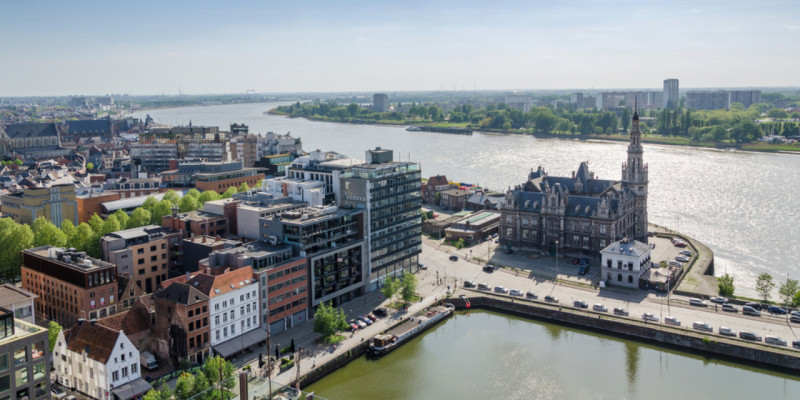
Many expats who move to Antwerp underestimate how sharply the job market divides along language lines. Dutch is the working language of Flanders, and most roles in administration, retail, and local services require at least functional proficiency. Yet the city's port, chemicals sector, and diamond trade pull in international talent on English-language contracts, creating a genuine but narrower parallel market for newcomers without Dutch. Antwerp's employment geography is also unusually clustered: where your employer sits, whether in the port zone, the Diamond District near Central Station, or the Blue Gate Antwerp campus in the south, shapes your daily commute as much as your career path.
The single largest employment cluster in Antwerp is the port zone on the right bank of the Scheldt, where around 1,400 companies operate across maritime logistics, port operations, petrochemicals, chemicals, oil and gas, warehousing, inspection, and customs. The Port of Antwerp-Brugesport ecosystem forms the core of Europe's largest integrated chemical complex, which means technical, engineering, and industrial roles are not just present but genuinely numerous. If your background is in shipping, engineering, chemicals, or industrial services, this is where the deepest demand in the city sits.
The city center tells a different story. The stretch from Central Station down the Meir commercial spine and into Antwerp South concentrates retail, hospitality, fashion, design, galleries, cultural production, and professional services. Multilingual customer-facing roles, creative and design positions, and business-services functions are most available here, making this district the realistic target for expats in those fields.
South of the center, the Blue Gate Antwerp and BlueChem campus represent Antwerp's expansion into sustainable industry. Belgium's first eco-effective water-bound business park, BlueChem focuses on sustainable chemistry, the circular economy, clean tech, bio-based activities, CO2 and hydrogen innovation, and mechanical and chemical recycling. The site also includes dedicated space for start-ups, scale-ups, spin-offs, and pilot projects in sustainable chemistry and energy technology, making it the most relevant cluster for technical, R&D, engineering, and production specialists who want to work in the emerging sustainability sector.
The Beacon, an independent non-profit co-founded by the City of Antwerp, Port of Antwerp, Lantis, University of Antwerp, Agoria, and Imec, functions as Antwerp's main port-technology and digital-innovation network. Unlike a traditional office district, it connects employers and professionals working across port technology, mobility, logistics innovation, digital infrastructure, and smart-city roles. Positions here tend to sit in technology, data, and engineering rather than operational or administrative functions.
The Diamond District, centered on Hoveniersstraat near Central Station, is internationally oriented by trade culture but highly specialized and network-driven. The Antwerp World Diamond Center (AWDC) describes Antwerp as the diamond trade capital of the world. Access to roles here is most realistic for candidates with backgrounds in diamond polishing, sorting, gemology, compliance, trade finance, or high-value-goods logistics; entry is largely through specialist channels rather than general job boards.
The practical first stop for any Antwerp job search is VDAB (Vlaamse Dienst voor Arbeidsbemiddeling en Beroepsopleiding), the Flemish public employment service. Filtering VDAB to Antwerp returns vacancies across logistics, administration, life sciences, finance and accounting, sales engineering, retail, hospitality, and operational roles. For EU and EEA nationals, EURES (European Employment Services) also supplies Belgian vacancies from partner public employment services and supports cross-border recruitment coordination.
For private-sector and professional roles, StepStone Belgium and LinkedIn are the platforms Belgian hiring managers and recruiters use most. StepStone covers skilled trades, communications, administration, and corporate functions in the Antwerp area. LinkedIn is widely used for professional, tech, finance, logistics, and international-company vacancies, and supports direct recruiter contact and language-filtered searches.
Port-specific roles require dedicated channels. Havenjobs aggregates logistics, maritime customer service, administrative, and port-related vacancies from Antwerp employers and agencies. The Port of Antwerp-Bruges jobs portal lists direct vacancies with the port authority itself, covering specialized port, engineering, technical, maritime, operations, and corporate profiles.
For diamond-sector roles, AWDC Jobs (Antwerp World Diamond Centre, Hoveniersstraat 22, 2018 Antwerp) is the specialist channel, covering vacancies across diamond companies in an internationally oriented trading environment. It is most useful for candidates with experience in diamond polishing, sorting, gemology, compliance, logistics, or luxury goods. From 1 January 2026, the Flemish Government recognizes diamond polishers and diamond sorters as medium-skilled shortage occupations, meaning Antwerp diamond employers can hire non-EU candidates in these roles via a simplified single-permit route without a prior labor-market test. This applies specifically to these listed shortage occupations and not to general diamond-office or administrative roles.
For finance, accounting, office support, technology, engineering, sales, and corporate profiles, contacting recruitment consultancies directly improves results. Michael Page Antwerp operates as a regional hub for BeLux professional and executive recruitment. Robert Half Antwerp, at Roderveldlaan 4, specializes in finance, accounting, administration, and technology. Hays Antwerp, at Noordersingel 23 C4, covers specialist professional markets across Belgium and operates an English-language candidate site.
Dutch is a significant factor in most Antwerp job searches. Many local-facing roles in administration, marketing, retail, and public services require at least working Dutch. English is sufficient for a narrower range of positions: international logistics, port-linked corporate functions, diamond-sector specialist roles, tech and corporate support, and multilingual sales. Candidates without Dutch should concentrate on those niches while actively building Dutch-language skills to widen options over time.
Belgian employers expect a standard international CV accompanied by a cover letter. Submitting an application without a cover letter reduces your chances with most Flemish employers. Plan for a search measured in months if you are arriving without a role already secured and without strong Dutch; candidates with shortage skills, port or logistics experience, diamond-sector backgrounds, or language-specific sales profiles tend to move more quickly. Translating CV keywords into Dutch for Dutch-language vacancies and being available for in-person interviews both strengthen a candidate's position in a competitive local market.
Get regular tips and advice to make the most of your expat life
Salaries and benefits in Antwerp
Belgian job offers are quoted in gross monthly salary, and the net figure after deductions is materially lower than newcomers often expect. Employees contribute 13.07% of gross salary in social security, and personal income tax is withheld on top of that. Always request a net salary simulation before accepting an offer: the gap between the headline gross figure and take-home pay is significant across all salary levels.
Belgian healthcareworks differently from employment systems where the employer provides insurance directly. Every employee must register with a mutualiteit (health insurance fund) or the public Auxiliary Fund when starting work. Coverage applies from the date of affiliation and is financed through compulsory social-security contributions rather than as a separate employer benefit, so it follows the worker rather than being tied to a specific employer.
Statutory paid annual leave is 20 days for a full-time, 5-day-week employee, plus 10 public holidays per calendar year. Workers may not normally be required on site on public holidays; if a holiday falls on a Sunday or non-working day, a substitute rest day is due. Regarding sick leave, the employer guarantees full salary during the first period of incapacity. From day 15, the obligation shifts to a combination of employer payment and a sickness-insurance ceiling under the RIZIV/INAMI national sickness and disability insurance scheme, with daily rates depending on the worker's salary level and the applicable insurance ceiling. Unlike purely discretionary sick-pay arrangements, these obligations are set by statute and the employer cannot reduce them unilaterally.
Parental leave entitlements are established by law and apply from the first day of work. Maternity leave is 15 weeks, with up to 6 weeks available before the expected birth date and 9 weeks after, with an extended framework for multiple births. Birth leave (paternity or co-parenting leave) is 20 days for any worker whose parentage is established, regardless of whether the contract is full-time or part-time, and must be taken within 4 months of the birth.
Notice periods on open-ended contracts are determined by seniority and whether the termination is a resignation or dismissal. For contracts started from 1 June 2026 onward, a revised notice table applies; for contracts predating that date, the earlier table remains in force. The current notice-period rules are published by the Federal Public Service Employment. Because notice periods are governed by statute and collective agreement rather than solely by employer discretion, it is worth checking the applicable rules before signing.
A year-end bonus or 13th-month premium is not a universal statutory right, but most sectors and companies provide one through collective agreements. The entitlement and amount depend on the applicable joint committee and company rules, so checking the relevant sector agreement when evaluating an offer is practical. Beyond salary, most Antwerp employers include meal vouchers (maaltijdcheques), a transport allowance for home-to-work travel, an annual bonus, and a training budget as standard components of the package. These benefits add meaningfully to gross pay and should be weighed alongside headline salary figures when comparing competing offers.
Work culture in Antwerp
Most office workers in Antwerp operate under flexible working hours: there is no fixed start or end time, and employees spread their weekly hours according to personal and operational needs. Fixed schedules with a defined start time, end time, and a compulsory unpaid lunch break of at least 30 minutes after 6 hours of work are standard for front-line, retail, and certain public-service roles. Asking which arrangement applies before your first day avoids misunderstandings on either side.
Antwerp's workplace communication style is direct and task-focused. Punctuality is expected, and meetings tend to be structured rather than open-ended. Public-sector and port/logistics employers apply formal HR frameworks, while university-linked and some private employers offer more team-based flexibility. What distinguishes Belgian workplaces is the degree to which these norms are codified: notice periods, working-time rules, and the terms of any telework arrangement are governed by law or collective agreement rather than purely by employer discretion. This means your rights on each of these points are established before you start, which is worth understanding at the contract stage rather than discovering later.
Hybrid and remote work is available in office, tech, professional-service, and corporate roles, but arrangements are becoming less generous. A Flemish Government update now directs public-sector staff to spend at least half their working time at an office, satellite office, or with clients. University of Antwerp staff with teleworkable functions and at least 50% employment retain at least one home-working day per week. Expect little or no remote flexibility in port operations, logistics, manufacturing, retail, hospitality, and public-facing services. Belgian law requires a written telewerk (telework) agreement for structural homeworking; if one is not offered upfront, ask for it before accepting a role.
Work relationships in Antwerp are built through reliable collaboration and visible team participation. Cross-department cooperation is valued in city and public-sector environments, while port and industrial employers emphasize work-life balance and team cohesion as part of their employer proposition. Before joining, ask specifically for the written telework agreement, expected in-office days, the applicable lunch-break rule, and whether flexible hours apply from day one.
Getting to work in Antwerp
Commuting in Antwerp follows a car-led but multimodal pattern. Cycling has doubled in Belgian urban commuting over the past 20 years and is especially strong across Flanders; workers in city-center offices and along tram and rail corridors actively use public transport. The car remains the largest single commuting mode overall, but the right combination of cycling, public transport, or employer shuttle depends entirely on where you live relative to your worksite.
Rush hour is genuinely stressful. The main peak windows are broadly 06:30-10:00 in the morning and 16:00-18:00 in the evening, with SNCB's rail pricing peak defined more narrowly as 06:01-08:59 and 16:01-17:59 on weekdays. Infrastructure works affecting tunnels, tram lines, and Scheldt crossings mean the fastest route can change day to day; Slim naar Antwerpen publishes current works and alternative-route guidance and is a practical resource to check before committing to a commute plan.
Workers in city-center and Berchem office roles have the widest choice of modes: walking, cycling, tram, bus, and rail from Antwerp-Central all converge here. Living in the historic center, Eilandje, Zuid, Borgerhout, or Berchem reduces daily commute friction for retail, creative, hospitality, and professional-service roles. Berchem offers a more residential feel while retaining tram, bus, and rail connections. For workers at Blue Gate Antwerp or BlueChem in the south of the city, checking the specific site entrance and available connections before signing a lease is worthwhile; neighborhoods in Antwerp Zuid, Kiel, and areas adjacent to Hoboken can reduce travel time, while proximity to Berchem or Central Station suits dual-career households who also need rail access.
Port zone jobs often sit on secured industrial sites where standard public transport is limited or absent. Ask your employer before arriving whether they participate in the Pendelbus or I-BUS collective shuttle schemes, as access depends on employer affiliation rather than general public routes. The Port of Antwerp-Bruges Bike Bus transports cyclists and their bicycles across the Scheldt and Channel Basin for workers who cycle to port worksites. For port commuters living on the Left Bank (Linkeroever), Scheldt crossings are available via the St Anna Tunnel, the St Anna Ferry, and the Kennedy Cycling Tunnel.
Cycling to work is realistic for inner-city commutes and for routes that combine a bike leg with public transport. Antwerp is flat and has an expanding cycling network, though tunnel and tram infrastructure works can temporarily alter the best routes. For office roles, a bike-plus-tram or bike-plus-rail combination frequently outperforms driving during peak periods. Before signing a lease, test your planned route at peak hours rather than assuming a car will be fastest.
Good to know:
De Lijn is the Flemish public tram and bus operator serving Antwerp city routes, while SNCB/NMBS is the Belgian national rail operator connecting Antwerp to surrounding cities and suburbs.
Frequently asked questions
The market is active but competitive, and Dutch proficiency significantly widens available options. The strongest demand for expat-accessible roles sits in port logistics, maritime services, chemicals, life sciences, finance and accounting support, technical trades, and multilingual commercial functions. English-only candidates can find roles, but in a narrower range concentrated in international companies, port-linked employers, and specialist technical positions.
The dominant sectors are port logistics and maritime services, petrochemicals and chemicals (Antwerp hosts Europe's largest integrated chemical cluster), the diamond trade, retail and wholesale, creative industries including fashion and design, life sciences, and public services. Blue Gate Antwerp is expanding Antwerp's footprint in sustainable chemistry, circular economy, and clean tech.
Employment concentrates in five clusters: the port and harbor zone for logistics, shipping, and chemicals; the city center and Meir for retail, offices, and services; the Diamond District near Central Station for diamond trade; Blue Gate Antwerp in the south for sustainable chemistry and clean tech; and The Beacon innovation hub for PortTech and digital roles. If your job is port-linked, check the exact site address before choosing housing, because many worksites are outside the historic center.
The City of Antwerp employs more than 7,500 people across municipal services. The port ecosystem brings together around 1,400 companies in logistics, maritime, chemicals, and industrial services under the Port of Antwerp-Bruges authority. Universities, hospitals, and public-service institutions are also major employers. Searching by sector cluster (port/logistics, chemicals, life sciences, public services) is often more productive than targeting a single ranked employer list.
Start with VDAB, the Flemish public employment service, for the full Flemish market filtered to Antwerp, then add LinkedIn, StepStone, Havenjobs, and sector-specific boards such as AWDC Jobs for the diamond sector. For professional roles, contact Antwerp offices of Michael Page, Hays, or Robert Half directly. If you are non-EU, check whether your role and salary meet Flanders' economic-migration thresholds before applying. Starting Dutch-language classes accelerates the process significantly for most positions.
Belgian salaries are discussed in gross monthly terms, and the net figure after the 13.07% employee social security contribution and income tax is substantially lower than the headline number. Sector collective agreements set minimum pay scales for most industries. Most companies also pay a year-end bonus or thirteenth-month premium, and standard fringe benefits such as meal vouchers, a transport allowance, and sometimes a training budget form part of the real package. Always request a net salary simulation when evaluating an offer.
Expect a direct, punctual, and structured work style underpinned by written HR rules on schedules, telework, and working time. Many office workers operate on flexible hours without a fixed start or end time. In multinational, port, logistics, and life-sciences environments English is often used internally, but Dutch remains an advantage for integration and client-facing work. Evaluate the full package, including gross salary, net pay, meal vouchers, transport allowance, and hybrid arrangements, rather than headline figures alone.
It varies sharply by worksite. City-center and Berchem office roles are reachable by tram, bus, rail, cycling, or walking, and a bike-plus-tram combination often outperforms driving during peak hours. Port and industrial-zone jobs often require a car, an employer shuttle, or a cycling-plus-public-transport combination. Rush hour runs broadly from 06:30 to 10:00 in the morning and 16:00 to 18:00 in the evening, and ongoing infrastructure works add disruption on some corridors. Check your exact employer site address before choosing where to live.
Hybrid and remote arrangements exist in office, tech, corporate, and professional-service roles, but are becoming less generous. A Flemish Government update requires public-sector staff to spend at least half their working time on-site. Belgian law requires a written telework agreement for structural homeworking. Expect minimal remote flexibility in port operations, logistics, manufacturing, retail, and hospitality. Always clarify the specific employer policy before accepting an offer.
ℹ️
We do our best to provide accurate and up to date information. However, if you have noticed any inaccuracies in this article, please let us know in the comments section below.
I fell in love with words at an early age After a break to focus on my studies, I rediscovered the joy of writing while keeping a blog during my years between London and Madrid. This passion for storytelling and for exploring new cultures naturally inspired me to create Expat.com, a space for my own reflections as well as for anyone wishing to share their experiences and journeys abroad.