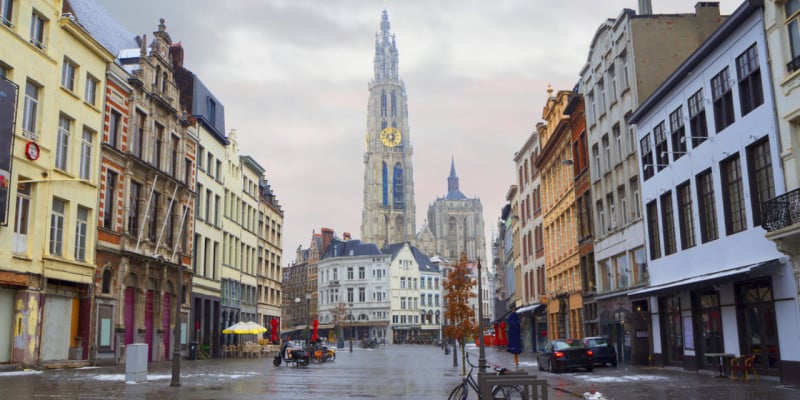
Renting in Antwerp means navigating a market where the postcode on a listing tells you almost as much as the price. The city is organized into ten administrative districts, each with its own rent level, character, and commute profile: a studio in the historic center (postcode 2000) starts around EUR 925 furnished, while a room in outer Stuivenberg can cost as little as EUR 500. Standard residential leases in Flanders run for nine years, a legal framework very different from short-term rental norms elsewhere in Europe, and the rental guarantee alone can reach three months' rent before you move in.
Start your search with the postcode, not the city name. Antwerp is organized as a single municipality containing ten districts, and each postcode signals a distinct neighborhood with its own rent level, character, and commute profile. A listing in postcode 2000 (historic centre) and one in 2060 (north of the centre) can differ sharply in price and feel even though both appear under "Antwerp" in a search. Check the postcode on every listing before comparing prices.
The historic center (Antwerpen district, postcode 2000), Zurenborg, Het Zuid, 't Eilandje and Berchem share stronger walkability, a deeper pool of furnished and apartment options, and clearer links to workplaces, public transport, and everyday services than the outer districts.
The historic center is the most convenient choice if you are arriving without a car. Walking access to shops, cultural venues, and Antwerpen-Centraal station makes it easy to settle quickly. The trade-off is price: it is the most expensive part of the city, with furnished studios starting around EUR 925 and one-bedroom apartments from EUR 1,418. The housing stock runs mainly to apartments and renovated city units, which suits single professionals and short-stay expats well but leaves families with limited options.
Zurenborg (postcode 2018) sits south-east of the center and is known for its Art Nouveau townhouses and the café square at Dageraadplaats. It draws professionals and couples who want a genuine neighborhood feel while staying close to central Antwerp. Rents here sit at a premium: a 185 m² four-bedroom penthouse was listed at EUR 2,400 per month plus EUR 175 in charges, which gives a sense of the ceiling. Budget options are scarce.
Het Zuid (The South) is Antwerp's arts and gallery district, centered around the Royal Museum of Fine Arts area. Renovated apartments and townhouses at premium rents define the stock, making it a strong option for culture-focused expats who want polished surroundings without being directly in the busiest part of the historic core. 't Eilandje, by contrast, is a regenerated dockside area north of the historic center, popular for its modern waterfront apartments and newer building stock. It sits at a mid-price tier relative to the historic center and Het Zuid, and works well for young professionals and short-stay expats who want contemporary surroundings close to the port area.
Berchem is a practical mid-price residential district south-east of the center, well suited to families, students connected to Middelheimcampus or Campus Groenenborger, and commuters using Antwerpen-Berchem station. It sits between the center and the outer residential areas and offers a wider range of apartment and family-house options than the historic core. Families and those on a tighter budget should also look at Wilrijk, an outer residential district that offers more space and quieter surroundings at a mid-price level, particularly for those whose daily destination is one of the southern campuses.
For the most budget-conscious approach, Stuivenberg (north of the center) and Merksem (outer north) represent the lower end of the market in the data. Student room listings in Stuivenberg have ranged from EUR 500 to EUR 550 excluding charges; a furnished room in Merksem was listed at EUR 675 excluding charges. Deurne, a large outer district, can also offer more space at lower prices than central Antwerp, but the exact address matters: Deurne stretches across a wide area, so verify the actual commute time rather than relying on the district name alone.
Your daily destination should drive the neighborhood decision. Students and staff whose campus is in the city center or near 't Eilandje benefit most from central Antwerp; those connected to Middelheimcampus or Campus Groenenborger are better served by Berchem, Wilrijk, or postcode 2020. If your workplace is in the north around the port, test peak-hour routes carefully before committing to a lease, as crossing the city can add significant travel time beyond what the straight-line distance suggests.
Safety in Antwerp varies by street rather than by broad district label. Antwerp police have carried out targeted operations against drug-related activity and public-order issues in specific parts of the city center and east. Visit any neighborhood you are considering at different times of day and check the immediate street environment before signing, rather than relying on district-level generalizations.
Good to know:
When comparing listings, be aware that Zwijndrecht, Mortsel, and Edegem are neighboring municipalities, not Antwerp city districts. Their listings may appear in broad Antwerp-area searches but carry different administrative rules and commute dynamics. Do not mix their prices into Antwerp city neighborhood comparisons.
Apartments are the most common rental type in Antwerp's private market. Studios and one- to two-bedroom apartments make up the bulk of available listings, offered both furnished and unfurnished. Unfurnished apartments dominate long-term listings; furnished units are more common in short-stay, serviced, and coliving formats. When you see appartement te huur in a listing, that simply means "apartment for rent"; gemeubeld or bemeubeld means furnished, and vrij vanaf tells you the date the property becomes available.
Furnished short-stay apartments and studios are well suited to newcomers who need an immediate base before signing a long-term lease. Several operators in the central Antwerp market offer furnished studios specifically for short-stay use, and some coliving buildings bundle a furnished private studio with shared amenities: a terrace, garden, laundry, bicycle storage, fitness room, and co-working space. These all-in formats cost more per month than an equivalent unfurnished long-term rental, but they eliminate the upfront cost and complexity of setting up separate utility contracts from scratch.
Coliving and co-housing are available in Antwerp as a distinct category. These typically involve a furnished private studio within a managed building, with common areas and services handled by the operator. They reduce setup time considerably and suit professionals or newcomers who want flexibility without negotiating a full standard lease.
Students have their own dedicated market. The University of Antwerp offers furnished single rooms with shared facilities at its residences, with all costs included in the monthly rent. Budget rooms at university residences are listed at EUR 338 per month including costs; rooms through Kotplace range from EUR 370 to EUR 490. Students who do not secure a university place can search private koten (student rooms) through Kotplace or through Kotweb. The University of Antwerp directs incoming students to Kotweb and recommends looking for the green quality label on rooms listed there. A kot is specifically student accommodation and is not used for professional rentals.
Houses for rent exist in Antwerp but are less common than apartments in the central and inner districts. Families seeking a house should focus their search on the outer districts (Berchem, Wilrijk, Deurne), where larger residential properties are more available. Rental agencies list larger apartments and houses through the same main platforms as standard apartments.
Get regular tips and advice to make the most of your expat life
Rental prices in Antwerp
Rents in Antwerp are not cheap by European standards, and the gap between the central and outer areas is meaningful. Almost all listings show a base rent plus monthly charges (often written as rent + charges, for example EUR 680 + EUR 130). Charges typically cover building maintenance and may include some utilities such as water or heating, but this varies by contract. Common charge amounts in the market run from EUR 130 to EUR 175 per month. Always confirm in writing what the charges cover and how they are settled, since some are fixed provisional amounts reconciled annually, while others are flat fees.
An unfurnished studio costs approximately EUR 680 to EUR 770 per month in base rent. A 43 m² studio in postcode 2020, for example, carries EUR 680 in rent plus EUR 130 in monthly charges. Furnished studios range from approximately EUR 925 to EUR 1,295, depending on location and what is included in the charges; the upper end of this range appears in postcode 2060. Fully furnished short-stay and coliving options, which bundle utilities and sometimes internet into the monthly fee, start from around EUR 1,267 for a furnished studio in central Antwerp.
For larger units, a furnished one-bedroom apartment runs from approximately EUR 1,418 to EUR 1,469 per month. A furnished two-bedroom apartment is around EUR 1,550 in the private market.
The neighborhood matters as much as the property type. The historic center (postcode 2000) is the most expensive tier across all categories. Postcode 2020 sits at a mid-level, and the budget-oriented outer areas (Stuivenberg, Merksem, Deurne) offer rooms from EUR 500 to EUR 675 in the student-adjacent market. When budgeting, add the monthly charges to the headline rent from the start; treating charges as optional extras is one of the most common missteps for newcomers arriving from markets where all-inclusive listings are the norm.
Finding accommodation in Antwerp
For standard long-term rentals, Immoweb and Zimmo are the two main Belgian listing portals, covering apartments, studios, and houses. Estate agents list on both platforms, so a search there surfaces both direct-landlord and agency-managed properties. Set up alerts for your target postcode, size, and budget so you are notified as new properties are added. For student rooms and koten, use Kotweb and Kotplace, the dedicated Belgian platforms for student accommodation.
Allow at least four weeks for an active search. Results come faster when you are already in Belgium and can attend viewings in person. Sending an online inquiry through a portal and waiting for a reply is often not enough: calling the agent or landlord directly after messaging significantly improves response rates. Prepare your income documents or enrollment proof before the first viewing, not after, so you can submit a complete file immediately when a property becomes available.
If you are relocating from abroad and cannot attend viewings immediately, arrange short-term accommodation first and begin your long-term search once you are on the ground. In-person viewings and same-day responses to listings give a material advantage in the Antwerp market. A furnished short-stay studio or serviced apartment is a practical first base while you search.
Most listing portals and landlord communications are in Dutch. Most agents and many landlords in the city can communicate in English or French, but lease documents will be in Dutch and should be read carefully or reviewed with a translator before signing.
Treat any listing that asks for payment before a signed lease or before an in-person verified viewing as high risk. Use established platforms, verify the property address independently, and avoid transferring a deposit to an unverified private account. The pace of the market creates pressure to act quickly; slow down any transaction that asks for upfront money before the landlord's identity, the property address, and the contract terms are confirmed in writing. The City of Antwerp's rental advice service offers practical guidance on navigating these situations.
How renting works in Antwerp
Residential rental contracts in Antwerp are governed by Flemish housing law. The default is a standard nine-year lease, the norm in Belgium, and it differs substantially from the shorter tenancy terms common in many other countries. A short lease of three years or less is also available, but it carries a critical procedural risk: if neither the tenant nor the landlord gives written notice at least three months before the end date, the short lease is automatically converted, retroactively from the start date, into a nine-year lease. A short lease may be renewed once in writing under the same conditions, provided the total combined duration does not exceed three years. Plan your exit date and notice requirements before you sign, not at the end of the tenancy.
The rental guarantee (huurwaarborg) is legally capped at three months' rent for private residential leases in Flanders. In practice, landlords in Antwerp ask for two or three months' rent before moving in. The deposit must be held through the federal e-DEPO system, which manages it digitally for both tenant and landlord so that neither party can access it unilaterally during the tenancy. Tenants who cannot pay the guarantee upfront may apply for an interest-free rental-guarantee loan from the Vlaams Woningfonds. If that loan is refused, Antwerp residents can ask their local social center to provide a written guarantee to the landlord on their behalf; only the person named on the rental contract can apply for this assistance.
Documents are requested in stages. Before a viewing, a landlord or agent may ask only for contact details: first name, surname, phone number, email address, and home address. After the viewing, they may request proof of income (bank statements, payslips, or certificates) and household composition to build a rental file. Once selected as a tenant, they may ask for a copy of your identity document and information about your marital or legal cohabitation status. Nationality must not be used as a selection criterion and is explicitly treated as discrimination-sensitive under Antwerp's equal-opportunity rental guidance.
Every residential lease signed in Antwerp must be registered with FPS Finance within two months of signature. Registration is handled online through MyRent or at the Antwerp registration office (FOD Financiën, Italiëlei 4 bus 3, 2000 Antwerpen). Do not leave this step until the end of your moving period.
Under a standard nine-year lease, a tenant may terminate at any time by giving three months' written notice. Leaving during the first three years triggers a financial penalty on top of that notice period: three months' rent if you leave in year one, two months' rent in year two, and one month's rent in year three. After the first three-year period, the tenant can exit with three months' notice and no additional compensation. The landlord may terminate with six months' notice for own occupation, or without specific grounds at the end of a three-year period by paying the tenant compensation of nine months' rent at the end of year three, or six months' rent at the end of year six. Factor these early-exit costs into your decision before signing a standard lease if you are unsure about your length of stay.
Antwerp rental properties must meet the housing quality standards set by the Vlaamse Codex Wonen. The city issues conformity certificates after inspection to confirm that a home and its building's common areas are safe and of sufficient quality.
Foreign newcomers in Antwerp face structural disadvantages that locals do not. The most common: no Belgian rental history, no locally verifiable income documentation, and no established network. Landlords and agencies legally assess income, payment reliability, and file completeness after a viewing, and many prioritize candidates with stable, locally verifiable income. The absence of a Belgian credit history is not a disqualifier in itself, but the absence of Belgian payslips or a local employer letter can be. Prepare proof of income or savings, a clear description of your employment or self-employment situation, identity details, and contact information before your first viewing, not after.
Rental discrimination based on ethnic origin is an identified problem in the Antwerp market. The city's own practice tests found that candidate tenants of ethnic origin were discriminated against in 19% of male tests and 15% of female tests; six out of ten estate agents did not discriminate. If you encounter discriminatory treatment, the Infopunt Discriminatie Huurwoningen is the official Antwerp channel for reporting and guidance on equal-opportunity rental rights.
Dutch is the working language of most rental interactions and all municipal housing pages. Newcomers are most likely to need Dutch support when reading and negotiating lease clauses, completing huurwaarborg assistance forms, understanding building inspection or conformity documents, and handling repair disputes with a landlord. Having a Dutch-speaking contact or using a professional translation service for lease review is practical risk management, not an optional extra.
The deposit is the biggest upfront financial hurdle. Budget for two to three months' rent as a guaranteed requirement before moving in, held via the e-DEPO system. If you cannot finance this yourself, apply first for an interest-free loan from the Vlaams Woningfonds; if refused, Antwerp's social centers can provide a written guarantee to the landlord on your behalf. Lease registration via MyRent within two months of signing is a legal obligation; handle it promptly.
Antwerp has four official support channels for tenants facing rental difficulties. Huurdersbond Antwerpen vzw (Langstraat 102, 2140 Borgerhout) provides free legal advice on rental matters and is referred to by multiple city housing services. The City of Antwerp's rental advice service offers general guidance and referrals, including on paying the rental guarantee. The city's mediation service for landlord-tenant disputes (Huurbemiddeling voor huurders) is free and available when both parties agree to participate. The Infopunt Discriminatie Huurwoningen handles discrimination questions and reports specifically in the rental housing market.
Utilities are not automatically included in Antwerp rents. They are bundled into the monthly cost in furnished short-stay apartments, coliving buildings, and serviced apartments, but in standard long-term private rentals, furnished or unfurnished, you will set up separate electricity, gas, internet, and possibly water contracts in your own name. Always check the lease and the charges breakdown before assuming any utility is covered.
Antwerp households choose a commercial electricity and gas supplier in the liberalized Flemish energy market. The physical distribution network for both is operated by Fluvius Antwerpen, whose charges are included in the bill from your chosen commercial supplier. When you move into a property, you open or transfer a supply contract in your own name with the supplier of your choice and receive a single monthly bill covering both supply and distribution charges. In apartment buildings with collective energy meters, the landlord or building manager may recharge consumption to tenants rather than each tenant opening individual contracts. Confirm before signing your lease whether energy is individually metered or collectively managed, and clarify how monthly charges are calculated and settled in that case.
Tap water in Antwerp is supplied by Water-link, the city's sole water provider. Combined heating, electricity, and gas costs for two people in an 85 m² Antwerp apartment run approximately EUR 175 per month. This figure excludes internet and mobile, so budget for those on top of rent and charges unless your landlord has explicitly confirmed utilities are bundled.
Main residential internet providers serving Antwerp include Proximus, Telenet, Orange Belgium, and mobile virtual network operators such as Mobile Vikings that sell service over the main networks. Home internet plans range from approximately EUR 29 to EUR 89.49 per month depending on provider, speed, and whether a mobile bundle is included. Typical residential speed options range from 100 Mbps to 500 Mbps; availability depends on the address and should be verified for the exact rental property before signing a contract. You can compare current offers on callmepower.be before committing.
For mobile service, Belgium's three network operators are Proximus, Orange Belgium, and Telenet/Base. SIM-only plans from mobile virtual network operators start from around EUR 3 per month for a basic data allowance, while bundled home internet and mobile plans from major operators reach up to approximately EUR 89.49 for unlimited home broadband with 85 GB mobile data.
Frequently asked questions
An unfurnished studio runs EUR 680-770 per month in base rent, plus EUR 130-175 in monthly charges. A furnished studio costs EUR 925-1,295 per month. A furnished one-bedroom apartment is typically EUR 1,418-1,469 per month, and a furnished two-bedroom around EUR 1,550 per month. Always add monthly charges to the headline rent when comparing listings, as charges are a routine cost rather than an optional extra in the Antwerp market.
The historic center (postcode 2000), Zurenborg, Het Zuid, 't Eilandje, and Berchem are the most practical first-landing options for newcomers: they offer strong walkability, furnished apartment availability, and good transport links. Families and those on tighter budgets should also consider Wilrijk and Deurne. Base your choice on your daily commute destination first, then budget and lifestyle, and check the postcode on every listing rather than relying on the broad city name.
Start with Immoweb and Zimmo for standard long-term apartments. Use Kotweb or Kotplace for student rooms. Set alerts for your target postcode, size, and budget, respond to listings the same day, and call the agent directly after sending a message. If you are relocating from abroad, arrange short-term accommodation first and begin your long-term search once you are on the ground, as in-person viewings give a clear advantage over remote applications.
Before a viewing, a landlord may ask only for your contact details: name, phone number, email, and home address. After the viewing, they can request proof of income (payslips, bank statements, or an employer or university letter) and household composition. Once selected, they may ask for a copy of your identity document and your marital or legal cohabitation status. Prepare your passport or ID, proof of income or enrollment, and Belgian contact details in advance so you can submit a complete file immediately after a viewing.
Standard residential leases in Flanders run for nine years. Short leases of three years or less are available but carry an automatic-conversion risk: if neither tenant nor landlord gives written notice at least three months before the end date, the short lease is retroactively converted into a nine-year lease. If you need genuine short-term flexibility, search specifically for furnished short-stay, coliving, or serviced apartment options with explicit short-term terms written into the contract.
Budget for two to three months' rent as a rental guarantee before moving in; this is the standard range in the market and the legal maximum under Flemish housing law. The deposit must be held through the federal e-DEPO system rather than paid directly to the landlord. If you cannot fund the guarantee yourself, you can apply for an interest-free loan from the Vlaams Woningfonds; if refused, Antwerp's social centers can provide a written guarantee to the landlord on your behalf.
Not automatically. In standard long-term rentals, electricity, gas, internet, and mobile are usually set up independently in your own name. Most listings show a base rent plus monthly charges (typically EUR 130-175), which may cover building maintenance, water, or heating depending on the contract. Utilities are bundled into the monthly cost mainly in furnished short-stay apartments, coliving buildings, and serviced apartments. Always confirm in writing what the listed charges include before signing.
The biggest obstacles are the absence of a Belgian rental history or locally verifiable income, the upfront deposit of two to three months' rent, Dutch-language lease documents, and a competitive market where in-person applicants with complete files have a clear advantage. Rental discrimination based on ethnic origin is an identified problem: the city's own practice tests found it in roughly one in six tested cases. The Infopunt Discriminatie Huurwoningen is the official reporting channel, and Huurdersbond Antwerpen vzw offers free legal advice on rental matters.
Options include furnished short-stay studios and apartments marketed for short stays, serviced apartments and apart-hotels, and coliving buildings with monthly-rate furnished studios. University of Antwerp residences are available for eligible students. Confirm notice periods, deposit terms, and utility arrangements before paying, as these vary significantly between operators. Arranging short-term accommodation first is a practical strategy for anyone relocating from abroad before signing a long-term lease.
Yes. Every residential lease signed in Antwerp must be registered with FPS Finance within two months of signature. Registration is handled online through MyRent or in person at the Antwerp registration office (FOD Financiën, Italiëlei 4 bus 3, 2000 Antwerpen). Failure to register within the deadline is a procedural breach, so handle this step promptly and do not leave it until the end of your moving period.
ℹ️
We do our best to provide accurate and up to date information. However, if you have noticed any inaccuracies in this article, please let us know in the comments section below.
I fell in love with words at an early age After a break to focus on my studies, I rediscovered the joy of writing while keeping a blog during my years between London and Madrid. This passion for storytelling and for exploring new cultures naturally inspired me to create Expat.com, a space for my own reflections as well as for anyone wishing to share their experiences and journeys abroad.