

Deprived of international trade, companies are forced to deal with a complex set of new rules and exorbitant fines for non-compliance. Countries concerned can no longer import or export their needs, and this blockage affects not only physical products but also money.
Dealing with embargoes between your expat country and your home country
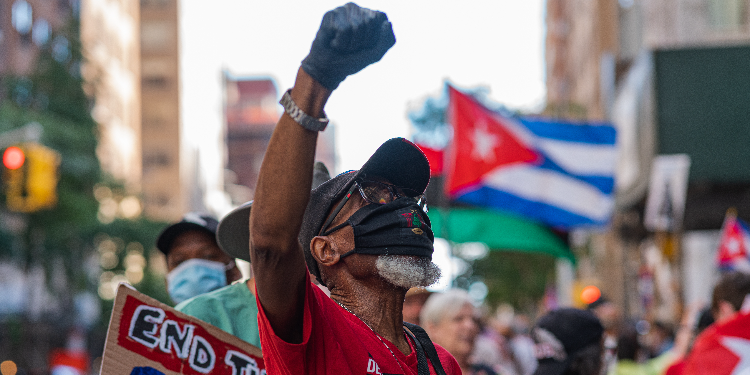 © Shutterstock.com / Steve Sanchez Photos
An ultimate weapon to constrain countries, embargoes affect all spheres of the economy. While most negotiations are done between central economic and political authorities, little consideration is given to the population, including expatriates. Yet, they are direct victims of these measures that often result in a lack of resources, shortage of raw materials, medical emergencies, insecurity, etc.
In this article
When populations are held hostage
Russia, North Korea, Ukraine, Belarus, Turkey, Syria, Iraq, Iran, Myanmar, Yemen, Somalia, Zimbabwe, Burundi, the Democratic Republic of Congo (DRC), Sudan, South Sudan, Central African Republic, Republic of Guinea, Guinea-Bissau, Libya, Tunisia, Venezuela, Nicaragua, and Mali since January 9, are all embargoed countries. However, economic sanctions that have been taken international vary by country. In Russia, for example, there is a military embargo. In Iran, an embargo means the freezing of assets (blocking bank accounts and other financial assets), and other restrictions in addition to the military blockade. The same applies to the DRC, Venezuela and Libya.
How do expats cope with an embargo between their host country and their home country? For families with one member living in the areas concerned, things tend to get complicated. The embargo voted by the Economic Community of West African States (ECOWAS) against Mali plunged international travellers into uncertainty. In the early days of the embargo, Jennifer Edong, a foreigner, spoke to AFP: “On day one, there was no bus, we were stuck because of the border closures". But she hopes the situation will improve quickly. Yaza Zakaria Touré, a representative of Africa Tour Trans, Bamako's main road carrier, also testified: "All the trips that were already scheduled with us had been cancelled for the week. So we had to wait until we got more information from the authorities". A Nigerian tourist expressed his dismay regarding the lack of consideration for international travellers. "We could not even take a shower. We had nowhere to go, no money to eat", he said, seeking help from the government to cross the border.
Join the community
Get regular tips and advice to make the most of your expat life
Living in Iran under embargo
The sad reality of embargoes remains hidden to the international community. There are so many lives in suspense that we are not even aware of. In Iran, the return of the embargo in 2019 reactivated the infernal cycle of rising prices, job losses, salary cuts, shortage of raw materials, lack of medicines and everything. The then US Secretary of State, Mike Pompeo, supported these measures against Iran. "The situation is much worse for the Iranian people, and we are convinced that this will lead to a change for them", he said to the international media. But the population was tired. A refugee in Italy, who is an engineer of Iranian origin, comments: “It is taboo to admit that we have to look for food, medicine, water, find electricity. Even for me, it is taboo. People don't realise what "living under embargo" means". Another refugee confirms: “It's not fun. We are being deprived of our dreams. I think a lot about my family who stayed there. I'm ashamed and scared at the same time. It is complicated. The Covid-19 pandemic only made things worse". People without resources rely on government aid. When a state itself is cornered, life is reorganised behind the scenes. Like in other embargoed countries, parallel markets have been organised in Iran for a long time. Because in reality, transactions keep going in the dark to escape sanctions. Thus, during the 2015 embargo, Iranians pointed out the crucial role of China, Iran's leading trading partner. Even today, China maintains and strengthens its relations with Iran. In March 2021, the two countries signed a 25-year strategic and commercial cooperation agreement. China is smoothly urging the US to end sanctions against Iran, especially on the nuclear front.
Others, like Dubai, prefered to leave. This was a historic event for Iranians, while the United Arab Emirates referred to it as an exodus. Goods that cannot be found in Iran transit via Dubai, which serves both populations and businesses. Money transfers are made via Dubai. Many Iranians moved to Quebec and deplored the decline of democracy in their home country. "We have a lot of family there, so we are concerned. But the situation is unpredictable", says Feoad Goodarzi, who has lived for 5 years in Quebec with his partner. Interviewed by Radio Canada in January 2020, the couple mainly relies on poor information exchanged via the Internet. "We are still lucky that we can call and text our loved ones. The problem is that we have no idea what will happen in an hour or two. Politics is very unpredictable in this region, and very complicated too".
Turkey: Are tourists returning to Akyaka?
At the end of December 2020, Armenia announced "the lifting of the trade embargo on Turkish products". This embargo was announced in 2020 following the war in Nagorno-Karabakh, a disputed region between Armenia and Azerbaijan. Turkey's military support to Azerbaijan disrupted its ties with Armenia. The conflict was finally settled through Russian intervention. Interviewed by AFP on January 13, Engin Yildirim, director of the Akyaka traders' association, believes that things are going to improve between the two countries. "Both governments are in for the reopening. The population is paying close attention to whatever is happening with serenity. We have no problem with the Armenians, and neither do they with us". Located in the far northwest of Turkey, Akyaka hasn't found its lost attractiveness. Locals are hoping for a return of tourists, starting with Armenians. But for now, Akyaka Station remains hopelessly quiet. Engin Yildirim, goes back to the origins of the crisis: "Since the border closure in 1993, this region has been a dark spot as it is locked on all sides. This is our only opening to the rest of the world". Local historian and minority specialist Vedat Akçayoz recalls that Akyaka is a multicultural area, home to Turks, Armenians, Kurds, Georgians, Azeris and many minorities. He believes that it is high time that people live in peace.
Cuba: division on possible lifting of restrictions
In 2016, the United States and Israel voted against the economic and financial embargo imposed on Cuba. The Obama administration then recognised the failure of this strategy. Where Obama and Trump failed, Joe Biden is in an ideal position to take a new step towards conciliation. But for Léo Juvier, a Cuban activist who currently lives in Belgium, the question doesn't even arise. He spoke to the Belgian channel RTBF: "We must maintain the embargo of the United States until they start respecting human rights and reimburse whatever they owe for expropriations". Still, he points out that the embargo has not affected certain commercial relations, including those with Belgium. Meanwhile, Norma Goicochea, Cuba's ambassador in Brussels, emphasises the humanitarian dimension, speaking of "genocide" and "systematic violation of the rights of the entire Cuban population. The pandemic aggravated the existing crisis. The population reckons that dependence on foreign countries has become challenging to sustain, especially for young people, frustrated all these constraints.
An insight into the Mali embargo
The Economic Community of West African States (ECOWAS) met at an extraordinary summit in Accra on January 9 and decided on severe sanctions on Mali. The junta, in power following the coup d'état of August 2020 and May 2021, was blamed once again by the ECOWAS. The embargo was applied immediately. The sanctions include stopping financial aid, closing borders between Mali and other ECOWAS member states, freezing transactions, except for pharmaceuticals and basic necessities. However, the sanctions would be gradually lifted only after obtaining a satisfactory chronogram.
Initially, Colonel Assimi Goïta and Prime Minister Choguel Kokala Maïga had signed a Transition Charter, providing for the holding of a presidential election on February 27, pleading for democracy. However, they both ultimately want to extend the military transition for another five years. As the junta refused to review that period from five to four years, which contradicts the Charter they created, ECOWAS stepped up.
How can the military junta be pulled down without affecting the population? This is a difficult equation for a country plagued by terrorism threats and political instability. The population is divided between pro and anti-military junta. Amid the protests, hundreds of thousands of locals and foreigners are trapped by the embargo. Kako Nubukpo, Commissioner for the West African Economic and Monetary Union (UEMOA), pointed out that from the moment all Mali's accounts were frozen with the central bank, the Malian treasury can no longer carry out financial transactions since all external transactions go through the central bank. So Mali is cut off from the rest of the world. Locals and expatriates call this a double jeopardy. "How do we send money to our families if we can't do Westen Union anymore?" "Will we even get our salaries?" Without money, how do they pay for medicine, food, gasoline, etc.? How do they fight Covid-19? The embargo looks like a vicious circle. Economists warn of the risks of a sharp drop in revenue and a lack of resources available in the country. The consequences are immeasurable if we add to this the ban on raising funds on the international market.
Designed to compel the country concerned to quickly and concretely modify its policy, embargoes deeply impact entire populations forced to come to terms with decisions beyond their control. Concern, frustration, and expectation resonate in all minds.
Comments
Essential services for your expat journey

Choose the best health insurance
Protect your health and get easy access to treatment for expats.

Plan your international move
Facilitate your move by getting a quote from our top rated movers.

Open a bank account that suits you
Discover the best international banks to manage your money securely.

International life insurance
Simple term-life insurance covering you & your family across borders
Further reading
How to build a professional network in Mauritius as an expat
Travel or move abroad after retirement?
Why more expats in Mauritius want to make a difference
Is social media an essential ally or a digital trap for expats?
Who are today's expats?
Not feeling like yourself after moving abroad?
10 driving mistakes to avoid abroad
Expat family life: Letting go of home without losing your roots
Moving abroad: Escape or a fresh start?
Join the community
Get regular tips and advice to make the most of your expat life