

Things are getting worse day by day. On Tuesday afternoon, the G7 met urgently to agree on a final plan and possible sanctions against the new Taliban regime. On Monday, the United States repatriated about 16,000 people, which makes 42,000 since July. Regarding France, around 2,000 people were repatriated within a week. Expats and Afghans who are still there are panic-struck. On Saturday last, more than 18,000 Afghans trampled in front of Kabul airport, desperate to escape the chaos. A crowd movement caused the death of 7 people. By August 16, 12 people had already died at the airport. Western military forces are overwhelmed; Afghan soldiers seem to have already surrendered. The future looks uncertain for thousands of Afghans and expatriates.
Expats amid the chaos in Afghanistan
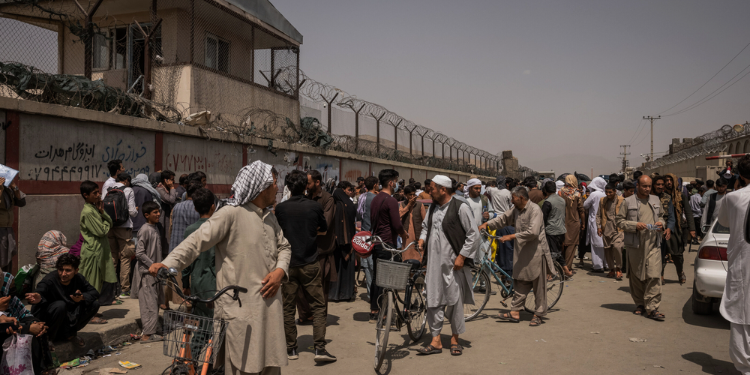 © john smith 2021 / Shutterstock.com
The Taliban have warned of a heavy price to pay if the United States does not withdraw all of its troops by August 31. The US government admits having been surprised by the speed of the Taliban offensive attack. Still, it could well maintain its soldiers after August 31 to ensure repatriation. But on Tuesday morning, France announced that it would stop repatriation on Thursday if the United States decides to leave Afghanistan on August 31.
The chaos as the Taliban capture Kabul
On May 1, the American president announced that US troops would be withdrawn from Afghanistan. This came as no surprise as Joe Biden had included this in his program. America's longest war ends with a bitter aftertaste as the country prepares to commemorate 20 years of the September 11 attacks. On July 8, the American government stated that more than 90% of the 2,500 soldiers still present in the territory had been evacuated. The Biden government is thus completing a policy that began many years ago, under the Obama and Trump mandates. Above all, the United States does not want the world to experience the trauma of the Vietnam War once again. But the damage seems already done. With more than 3,500 soldiers down in Afghanistan, US troops are questioning the purpose of their mission (figures: Watson Institute for International and Public Affairs). Thousands of people have been wounded, disabled, victims of post-traumatic shock during this war, and families have been traumatized. The brutal fall of Kabul on August 15 sounds like yet another blow to Western countries and raises fears of more violence. Locals talk about an understaffed Afghan army, affected by corruption, and unresponsive authorities. Who is going to ensure their safety, and how? The Taliban are trying to reassure the Afghans, but the reality is something else.
Join the community
Get regular tips and advice to make the most of your expat life
Repatriation of Afghans and expatriates
On Monday morning, 193 civilians arrived in Brussels. There were some Belgian nationals, but most of them were Afghans, according to international media. On Tuesday morning, an Afghan exfiltrated by the French authorities was placed in police custody in Paris. Suspected of having links with the Taliban, he admitted being part of the movement, in particular, having been "responsible for a Taliban roadblock in Kabul", according to the French media. 4 of his relatives are under the supervision of the Directorate General of Internal Surveillance (DGSI). Since then, France is having trouble with repatriation issues.
At the same time, thousands of Afghans who have collaborated with Western countries fear being suspected, abandoned and forgotten. Many of them are interpreters, drivers, guides, journalists, cooks, lawyers, teachers, etc., who have worked with foreign soldiers, and have been blacklisted by the Taliban.
In fact, the whole population currently wishes to flee the new regime. The war in Afghanistan has already taken the lives of more than 51,000 civilians and over 69,000 Afghan police and military personnel. The Taliban have lost more than 51,000 men (according to estimates by the Watson Institute for International and Public Affairs, October 2001-April 2021). Artists, athletes, journalists, teachers, politicians, most of them being freedom fighters, are particularly worried, especially women.
The future for Afghan women
Taekwondo champion Zakia Khudadadi should have represented her country at the Paralympic Olympics, which began on Tuesday. But her dream has been shattered by the return of the Taliban. With her teammate, Hossain Rasouli along with some 50 other Afghan sportsmen, she was finally exfiltrated on Monday after hiding since the situation got worse. This operation was led by Australian services, with the support of Nikki Dryden, a human rights lawyer and former swimmer, Alison Battisson, director of the NGO Human Rights, and Craig Foster, former Australian footballer.
Kimia Yousofi, sprinter and Olympic flag bearer, wonders whether she will be able to represent her country again one day. Khalida Popal, the founder of the first national women's football team, spoke to the international media. "With the return of Sharia law, how can we preserve women's freedom?" Following death threats, Khalida Popal found refuge in Denmark in 2016.
A feeling of abandonment
While some haven't got any answers until now, for others, the response has been negative. Many Afghans find the reaction of the United States and the international community cruel. In the beginning, the Afghans had high hopes, but today they feel abandoned by Western countries, especially those they have worked with.
The complicated return of expatriates
RFI journalist Sonia Ghezali, an expatriate in Afghanistan since 2016, confided in French media France Inter. “They entered Kabul without a shot! “ According to Euronews, the Taliban are indeed actively looking for any Afghan who has collaborated with the international community: "They are going door to door in Kabul, hunting for journalists", says one of her friends. On August 8, Toofan Omar, head of private radio Paktia Ghag and contributor to German international radio Deutsche Well, was shot dead by "unidentified people", according to UNESCO. UNESCO Director-General Audrey Azoulay strongly condemns the murder and intends to strengthen the safety of journalists. Still, the United States is being held responsible for the ambient chaos. Meanwhile, the Taliban speak about their "new openness policy" and ensure that foreigners have access to Kabul airport, even though expats and locals claim otherwise.
What does the future look like for Afghanistan?
Exfiltrations are underway. Time isn't in favour of Western countries, though, as the Taliban reiterate their threats. Meanwhile, Afghans who are stranded in the country feel trapped and abandoned by Western powers. In 2014, France withdrew 70,000 soldiers who were fighting with the international coalition. Both the human and the financial costs are unparalleled. The United States, on its own, invested $ 1,000 billion. Afghans, expatriates, soldiers, their families, and the whole world are astonished by how the Taliban took over Kabul.
In Kabul, life has come to a standstill. School and universities have closed until further notice. Humorists and artists have deserted the streets and burned their working instruments. The situation is perhaps even more dramatic for women who are losing their hard-won rights. Today, they are once again forced to wear the burqa, and they can no longer go out on their own. Memories of the previous Taliban regime (1996-2001) is still fresh in people's minds. The Taliban are talking more and more to reassure the population, but the Afghans won't let themselves be fooled. Some are ready to do anything to flee the country, while others fear further restrictions. But for them, it is clear that the world has left Afghanistan in the hands of the Taliban.

Comments
Essential services for your expat journey




Further reading
How to build a professional network in Mauritius as an expat
Travel or move abroad after retirement?
Why more expats in Mauritius want to make a difference
Is social media an essential ally or a digital trap for expats?
Who are today's expats?
Not feeling like yourself after moving abroad?
10 driving mistakes to avoid abroad
Expat family life: Letting go of home without losing your roots
Moving abroad: Escape or a fresh start?
Join the community
Get regular tips and advice to make the most of your expat life