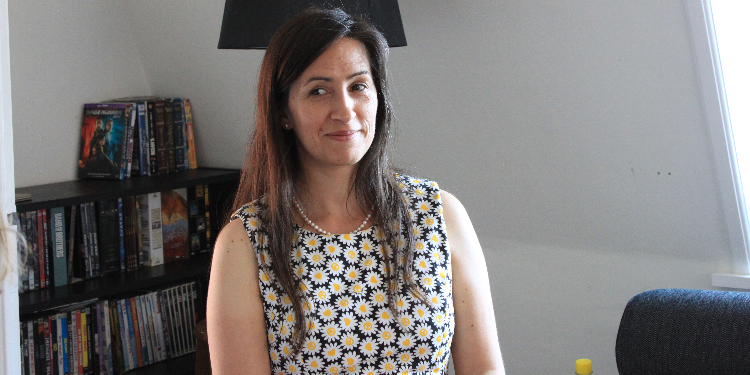
Aude is originally from Rhône-Alpes, France. During her Erasmus student exchange year in Milan, she met a young Dane who is now her husband and their four daughters' dad. Passionate about Hygge, she talks to us about expat life in Denmark and her definition of well-being.
Can you briefly introduce yourself and tell us about your background?
My name is Aude, and I'm 44. I am from Rhône-Alpes, in France, but I also have Breton roots. I have been married to a Dane since 2003. We have 4 daughters aged 7 to 16. We met in Italy, in Milan, during an Erasmus exchange year.
Before coming to live in Denmark, we lived in San Francisco, in the United States, for almost 3 years (with a year of transition in France).
How long have you lived in Denmark? What attracted you there?
We have been living in Denmark for 10 years this summer. We initially intended to stay here for 3 to 5 years before relocating to another country. That was an uncertain period as we returned from the US, and we did not want to stay in France.
We chose Denmark because we wanted our children to learn the language (we mostly speak French at home). We also knew that it was the quality of life we were looking for.
Join the community
Get regular tips and advice to make the most of your expat life
Did you find it hard to adapt to Denmark?
We didn't have any particular issues. My husband had moved earlier to do all the paperwork (find an apartment, etc.) because he was already working there. For a year, he spent a week in France with us and then a week in Denmark, so it was a sort of family reunification for us.
However, it took me over 7 months to receive my yellow card (the social security card). I had to provide an employment contract, but this is not representative. Normally for expats coming from Europe, it takes a maximum of three months.
Regarding integration, my husband already had a lot of friends here, so we could rely on them and on his family's support. For me, however, it has been very slow. I spoke a little Danish when I came here. I could only interact with the Danes when I started taking intensive Danish language classes. That is when my third daughter secured a place at the nursery. That's when I really started to adapt.
But most of my friends/acquaintances are either French, my husband's Danish friends, or people (Danish or others) a few mixed couples. It was exactly the same when we were in the United States. We tend to create bonds with people we have things in common with.
You are the holder of a degree in architecture but are currently working as a moderator and customer service agent for a website. What explains this career change?
After graduating in 2004, I immediately had my first two children (in Paris). Then we went to the United States when they were 1 and 3 years old. It was important for me to be 100% present for my children at least for the first year.
The career of an architect is very time-consuming, and this was not compatible with my view of parenting. Besides, it's still a normal thing in a lot of architectural firms to spend sleepless nights trying to finish projects, and I had no desire to do it again.
When we arrived in Denmark (with our 3rd child, who was 6 months old), I couldn't see myself with a career in architecture (although I love Danish architecture). So I wanted a job that was in line with my needs and desires, that would bring me the quality of life I was looking for. The company I work for is very flexible. I work from home, so I can arrange my working time around children's appointments when necessary. And when they are sick, it is much easier.
Although it is not in my field of study, this job allowed me to acquire new skills in various areas such as internet safety for children, customer service, etc. It also gives me a lot of free time to do other things, such as blogging and getting involved in my community.
How would you define the Danish labour market? Are there opportunities for expats in the Covid-19 era?
The global health crisis hasn't spared Denmark. The catering and retail sectors, as well as culture and entertainment-related jobs, are the most affected. So it's definitely not the right time for expats to come here and seek work.
Internships have also been affected, but I'm not sure whether internships that had been signed before the crisis are still on for people who were not yet in the country. The construction industry, however, is flourishing.
For companies using new technologies, research does not seem to have been impacted. So there may be opportunities for expatriates in these sectors.
What is the current situation in Denmark? What health measures are in place?
So far, Denmark has handled the Covid crisis relatively well, although there have been inconsistencies on some points. Since the past few months, there are entry restrictions for foreign nationals. It is currently not allowed to come to Denmark for tourism or visiting your family, so you really need a solid reason.
Some border posts with Germany have been closed, and the rest of them are under strict control. In fact, the border controls had been relaxed for some time, and many people seized the opportunity to cross borders. This is why the control has been reinforced.
Anyone arriving in the country must provide a negative PCR test obtained within 72 hours, and then self isolate for 10 days. For Danes and Danish residents, they can end self-isolation if the test taken after 4 days is negative.
The government recommends people to work from home as much as possible and limit contact with other people outside their social bubble (meeting 5 people maximum is allowed).
Wearing a mask is compulsory in shops and public transport. But you can still walk without a mask in open spaces in the city provided the 2 meters social distancing is observed. But lost of the time, people are keeping one meter away from each other.
Since March 1, 2021, businesses of less than 5,000m² have reopened, and outdoor sports activities have resumed with a maximum of 25 participants (for 5 previously). Restaurants, cafes are still closed but can provide take away services. Some places of interest, like the zoo, will reopen, but you will have to provide a negative PCR test obtained within 72 hours to access them. The government recently started talking about a Covid vaccine passport to reopen borders and attract tourists.
Schools, kindergarten (and their Danish equivalent) are all open since August 2020. Most classes that were in distance learning mode have resumed in face-to-face since February. However, students from different classes are not allowed to mix.
In Copenhagen, some classes are in distance learning mode since two weeks before Christmas. My two eldest children are happy to study at home, even if they miss seeing their friends. In other parts of Denmark, all pupils (not students) are back at school. It actually depends on the different regions and their contamination rates.
Well-being, happiness, self-respect, etc., are things that are particularly important to you. Have you found them in Denmark?
Among the countries I have lived in, Denmark is the most advanced on gender equality, acceptance and tolerance, education, fighting against corruption, etc. People trust each other, and certain behaviours that might seem offensive in some countries are quite normal here, such as leaving your pram with the baby in it outside a cafe (most parents choose a window seat to have a view of the pram). In a way, Danes focus on simple things about everyday life. Individual well-being is important to society.
The relationship with the hierarchy is totally different from France: it is more of a flat hierarchy where there is trust and respect develop on both sides. This even applies to bosses, team leaders and employees, as much as with teachers and students. Everything is not perfect there, especially when it comes to politics, but overall, life is good.
I think I've found the right balance in Denmark, and I see myself growing old here. But I would not say no to moving to another country to discover another culture.
What does “Hygge” mean for an expat and how does it fit into your everyday life?
"Hygge" is not just about the cosy, well-being at home, with family and with friends. It applies to Danish society as a whole. As far as possible, the use of any space depends on "hygge". It's about finding how to make the space as pleasant as functional, be it visually or physically. And it contributes to the quality of life.
Expats used to work until 6/8 p.m. on weekdays indulge in a completely different lifestyle. A typical working day in Denmark goes from 8 a.m. to 4.30 p.m., so you usually finish between 4 p.m. and 5 p.m. This is because nurseries and daycares close at 5 p.m. sharp.
Many expats find it hard difficult to experience "hygge" with the Danes. It isn't so easy to create bonds with them. "Hygge" with friends is only possible when you can be yourself, without a mask. Still, expats can find the "hygge" without mingling with the Danes. It simply means living the present, paying attention to the things around us and, maybe sometimes, finding pleasure in simple things.
"Hygge" also lies in our work-life balance, in knowing how to appreciate moments of sharing, joy, and well-being.
Have you encountered any difficulties so far regarding your children, whether in terms of their education or their socialization?
As we only expected to stay a few years, we chose to send them to French school. And for the moment, our children remain in the French system because this school's approach is closer to the mode of education that we want: a French education with a Danish influence. The feedback from our acquaintances, whose children are in the Danish system, is not always positive.
Next year, it's likely that our second child (who is 14) will switch to the Danish system to be in a school that offers a computer/design option. Next year my vision of the Danish school (lacking in structure) may be changed or strengthened!
Being in a French school did not make learning Danish easier. When we arrived, Danish classes were almost non-existent in the school (which made us feel weird. Since our arrival, the Lycée Prins Henrik has been trying to increase the number of Danish classes. We don't think it's enough, though.
For our two eldest children, Danish really took off towards CM2. Today, they have a good command of the language. Our eldest will take her Danish baccalaureate next year in addition to the French baccalaureate and will therefore be able to study in Denmark if she wishes.
Our third child has spent more time in the Danish system and joined the French school at a higher level, so she has a good level too. Our fourth child has already decided that she doesn't like Danish (she is only 7) but understands it very well (and speaks it when she has to). I think learning Danish was the greatest difficulty we encountered due to our choices. I have children who are content with a small circle of friends, mostly classmates. So the language they speak depends on the people they are with.
What would you advise people who would like to relocate to Denmark?
Learn Danish! If you can, a little before, and if not on the spot.
Take part in activities with Danes.
Try to have a job contract before leaving.
Check with your embassy in Denmark about the requirements.
Contact associations (depending on your country): some organize workshops. This can be of great help for trailing spouses.
Enquire on the downsides of living in Denmark: the weather (grey) and limited sunshine, the high cost of living integration is not necessarily easy (especially when you're in a small city)
The health system is free of charge, but the relationship between doctors and patients is different. Sometimes, you really have to insist on getting things done.
Carefully weigh the pros and cons. Since Denmark is a Nordic country, the lifestyle is quite different from South European countries. But in my eyes, life is sweet in Denmark.
A journalist, holder of the DALF C1 and C2 and a diploma from the University of Mauritius, I have nearly twenty years of writing experience. After six years in the Mauritian press, I joined Expat.com, where I have been working for over a decade, including five years as editorial assistant, and now as editorial manager.