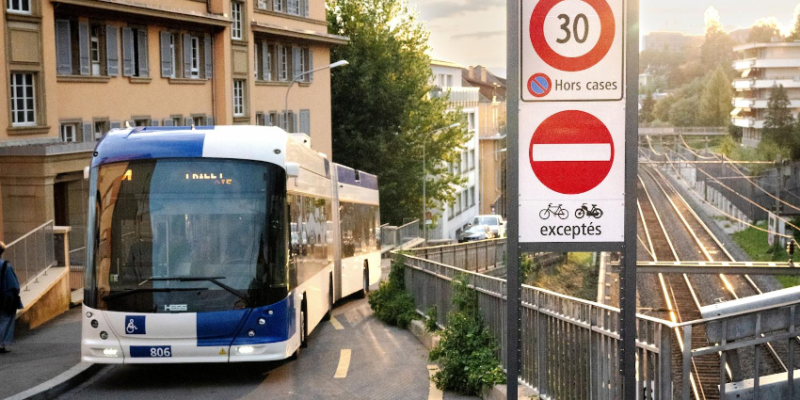
Lausanne is a hilly city built between a lake and higher ground, which might suggest that driving is the only practical way to get around. The reality is the opposite: the city runs on two automated metro lines, a dense bus and trolleybus network, and a single integrated fare system called Mobilis that covers every tl vehicle and eligible local trains on one ticket. Public transport ridership has grown 50% over the past decade, and car ownership in Lausanne sits well below the average for comparable Swiss cities. One thing that catches many newcomers off guard: unlike pay-as-you-go transit systems, every tl vehicle requires a valid ticket before boarding, which makes downloading SBB Mobile and buying tickets in advance the essential first step on arrival.
Lausanne's steep lake-to-hill topography would make a car-centric city exhausting. Instead, the city runs on a dense, integrated public transport network operated by tl (Transports publics de la région lausannoise), covering metro lines, buses, and trolleybuses, all woven together with regional and national rail from Lausanne main station. One fare system, Mobilis, covers every tl mode and eligible local trains within the zones you select, so a single ticket works across a bus, the metro, and the connecting regional rail leg of the same journey.
The first practical action before your first commute is to download SBB Mobile, the Swiss national rail and transport app. Available in English, French, German, and Italian, it handles journey planning, ticket purchase, and the EasyRide feature: a location-based check-in on your smartphone that automatically calculates the cheapest fare for your trip. Unlike tap-in/tap-out systems where you board and the gate reads your card, all Lausanne public transport requires you to hold a valid ticket before stepping on board. EasyRide replicates some of that convenience digitally, calculating and charging you after you check out on the app.
Every journey within central Lausanne falls inside the Grand Lausanne fare area, which covers Mobilis zones 11 and 12. These two zones are always sold together; you cannot purchase zone 11 or zone 12 separately. A standard single Grand Lausanne ticket covers unlimited travel by bus, metro, and eligible local rail for its validity period. For regular use, it is worth comparing day cards, monthly passes, and annual subscriptions at the tl online shop before committing to single tickets.
Station signage, stop announcements, and official notices are in French, the administrative language of Lausanne. The key terms you will encounter: billet (ticket), zone, arrêt (stop), correspondance (connection), validité (validity). In practice, the TL app, SBB Mobile, and the Mobilis website all offer English interfaces, so navigating the system doesn't require fluency in French. Walking covers short central trips well, but the city's significant elevation changes mean that many daily commutes combine a short walk with the metro or a bus rather than walking the whole way.
Two automated metro lines form the backbone of daily movement in the city. The m2 is the essential line for most newcomers: it climbs from Ouchy-Olympique on the lakefront up through Lausanne-Gare (the main railway station), Lausanne-Flon (the central interchange for the entire tl network), Riponne, and onward to Croisettes. This single line solves what would otherwise be a long, steep uphill walk or drive between the lake, the station, and the upper city, making it the most practical daily tool for the majority of residents. The m1 runs west from Flon along a largely flat corridor toward EPFL and the university campus, making it the key commuting line for researchers and students.
A standard adult metro ticket for Grand Lausanne costs CHF 3.90 (approx. USD 4.80). Zones 11 and 12 are always bundled: you cannot purchase a ticket for one zone alone. Tickets can be bought through the tl app, SBB Mobile, station vending machines, tl counters, or by SMS. Day passes purchased digitally display as a QR code on your phone or can be printed. A third line, m3, received a federal infrastructure concession but is not yet operational; plan your commutes around m1 and m2 for the foreseeable future.
One limitation to plan around: the metro runs a full night service only on Friday-to-Saturday and Saturday-to-Sunday nights. On weekday nights, metro service stops, and you will need to use the TL night bus network, a taxi, or Uber for late journeys. During peak commuting hours, the m2 and m1 are both heavily crowded; if you are commuting during rush hour, allow extra time and be prepared to let a full train pass at busy stations like Lausanne-Gare before boarding a less crowded one.
Good to know:
Swiss law requires public transport stops to meet accessibility standards, but the adaptation of stations nationwide was not fully complete by the statutory deadline. If reduced mobility affects you or a family member, check step-free access details in the timetable or in the SBB Mobile app before traveling.
Join the Lausanne community
Get regular tips and advice to make the most of your expat life
Buses in Lausanne
The tl bus and trolleybus network complements the metro by reaching the hillside neighborhoods and in-between areas that the metro lines do not serve. For daily commuters, four routes stand out as particularly useful: Line 1 runs a north-south cross-city link from the lakefront through Lausanne-Gare and the city center to Blécherette; Line 3 connects northern neighborhoods including Bellevaux directly to the main station; Line 6 covers lakeside western areas, the city center, and northeastern neighborhoods via St-François and Bessières; and Line 21 runs from the station toward Beaulieu and northern Lausanne, with an extension east toward Paudex. For your specific neighborhood, check the full tl route map to identify which line serves you most directly.
A standard bus ticket for Grand Lausanne costs CHF 3.70 (approx. USD 4.50). The same Mobilis ticket is valid across buses, trolleybuses, the metro, and eligible local rail within your selected zones: there is no separate bus-only product. For app-based journey planning, both the tl app and SBB Mobile cover the full tl bus and metro network, with the tl app optimized for Lausanne-specific routes and SBB Mobile covering the full Swiss network and selling night-network tickets.
A night bus network operates on Friday-to-Saturday and Saturday-to-Sunday nights, covering a reduced set of tl routes at no extra supplement beyond the standard Mobilis ticket price. You can buy night-network tickets through SBB Mobile, the SBB website, ticket machines, or SBB Travel Centers. On other nights of the week, night buses do not run, so late returns on weeknights require a taxi or Uber.
Lausanne's upcoming tram line
Lausanne's first modern tram line, T1, is under active development and will connect Lausanne-Flon with Renens-Gare in its first phase, covering approximately 4.6 km across 10 stations with a journey time of around 15 minutes. A planned extension of the corridor will eventually reach Villars-Sainte-Croix/Croix-Péage. Testing is underway, and commercial operation is targeted for the end of the year it opens; check the current status at tl.ch before factoring the T1 into any commute plan.
Once open, the tram will run at approximately 6-minute frequency and will be fully integrated into the Mobilis fare system. A one-zone Mobilis ticket currently costs CHF 3.20 (approx. USD 3.90), though the exact zone configuration for tram travel should be confirmed when the line opens. For newcomers arriving now, the T1 is upcoming infrastructure rather than a current option.
Paying for transport in Lausanne
All public transport fares in Lausanne run through the Mobilis zone-based system. Every journey within central Lausanne falls under the Grand Lausanne fare area (zones 11 and 12, always sold together). The entry-level option for short hops of 1 to 3 stops within 30 minutes on bus or metro is the short-distance ticket at CHF 2.30 (approx. USD 2.85); it covers neither cross-city trips nor rail connections, so use it only for genuinely brief on-network journeys. For anything longer, the standard single Grand Lausanne ticket costs CHF 3.70 (approx. USD 4.50) and covers unlimited travel across zones 11 and 12 for its validity period.
If you plan to make more than two or three journeys in a single day, a Grand Lausanne day card at CHF 9.80 (approx. USD 12.15) becomes the better value; it is valid from purchase until 05:00 the following morning when bought by SMS, and a reduced-fare version is available at CHF 6.90 (approx. USD 8.60). For daily commuters, the economics shift decisively toward a subscription. A monthly Grand Lausanne pass costs CHF 78 (approx. USD 97) and an annual pass costs CHF 780 (approx. USD 967); both cover unlimited travel on bus, metro, and eligible local rail within zones 11 and 12. Subscriptions are loaded onto a SwissPass card, the standard Swiss public transport card.
Two age-based discounts reduce these costs meaningfully. Passengers up to age 24 can select the Mobilis Jeune category when buying weekly, monthly, or annual subscriptions. Older passengers qualify for a Mobilis Senior subscription at CHF 67 monthly (approx. USD 83) or CHF 670 annually (approx. USD 830) for zones 11 and 12. In addition, retired residents registered with the City of Lausanne may be eligible for a 50% municipal subsidy on the annual Mobilis Senior subscription, reducing the personal contribution to CHF 40 (approx. USD 50) per year. Confirm eligibility conditions for the subsidy with tl or the City of Lausanne directly.
Tickets are available through the tl online shop, the tl app, SBB Mobile, station vending machines, tl counters, and by SMS for Grand Lausanne single and day tickets. There is no contactless bank-card boarding at platform validators; you must have a valid ticket in hand before stepping onto any tl vehicle.
Taxis and ride-hailing in Lausanne
Licensed taxis in Lausanne are regulated by the Service intercommunal des taxis. The base fare is CHF 6.20 (approx. USD 7.70), with a per-kilometer rate of CHF 3.00 (approx. USD 3.70); a typical short urban trip comes to around CHF 13.70 (approx. USD 17.00). You can book taxis by phone through operators such as Taxiphone, through the Taxi Lausanne app on iOS, or by hailing them at taxi ranks around the city. Payment acceptance varies by operator: not all taxis take cards, so confirm when booking if you prefer not to pay cash.
Uber operates in Lausanne at pricing broadly comparable to licensed taxis, with surge pricing during peak demand. Neither taxis nor Uber make practical sense for everyday commuting in a city with metro and bus coverage as dense as Lausanne's; their real value is for door-to-door trips with luggage, late-night returns after the last bus, or the occasional journey to an address outside the transit network.
For a direct transfer to Geneva Airport, Taxi Cité Lausanne quotes a fixed fare of CHF 250 (approx. USD 305). That is a substantially higher cost than the train alternative covered in the airport section below, making taxis for airport runs most sensible for groups, very late arrivals, or journeys with heavy luggage where the fixed price is worth the convenience.
Cycling and walking in Lausanne
Lausanne's pedestrian center, centered on the Flon, Saint-François, and old town area, is compact and walkable: shops, offices, and metro interchanges sit within short distances of each other, and the Ouchy lakefront offers a flatter, pleasant walking corridor connected directly to the m2 at Ouchy-Olympique. Above the station, hillside districts are walkable but genuinely steep; when planning a route on foot, check elevation changes rather than just distance, since a 500-meter walk uphill can take as long as a much longer flat one.
Lausanne has 131 km of cycling facilities across the city. Cycling comfort varies considerably by route: protected lanes and dedicated paths are comfortable, but steep mixed-traffic streets are harder going. The city maintains a public map of its cycle infrastructure, and the Hautes Écoles cycle route connecting central Lausanne with the EPFL and university campus has been improved and is a priority axis for the municipality. Before choosing a commute route, consult the City of Lausanne's cycle-facility map: a slightly longer mapped route is often more comfortable than a direct uphill stretch in mixed traffic.
An e-bike changes the equation for cycling in Lausanne. The climbs between the lakefront, the station, and the upper neighborhoods that make standard cycling demanding become manageable on an electric-assist bike, putting regular cycle commuting within reach for most people. For short-term rental, Bicy.ch Lausanne (Place Benjamin-Constant 2, 1002 Lausanne) offers half-day e-bike rentals from CHF 30 (approx. USD 37). Day rentals through Rent a Bike start from CHF 38 (approx. USD 47) for a standard city or country bike. For regular commuting, Decathlon Lausanne offers monthly subscriptions from around CHF 20-22 (approx. USD 25-27), with a minimum three-month commitment, available in-store only.
Two bike-share systems serve Lausanne. Lime operates a free-floating electric bike network across the Lausanne-Morges region using virtual stations: you locate and unlock bikes through the Lime app and return them to designated bike racks or areas rather than fixed docking stations. For a subscription-based option, PubliBike Velospot covers the regional network with a 6-month subscription from CHF 34 (approx. USD 42) and an annual subscription at CHF 69 (approx. USD 86), both including free ride minutes for regular and e-bikes. SBB Mobile integration via Tap&Go is planned for the Lausanne-Morges-Nyon region; check PubliBike for current availability before subscribing.
One note for both pedestrians and cyclists: major infrastructure works for the incoming tram line and other urban projects are actively reshaping street layouts in parts of the city. Expect localized diversions and temporary route changes around construction zones in the coming years.
Driving in Lausanne
For most newcomers living and working inside Lausanne, a car is not necessary. Public transport ridership in the city has grown 50% over the past decade, and private car ownership stands at around 312 vehicles per 1,000 residents (Swissinfo), well below the average for comparable Swiss and European cities. The practical advice is to test daily life on public transport for the first few weeks before committing to car ownership, since most residents find transit covers their needs adequately.
Any car driven on Swiss motorways, including the Lausanne-Geneva route used for airport transfers, requires an annual motorway vignette costing CHF 40 (approx. USD 50). This is a flat annual sticker: there are no per-journey or per-day options. Without it, you cannot legally drive on Swiss motorways. Vignettes are available at border crossings, petrol stations, and online via ch.ch.
Parking in central Lausanne is scarce and expensive. On-street metered spaces cost CHF 3 to CHF 8 per hour (approx. USD 3.70 to USD 9.90) depending on the zone, payable via PayByPhone. Public parking garages charge CHF 28 to CHF 48 per day (approx. USD 35 to USD 60). Residents registered at a Lausanne address with a vehicle registered in Canton Vaud in their own name can apply for an annual residential parking permit (macaron) for CHF 500 (approx. USD 620) per year, or CHF 280 (approx. USD 348) for a semester.
Peak-hour congestion adds real time to any car journey in the city: a 10 km trip during the evening rush takes over 27 minutes on average, with an average congestion level of 40.7% (TomTom Traffic Index). The city is actively redesigning central streets, including the St-François-Chauderon axis, to prioritize public transport, walking, and cycling over through car traffic, while keeping car access to central parking garages. Drive into the center only when there is a specific reason to do so. A car genuinely helps for weekend mountain and rural excursions, bulky item transport, destinations outside the public transport network, or multi-stop late-night journeys. Short-term rental for these occasions starts from around CHF 56 (approx. USD 70) per day for a small car, making rental a practical alternative to ownership for infrequent needs.
Lake transport and bike share in Lausanne
The CGN (Compagnie Générale de Navigation) operates lake boat services from Lausanne-Ouchy, the lakefront terminus of the m2, across Lake Geneva to Évian-les-Bains in France on its N1 line. An adult second-class single ticket costs CHF 44 (approx. USD 55), with a half-fare version at CHF 22 (approx. USD 27). This service is primarily relevant for people who live on one side of the lake and work or travel regularly to the other. Tickets must be purchased and validated before departure; traveling without a valid ticket incurs a penalty supplement. Note that bicycle transport is excluded on the N1 Lausanne-Évian service, and some sailings are marked as high-occupancy. Check the CGN timetable for the current schedule before planning any regular cross-lake commute.
Geneva Airport (GVA), approximately 60 km from Lausanne, is the main international gateway for arrivals and departures. The airport's railway station is integrated directly into the terminal building, steps from baggage claim, so there is no shuttle or separate transfer to reach the trains. The direct SBB/CFF train to Lausanne is the obvious first choice: direct services run in approximately 49 to 63 minutes, with the earliest departures leaving Lausanne before 04:00. On Friday-to-Saturday and Saturday-to-Sunday nights, night-train services also connect the two points. Geneva Airport currently offers a CHF 10 (approx. USD 12) discount on train journeys to or from the airport; check the current terms on the Geneva Airport website before traveling. For SWISS flight passengers, the SWISS Air Rail option through SBB/CFF integrates the rail leg directly into the flight booking at a quoted 51-minute journey time.
Buy your Lausanne train ticket at the airport station machines, the SBB counter inside the terminal, or in advance via SBB Mobile. The train is the right choice for most arrivals, particularly families and budget-conscious travelers during daytime hours.
A direct taxi from Lausanne to Geneva Airport is available as a fixed-fare service at CHF 250 (approx. USD 305), making it useful for very late or early arrivals when no convenient train runs, for heavy-luggage situations, or for groups where the per-person cost becomes more competitive. At the airport, use only the official taxi area or pre-booked licensed services. Geneva Airport explicitly warns that unauthorized operators do not hold an official concession; decline unsolicited driver offers inside the terminal.
A local airfield, Lausanne-Blécherette, exists within the city but is not a practical option for international flights.
Have questions about getting around Lausanne after your move? Join the Expat.com community to connect with expats who have already navigated the city's transport network.
Frequently asked questions
Download SBB Mobile on day one: it covers journey planning and ticket purchase in English across the entire Swiss network. Use the m2 metro for north-south movement between Ouchy on the lakefront, the main railway station, and Flon, and tl buses for the neighborhoods the metro does not reach. A Grand Lausanne Mobilis ticket, covering zones 11 and 12, is valid on all buses, trolleybuses, and metro within central Lausanne. Walking works well in the pedestrian center and along the lakefront, but the city's steep terrain makes the metro the most practical option for many daily trips.
Yes. Lausanne has a dense network of tl buses, trolleybuses, and two metro lines, all integrated under the Mobilis fare system, with SBB regional trains extending coverage beyond the city. Public transport ridership in Lausanne has grown by 50% over the past decade, which reflects how central these modes are to daily life. Check the tl service status page before important early commutes, particularly during infrastructure works or timetable-change periods.
There is no tap-in/tap-out system at validators: you must obtain a valid ticket before boarding each time you travel. For occasional trips, buy single or day tickets via the tl app, SBB Mobile, or station machines. For regular commuting, a Mobilis monthly or annual subscription loaded on a SwissPass card is the most practical option. Hotel guests paying the overnight visitor tax may receive a Lausanne Transport Card for free use of public transport during their stay.
The m2 is central to daily life in Lausanne: it links Ouchy on the lakefront to the main railway station, Flon interchange, and the upper city, directly solving the challenge of the city's steep terrain. The m1 connects Flon to the EPFL and university campus corridor, making it the essential line for anyone working or studying there. Both lines run at high frequency but are heavily used at peak hours, so allow extra time during rush periods. Night metro service operates only on Friday-Saturday and Saturday-Sunday nights; on weekday nights, plan around taxis or the night bus network.
Uber operates in Lausanne and is generally available, including for late-night trips when public transport has stopped. It is most practical as a backup for door-to-door travel with luggage, late arrivals, or short trips outside transit hours, rather than as a daily commute tool. Surge pricing applies at peak demand periods. For everyday use, public transport is both more predictable and substantially cheaper.
Lausanne is excellent for walking in the pedestrian center around Flon and Saint-François and along the Ouchy lakefront. For cycling, the city has 131 km of cycling facilities on municipal territory, but the hills require careful route planning before committing to a regular bike commute. An e-bike makes a significant practical difference: with one, most routes across the city become manageable regardless of elevation change. Check the City of Lausanne's cycle-facility map before settling on a cycling route.
Walking is free for short trips in the city center. For public transport, a short-distance Mobilis ticket at CHF 2.30 (approx. USD 2.85) covers 1-3 stops within 30 minutes; a full cross-city ticket costs CHF 3.70 (approx. USD 4.50). A Grand Lausanne day card at CHF 9.80 (approx. USD 12.15) covers unlimited travel from purchase until 05:00 the following morning and pays off from about three separate journeys in a day. For regular commuters, a monthly Mobilis pass at CHF 78 (approx. USD 97) is the most cost-effective solution.
Walking accounts for 45% of trips in Lausanne, public transport for 25%, cycling for 15%, and private cars for 15%. The city has around 312 private cars per 1,000 residents, well below averages for comparable European cities, which reflects how effectively people rely on public transit. Most commuters combine a metro or bus ride with a short walk at each end. The practical starting point is to identify which Mobilis zones cover your home and workplace, then decide between a subscription, day cards, or app tickets based on how often you travel.
For most newcomers living and working in Lausanne, a car is not necessary: public transport covers most daily commutes, public car parks cost CHF 28-48 (approx. USD 35-59) per day, and peak-hour congestion adds over 27 minutes to a 10 km evening trip. A residential parking permit for those who qualify costs CHF 500 (approx. USD 615) annually. A car genuinely helps for weekend mountain trips, suburban errands, or destinations outside the public transport network. Short-term rental from around CHF 56 (approx. USD 69) per day is worth considering for occasional use rather than buying outright.
The direct SBB/CFF train from Geneva Airport is the standard connection: the station is built directly into the terminal, no shuttle is needed, and direct services run in approximately 49-63 minutes with departures starting before 04:00. Geneva Airport also offers a CHF 10 (approx. USD 12) discount on train tickets. A taxi at a fixed fare of around CHF 250 (approx. USD 305) is the practical fallback for very late arrivals, heavy luggage, or groups. At the airport, use only official licensed taxis or pre-booked services, and decline unsolicited offers from drivers inside the terminal.
ℹ️
We do our best to provide accurate and up to date information. However, if you have noticed any inaccuracies in this article, please let us know in the comments section below.
I fell in love with words at an early age After a break to focus on my studies, I rediscovered the joy of writing while keeping a blog during my years between London and Madrid. This passion for storytelling and for exploring new cultures naturally inspired me to create Expat.com, a space for my own reflections as well as for anyone wishing to share their experiences and journeys abroad.