Lausanne packs a food scene of surprising range into a compact lakeside city: traditional Vaud inns serving papet vaudois, Michelin two-star restaurants, UNESCO-listed vineyards producing Chasselas wines that appear on every local wine list, and an international grocery network covering Japanese, Spanish, Portuguese, and English-market specialty products. For expats settling here, the food culture is accessible at every level of formality and budget, but the cost of eating out is a practical reality to plan around: a meal at an inexpensive restaurant runs around CHF 25 (approx. USD 31), and a mid-range dinner for two approaches CHF 100 (approx. USD 122) without drinks. What sets Lausanne apart is the directness of its connection to local food and wine production, with the Lavaux vineyard terraces just outside the city and an artisan chocolate heritage dating to 1830 woven into the everyday dining scene.
Café and bakery life in Lausanne operates on a sit-down, unhurried rhythm that shapes the city's daily social fabric. Cafés, bakeries, tea rooms, and pastry shops are not simply coffee-to-go counters: they function as breakfast stops, brunch venues, midday meeting points, and pre-dinner apéro (aperitif) spots throughout the day. The city's pedestrian core is dense with these spaces, and residents move between them at different hours for different purposes. Arriving and leaving immediately is less common than in grab-and-go coffee cultures; ordering at a table and staying a while is the norm.
Lausanne's culinary identity draws from several distinct sources. Vaud regional cuisine and local produce set the baseline; Lavaux wine culture, built on the UNESCO-listed vineyard terraces east of the city, gives Lausanne an unusually direct relationship with its wine. Swiss alpine and traditional restaurant formats coexist with contemporary French-influenced gastronomy, and a broad international mix covering Lebanese, Indian, Italian, Chinese, Thai, and other cuisines fills the gaps between. The result is a compact, walkable city where eating and drinking form a central layer of daily life rather than being confined to formal occasions.
Weekend habits reinforce this pattern. Saturday mornings draw residents to the pedestrian market on and around Rue de Bourg and Place de la Riponne; brunch spots fill up by late morning; lakeside terraces come into their own when the weather allows. Wine-linked outings toward the Lavaux terraces, particularly in summer, are a weekend fixture for many residents. The Lausanne food and drink guide published by the city's tourism office captures the breadth of these options, from market producers to fine-dining addresses, and is a practical starting reference for new arrivals.
Current dining trends in Lausanne include rooftop and terrace dining, food trucks operating around Place de la Riponne on weekdays, pop-up summer terraces, and continued visibility for Michelin- and Gault&Millau-rated gastronomy. The city's food scene draws coverage from curated restaurant guides and local food journalists, which means new openings tend to be well-documented and findable quickly.
The signature dish of the canton of Vaud is papet vaudois: a generous combination of leeks and potatoes served alongside saucisse aux choux (cabbage sausage). It appears on the menus of traditional inns and regional-cuisine restaurants throughout Lausanne and is the dish most closely associated with the local culinary identity. The regional cuisine restaurant guide on Lausanne Tourisme lists the venues where papet vaudois and other Vaud dishes are reliably served, making it a useful first stop for anyone wanting to explore this side of the food scene.
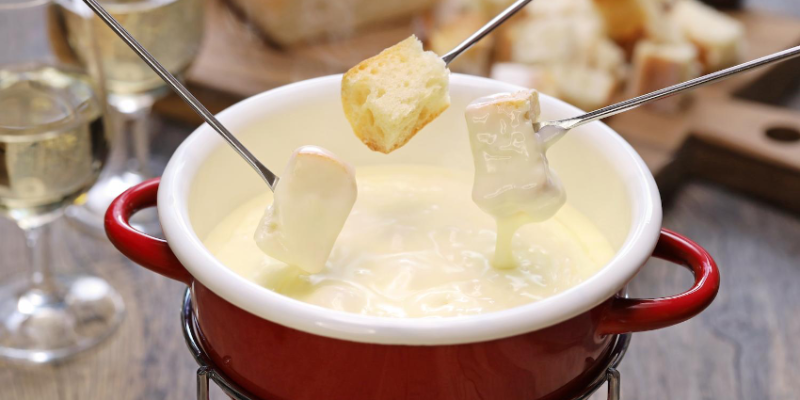
Cheese fondue, a shared pot of melted Gruyère and Vacherin fribourgeois, is one of the most visible dishes in Lausanne's traditional and chalet-style restaurants. Chalet Suisse is among the venues listed by Lausanne Tourisme for this experience. The Swiss custom around fondue is to keep the pot at a gentle simmer and stir as you dip; tradition holds that dropping your bread into the pot carries a social forfeit. Alongside fondue on the classic Vaud inn menu are charcuterie vaudoise (cured-meat platters) and malakoffs, deep-fried cheese fritters that appear in historic cafés and brasseries across the city. For those who want to sample malakoffs in a dedicated context, the Lausanne à Table gourmet program, which runs from May to December each year, regularly features them alongside other local specialties; the program also includes family-oriented food activities on Wednesday afternoons linked to city museums.
The local dessert most tied to the regional inn tradition is tarte à la raisiné, a sweet tart made with concentrated grape must, typically served alongside the classic savory dishes at Vaud-cuisine restaurants.
Lausanne'sartisan chocolate history is genuinely local, not a generic Swiss story. The Kohler family opened a chocolate factory in the city in 1830, and today multiple artisanal chocolatiers operate in the city center. The Lausanne Choco Tour, priced at CHF 29 (approx. USD 35) per person, is a self-guided experience: participants choose five participating chocolatiers, collect a tasting box, and explore the city's chocolate landscape at their own pace.
Wine is inseparable from everyday eating-out life in Lausanne. Chasselas, a dry, light white wine, is the dominant local variety, grown partly on the city's own wine estates and widely served as an apéro. Pinot Noir is the principal local red. Both varieties are produced on the Lavaux UNESCO-listed vineyard terraces east of the city, and wine bars and restaurants throughout Lausanne carry Lavaux wine lists, making these wines part of ordinary dining rather than a specialist excursion.
The central pedestrian market, held every Wednesday and Saturday morning around Rue de Bourg, Place de la Riponne, and neighboring streets, brings around 100 stalls of local artisans, regional specialties, fresh produce, cheeses, bakers, and butchers into the city center. The atmosphere is relaxed and Mediterranean in feel, and it functions as both a shopping destination and a place to eat on the spot. For a more structured introduction to local flavors, the Lausanne Food Tour offers a guided city-center tasting with a local guide covering five local specialties, with adult places at CHF 155 (approx. USD 190) and children under 16 at CHF 50 (approx. USD 61). The annual Miam Festival, held on the Pentecost weekend, brings together food trucks, local restaurateurs, artisans, and producers in a city-wide street-food event.
Join the Lausanne community
Get regular tips and advice to make the most of your expat life
Types of dining in Lausanne
Lausanne covers the full range of dining formats within a compact, walkable footprint. At the informal end, cafés, bakeries, and tea rooms handle breakfast and brunch; bistros and takeaways serve quick weekday lunches; food trucks operate a growing and increasingly professional circuit, particularly around Place de la Riponne. Traditional pintes (Lausanne's equivalent of an informal inn with regional dishes) and brasseries carry Vaud regional cooking. Wine bars, rooftop restaurants, and hotel dining rooms fill the mid-to-upper range. At the top, fine dining reaches a genuine international level: La Table du Lausanne Palace holds two Michelin stars, Le Berceau des Sens at EHL (the École hôtelière de Lausanne) holds a Michelin star with a Gault&Millau rating, and Anne-Sophie Pic at the Beau-Rivage Palace is listed among the city's exceptional tables by Lausanne Tourisme.
International fast-food chains are present: McDonald's has a central location at Rue de Bourg 47-49, and Burger King and Five Guys also have locations in Lausanne. Open-air food markets function as a distinct dining format: the central Wednesday and Saturday market has food stalls for immediate eating, while the Marché dominical d'Ouchy runs every Sunday from April to September (08:00 to 20:00) along the lakeside Allée des Bacounis, adding a weekly outdoor-market dimension to lakeside dining.
Good to know:
The pinte, Lausanne's traditional informal restaurant format, is the closest local equivalent to a pub with food: unpretentious, often regional in menu, and typically open to walk-ins. It is distinct from a brasserie, which tends to be larger and more formal in service.
Food neighborhoods in Lausanne
The most versatile neighborhood for price range and cuisine variety is Le Flon, a former industrial district now dense with bars, cafés, brasseries, Italian restaurants, Japanese and Thai venues, Turkish, Tex-Mex, burger, wine-bar, rooftop, and pub formats, all within a few block, including budget-accessible options such as KFC, kiosks, pretzels, and casual Asian kitchen formats alongside more polished restaurant concepts. Le Flon is the address for late evenings, rooftop dining, and casual international food at any time of day.
The Centre-ville pedestrian area, centered on Rue de Bourg, Place de la Palud, and the streets around Place de la Riponne, is Lausanne's primary market and food-shopping zone. The Wednesday and Saturday country market fills these streets with around 100 stalls; fine-food shops, cafés, and historic restaurants line the same streets for the rest of the week. Price levels here are mid-range, and the pedestrian layout makes it comfortable to move between venues on foot. The Rue de Bourg area guide covers the main addresses along this axis.
La Cité, the historic quarter around the Cathedral, is where Lausanne's oldest food culture survives. Lausanne Tourisme designates several establishments in the area as cafés historiques: emblematic restaurants and meeting places with period décor, traditional dishes, and an old-café atmosphere. The historic cafés guide maps these addresses and is worth consulting if you want to experience the city's longest-running dining institutions.
The Ouchy and station axis, linked by the M2 metro, covers two distinct registers: lakeside cafés and restaurants at Ouchy for terrace dining and weekend brunch, and a practical everyday corridor along the station end that includes bagels, ramen, Italian products, and Tibits, a vegetarian buffet-style restaurant at the station itself. The seasonal Sunday market along the lake runs from April to September and adds a food-market dimension to this stretch.
Rôtillon is Lausanne's emerging neighborhood for trendier, more informal dining: a small, colorful central area described by Lausanne Tourisme as one of the city's newer fashionable districts, with a pronounced Italian dining identity including La Grappe d'Or and fast-casual options along Rue Cheneau-de-Bourg.
Beyond the main districts, Food Halle 15 presents seven international culinary concepts under one roof, a format useful for groups with mixed tastes. For residents settling in the east of the city, the Marché de la Sallaz, held every Thursday afternoon year-round, serves as a local neighborhood market, smaller and more residential in character than the central market but practical for everyday fresh shopping.
International cuisine in Lausanne
Fine French-influenced gastronomy is the most formally developed international strand in Lausanne's restaurant scene. Anne-Sophie Pic at the Beau-Rivage Palace, La Table du Lausanne Palace, and Le Berceau des Sens at EHL all operate at Michelin and Gault&Millau level. Reservations at these addresses are essential and should be made weeks in advance for evenings and weekends via TheFork, which covers the full Lausanne restaurant spectrum with live booking slots.
Italian cuisine has a strong everyday presence across restaurants, delis, and takeaways. Mauro Traiteur and Un Po' Di Più are named Italian dining addresses, while the Rôtillon quarter carries an established Italian feel. For Italian specialty food shopping, three dedicated addresses are worth knowing: Amore e More (Avenue de la Gare 34, open Monday to Friday 08:00 to 19:00) stocks olive oil, cheeses, meats, wines, pasta, sauces, Parma ham, and Italian coffee; Non Solo (Av. du Tribunal-Fédéral 5) is a salumeria offering aperitif platters and panini fillings; and Chez Betty (Route de Prilly 5, 1004 Lausanne) carries a comparable Italian grocery range. Italian prepared-food traders are also a consistent presence at the Wednesday and Saturday pedestrian markets.
Asian cuisines are well represented across both restaurants and specialty grocery. Thai cuisine is available at Thaï au lac, Vietnamese-style sandwiches at My Sandwiches Lausanne, and Japanese and Thai venues operate in Le Flon. For Japanese pantry shopping, Uchitomi (Rue Grand-Saint-Jean 4, 1003 Lausanne) stocks gyoza, okonomiyaki mixes, and other Japanese specialty products. Asia Food Import Export is an established Lausanne specialist for Asian, Persian, Turkish, and Balkan ingredients and spices.
Indian cuisine is available through Laxmi (listed by Lausanne Tourisme under Indian cuisine) and Tandoori Flames. Middle Eastern, North African, and East African cuisines are represented by Abyssinia (an Ethiopian restaurant near Riponne) and Le Marrakech. For international pantry staples covering Latin America, the Middle East, and the Mediterranean basin, Aux Spécialités de la Palud (Place de la Palud 9, 1003 Lausanne) is a dedicated specialty grocer. The Marché du Quartier Hussein (Rte Aloys-Fauquez 13, 1018 Lausanne) offers general groceries plus international products and is open daily 08:30 to 21:30.
Expats looking to source imported pantry items from English-language markets can use The English Grocer, which has a collection point at Place de la Gare 2, 1001 Lausanne, with weekday hand delivery and chilled delivery options covering products not consistently stocked in Swiss supermarkets.
Portuguese grocery shopping is covered by Euro Peixe (Rue Saint-Martin 20, 1003 Lausanne), open Monday to Saturday, with fresh and dry products, meat, charcuterie, and fish. For Spanish specialty products, El Andaluz (Rue Couchirard 2, 1004 Lausanne) is a long-established importer selling Spanish cheeses, cured meats, olives, beer, wine, oils, and preserves, with Portuguese and Latin American products also in the range. Orígenes operates as a Lausanne-based online Spanish specialty grocer delivering across the French-speaking part of Switzerland within 24 to 72 hours, with more than 100 artisan references. Mexican grocery products, including tortillas, salsas, tequilas, and mezcals, are available through Mexicana Lausanne via an e-shop and pickup model.
Grocery shopping in Lausanne
Migros and Coop are present throughout Lausanne, with broad ranges of fresh produce, own-brand staples, and Swiss specialties. A practical detail that surprises many new arrivals: Migros does not sell alcohol. Wine, beer, and spirits must be purchased at Coop, Denner, or a specialist retailer. For budget grocery shopping, Denner, Aldi Suisse, and Lidl are the clearest discount options; Lidl has a verified branch at Rue de Genève 33, 1003 Lausanne, findable via the Lidl store locator. Shopping at discount chains rather than Migros or Coop can meaningfully reduce a household's monthly food bill. For premium and specialty food-hall shopping, Manor Food operates a department-store food-hall format in Lausanne.
Both Migros and Coop offer online grocery delivery to Lausanne addresses. Migros Online has a minimum order of CHF 99 (approx. USD 121), with delivery costs varying by order value. Coop requires a minimum of CHF 99.90 (approx. USD 122) and offers free delivery from CHF 200 (approx. USD 245); same-day delivery is available for an extra CHF 5 (approx. USD 6), with delivery in a chosen one-hour slot. Both services are convenient during the first weeks of settling in before routines are established.
The central pedestrian market on Wednesday and Saturday mornings and the seasonal Marché dominical d'Ouchy on Sundays from April to September are practical alternatives for fresh local produce, cheeses, bread, and regional specialties, and can offer better value for seasonal items than supermarkets. A realistic monthly grocery budget for one person in Lausanne runs about CHF 350 to CHF 500 (approx. USD 430 to USD 615), depending on whether you shop mostly at discount chains or split between mid-range supermarkets and specialty shops. This is significantly higher than grocery budgets in most other European cities, and factoring it in early helps avoid surprises. One straightforward way to reduce daily costs: Lausanne's tap water meets municipal quality standards and is safe to drink, so relying on the tap rather than buying bottled water cuts a recurring expense.
Eating out costs in Lausanne
Restaurant prices in Lausanne are high by most international standards, and realistic budgeting from the start prevents later adjustments. A meal at an inexpensive restaurant costs around CHF 25 (approx. USD 31). A three-course dinner for two at a mid-range restaurant, without drinks, runs approximately CHF 99.50 (approx. USD 122). A fast-food combo meal at a McDonald's-equivalent costs around CHF 15.50 (approx. USD 19). For individual drinks, a cappuccino in a Lausanne café runs approximately CHF 5 (approx. USD 6), and a 0.5-liter domestic draught beer is around CHF 8.50 (approx. USD 10).
At the top end, gastronomic restaurants such as Pic au Beau-Rivage Palace show an average price of around CHF 175 (approx. USD 214) per person. Casual international restaurants across the city average CHF 25 to CHF 45 (approx. USD 31 to USD 55) per person, illustrating the wide spread between everyday dining and fine dining in Lausanne.
Most residents focus restaurant meals on evenings and weekends, relying on menu du jour (daily set lunch) options, workplace canteens, bakeries, supermarket prepared foods, and home cooking during the week. Weekday set lunches at brasseries and bistros typically offer the best cost-to-quality ratio in the city and are a reliable way to eat well without the full evening-meal outlay.
Dietary requirements in Lausanne
Vegetarian options are easy to find across Lausanne's mainstream restaurant scene. Most brasseries and bistros carry at least one vegetarian main. Local venues that explicitly offer vegetarian menus include Racines and Lucette. Vegan dining is equally straightforward: Lausanne Tourisme's veggie and vegan restaurant guide lists dedicated addresses, and Racines (plantbased-racines.ch) is a 100% plant-based organic café-restaurant, pastry shop, caterer, and grocery in the city center.
Gluten-free options are findable but need venue-by-venue confirmation for coeliac-level needs. The gluten-free address guide on Lausanne Tourisme highlights seven addresses with gluten-free options, with Racines and Lucette explicitly advertising gluten-free products and desserts. For severe allergies, ask staff directly: "Est-ce qu'il y a des traces de gluten ? Pouvez-vous vérifier avec la cuisine ?" Swiss food information law requires allergen information to be provided but permits it to be communicated orally by staff rather than necessarily in writing on the menu, so asking the server directly is both expected and effective.
Halaldining is available but requires checking per venue, as labeling is not uniform. L'Oriental (Rue du Maupas 22, 1004 Lausanne) is a halal butcher, caterer, takeaway, and oriental grocery, and is the clearest dedicated halal food address in the city. Some delivery-platform listings also carry halal-tagged Lausanne restaurants. When dining out with any serious allergy or dietary restriction, stating it explicitly at the start of the meal is the most reliable approach: "Je suis allergique à…" for an allergy, or "Je suis intolérant/e au/à la…" for an intolerance.
Kosher options are limited and specialized. The Communauté Israélite de Lausanne et du Canton de Vaud (CISRL) operates a strictly kosher community-center restaurant under Lausanne Rabbinate supervision. A kosher butcher is located at Avenue Juste-Olivier 7, 1006 Lausanne. Outside these specialist addresses, kosher-certified restaurant dining in Lausanne is not widely available. For pantry shopping across dietary categories, Racines doubles as a plant-based grocery, and L'Oriental covers halal grocery needs.
Food delivery in Lausanne
Just Eat and Uber Eats are the two active city-wide delivery platforms in Lausanne, covering several hundred restaurant partners and grocery delivery options across the city's postcodes. Just Eat has the broadest local restaurant coverage and is the primary platform for restaurant delivery. Uber Eats complements it, particularly for grocery and convenience delivery, with Lausanne merchants including Épicerie Ananth Shop and MD Supermarché listed for quick-commerce needs.
Delivery fees on Just Eat range from CHF 0 to CHF 9.90 (approx. USD 0 to USD 12) depending on the restaurant, with minimum order values that vary by partner and typically fall between CHF 10 and CHF 25 (approx. USD 12 to USD 31). Delivery times for central Lausanne restaurants range from roughly 15 to 55 minutes on Just Eat, with many central addresses showing 15 to 35-minute windows. Uber Eats grocery and convenience merchants can be faster, around 10 to 15 minutes when available. Coverage is strongest in central postcodes and during regular meal times; late-night and remote-address options are more limited and should be checked in the app. Tipping delivery riders is optional and not automatically expected, unlike in some other markets.
Quick-commerce grocery delivery through these platforms is more expensive than shopping at a supermarket but is useful for immediate needs, particularly during the first weeks of settling in before regular shopping routines are established.
Reservations are recommended for evenings, weekends, and any popular venue. TheFork lists Lausanne restaurants with live booking slots, cuisine and neighborhood filters, and current promotional offers, making it the most practical starting point for planning a dinner out. Some restaurants accept online reservations up to 60 days in advance; others take bookings by phone only; a minority of casual venues operate without reservations as a general rule. For group dining, plan ahead: restaurants that explicitly advertise group capacity and separate dining rooms are safer choices than relying on walk-ins with a large party.
Kitchen hours follow a continental pattern that differs from North American and some northern European norms. Lausanne restaurants typically serve lunch from around 12:00 to 14:00 and dinner from around 19:00 to 21:30, with kitchens closed between services. Arriving at 15:00 expecting a full menu will often find a limited or unavailable kitchen. A small number of central and international casual venues serve continuously. Lausanne is not a late-night dining city: dinner booking slots on platforms commonly begin at 18:30 to 20:30, and kitchens generally stop taking orders earlier than in southern European capitals. Arriving after 21:00 without a reservation at a traditional restaurant may leave few options.
Cards are widely accepted: contactless, Visa, Mastercard, Amex, and Apple Pay are all standard in mid-range and upmarket restaurants. Carrying a small amount of CHF cash remains useful for market stalls, smaller cafés, and street-food operators that may have card minimums or prefer cash. Tipping is discretionary: Swiss restaurant prices include service, and rounding up the bill or leaving a franc or two for good service is appreciated but is not the obligatory percentage expected in some other cultures. Payment terminals may prompt for a tip; you can decline without awkwardness.
Splitting the bill is common and accepted; tell the server at the beginning of the meal if the table wants separate bills rather than waiting until the end. Dress code varies by venue: casual dress is fine in brasseries, bistros, and Le Flon restaurants, while Michelin-starred and hotel dining rooms expect smarter attire. Sharing formats, with multiple small plates for the table, are the norm at contemporary concept restaurants such as Eat Me; traditional restaurants maintain a course-by-course structure.
Settling into a new city's food culture takes time, and Lausanne's range of formats, neighborhoods, and budget levels means there is genuinely something workable at every stage. Join the Expat.com community to connect with others already living in Lausanne who can share their current restaurant recommendations and neighborhood tips.
Frequently asked questions
Lausanne is best known for Vaud regional cooking: papet vaudois (leeks and potatoes served with cabbage sausage), cheese fondue, malakoffs (deep-fried cheese fritters), and charcuterie vaudoise. The city also has a genuine artisan chocolate tradition, with roots in the Kohler family's factory established there in 1830. Wine plays a central role in eating out: Chasselas white wine and Pinot Noir from the Lavaux UNESCO vineyards appear across restaurants and wine bars throughout the city.
Cafés in Lausanne operate as social spaces throughout the day: morning breakfast stops, weekend brunch venues, midday meeting points, and early-evening spots for an aperitif before dinner. The rhythm is sit-down and unhurried rather than grab-and-go, which is worth keeping in mind if you are used to quick-service coffee chains. The city center around Rue de Bourg and Place de la Palud is particularly dense with tea rooms, historic cafés, and bakeries.
The typical dinner window runs from 19:00 to around 21:30. Most restaurant kitchens open for dinner at 19:00 and stop taking orders by 21:30 or 22:00. Arriving after 21:00 without a reservation, particularly at smaller neighborhood restaurants, will likely leave few options, so booking ahead for evening meals is worth the effort.
Yes. A meal at an inexpensive restaurant costs around CHF 25 (approximately USD 31), while a three-course mid-range dinner for two runs roughly CHF 99.50 (approximately USD 122). Most residents manage costs by relying on weekday menu du jour (fixed daily lunch) deals, bakeries, workplace canteens, and home cooking during the week, reserving restaurant meals for evenings and weekends. Fast-food options cost around CHF 15.50 (approximately USD 19) for a combo meal.
Card payment is standard in mid-range and upmarket restaurants and cafés, with contactless, Visa, Mastercard, Amex, and Apple Pay all widely accepted. Smaller cafés, market stalls, and street-food vendors sometimes have card minimums or prefer cash, so carrying a small amount of CHF is practical for those settings.
Tipping is not obligatory in Lausanne because service is included in Swiss restaurant prices. Rounding up the bill or leaving a franc or two for good service is appreciated but entirely at your discretion. Payment terminals sometimes display a tip prompt, which locals routinely skip without any awkwardness. This is a meaningful difference from countries where 15-20% is the expected norm.
Just Eat and Uber Eats both offer city-wide coverage in Lausanne, with several hundred restaurant partners and grocery delivery options available on each platform. Delivery times in central areas typically run between 15 and 55 minutes, with some quick-commerce merchants delivering in under 20 minutes. Coverage is most reliable in central postcodes during standard meal times; availability for late-night orders and outer addresses is more limited.
The most common surprises are the high cost of eating out, the early end to dinner service (kitchens often close by 21:30-22:00), and the gap between lunch and dinner services when kitchens are closed entirely. Splitting the bill is normal and accepted, but it helps to tell the server at the start of the meal rather than at the end. Tipping is discretionary, not a fixed percentage, which catches many newcomers off guard in both directions.
Late dining is not the norm. Most restaurants run separate lunch (roughly 12:00-14:00) and dinner (roughly 19:00-21:30) services with kitchens closed in between, and Sunday and Monday closures are common enough to check in advance. For later dinners, restaurants in Le Flon and international casual venues are more reliably open than traditional cafés or neighborhood bistros.
ℹ️
We do our best to provide accurate and up to date information. However, if you have noticed any inaccuracies in this article, please let us know in the comments section below.
I fell in love with words at an early age After a break to focus on my studies, I rediscovered the joy of writing while keeping a blog during my years between London and Madrid. This passion for storytelling and for exploring new cultures naturally inspired me to create Expat.com, a space for my own reflections as well as for anyone wishing to share their experiences and journeys abroad.