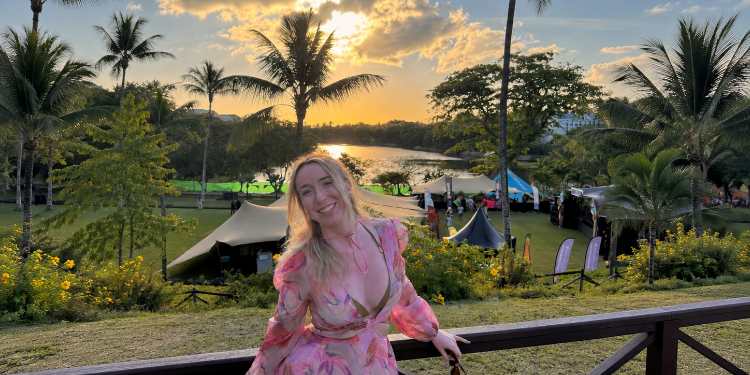
At 24, Élise chose to leave the structured framework of the French Army to fully embrace entrepreneurship and move to Mauritius with her partner. Thanks to the Premium Visa, she now works as an independent communications consultant for French clients, while sharing the behind-the-scenes of her new life on social media. She looks back on this career change, the preparation for her departure, and the realities of an expatriation that combines freedom, risk-taking, and new projects.
Can you introduce yourself and tell us about your journey?
My name is Elise, I'm 24, and I now work as a freelancer in communications and digital strategy.
My path has been a bit unusual, since I started my career in the French Army, where I worked in communications for two years. That experience taught me an enormous amount, both professionally and personally, but for a while I'd been wanting to build something that was truly my own.
So I started developing my freelance business on the side, before eventually deciding to leave the army and commit fully to my own venture. Today, I mainly help companies and organizations with their communications, social media strategy, content creation, and visual identity.
Alongside that, since we moved to Mauritius, my partner and I have also been sharing the behind-the-scenes of our move on social media. It's a project that started pretty spontaneously and has since become an increasingly important part of our daily life.
I really enjoyed my time in the army and I don't regret those two years at all. But I wanted more freedom in how I worked and, above all, the chance to build my own projects. On top of that, the army's budgets are currently quite limited, especially when it comes to opening new positions in my field.
Entrepreneurship had already been on my mind for a while. I'd actually started working as a freelancer before even leaving the army, since I was on a reservist contract for my last six months there, which let me test out my business and see if it could really work.
Our plan to move abroad then sped up this whole thought process. At some point, I had to choose between pursuing a fairly structured career in France or taking the risk of building a different kind of professional life. I chose the second option.
Join the community
Get regular tips and advice to make the most of your expat life
Did you face any challenges during this transition?
Yes, definitely. Moving from an environment like the army, which is extremely structured, to entrepreneurship, where you have to handle almost everything yourself, is a real shift.
When you go independent, it's no longer enough to just be good at your job. You also need to find clients, sell your services, handle admin work, manage your own schedule, and above all, accept having much less visibility on the months ahead. So I tried to prepare for this transition gradually rather than jumping in with no safety net.
I'd already launched my business and was working with a few clients who agreed to keep collaborating remotely. We'd also built up some savings before leaving. That doesn't remove all the uncertainty that comes with a change like this, but it does make it much easier to handle.
Originally, we mainly shared one goal: to experience living abroad and step away from the pace of life we had in Paris.
We were both in the military and realized that continuing our careers would eventually force us to make some tough choices between our professional and personal lives. We wanted to build our life together as a couple and, later, as a family, without feeling like we constantly had to put that on the back burner. It just wasn't the life we wanted to build together.
The idea of moving abroad started almost as a joke between us, and then we began seriously looking into what was actually possible.
We were looking for a country where we could keep working, with a fairly small time difference from France, since our work is still oriented toward French clients. The fact that French is widely spoken in Mauritius was also reassuring for a first experience living abroad.
Little by little, Mauritius ticked pretty much every box, and about six months after we'd truly made our decision, we were on the plane.
Did you know the island before moving there? What surprised you most when you arrived?
I personally had never been to Mauritius before moving there. My partner, on the other hand, already knew the island since he'd visited on holiday before, so we weren't heading into a total unknown.
I'd obviously watched a lot of videos, read plenty of accounts, and done my research before we left, but discovering a country online and actually living there day to day are two very different things. That's exactly why we try to show both our wins and our struggles here in our videos.
What surprised me most when I arrived was the beauty and diversity of the landscapes. Even after seeing tons of photos and videos beforehand, seeing it in person is completely different. Within a very short distance, you can go from paradise-like beaches to mountains, to sugar cane fields, or from very touristy spots to much more local areas. I was also struck by the mix of cultures and influences you really only discover once you're actually there.
The Premium Visa simply suited our situation best at the time we left. It was also the easiest and most accessible option for us to come live in Mauritius for a year and see whether this new life really was a good fit for us.
For me, as a freelancer working mainly with clients in France, this visa was particularly well suited since I could keep running my business remotely from Mauritius.
We really saw this first year as a time to explore, to actually experience life on the island, to build our professional projects, and to figure out how we see ourselves here long term. If it turns out to be the right fit, we can then look into the different options for settling more permanently.
How did you prepare your move on the administrative, financial, and professional fronts?
We started preparing our move several months in advance.
On the administrative side, we obviously had to put together our Premium Visa application, arrange insurance, gather the various required documents, and organize everything related to leaving France.
Financially, we were especially keen not to arrive in Mauritius and immediately depend on next month's income. So we built up savings before leaving and tried to anticipate the cost of settling in as much as possible.
Professionally, I grew my freelance business beforehand so I wouldn't be starting completely from scratch once we arrived. I wanted to keep clients and income coming from France, which also fit well with our choice of visa.
We'd also looked for housing before arriving and planned to rent a car at first. The idea was really to lock down the essentials while accepting that we couldn't plan for everything from a distance.
Did you run into any difficulties with the paperwork?
Overall, we mostly found that it required a lot of planning ahead and research.
The trickiest part is sometimes telling official information apart from the countless personal accounts you find online. Situations can vary a lot from one person to another, and some information quickly becomes outdated.
So we tried, as much as possible, to rely on official sources for anything important and to prepare our documents in advance. Moving abroad always comes with a few surprises along the way, but we never ran into anything that made us question our decision.
What does a typical day look like for you as a freelancer in Mauritius?
That's actually one of the things I enjoy most these days: no two days really look alike.
I still work with French clients, so I have to stay organized around the time difference. I might spend part of my day on a client's strategy, content creation, social media, or calls.
On top of that, there's now our own content creation about our life in Mauritius. We share a lot about our daily life, our discoveries, and the realities of settling in. That naturally involves filming, editing, and a lot of interaction with the people who follow us.
The upside of working for myself is that I can organize my schedule with a lot more freedom. I can work from home in the morning, take a few hours in the afternoon to explore somewhere new, and then get back to my laptop later if needed.
Has moving to the island changed your relationship with work?
Yes, even though we're still at the very start of our life here.
In France, I sometimes felt like my days were built entirely around work, and everything else had to fit around that typical Parisian commute-work-sleep routine. Here, I try to do the opposite: build a work setup that also lets me actually enjoy the place we chose to live in.
That doesn't necessarily mean working less. But I think the real difference is having the freedom to choose when, where, and on which projects I work.
That's also exactly what I was looking for when I left a very rigid professional environment.
Are you planning to stay in Mauritius long term?
Right now, we don't have a definite answer to that yet.
We came on a one-year Premium Visa specifically to give ourselves time to really discover what it means to live in Mauritius, beyond a holiday or those first few weeks when everything feels new and exciting.
For now, we feel really good here and can already picture ourselves staying. The real question will be whether, after this first year, our situation allows us to get another visa to stay in Mauritius longer term.
So we're going to make the most of this year to grow our professional projects, discover even more of the island, and look into the different options that could let us continue this adventure beyond the Premium Visa.
What advice would you give to people considering a career change and working as a freelancer in Mauritius?
First, I'd say don't idealize either entrepreneurship or moving abroad. Both bring a lot of freedom, but also a lot of uncertainty, and combining the two takes real preparation.
If possible, I'd recommend starting to build your business before you leave. Already having a few clients, testing your offer, and confirming it actually generates income completely changes how you experience the move.
I also think it's important to have a safety net of savings. Arriving in a new country feeling like you absolutely have to land a client within the next few weeks can quickly turn a wonderful experience into a source of stress, especially since it's difficult to work locally as a foreigner here.
Finally, it's really worth looking closely into the status and visa that match your specific project. Coming to work remotely for clients abroad and coming to build a business directly in the Mauritian market don't necessarily follow the same rules.
As for us, we tried to prepare as much as we could in advance, then accept that part of the adventure would simply be learned once we were actually here. And I think that's ultimately what makes this whole project so interesting.
A journalist, holder of the DALF C1 and C2 and a diploma from the University of Mauritius, I have nearly twenty years of writing experience. After six years in the Mauritian press, I joined Expat.com, where I have been working for over a decade, including five years as editorial assistant, and now as editorial manager.