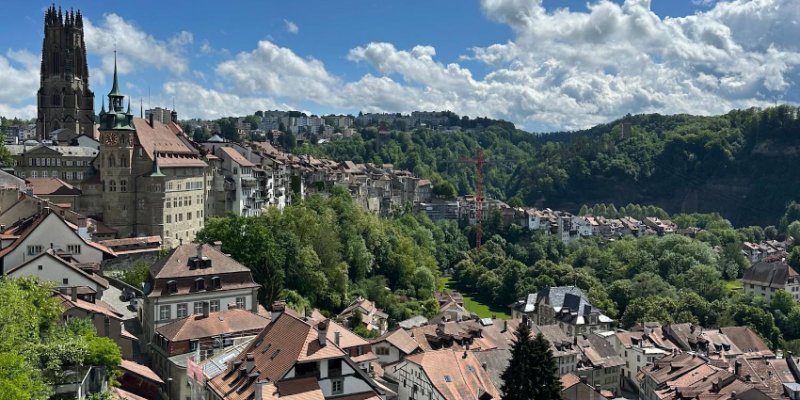
Many expats who have settled in Fribourg say the same thing after the first few months: the city is calmer, smaller, and more bilingual in daily practice than they had expected, and adjusting to all three simultaneously takes longer than the move itself. Comparable in feel and scale to a mid-sized English cathedral city, Fribourg carries Swiss costs and a French-German bilingual environment that operates as a live daily feature rather than a scenic backdrop. A single person's monthly budget runs CHF 2,700 to CHF 3,600 (approximately USD 3,294 to USD 4,392); housing is tight, especially around university enrollment periods, and French unlocks everyday life in the city. The gap between arriving and genuinely feeling settled is real, but the city's compact scale, strong safety record, and active cultural life make that investment worthwhile for the right newcomer profile.
Compact, bilingual, and unhurried: Fribourg is a cantonal capital that carries more institutional and cultural weight than its size suggests. Home to a bilingual university, medieval old town, cantonal government, and solid rail connections, the city officially describes itself ashuman-scale, and that phrase is not just marketing. Most daily errands, cultural visits, school runs, and social stops happen within a walkable radius. Unlike Geneva, Lausanne, or Zurich, the city does not generate the low-grade pressure of a large employment center; the tempo here is noticeably slower and more predictable.
What draws people to Fribourg is a consistent set of factors: a central location on the Swiss rail network, a genuinely bilingual French-German environment that exists as a live daily feature rather than a tourist trait, proximity to countryside, relative affordability by Swiss standards, and the presence of theUniversity of Fribourggiving the city a student-driven social energy that smaller Swiss towns lack. Residents who arrive from major cities like London or New York often find the adjustment more significant than they expect: the social scene is quieter, the job market is narrower, and the city's medieval topography, with its steep slopes, cobblestoned streets, and the Sarine/Saane river cutting through the lower town, gives everyday movement a different texture entirely.
The most common early adjustments are financial rather than cultural. Swiss-level costs hit immediately; housing is competitive, especially around university enrollment periods; and French is the practical language of daily life in the city even though German is the other official cantonal language. People who arrive expecting a ready-made social network, a large English-speaking expat community, or a dense nightlife scene need to recalibrate. Fribourg's social rhythms build gradually through regular participation rather than arriving pre-assembled.
The city divides naturally into three bands: the historic central areas with strong character appeal, the practical student-adjacent districts close to the university, and the residential neighborhoods on the city's outer edges suited to families and cost-conscious renters. All of them are served by the TPF (Transports publics fribourgeois) urban bus network, centered on Fribourg/Freiburg station, so car ownership is rarely necessary regardless of where you land.
Pérolles is the central district closest to the University of Fribourg and higher-education facilities, with daily services, bus links, and walkable access to the station. It suits students, younger professionals, and remote workers who prioritize connectivity and campus proximity over residential quiet. Price tier: medium to high. Nearby, Bourg is the historic upper-town quarter around the old city fabric, appealing to professionals, couples, culture-focused newcomers, and retirees who value centrality and heritage. The trade-off is older building stock and tighter streets.
Down in the lower town, the Basse-Ville (lower town) districts of Auge and Neuveville offer a village-like quality along the Sarine, scenic and historic, with immediate walking access to riverside paths. Auge suits retirees, couples, and remote workers seeking a quieter historic setting; Neuveville attracts culture-focused professionals who prefer river access over proximity to the station. Both rely on the city bus network and steep walking links to the upper town.
For more space at lower cost, the outer residential districts are the practical choice. Schoenberg, on the eastern heights of the city, is Fribourg's largest and most socially mixed district and the most affordable option within the municipality. It suits families and cost-conscious renters who need more square footage without a historic postcard setting. Guintzet-Gambach is a practical, institutionally oriented district with school infrastructure and family services, suited to families and professionals who want a city address with school access and bus links. Jura-Torry and Beaumont-Vignettaz are residential districts aimed at families and longer-stay residents who prioritize practical housing over central atmosphere. Beaumont-Vignettaz is notably home to the Vignettaz primary school, where a complete bilingual French-German stream is being progressively introduced across primary grades, making it a specific draw for families who want bilingual public education without private school fees.
Join the Fribourg community
Get regular tips and advice to make the most of your expat life
Cost of living in Fribourg
Fribourg is meaningfully cheaper than Zurich, Geneva, and Lausanne, and residents consistently describe it as one of the more affordable places to live within Switzerland. That said, "affordable by Swiss standards" still means expensive by almost any international benchmark, and newcomers arriving on non-Swiss salaries or paid in USD feel the cost structure sharply from their first month. The Swiss franc remained strong against the dollar, so budgeting in CHF from the outset is essential, not optional.
A single person's total monthly budget including rent typically falls between CHF 2,700 and CHF 3,600 (approximately USD 3,294 to USD 4,392). Without rent, recurring monthly spending runs roughly CHF 1,300 to CHF 1,600 (approximately USD 1,586 to USD 1,952). The main rental platform active in the Fribourg market is ImmoScout24, where current listings give a live picture of available stock. A studio runs CHF 835 to CHF 1,000 (approximately USD 1,019 to USD 1,220) monthly; a one-bedroom apartment CHF 1,000 to CHF 1,367 (approximately USD 1,220 to USD 1,668); and a two-bedroom apartment roughly CHF 1,600 to CHF 2,060 (approximately USD 1,952 to USD 2,513).
Beyond rent, the main recurring household costs are groceries, running roughly CHF 450 to CHF 650 monthly (approximately USD 549 to USD 793), utilities (electricity, heating, water) at CHF 150 to CHF 260 monthly (approximately USD 183 to USD 317), and home internet at around CHF 50 monthly (approximately USD 61). For transport, the Frimobil canton-wide monthly pass costs CHF 87 (approximately USD 106), covering unlimited travel across the cantonal network and making car ownership largely redundant for daily life.
Eating out adds up quickly at Swiss prices: a budget restaurant meal runs around CHF 25 (approximately USD 31), a mid-range dinner for two around CHF 100 (approximately USD 122), and a coffee around CHF 4.80 (approximately USD 5.86). A gym membership costs about CHF 70 per month (approximately USD 85). Swiss consumer-price inflation was comparatively low when these figures were collected, so the bigger ongoing pressure is housing and fixed Swiss costs rather than runaway food-price increases.
Climate and weather in Fribourg
Fribourg sits on the Swiss Plateau with a temperate oceanic climate (Köppen Cfb classification) influenced by continental conditions: cool, grey winters with frequent fog and low-sunlight periods, and warm summers with convective rain and thunderstorms. The pattern will feel broadly familiar to anyone from western or central Europe, but winter fog on the Plateau is more persistent than most newcomers expect, and the contrast between summer green and winter grey can take adjustment.
The most comfortable period for daily outdoor life runs from late spring through early autumn, when longer daylight hours, accessible river paths, and the old town's hillside setting combine to make the city genuinely pleasant. Beyond seasonal mood, the growing frequency of summer heatwaves is a practical issue: most Fribourg housing is designed around heating and insulation rather than cooling, so top-floor, poorly shaded, or older apartments can become uncomfortable during heat spells. When apartment hunting, check ventilation, shade, and the local microclimate around the unit before signing.
For day-to-day packing and gear, the practical list is: layered clothing, a waterproof rain jacket, waterproof shoes or boots for the city's cobblestones and bridges in damp conditions, warm winter outerwear, and lighter summer clothes for warm spells. The city's topography, with its steep slopes, stone bridges, and seasonal damp, makes practical grippy footwear more useful than dress shoes for everyday movement.
Good to know:
The MeteoSwiss climate portal provides historical averages, seasonal breakdowns, and monthly weather norms for the Swiss Plateau region, which is the most reliable reference for setting realistic seasonal expectations before arrival.
Getting around Fribourg
Fribourg is highly walkable in its compact center: most daily errands, cultural venues, schools, and services are within walking distance. The city's bus network, operated by TPF (Transports publics fribourgeois), connects all neighborhoods through the Fribourg/Freiburg station hub, and the canton-wide Frimobil monthly pass at CHF 87 (approximately USD 106) covers unlimited travel across the entire cantonal network. A car is rarely necessary for daily life within the municipality.
Cycling is practical with the city's active cycling infrastructure and PubliBike bike-share stations, which can be accessed via the PubliBike app. For cargo needs, Carvelo offers cargo-bike hire across the city. Car-sharing through Mobility and taxi services cover cases where neither walking nor public transport is sufficient. The city's mobility observatory tracks all shared options through the SharedMobility platform map.
For rail and regional connections, the SBB Mobile app is the primary tool for planning and booking journeys: it covers Swiss Federal Railways routes, regional bus connections, and most cantonal transport links. For transport-specific details including fares, routes, cycling infrastructure, and commuting options, the Fribourg Région access and transport page provides an organized overview for new arrivals.
Language and communication in Fribourg
French is the practical default for daily life in the city of Fribourg: municipal services, shops, schools, healthcare, and neighborhood-level conversation all operate in French. German is the other official cantonal language and is institutionally present in bilingual signage, university materials, and some cantonal offices, but in the city itself, you need French to navigate comfortably day to day. The canton's official bilingualism framework governs how the two languages are balanced across public institutions.
English handles initial arrival tasks reasonably well: the University of Fribourg offers English-taught programs mainly at Master level, and international and academic workplaces operate comfortably in English. Beyond those contexts, English is limited in everyday services, street-level administration, trades, and small local shops. The honest picture is that English gets newcomers through the first few weeks; French is what makes long-term life comfortable.
In daily interactions, the social norm is to open with Bonjour before asking whether English or German is possible. Service and administrative exchanges tend to be concise rather than chatty; written appointments are standard. A few practical phrases that carry genuine weight for new arrivals: Bonjour, je viens d'arriver à Fribourg (Hello, I've just arrived in Fribourg); Est-ce que vous parlez anglais? (Do you speak English?); and Je cherche le bureau du contrôle des habitants (I'm looking for the residents' registration office). The last one is particularly useful, since registering with the local residents' office is the first administrative step after arrival.
Fribourg's bilingual character also includes local linguistic layers worth knowing about: Bolze is a bilingual French-Swiss-German dialect spoken mainly in the Basse-Ville districts, and a local patois also exists. Both are cultural markers rather than languages newcomers are expected to learn or encounter regularly.
Where to develop French skills in Fribourg: the University of Fribourg Language Centre offers semester courses in French as a foreign language for university-affiliated learners; the Canton of Fribourg's integration bureau (IMR) runs free public French and German sessions at Parc des Grand-Places on weekday evenings during the summer months; and inlingua Fribourg (Rue St-Pierre 4, 1700 Fribourg) offers intensive courses in French, German, English, Italian, Spanish, and Portuguese year-round.
Culture and social norms in Fribourg
Fribourg's public identity combines medieval heritage, university life, and an active municipal cultural program. The city funds artist residencies, cultural events, and neighborhood programming throughout the year, and explicitly treats culture as part of urban quality of life rather than a luxury add-on. That said, the social texture of daily life is distinctly Swiss-French in its register: polite and measured at first contact, warming over time through consistent presence rather than initial expressiveness.
The baseline social norms are worth knowing before arrival. Greet people at the start of every interaction; keep noise low in residential buildings and on public transport; respect queues and shared spaces. Punctuality is a genuine social norm, not just a professional expectation: arriving late without notice is read as disrespectful across all contexts, from a coffee with a new acquaintance to a school appointment. Making an effort in French, even imperfect, is the most practical social signal in the city; the bilingual setting means German is appreciated in the wider cantonal context, but French opens more doors within the city itself.
Religion structures the calendar in ways newcomers notice quickly. The canton of Fribourg has nine public holidays, including Catholic feast days, with some variation between Catholic and Reformed areas. Shops, public offices, and many services close on these days. Checking local opening hours around cantonal holidays, particularly those that differ from holidays observed in most countries of origin, avoids practical frustration in the first few months.
The most reliable path to genuine integration is consistent participation over time: joining recurring activities through municipal cultural venues, university-linked programs, sport clubs, or neighborhood events builds trust and social connection more effectively than attending a single networking event. The Cohésion sociale department at the city runs the municipal integration program, covering participation, anti-discrimination initiatives, and community support, and is a practical resource for newcomers who want to understand what local social infrastructure is available.
Pace of life and work culture in Fribourg
Compared with Zurich, Geneva, or Lausanne, Fribourg runs at a noticeably calmer pace. The city is smaller in scale, the job market is narrower, and the social rhythm is less driven by professional networking events or late-night industry gatherings. Residents who move from larger Swiss cities regularly describe the shift as a genuine relief; those arriving from major international financial centers find it a significant gear change.
The professional structure, however, remains fully Swiss: standard employment contracts set a 40-hour working week, cantonal working-time rules restrict night and Sunday work except in defined sectors, and lunch is a short break rather than an extended midday meal. Contracts are formal, deadlines are real, and punctuality applies as much to professional meetings as to social ones. The city's smaller scale simply means that the transition between work and leisure is shorter and less fraught than in larger centers.
Work-life balance is consistently rated as good in Fribourg: nine cantonal public holidays, structured working hours, and a compact city size mean that finishing the working day and reaching a park, the riverside, or a café involves a short commute rather than an endurance test. Remote work is an established feature of the city's work culture; the canton has incorporated remote-work provisions into its public-sector employment framework, and the trend extends into the private sector. For remote workers and digital nomads, Fribourg's compact layout and infrastructure support home-based or café-based work without needing a large coworking ecosystem to anchor daily routines.
Seasonal shifts are visible in the city's pace: warmer months bring outdoor programming, longer opening hours, and a more active public life; winter and the cantonal holiday calendar bring more marked slowdowns, with administrative and commercial rhythms reflecting closures that go beyond the national Swiss public holiday schedule.
Food culture in Fribourg
Fribourg's culinary identity is rooted firmly in local terroir and dairy tradition. Fondue, Gruyère cheese, and regional dairy products are everyday staples rather than tourist-facing items, and the canton's agricultural and cheese-making heritage shapes what appears on menus and market stalls across the city. Fribourg holds status as a UNESCO Creative City of Gastronomy, which funds projects linking creativity and food and gives the restaurant scene more ambition than a city of this size might otherwise sustain. International dining options exist but are moderate rather than metropolitan in range.
The Marchés de Fribourg (city markets) are a genuine part of daily food culture: regular open-air markets in the city center offer local produce, cheese, seasonal vegetables, and artisan products. Shopping at the market is one of the most practical and social ways to connect with the city's food rhythms from week one.
The annual Bénichon season in autumn is the food event of the year across the canton: a traditional harvest celebration with a codified multi-course meal, including cuchaule (a saffron-laced brioche) and Bénichon mustard, served in restaurants and homes throughout Fribourg. For newcomers, attending a Bénichon meal is one of the most direct points of entry into local food culture and is worth planning around in the first autumn after arrival.
Leisure and social life in Fribourg
Day-to-day leisure in Fribourg centers on walking, outdoor recreation around the old town and riverside landscape, and a cultural program that is noticeably rich for a city of its size. The Sarine/Saane river, the Jardin botanique de l'Université de Fribourg, and the surrounding green spaces form the backbone of outdoor daily life, and the city's free public activities program, Lisez, jouez, bougez!, runs close to 70 free or low-cost events combining reading, games, movement, and culture in public spaces each year between May and September. For newcomers without an established social network, these events are a low-barrier way to meet people and settle into the city's rhythms.
The arts and cultural scene is stronger than the city's scale would suggest. Municipal cultural programming, the university, museums, small performance venues, and artist residencies all contribute. The city's culture service funds 10- to 30-day artist residencies in venues including the University of Fribourg, Le Bilboquet, Bruit Rose, and L'Atelier. The annual Nuit des Musées de Fribourg opens multiple institutions simultaneously and is one of the year's social highlights. For more on what's currently on, the city's culture page tracks programming across venues.
Nightlife is present but moderate: Fribourg Tourism's listings cover bars, student venues, and cultural evenings across the region. The city is not a club-focused destination, and people who depend on a dense late-night scene should recalibrate expectations accordingly. For most residents, social life builds through bars, sport, organized activities, and local events rather than a large after-dark infrastructure.
Weekends follow an outdoor and event-led rhythm: walks through the medieval lower town and riverside areas, café stops, museum nights, heritage visits, seasonal festivals, and short excursions. The Fribourg summer guide gives a good sense of the seasonal event calendar for the warmer months.
Family life in Fribourg
Fribourg is strongly oriented toward families in its infrastructure and services. The city coordinates childhood, school, and social-cohesion support through a municipal strategy covering children and young people, and free or low-cost children's activities run through public cultural and neighborhood programs year-round. For families arriving with children, the practical landscape is structured but requires active navigation, particularly around childcare places and school enrollment.
One of the most significant options for bilingual-education-focused families is the Vignettaz primary school in the Beaumont-Vignettaz district, where a complete French-German bilingual stream is being progressively introduced across primary grades. This is a public school option, meaning access to bilingual education does not require private school fees, though availability depends on the rollout timeline for specific grade levels. The relevant announcement is on the cantonal education department's site.
The municipal preschool care system covers children from 4 months to approximately 4 years through crèches (day-care centers), day families, garderies (nursery schools), and early-learning workshops. After-school care, known as AES (accueil extrascolaire), covers primary pupils before and after school and at lunchtime. The tariff scales from CHF 13.50 to CHF 166.35 (approximately USD 16 to USD 203) per full day, depending on household income. A complete application submitted on time does not guarantee a place: apply early, apply to multiple options, and plan several months ahead rather than on arrival. Full details on applying and fee schedules are on the city's preschool care page.
For families arriving with children of primary school age who are not yet fluent in French, the SCEPM (Secteur Contact école-parents migrants) is a dedicated municipal service bridging newly arrived families and Fribourg primary schools. It covers information on the school system, school life, family support services, associations, and integration resources, and operates specifically for families navigating the local system from abroad.
Beyond school-related services, family community resources include LivrEchange, an intercultural library offering children's activities, multilingual story sessions, French and German conversation workshops, and basic administrative support. The Passeport vacances program offers low-cost vacation activities for children living in Fribourg. The newly established Guichet famille (family support counter) provides social guidance and links to partner organizations including the Association pour l'éducation familiale and the Fédération des associations des parents d'élèves, making it a practical first stop for families who need administrative guidance or social support after arrival.
Safety in Fribourg
Fribourg is a generally safe city by Swiss and international standards. The main day-to-day risk is petty theft, the most common offense category in the canton. Traffic-related incidents and occasional friction in nightlife areas or central public spaces after dark complete the realistic picture. None of these represent unusually elevated risk compared with other Swiss cities.
During the day, the city's residential and central areas feel calm. After dark, standard urban caution applies: use lit pedestrian routes, avoid isolated parking levels and underpasses when alone, and stay more alert near the station and nightlife areas where footfall drops late at night. The Police locale de la Ville de Fribourg (Route de l'Aurore 4a, 1700 Fribourg) handles municipal public-space matters, parking, lost property, and local order issues. The Police cantonale Fribourg handles criminal complaints, emergency intervention, and territory-wide policing.
Emergency numbers to have ready from day one: 117 for police, 144 for ambulance or medical emergency, and 118 for fire. The Fribourg medical on-call service for non-urgent medical questions is reachable at 0800 17 01 71. The city's emergency information page consolidates these contacts in one place.
Anyone who is a victim of physical, psychological, or sexual violence can call 142, the new victim-support helpline covering French-speaking cantons including Fribourg. The Centre LAVI Fribourg (tel. 026 305 15 80) provides victim support for children, adolescents, men, and traffic victims. Women and children facing domestic violence can contact SOS Femmes / Solidarité femmes Fribourg (tel. 026 322 22 02) for emergency refuge and support.
Environment in Fribourg
Fribourg's environmental credentials are a genuine quality-of-life asset. Tap water is safe to drink and comes 99% from spring water, governed by the city's drinking-water regulation. Air quality has improved over recent years: the canton monitors ozone, nitrogen dioxide, and fine particles through a live air-quality map and historical data, and current sustainability indicators confirm improving environmental health conditions. For most newcomers arriving from larger or more industrialized cities, the environmental baseline in Fribourg is a noticeable step up.
The city's Programme Nature et Paysage manages urban parks, biodiversity plantings, and cool islands across the city: shaded seating areas designed to provide relief during summer heat spells. Main outdoor spaces within easy reach include La Motta park, the Jardin botanique de l'Université de Fribourg, and the Sarine/Saane riverside paths. These are integrated into daily life, not just weekend destinations.
Fribourg has a strong sustainability culture at the institutional level: the city runs a local sustainability strategy aligned with the UN 2030 Agenda, a climate-and-sustainability laboratory, participatory events, biodiversity initiatives, and soft-mobility programs. A cantonal climate regulation is now in force, formalizing climate governance across the canton. For anyone who weighs environmental policy when choosing where to live, the city's approach is substantive rather than superficial. The full picture is on the municipal sustainability page.
The main environmental nuisance in Fribourg is traffic noise, which is moderate and concentrated around road arteries rather than city-wide. The canton's road-noise register is accessible through the cantonal cartographic portal: checking a specific address before renting takes a few minutes and is worthwhile for anyone sensitive to noise levels. Infrastructure works in the historic lower town, including bridge closures affecting the Auge district, can noticeably affect movement in localized areas for extended periods, which is worth factoring in when choosing a neighborhood.
Expat community in Fribourg
Fribourg has a medium-sized international community: large enough to find social entry points without difficulty, small enough that most newcomers eventually integrate into local life rather than remaining inside a self-contained expat bubble. Integration experience varies considerably depending on language background, professional context, and how quickly newcomers engage with French-language local settings.
Official integration support services are well organized. The city's Cohésion sociale department runs a multi-year integration program covering information services, early childhood support, participation initiatives, diversity management, and anti-discrimination work. The S'installer à Fribourg portal provides practical settling-in resources with language and integration guidance. The CCSI Fribourg (Centre de contact Suisses-Immigrés) handles migration-related questions from residents. RESPIRE Fribourg (Route des Arsenaux 24) offers in-person support with published office hours. The IMR (Bureau de l'intégration des migrant-e-s et des réfugié-e-s) organizes free public language courses and broader integration support at the cantonal level. For non-French-speaking newcomers in particular, these services bridge the gap between arrival and functional local integration.
For informal social connection, the Fribourg Social Meetup group organizes in-person events in Fribourg, described as English-French, language exchange, culture exchange, dining, and new-in-town gatherings. The Fribourg Social Meetup page shows upcoming events and is one of the most accessible starting points for newcomers who want to meet people before developing a local network. The r/Fribourg subreddit also has active posts from newcomers in English and French and is a useful low-barrier community for first questions and local advice.
Longer-term international residents tend to describe Fribourg as socially workable but not instantly open: consistent effort, French-language engagement, and regular participation in local activities are what build genuine mixed networks over time.
Fribourg's advantages and challenges are two sides of the same coin, and understanding both is what separates a realistic relocation decision from a romanticized one.
On the positive side: the compact, human-scale city layout means daily errands, cultural venues, green spaces, and transport are all within easy reach, and the medieval setting gives the city a distinctive character rather than a generic commuter-town feel. Safety and environmental quality are genuine strengths: clean spring water, improving air quality, active green-space management, and a structured sustainability culture are practical assets in daily life. Affordability relative to Switzerland's major cities is real: Fribourg consistently comes in below Zurich, Geneva, and Lausanne in overall cost of living, and the monthly transport pass at CHF 87 (approximately USD 106) covers the entire cantonal network. The bilingual university presence and municipal cultural program make the city intellectually and socially richer than its size alone would suggest.
Against those advantages, the challenges are equally concrete. The city is still expensive by almost any international standard: a single person needs CHF 2,700 to CHF 3,600 monthly all-in (approximately USD 3,294 to USD 4,392), and housing is the most persistent pressure point. The rental market is tight: the city's own housing policy materials link housing scarcity directly to quality-of-life pressure and the risk of residents leaving. And for anyone renting an older or poorly ventilated apartment, summer heat is an increasingly real comfort issue that the city's own climate agenda now formally addresses.
Frequently asked questions
Fribourg suits digital nomads who want a calm, well-connected Swiss base rather than a large international hub. The city is compact and walkable, public transport is strong with a monthly canton-wide pass at CHF 87 (approximately USD 106), and costs run meaningfully lower than Zurich or Geneva, though a single person still needs CHF 2,700-3,600 (approximately USD 3,294-4,392) all-in each month. English works in professional and university contexts but French is needed for daily life. The city has no large coworking ecosystem or established nomad community, so those who value that infrastructure should factor it in before choosing Fribourg as a base.
For a short stay connected to the university or an international employer, English carries you through initial tasks. For comfortable long-term life, French is essential: housing viewings, municipal administration, schools, healthcare, and neighborhood social life all operate primarily in French. German is useful across the wider bilingual canton but French is the city-level priority. Starting French classes before arrival makes the transition significantly smoother, and the city's Language Centre and inlingua Fribourg both offer courses year-round.
For a single person, budget CHF 2,700-3,600 (approximately USD 3,294-4,392) all-in each month. Rent is the largest variable: a studio runs CHF 835-1,000, and a one-bedroom CHF 1,000-1,367. Beyond rent, recurring monthly costs include groceries (CHF 450-650), utilities (CHF 150-260), internet (around CHF 50), and transport (CHF 87 for the Frimobil monthly pass). A budget restaurant meal costs around CHF 25 and a mid-range dinner for two around CHF 100. Expats paid in USD should factor in the strength of the Swiss franc when planning their budget, as the exchange rate amplifies the cost gap.
Fribourg is generally safe across all its districts, with no official neighborhood-level crime ranking identifying one area as significantly riskier than another. In practice, the choice comes down to lifestyle fit: central historic areas such as Bourg, Auge, and Pérolles feel lively and walkable, while residential districts including Schoenberg, Jura-Torry, and Beaumont-Vignettaz are quieter. Standard urban caution applies after dark near the station, underpasses, and isolated areas. Checking lighting and commute routes during an apartment viewing gives a more reliable read than any generalized ranking.
Fribourg rewards longer-term commitment. Students, families, professionals, and retirees who invest in French, local routines, and community connections find the city's compact scale an advantage over time. Short-term stays are possible but housing availability is narrower and furnished options are more limited than in larger Swiss cities, making short stays proportionally more expensive and harder to arrange logistically. Those planning a stay of less than six months should start their housing search well in advance and budget for a premium on furnished options.
The most common surprises are the intensity of Swiss-level costs despite the city feeling small and quiet, the competitiveness of the housing search especially around university term starts, and the contrast between the city's charming medieval setting and the structured, administrative nature of Swiss everyday life. Many newcomers also find that daily life becomes noticeably easier once they use French regularly rather than relying on English. The topography, with its steep slopes, cobblestones, and bridges, catches many newcomers off guard for cycling or carrying groceries on foot.
Foreigners can rent in Fribourg, but the process is formal, and availability is tighter than in larger Swiss cities. Landlords typically expect proof of income, a valid residence permit or permit application, references, and a deposit; having these documents ready before starting your search saves significant time. ImmoScout24 is the main platform for rental listings. Arriving during university term start periods, typically in September, makes competition more intense, so it's advisable to start searching two to three months ahead.
The main downsides are high costs relative to most countries of origin, a tight housing market with limited short-term furnished options, the need for French for genuine daily integration, a smaller job market than in major Swiss cities, moderate nightlife, and, increasingly, summer heat in older housing not designed around cooling. None of these is unusual for a small Swiss city, but together they form the realistic picture of what the city asks of newcomers, particularly those arriving on non-Swiss salaries or paid in USD.
Fribourg's small size tends to push newcomers toward local integration over time, as there is no large self-sustaining expat bubble to fall back on. University connections, international workplaces, the Fribourg Social Meetup group, and the r/Fribourg subreddit help at the start. Everyday social life is French-speaking and locally oriented, so expats who learn French, join recurring local activities, and accept the gradual pace of Swiss social connection build genuine mixed networks rather than remaining only in international circles.
ℹ️
We do our best to provide accurate and up to date information. However, if you have noticed any inaccuracies in this article, please let us know in the comments section below.
I fell in love with words at an early age After a break to focus on my studies, I rediscovered the joy of writing while keeping a blog during my years between London and Madrid. This passion for storytelling and for exploring new cultures naturally inspired me to create Expat.com, a space for my own reflections as well as for anyone wishing to share their experiences and journeys abroad.