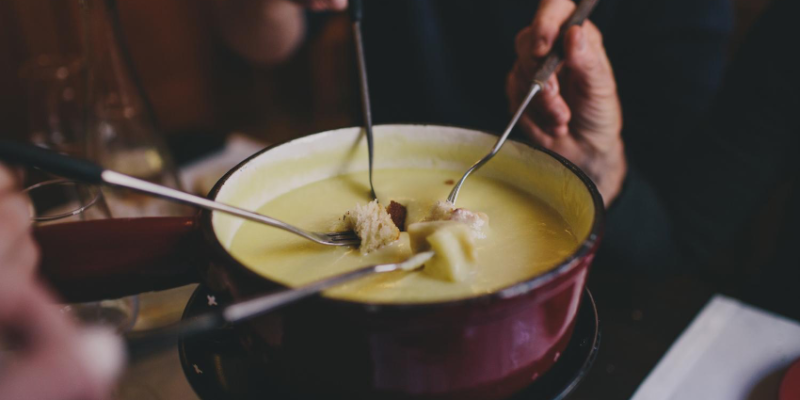
Understanding what to eat in Fribourg, and what it will cost, is one of the practical priorities for any new arrival. A simple restaurant meal starts at around CHF 25 (USD 30.50), which makes eating out daily a significant monthly expense even before reaching gastronomic addresses. What sets Fribourg apart is not just the price level but the depth of its food identity: the city holds membership in the UNESCO Creative Cities Network for Gastronomy, and its signature dish, fondue moitié-moitié made with Gruyère AOP and Vacherin Fribourgeois AOP, is a genuine everyday social meal for residents rather than a set piece for visitors.
Cheese sits at the center of daily eating in Fribourg in ways that go beyond menu choices. The canton produces two internationally protected cheeses under the AOP (Appellation d'Origine Protégée) label, Switzerland's protected designation of origin: Gruyère AOP and Vacherin Fribourgeois AOP. Both are raw-milk cheeses made exclusively in defined areas of the canton, and both appear in the city's signature fondue. This regional terroir identity, built around dairy, seasonal produce, and traditional recipes, forms the cultural backbone of what Fribourg eats and how it socializes around food.
The city is a member of the UNESCO Creative Cities Network for Gastronomy, a designation that carries real civic weight here. Food events, community meals, and gastronomy projects are woven into public life rather than staged for visitors: restaurants and cafés function as everyday meeting places for residents, students, and local organizations, not primarily as tourist destinations. That institutional seriousness about local food is noticeable when you arrive, and it shapes what you find on menus, in markets, and at seasonal celebrations.
Alongside this terroir-rooted foundation, a contemporary layer has taken hold. Bistronomy (relaxed fine-dining that combines bistro informality with gastronomic ambition), vegetarian- and vegan-friendly seasonal cooking, and creative food-and-culture crossover events all sit alongside the traditional café-brasserie culture that remains the city's day-to-day backbone. Fribourg's regional food identity now spans everything from 150-year-old fondue institutions to newly opened fusion addresses driven by a genuinely international university population.
Meal rhythms follow Swiss norms that differ from many countries. Cafés open as early as 06:00 in the center for breakfast. Lunch revolves around a menu du jour (daily set special, typically two or three courses), which is the most cost-effective way to eat out on a weekday. Dinner clusters early: most restaurants take bookings for 19:00 to 20:00, and kitchens at traditional venues often close before 21:00. Weekend food life centers on market visits, café meals, fondue, and group dining rather than a single brunch tradition.
Fondue moitié-moitié (literally "half-half") is the city's signature dish: a communal cheese fondue made with equal parts Gruyère AOP and Vacherin Fribourgeois AOP, melted together and served with cubed bread for dipping. A second local style, fondue fribourgeoise au Vacherin, uses Vacherin Fribourgeois alone and produces a creamier, milder result. Both are available year-round at traditional restaurants. The AOP label guarantees that the cheeses are produced in a defined geographic area using regulated methods, so the fondue you eat in Fribourg uses the same raw-milk cheeses sold internationally under the same name.
For the classic experience, Café du Midi in the pedestrian center, a fondue institution since 1877, and Café du Gothard in the Bourg district are the most directly referenced addresses for tasting both fondue styles alongside other regional dishes. Café du Gothard also serves Jambon de la Borne AOP, a smoked regional ham with protected origin status, as part of its Fribourg-focused menu.
The Bénichonn is Fribourg's most distinctive seasonal food tradition: a multi-course harvest-festival meal eaten in autumn across the canton. Its table combines Cuchaule AOP (a saffron-flavored brioche-style bread) with moutarde de Bénichonn (a sweet-spiced spread made with vin cuit, or cooked pear and grape must, combined with mustard flour, sugar, aniseed, cinnamon, and cloves), Jambon de la Borne AOP, meringues with double cream, and other heritage dishes. What surprises many newcomers is that the Bénichonn is a living seasonal event embedded in the local calendar: restaurants and househol ds across Fribourg participate each autumn.
The regional bakery tradition extends well beyond the Bénichonn table. Local pastry shops carry meringues with double cream year-round, alongside other specialties including salée à la crème, gâteau payernois, fine salée, and pains d'anis (anise-flavored breads rooted in local baking history). These items appear in bakeries and at the city's markets.
The weekly food-and-flower market at Place de l'Hôtel-de-Ville and Place Georges-Python runs every Wednesday morning from 06:30 to 12:00, with no market on public holidays. A Saturday market at Place de l'Hôtel-de-Ville complements the Wednesday offer with regional fresh products. Both are the natural starting point for picking up Fribourg cheeses, charcuterie, and seasonal produce directly from local producers.
Join the Fribourg community
Get regular tips and advice to make the most of your expat life
Types of dining in Fribourg
The distinction between a café and a restaurant is looser in Fribourg than in many other countries. Most cafés serve full meals at lunch and dinner alongside coffee and drinks; "brasserie" on a sign typically means a relaxed, all-day venue rather than a specialist beer establishment. The city's most-visited café-restaurants, including Café du Marché near the market square and student-area institutions such as Café Populaire, run from early morning through the evening, offering seasonal vegetarian and meat dishes, local wines, and daily specials rather than a fixed menu. This café-brasserie model is the backbone of everyday eating in Fribourg.
Fine dining is well represented for a city of Fribourg's size. Le Pérolles on Boulevard de Pérolles and Restaurant des Trois Tours both hold Michelin and Gault&Millau recognition and are Fribourg's flagship gastronomic addresses. Le Pérolles operates Wednesday to Saturday for lunch and dinner only, so advance booking is essential. Several other addresses, including La Cène, operate on limited seatings and require payment at the time of booking.
International fast-food chains including McDonald's and Burger King operate in Fribourg alongside a local fast-food landscape of kebab shops, pizza takeaways, and casual burger restaurants. These sit alongside the stronger café-brasserie and regional-restaurant culture rather than replacing it.
Fribourg offers several distinct formats for browsing and buying food outside a restaurant setting. The Marché Bio de Fribourg brings together more than 30 organic farmers from the canton, offering regional organic produce and sustainable-food activities. Bio26, a covered cooperative grocery in the city center, stocks over 1,000 organic and local products, including Fribourg cheeses, local bread, charcuterie, jams, and regional wine, and functions effectively as a covered market for organic shoppers. In summer, Le Port de Fribourg operates as a seasonal riverside café-restaurant and event space on the Sarine, adding outdoor dining to the warm-weather food offer.
Food neighborhoods in Fribourg
Fribourg's compact size means most dining districts are within 15 to 20 minutes on foot from the main station. The city's topography divides the dining landscape along a vertical axis: the upper town (Bourg) sits above, the lower town (Basse-Ville, also called Neuveville) below, linked by funiculars and staircases. Contemporary dining addresses concentrate along Boulevard de Pérolles to the south.
The Bourg district, centered on Place de l'Hôtel-de-Ville and the area around the cathedral, is the natural starting point for traditional Fribourg cuisine. Café du Gothard here serves cheese fondues, Jambon de la Borne AOP, and regional Swiss classics. The Saturday market on Place de l'Hôtel-de-Ville makes this the logical spot for a market-to-table morning, combining fresh-produce shopping with a café stop before the stalls close.
The Basse-Ville (Neuveville) offers a historic riverside setting with traditional Fribourg cooking. Café de l'Ours on Rue de la Neuveville is a warm historic restaurant serving Fribourg dishes and regional products, listed in the city's restaurant guide as one of the lower-town addresses worth knowing. The neighborhood's character is quieter than the upper town and well suited to an evening walk followed by a regional meal.
Boulevard de Pérolles is where modern and gastronomic Fribourg concentrates. Le Pérolles restaurant anchors the upper end, while the adjacent Quartier de la Fonderie, around the Fri-Son cultural venue and the Chocolat Villars site, hosts the city's most trend-oriented creative food addresses. Fribourg Tourism identifies this area as part of the city's evolving gastronomy scene, with bistronomy and creative food-and-culture crossover events alongside more established restaurants.
For street food and food trucks, the City of Fribourg officially licenses rotating vendors at four locations: Pérolles-Charmettes, Pérolles-Domino, Rue de Romont–Square des Places, and Bourg–Place de l'Hôtel-de-Ville. Recurring vendors include Indian, oriental, and churros concepts alongside seasonal ice cream and coffee stands. The Schoenberg district, home to Le Raisin d'Or (an Asian gastronomy address) and the periodic Mercado Schoenberg market, rounds out the city's geographic food spread.
International cuisine in Fribourg
Fribourg's university population sustains a broader international dining offer than its size might suggest. Italian cuisine is the most strongly represented international category, with multiple established restaurants including Da Antonio, Cibo e Vino, Michelangelo, Anema e Core, La Roma, La Scala, and Ristorante Pizzeria Mamma Mia among the venues in the city's restaurant listings. Because restaurant turnover in a small city can move quickly, it is worth checking that a specific venue is still open before visiting.
Asian cuisine is well represented across multiple styles. Restaurants include Thai Jing, Tomodachi, MyYaki, Ji Xiang, Punkt, Le Bonheur, Thong Baï Thaï Food, and Le Raisin d'Or in the Schoenberg district. Beyond Asian and Italian, the city's international offer includes miQuiztlI (Mexican, with a pre-Hispanic-influenced menu), Host India at Beauregard 4 (Indian food with online ordering), Walima and Le Comptoir Libanais (Lebanese and oriental), Hasi House (Balkan cuisine), and Abyssinia Café et Restaurant (Ethiopian).
For specialty international ingredients, MULTI-MARKET 3J stocks products from the Fribourg region alongside goods from India, Pakistan, Sri Lanka, Africa, and Latin America. Gakomo, a specialty boutique in the city center, carries African fine-food products including spices, dried fruits, infusions, flours, chocolate, and rhums arrangés (rum infused with tropical fruits and spices).
Grocery shopping in Fribourg
The two dominant mid-range supermarket chains in Fribourg are Migros and Coop, both with multiple city branches. Coop Supermarché City Fribourg Food is a central location for everyday shopping. One difference that regularly surprises newcomers: Migros does not sell alcohol. Wine, beer, and spirits must be bought at Coop, Denner, specialist shops, or licensed retailers, so one-stop supermarket shopping for a dinner party requires a second stop. Swiss supermarkets also operate on restricted hours compared to many countries: most close between 18:30 and 20:00 on weekdays and earlier on Saturdays, with most branches closed on Sundays except for outlets located inside train stations.
For budget grocery shopping, Denner (with a Denner Express branch at Rue de Criblet 4), Lidl, and Aldi are the lower-cost options in Fribourg. The University of Fribourg Welcome Center lists all three as main grocery stores for newcomers on a tighter budget.
Atout Vrac at Grand-Rue 10 is a specialty grocery focused on local, sustainable, and packaging-free products, with most of its range sourced from the Fribourg region or elsewhere in Switzerland. Bio26, the covered cooperative in the city center, stocks over 1,000 organic and local products including Fribourg cheeses, charcuterie, bread made with local flour, jams, pastries, and local wine.
The weekly food-and-flower market at Place de l'Hôtel-de-Ville runs every Wednesday morning from 06:30 to 12:00 (no market on public holidays) and on Saturday mornings, with regional fresh produce, local terroir products, and flowers. The Marché Bio de Fribourg gathers more than 30 organic farmers from the canton; it is distinct from the weekly market and focuses specifically on certified organic produce. For international grocery products, MULTI-MARKET 3J carries goods from India, Pakistan, Sri Lanka, Africa, and Latin America alongside local Fribourg products.
Both main chains offer online grocery delivery. Migros Online has a minimum order of CHF 99.00 (USD 118.00) with next-day delivery available where capacity allows, using selectable slots between 06:30 and 21:00. Coop requires a minimum order of CHF 99.90 (USD 119.00) and delivers chilled and frozen products in insulated packaging on a chosen date. A realistic monthly grocery budget for one person runs from approximately CHF 400 to CHF 600 (USD 480 to USD 720), based on University of Fribourg cost-of-living guidance.
Eating out costs in Fribourg
Eating out regularly in Fribourg is a significant expense by most international standards. A meal at an inexpensive restaurant costs around CHF 25 (USD 30.50) per person; a three-course dinner for two at a mid-range restaurant runs to approximately CHF 100 (USD 122.00). A fast-food combo (McDonald's style) costs around CHF 13 (USD 15.90). Most residents manage the cost by mixing restaurant meals with weekday menu du jour lunches, market food, home cooking, and occasional takeaway rather than eating out at every meal (Numbeo).
Drinks at a café or bar add up quickly at Swiss prices. An espresso or cappuccino costs approximately CHF 5 (USD 6.10), a draught beer (0.5 liter) around CHF 6.50 (USD 7.95), and a street-food snack or kebab starts from about CHF 6.50 (USD 7.95). Price levels vary by neighborhood: the center and station area offer the most budget-friendly options, with fast food and casual meals from around CHF 13 (USD 15.90); the Old Town and Basse-Ville sit at a mid-range level around CHF 25 (USD 30.50) per person; Boulevard de Pérolles houses the gastronomic addresses including Le Pérolles and Restaurant des Trois Tours.
Service is included in Swiss restaurant prices by law, so there is no separate mandatory service charge to calculate. Tipping is appreciated but not obligatory; the standard practice is to round up the bill by a franc or two rather than apply a percentage. Cards, contactless, and mobile payments are widely accepted across Fribourg restaurants; keeping a small amount of CHF cash remains useful for smaller cafés, market stalls, and pop-up events (University of Fribourg Welcome Center).
Dietary requirements in Fribourg
Vegetarian options are easy to find across Fribourg's restaurant scene. L'Aigle Noir offers daily vegetarian versions of its menu, Le Sauvage has a dedicated vegetarian menu du maraîcher (market gardener's set menu), Café du Marché lists vegetarian dishes among its seasonal offer, and Lebanese and oriental restaurants such as Walima include vegetarian meze-style options. The combination of a large student population and a city-level gastronomy program focused on seasonal and creative cooking has pushed vegetarian menus into the mainstream rather than as an afterthought.
Vegan options are present but not universal. Walima lists vegan mezes, Café du Marché includes vegan dishes in its seasonal menu, Abyssinia Café et Restaurant is tagged with vegan dishes, and NEKO KITCHEN states that vegan options are available. At traditional cafés and brasseries, vegan dishes may not appear on the printed menu, so it's best to ask. Beyond restaurants, Migros Online filters over 1,000 labeled vegetarian and vegan products, and La Sage Espace Bio on Boulevard de Pérolles specializes in organic, gluten-free, lactose-free, and vegan grocery options.
Halal-declared options are available at a moderate number of Fribourg restaurants. Walima uses halal lamb and chicken for its shawarma and mezes, and Abyssinia Café et Restaurant carries a halal dietary tag. Formal independent certification from a recognized body was not confirmed for these venues, so diners with strict requirements should enquire directly before ordering.
Gluten-free restaurant options exist but are less consistently signposted than vegetarian choices. Restaurant l'Ibis offers gluten-free pizza, and NEKO KITCHEN states gluten-free options are available. In supermarkets, Migros stocks a labeled gluten-free range and filters for it online; Coop's Free From range covers gluten-free and lactose-free products. La Sage Espace Bio on Boulevard de Pérolles is the most specialized city-center option for gluten-free and lactose-free grocery shopping.
Swiss law requires restaurants to provide written allergen information for all dishes. If a server offers only a verbal response, you are within your rights to ask for the written allergen information. When eating out in Fribourg's French-speaking environment, use direct phrases: "Je suis allergique à…" (I am allergic to), "sans gluten" (gluten-free), "sans lactose" (lactose-free), "végétalien" (vegan), "sans viande" (no meat), "halal", or "Pouvez-vous vérifier avec la cuisine?" (Can you check with the kitchen?). Walima specifically asks customers with food allergies to contact the restaurant before ordering.
Food delivery in Fribourg
A couple of delivery platforms operate in Fribourg. Just Eat / Eat.ch has city-wide coverage and is the Swiss market leader by number of partner restaurants; Uber Eats also covers the city. For the widest restaurant choice and the most consistent service, Just Eat is the most reliable starting point for new arrivals.
A typical delivery time benchmark for Just Eat orders in Switzerland is 16 to 20 minutes, where the restaurant is within the active delivery zone. Tipping delivery riders is optional rather than expected, consistent with Swiss service norms generally.
Grocery delivery is also available through Just Eat's Fribourg page, which offers online grocery ordering alongside restaurant delivery, and through Uber Eats grocery partners in Switzerland. Coverage for grocery delivery specifically depends on which partners are active in Fribourg at any given time; checking the app at your specific address is the most accurate way to confirm availability and current restaurant selection. Fribourg is a compact city, and some neighborhoods or late evening time slots may have fewer active options than the center.
Reservations are advisable for gastronomic restaurants and popular dinner venues, especially on weekends. TheFork lists bookable restaurants in Fribourg and shows available slots; many venues also take reservations directly by phone or through their own website. La Cène is one example of a high-end Fribourg restaurant that requires advance payment at the time of booking because of limited seating, so check the policy when reserving at fine-dining addresses.
Dinner service runs earlier than in southern European cities. Most restaurants cluster bookable slots around 19:00 to 20:00, and kitchens at traditional venues often close before 21:00. Arriving at 21:30 expecting to order a full dinner is not realistic at most Fribourg restaurants. Some all-day cafés such as Café du Marché maintain extended hours, but that is an exception rather than the standard. Le Pérolles operates Wednesday to Saturday for lunch and dinner only, so planning a special meal there requires checking current hours directly.
Service charge is legally included in Swiss restaurant prices, which means the total on the bill is what you pay. There is no expectation of an additional 10 to 15% tip as in some other countries. Rounding up the bill by one or two francs for good service is considered courteous and is the standard gesture; leaving a separate banknote on the table is not the local custom. Dress code depends on the venue: casual attire works at cafés, brasseries, and neighborhood restaurants, while gastronomic addresses expect smart-casual without a strict formal code.
Summer closures are common even at established Fribourg restaurants. Multiple venues announce multi-week annual closures in late July and August, so check current opening hours directly before planning any meal, especially a special-occasion dinner. Fribourg's food traditions, especially fondue and the Bénichonn seasonal meal, carry genuine civic weight: fondue is an everyday group meal for residents year-round, not a tourist set piece, and the Bénichonn multi-course table is a living seasonal event that locals take seriously.
Frequently asked questions
Fribourg is best known for fondue moitié-moitié, made with equal parts Gruyère AOP and Vacherin Fribourgeois AOP, and for the Bénichonn, a multi-course harvest-festival meal eaten in autumn across the canton. The Bénichonn table combines Cuchaule AOP (a saffron brioche) with moutarde de Bénichonn, Jambon de la Borne AOP, meringues, and double cream. Fribourg is a member of the UNESCO Creative Cities Network for Gastronomy, giving its cheese and regional food culture institutional recognition that goes well beyond tourism.
Fribourg's café culture is practical and neighborhood-oriented: cafés-restaurants open from around 06:00 and combine morning coffee, daily lunch specials, terrace time, and informal dinner service under one roof. The line between a café and a restaurant is blurred, since most cafés serve full meals at lunch and dinner rather than just drinks and snacks. Venues like Café du Marché serve seasonal cooking all day to residents, students, and workers rather than positioning themselves as destination experiences.
Dinner reservations and kitchen service in Fribourg typically cluster around 19:00 to 20:00, and many restaurant kitchens close before 21:00. Arriving late without a reservation risks finding the kitchen already closed, which surprises visitors accustomed to later dining hours in southern European cities. Booking in advance is the safest approach, especially on weekends.
Yes, eating out regularly is a significant expense. A meal at an inexpensive restaurant costs around CHF 25 (USD 30.50), and a mid-range dinner for two runs to approximately CHF 100 (USD 122). Most residents manage costs by mixing restaurant meals with café lunches, market food, and home cooking rather than eating out at every meal.
Yes. Card payment, including contactless and mobile, is widely accepted across Fribourg restaurants, cafés, and shops. Cashless payment is increasingly standard throughout the city. Carrying a small amount of CHF cash remains useful for smaller cafés, market stalls, and food-truck events where card terminals may not be available.
No fixed tip is expected. Service is included in Swiss restaurant prices by law, so there is no obligation to add an additional percentage on top of the bill. The common practice is to round up by one or two francs as a gesture for good service, rather than calculating a set percentage as is customary in some other countries.
Food delivery works in Fribourg through three active platforms: Just Eat / Eat.ch has city-wide coverage and is the Swiss market leader by number of partner restaurants; Uber Eats also covers the city. Reliability is reasonable for the city center but can vary by neighborhood and time of day. Checking the app at your specific address is the most accurate way to confirm coverage before relying on it.
Common surprises include the early dinner rhythm, with kitchens often closing by 21:00; the high cost of even casual meals compared to most other countries; and the fact that fondue is a regular group social meal for locals year-round rather than a dish served mainly to tourists. The Bénichonn seasonal tradition also carries genuine cultural weight in the canton. Service is legally included in Swiss restaurant prices, so a tip of one or two francs is sufficient rather than the 10-15% expected elsewhere.
Generally, no. Most restaurants in Fribourg operate on standard Swiss hours with kitchens closing between 21:00 and 22:00. Some all-day cafés, such as Café du Marché, publish service until midnight, but late kitchen service is the exception. High-end restaurants like Le Pérolles operate only Wednesday through Saturday, so always verify kitchen hours directly before planning a special meal.
ℹ️
We do our best to provide accurate and up to date information. However, if you have noticed any inaccuracies in this article, please let us know in the comments section below.
I fell in love with words at an early age After a break to focus on my studies, I rediscovered the joy of writing while keeping a blog during my years between London and Madrid. This passion for storytelling and for exploring new cultures naturally inspired me to create Expat.com, a space for my own reflections as well as for anyone wishing to share their experiences and journeys abroad.