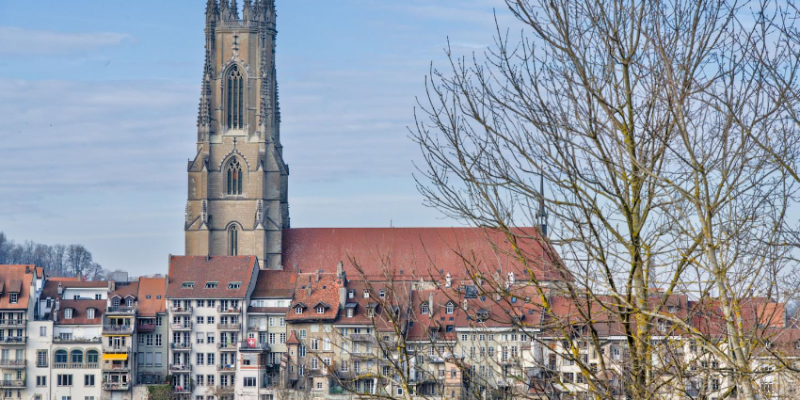
The first few weeks of searching for an apartment in Fribourg quickly clarify one thing: the market moves fast, and agencies expect a complete application ready at the moment of viewing. Fribourg is a compact, officially bilingual city built around a medieval river valley, with 12 distinct areas each offering a different balance of price, transport access, and atmosphere. Rents range from around CHF 1,050 (approx. EUR 1,124) for a studio to over CHF 2,985 (approx. EUR 3,194) for a large family apartment, with Swiss law capping the security deposit at three months' net rent, held in a blocked bank account in the tenant's name. Understanding these rules and the city's neighborhoods before you begin searching gives you a genuine practical advantage in a market where preparation is the deciding factor.
Fribourg's rental geography is shaped by the Sarine River valley, which divides the medieval lower town from the upper-town quarters and the newer residential districts extending outward. The city officially recognizes 12 neighborhoods, each with a distinct character, price tier, and practical trade-off for newcomers. Choosing the right one depends on whether you prioritize walkability, proximity to the university, family space, or budget.
The Bourg (historic center) covers the upper-town core and is Fribourg's premium central option. Walkable to shops, administrative offices, and public transport, it suits professionals and couples who want immediate access to city services and the old-town atmosphere. The trade-off is straightforward: housing stock tends toward older, smaller buildings, and rents sit at the top of the city range. Anyone expecting large or modern apartments will find more options in other districts.
Pérolles is the most practical choice for university-linked arrivals, students, and young professionals. Positioned between the university campus and central Fribourg, it offers good transport connections and a steady supply of furnished sublets and shared-apartment rooms, which is particularly useful when you arrive without a long-term lease already in hand. Rents here are mid-tier, making it one of the more efficient neighborhoods for the money.
Jura-Torry is Fribourg's most affordable inner district. The Torry section hosts subsidized and affordable rental housing managed by the Fondation de la Ville de Fribourg en faveur du logement, which keeps rents among the lowest within city limits. It suits budget-conscious renters and families who value proximity to city services without paying central prices, and it works well for longer-term residents who do not need a central address.
Schoenberg offers a quieter residential setting at a lower price tier than the old town and is one of the city's more densely populated outer quarters. Getting around from Schoenberg depends more on bus connections than in the central districts, so check routes and journey times before signing a lease, especially if you commute on foot or by bicycle.
The neighboring communes of Villars-sur-Glâne and Marly sit outside the City of Fribourg's administrative boundaries but appear regularly in rental portal searches. Listings there can offer better value or more modern housing stock than the city itself, but they fall under separate municipal administrations, which affects school registration and official residency processes. If a listing address falls in one of these communes rather than postal code 1700 Fribourg, confirm which municipality you are actually dealing with before applying.
Apartments are the dominant housing format across Fribourg'srental market, for both short and long-term stays. Standalone houses appear occasionally but represent a smaller share of available stock; families should focus their search on multi-room apartments rather than expecting a wide selection of houses.
Studios are a notably tight category. Supply is limited relative to demand, particularly around university term periods, which makes them competitive and harder to secure than larger apartments. If your budget or preference points toward a studio, plan for a longer search window or treat flatsharing as a practical fallback.
Flatsharing (colocation) is the standard affordable route for students and recent arrivals. The market is student-dominated, but privately arranged rooms in shared apartments are accessible to any newcomer who cannot yet secure a full lease. The AGEF University of Fribourg housing board lists rooms, sublets, and lease takeovers specifically aimed at people arriving in connection with the university; it is worth checking even if you are not an enrolled student, since private rooms listed there are not always restricted to students.
Furnished apartments exist in Fribourg but are largely short-stay or student-market products rather than standard long-term options. Furnished leases in Fribourg are mostly fixed-term arrangements with minimum durations, or university-linked rooms. Anyone signing a standard unfurnished lease of six months or longer should expect to furnish the apartment from scratch, which means budgeting for furniture, appliances, and basic household equipment before or shortly after arrival. For professionals relocating temporarily, furnished monthly rentals through platforms such as home.ch can bridge the gap while you search for a permanent lease.
For academic newcomers specifically, Fondation Apartis offers furnished rooms from CHF 365 (approx. EUR 391) per month, with shared bathroom and kitchen facilities. This is the most affordable furnished option in the city, but places are linked to academic arrivals and are limited in number.
A few French terms appear repeatedly in Fribourg listings and are worth knowing before you start searching. Meublé means furnished. Sous-location is a sublet, usually with a fixed end date tied to the departing tenant's timeline. Reprise de bail is a lease takeover, where you step into an outgoing tenant's contract on the same terms. Both sublets and lease takeovers carry fixed handover dates, so move quickly if you find one that fits.
Good to know:
Furnished or serviced short-term rentals often bundle utilities into the advertised price. Before comparing a furnished monthly rental against an unfurnished lease, confirm whether the furnished price is all-inclusive; the apparent cost gap can be smaller than it looks once you add charges and internet to an unfurnished lease figure.
Join the Fribourg community
Get regular tips and advice to make the most of your expat life
Rental prices in Fribourg
Fribourg sits at a price level meaningfully lower than Geneva or Zurich, but Switzerland's overall housing costs mean rents are still well above what most newcomers expect from a city of this size. Before comparing listings, it helps to know that Swiss apartments are described by room count rather than bedroom count: a "2.5-room" apartment typically means a living room, one bedroom, and a kitchen or bathroom counted as the half-room; a "3.5-room" adds a second bedroom. Knowing this notation saves considerable confusion when searching portals.
Across the active Fribourg rental market, apartments range from around CHF 1,050 (approx. EUR 1,124) per month for a compact 45 m² studio up to CHF 2,985 (approx. EUR 3,194) for a large 4.5-room apartment of 123 m². Most standard 2.5- to 3.5-room apartments fall between CHF 1,550 (approx. EUR 1,659) and CHF 2,300 (approx. EUR 2,461) per month. Those figures represent the realistic budget range for a newcomer looking for a self-contained apartment in Fribourg.
One consistent source of confusion in Fribourg apartment listings is the separation between net rent (loyer net) and charges. Many advertisements display both figures separately: for example, CHF 1,550 (approx. EUR 1,659) net rent plus CHF 100 to CHF 200 (approx. EUR 107 to EUR 214) in monthly charges covering heating, water, and building maintenance. Always check whether an advertised price is the all-in gross figure or just the net rent before comparing properties, and ask specifically about parking if you need it, since it is almost always priced as a separate line item.
For students and short-stay academic arrivals, furnished rooms through Fondation Apartis start from CHF 365 (approx. EUR 391) per month. Privately listed rooms in shared apartments on the AGEF housing board run higher: one example shows CHF 580 (approx. EUR 621) net rent plus CHF 120 (approx. EUR 128) in charges per month, illustrating that even the shared-apartment market in Fribourg reflects Swiss price levels rather than the student-housing rates common in other European cities.
Finding accommodation in Fribourg
The two main Swiss portals for renting in Fribourg are Homegate and ImmoScout24. These are the primary search tools for the Swiss rental market, not supplementary resources, and most serious listings appear on one or both. Set up alerts on both from the start of your search and filter strictly to 1700 Fribourg addresses to avoid mixing results with neighboring communes such as Villars-sur-Glâne or Marly.
Students and academic newcomers should also monitor the AGEF University of Fribourg housing board, which lists rooms, sublets, and lease takeovers not typically found on the main commercial portals. These listings are especially useful around university term starts, when demand for studios and rooms peaks sharply.
Most Fribourg rentals are managed through estate agents (régies). After identifying a property online, the process moves quickly: request a viewing, attend, then submit your full application dossier to the agency on the same day if possible. The City of Fribourg housing page confirms that renting requires completing an application form and submitting it to the régie promptly. Agencies will not hold a property while you gather documents, so prepare everything before your first viewing. Keep a signed copy of your lease once it is issued: the Contrôle des habitants (residents' registration office) requires the rental contract when you register your arrival in the city.
Treat the search as time-sensitive. Desirable apartments attract multiple applicants, and listings commonly carry fixed move-in dates. Allow four to eight weeks for a standard search, with tighter timing if you need a studio or a room around the start of the university term. If a listing looks unusually cheap or a landlord pressures you to pay before a visit, treat it as a warning sign: the AGEF housing board explicitly advises applicants to use common sense and be cautious of offers that seem too good to be true. Never send a deposit without a signed lease and a verified bank account in your name.
How renting works in Fribourg
Before you start viewing apartments, assemble your application documents. A standard Fribourg rental application requires three core items: a salary certificate (certificat de salaire), a certificate of domicile (attestation de domicile), and an extract from the debt-enforcement register (extrait du registre des poursuites). Foreign applicants renting through municipal or institutional landlords must also provide a copy of their B or C residence permit (or passport) and civil-liability insurance documentation. Prepare all of these before your first viewing so you can submit immediately afterward rather than losing the property while you locate paperwork.
Swiss law caps the rental security deposit (garantie de loyer) at three months' net rent for residential leases. The money must be placed in a blocked bank account opened in the tenant's name, not paid directly to the landlord. For a CHF 1,800 (approx. EUR 1,927) per month apartment, that means up to CHF 5,400 (approx. EUR 5,781) blocked on arrival: budget for this amount before you start applying, since it falls due at lease signing. Alternatively, a rental-guarantee insurer can provide a certificate accepted in place of the cash deposit, but only if the landlord explicitly agrees to this arrangement. When signing through an agency, an administration fee is standard practice; one Fribourg agency, Rosset, charges CHF 200 (approx. EUR 214) at lease signing to cover application processing and nameplate costs.
When a new lease is signed, the landlord must provide an official initial rent notification form (avis de fixation du loyer), which sets out the legal conditions under which the initial rent can be challenged. Once you receive it, read it, and keep it with your lease documents; it is your reference point if you later want to contest the rent level.
Swiss residential leases renew automatically unless terminated in writing before the contractual deadline. Both tenant and landlord must give three months' written notice, served on the termination dates specified in the lease. Missing that window means the lease continues for another full period. If you need to leave before the next contractual termination date, you can do so without further rental liability by presenting a solvent replacement tenant willing to take over the lease on the same terms. Without a replacement, you remain liable for rent until the next valid termination point.
For disputes between tenant and landlord, Swiss law requires a mandatory conciliation attempt before any court proceedings. In Fribourg, this goes through the Commission de conciliation en matière de bail for the Sarine district, located at Grand-Rue 27, 1700 Fribourg. For disputes involving a primary, non-luxury residence, this body charges no judicial fees. Once the lease ends, the landlord must give written consent to release the blocked deposit, or it is automatically released one year after the lease end date if the landlord has not asserted a claim through debt enforcement or court action in that period.
Challenges for expats renting accommodation in Fribourg
The single biggest practical obstacle for newcomers is speed. Fribourg agencies expect a complete application dossier at the time of viewing or immediately after; a good apartment will not wait while you locate documents. Gather your salary certificate, debt-enforcement extract, domicile certificate, identity document, and insurance paperwork before you start searching, not after you find something you want.
Lease documents, ancillary-cost statements, agency communications, and the état des lieux (handover inspection report) are all in French. The key point is that understanding clause-level detail in a lease, reviewing a charge statement, or engaging with the conciliation authority all require solid reading comprehension of formal French. If you are less confident with formal legal French, have someone review the lease before you sign.
Two cultural points regularly catch foreign newcomers off guard. The rental guarantee is non-negotiable: the City of Fribourg explicitly advises renters to expect a deposit before taking possession, and asking for a waiver will not go down well with any landlord or agency. Second, lease disputes in Switzerland are handled through formal conciliation channels as a first step, not through informal negotiation alone. Using the Commission de conciliation or seeking advice from a tenant organization is the standard Swiss approach to a disagreement, not an unusual escalation.
Many tenants in Fribourg do not act on rights they actually have. A canton-level survey by ASLOCA Fribourg found that only one in five tenants entitled to a rent reduction requested and obtained one. Newcomers unfamiliar with Swiss tenant protections are particularly at risk of missing rights, including the right to challenge an initial rent or contest ancillary charges. Contact ASLOCA Fribourg early if anything in a lease or handover is unclear; membership gives access to legal advice sessions held in Fribourg, Bulle, and Romont. Additional support is available through Caritas Fribourg, which advises and assists tenants in financial difficulty, and through the Canton of Fribourg's renter orientation page, which covers required documents and the rental process step by step.
For a standard long-term lease, utilities are not automatically included in the rent. Most Fribourg leases distinguish between the net rent and the frais accessoires (ancillary costs), which typically cover heating, water, building maintenance, and refuse collection. These are either billed monthly as advance charges reconciled annually, or charged at a flat rate; check the relevant clause in your lease before signing and ask the agency which system applies, since the annual reconciliation can produce an additional bill or a refund depending on actual consumption.
Electricity in Fribourg is supplied by Groupe E, the regional distributor. New tenants need to contact Groupe E directly to open or transfer an electricity account. In some buildings, however, electricity is billed through the landlord's ancillary-cost account rather than as a direct tenant contract; check your lease first to confirm which arrangement applies before contacting the utility. Water is supplied by the municipal Service des eaux under the city's drinking-water regulation and is typically channeled through the landlord's ancillary charges rather than billed directly to the tenant. As a monthly budget guide, basic utilities covering electricity, heating, cooling, water, and refuse for an 85 m² apartment run approximately CHF 278 to CHF 325 (approx. EUR 298 to EUR 348).
For internet and mobile service, the main providers operating in Fribourg are Swisscom, Sunrise, and Salt. Before signing a contract, use the federal Broadband Atlas to check fixed-network and mobile coverage at your specific address, since speeds and available technologies vary by building. To compare plans across providers, Comparis offers a side-by-side telecoms comparison tool. A home broadband subscription adds approximately CHF 47 (approx. EUR 50) per month. Mobile plans range from around CHF 10 (approx. EUR 11) to CHF 81 (approx. EUR 87) depending on data allowance and contract length. Swiss utility and telecom contracts are set up directly by the incoming tenant rather than transferred from the previous occupant, so you will need to contact providers yourself once your lease is signed.
Frequently asked questions
Apartments in Fribourg range from around CHF 1,050 for a compact studio to CHF 2,985 for a large 4.5-room apartment. Most standard 2.5- to 3.5-room apartments fall between CHF 1,550 and CHF 2,300 per month. Always check whether the advertised price is net rent or gross, since many Fribourg listings separate the base rent from monthly service charges. Student rooms through Fondation Apartis start from CHF 365 per month.
The main choices are Bourg (the historic upper town) for walkability and central access, Pérolles for university proximity and good transport links, Jura-Torry for more affordable rents including some subsidized housing, and Schoenberg for a quieter residential setting at a lower price tier. Your choice largely comes down to whether you prioritize central walkability, university access, or value for money. Families should check bus routes before committing to a more peripheral district.
Search on Homegate and ImmoScout24, the two main Swiss rental portals. Students and academic newcomers should also check the AGEF University of Fribourg housing board for rooms, sublets, and lease takeovers not listed on the main portals. After a viewing, complete the agency application form immediately and submit your full dossier the same day. Keep your signed lease ready for your arrival registration at the Contrôle des habitants.
Most agencies require a salary certificate, a certificate of domicile, and an extract from the debt-enforcement register. Foreign applicants should also provide a copy of their residence permit or passport and civil-liability insurance documentation. Prepare these documents before your first viewings so you can apply on the same day as the visit.
Desirable apartments attract multiple applicants quickly, and many listings advertise fixed move-in dates, leaving little flexibility. Studios and student rooms are particularly tight around university term starts. Set alerts on both main portals, filter to the 1700 Fribourg postcode to exclude wider canton listings, and have your full application dossier assembled before you begin viewing.
Most standard leases are open-ended and renew automatically unless either party gives formal written notice. Both tenants and landlords must give three months' notice served on the contractual termination dates stated in the lease. If a lease includes a rent indexation clause, Swiss law requires the lease to run for a minimum of five years for that indexation to be valid, so read the lease dates carefully before signing.
Swiss law caps the rental deposit at three months' net rent, and that money must be held in a blocked bank account opened in your name, not handed directly to the landlord. For an apartment at CHF 1,800 per month, that means up to CHF 5,400 blocked on arrival. Alternatively, a rental-guarantee insurer can provide a certificate that replaces the cash deposit if the landlord accepts this arrangement.
Standard long-term leases in Fribourg do not include utilities in the rent. Most listings show a net rent figure plus separate monthly charges covering heating, water, and building maintenance. Always check the lease's ancillary-cost clause and clarify whether the charges are a flat rate or an advance payment reconciled annually. Furnished and short-term rentals more often bundle utilities into the advertised price, so the distinction matters when comparing options.
The main challenges are speed (good apartments go fast and require a complete application dossier before viewing), upfront costs (up to three months' net rent as a blocked deposit on top of the first month), and Swiss rental culture (deposits are standard and non-negotiable, and disputes are resolved through formal conciliation before any court involvement). Lease documents and agency communications in Fribourg are in French, so you will need to read and respond in French throughout the process. Contact ASLOCA Fribourg early if anything in the lease or the property handover report is unclear.
Options for a landing period include furnished monthly rentals filtered for longer stays with Wi-Fi, fixed-term furnished apartments available from around three months minimum on platforms such as home.ch, and university-linked rooms through Fondation Apartis for academic newcomers starting from CHF 365 per month. Use short-term accommodation as a bridge while you visit apartments and complete a standard lease application rather than signing remotely before you have seen the city.
ℹ️
We do our best to provide accurate and up to date information. However, if you have noticed any inaccuracies in this article, please let us know in the comments section below.
I fell in love with words at an early age After a break to focus on my studies, I rediscovered the joy of writing while keeping a blog during my years between London and Madrid. This passion for storytelling and for exploring new cultures naturally inspired me to create Expat.com, a space for my own reflections as well as for anyone wishing to share their experiences and journeys abroad.