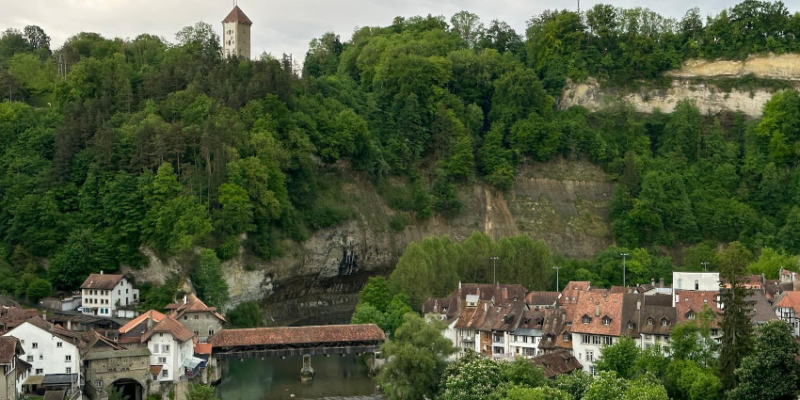
Fribourg has operated as a bilingual French-German city since the medieval period, and that dual identity runs through its leisure offer in ways newcomers notice quickly: public institutions program in both languages, the cultural calendar draws on both communities, and the free-access tier across museums and open-air events is broad enough to keep a new resident occupied for weeks without significant spending. The city's spring-to-autumn festival season covers international film, sacred music, contemporary live arts, and outdoor popular music. Year-round resources like MEMO, the bilingual public library and cultural space, and Kunsthalle Friart, the free contemporary art center in the Basse-Ville, provide a constant low-barrier cultural anchor. What distinguishes Fribourg most practically for new arrivals is how much of this offer costs nothing.
Free admission is the rule, not the exception, across Fribourg's museum circuit. The Musée d'histoire naturelle de Fribourg (Chemin du Musée 6) opens daily from 14:00 to 18:00 at no charge, featuring natural-science collections while a new building is being prepared for the end of 2028. Kunsthalle Friart, a non-collecting contemporary art center in the Basse-Ville (lower town) focused on rotating exhibitions, is equally free; its position in the Neuveville quarter makes it a natural addition to any walk through the historic lower neighborhoods. The model here is a Kunsthalle rather than a traditional museum: exhibitions change regularly, and the space prioritizes live contemporary work over a permanent collection, so there is always something new on offer.
Paid museums are priced modestly by Swiss standards. The Musée d'art et d'histoire Fribourg (Rue de Morat 12) charges CHF 10 (USD 11) for adults and CHF 8 (USD 9) for students and senior cardholders; children under 16 enter free, as do accompanied school classes. The most cost-efficient way to see the museum's holdings alongside those of the neighboring Espace Jean Tinguely – Niki de Saint Phalle (Rue de Morat 2) is the combined ticket at CHF 15 (USD 16) for adults and CHF 11 (USD 12) for concessions, covering both venues in a single visit.
MEMO, the city's bilingual library and toy library, functions as a cultural meeting and learning place open to all residents. Its participatory program runs year-round and covers game evenings, chess clubs, family animations, storytelling, workshops, and collaborations with neighborhood cultural partners, all at no charge. As a bilingual French-German space with no entry fee, it is the most accessible daily cultural anchor in the city for newcomers on any budget.
The Vieille-Ville (Old Town) and its Fortifications Trail form a free self-guided walk through one of Switzerland's most complete medieval urban landscapes. The historic lower-town neighborhoods of Auge and Neuveville, connected by the Pont du Milieu, and the upper Bourg quarter around the old center are the three main historic zones to explore on foot. No booking or entry is required. The Cantonal and University Library (BCU, Rue St-Michel 6) also offers free admission for individual visitors, adding a further no-cost cultural resource to the city center.
Équilibre, Fribourg's main performance theater, stages productions across theater, dance, and performing arts, with tickets ranging from CHF 20 to CHF 50 (USD 22 to USD 55) depending on the production. Each year in May, the Nuit des Musées de Fribourg opens all city museums on a single evening from 17:00 to 23:00 for a CHF 25 (USD 27) all-venue pass, with children admitted free: the most efficient way to cover the full museum circuit in one outing. Summer brings Format Mondial, a free open-air exhibition that turns Fribourg's public spaces into an outdoor gallery dedicated to illustrators and comic-book artists from the canton, running several weeks across July and August. Every spring, the Festival International du Film de Fribourg (FIFF) runs an international program centered on cross-cultural dialogue, making it one of the most accessible large events for newly arrived residents from any background.
Good to know:
Many of Fribourg's visually oriented museums, free open-air formats, and major international festivals carry programming that is accessible regardless of French or German proficiency. Smaller participatory workshops at institutions such as MEMO more commonly run in one or both local languages.
The city's parks, promenades, forests, and viewpoint paths cover 78 hectares of communal green space, all freely accessible year-round. The Jardin botanique de l'Université de Fribourg (Chemin du Musée 10, Pérolles district) is among the most practical free outdoor destinations in the city: 5,000 plant species across 22 themed sectors, open daily from 08:00 to 18:00. Parc du Domino, a few hundred meters from the main railway station, functions as the city's most versatile open public space, with a renovated playground, an accessible carousel suitable for people with reduced mobility, hammocks, ping-pong tables, giant chess, a water feature, basketball courts, and pétanque areas, all free.
The outdoor season runs from May to mid-September. Le Port de Fribourg (Planche-Inférieure 5) opens each year in May along the Sarine river as a seasonal outdoor venue with a relaxation zone, participatory gardens, a socio-cultural program, and a bistro, operating daily from 11:00 to 23:00 through mid-September. The Bains de la Motta open-air pool opens on a similar seasonal schedule, offering the city's main outdoor swimming option close to the Sarine. During hot, dry periods, canton-wide fire restrictions may apply to outdoor barbecues and open-flame gatherings.
Walking beyond the city is straightforward on foot or by bus. The Chemins de la Sarine is a regional trail network along the Sarine corridor between Rossens and Düdingen, accessible near bus stops and parking areas; it requires no specialist equipment and offers riverside walking through lowland scenery comparable to a long-distance regional footpath. Leisure cycling in the Fribourg region centers on scenic excursion routes rather than a dense urban protected-lane network, and the canton publishes a catalog of organized day rides for all levels. The FriActiv app, available from the canton, covers leisure routes, cycling excursions, and sport discovery across the region: the most practical free starting point for newcomers who want to explore outside the city center.
Day trips from Fribourg reach three distinct destinations within the region. Gruyères (La Gruyère) is the closest, a half-day trip combining a medieval village, a chateau, and the dairy-farming landscape of the surrounding countryside. Murten (Morat) and the Murtensee (Lake Murten) offer a relaxed alternative: well-preserved ramparts, lakeside walking, and a mild lake climate. Schwarzsee (Lac Noir), in the Fribourg Pre-Alps, provides mountain-lake scenery, walking trails, and themed family-friendly nature paths in a mountain setting accessible without specialized hiking gear.
Join the Fribourg community
Get regular tips and advice to make the most of your expat life
Shopping in Fribourg
The Bourg quarter, around Grand-Rue and Place de l'Hôtel-de-Ville, holds most of the old-town retail, cafés, and fashion shops. Fribourg Centre (Avenue de la Gare 10), directly opposite the railway station, consolidates 47 shops across four floors; standard hours run Monday through Thursday 09:00 to 19:00, Friday to 20:00, and Saturday 08:30 to 16:00, with food shops opening 30 minutes earlier and cafés from 08:00.
The weekly food markets are the most immediate route into local produce and community life. Three locations run on overlapping schedules: Place Georges-Python operates on Wednesday from 06:30 to 12:00 (moving to Rue de Romont when the square is occupied by events); Rue du Simplon / Pérolles runs on both Wednesday and Saturday from 06:30 to 12:00; and Place de l'Hôtel-de-Ville / Grand-Rue in the Bourg opens Saturday from 06:30 to 12:00. All markets close at midday, so arriving before 09:00 gives the best choice of produce.
Beyond the weekly rhythm, the city runs a series of specialty markets through the warmer months. The Marché aux puces de l'Auge (Place du Petit Saint-Jean) takes place on the first Saturday of every month from March to November, 08:00 to 16:00, with 30 to 50 exhibitors offering antique furniture, porcelain, and small objects. A vide-grenier (community flea market) follows on the last Saturday of the same period at Place Georges-Python. The annual Marché Bio brings more than 30 organic canton farmers to Place Georges-Python in late September; the Marché de la Saint-Nicolas, held in the Bourg quarter on the first Saturday of December, adds more than 60 artisan stands and hot food to the Saint-Nicolas celebrations. A Marché des artisans créateurs at Le Port de Fribourg, gathering around 60 regional artisan-creators, takes place in late June. Budget shoppers can find reduced-price clothing at Angéloz Mode Outlet (Rue St-Pierre 10), which sells end-of-collection and clearance stock for women and men and is open Tuesday through Friday and on Saturday.
Events and festivals in Fribourg
Every spring, the Festival International du Film de Fribourg (FIFF) anchors the cultural calendar with an international film program built around cross-cultural dialogue, now running for more than four decades and established as one of Switzerland's longest-running international film festivals. Late June into early July brings Belluard Bollwerk, the contemporary live-arts festival held in the historic Belluard fortress, which also hosts the Coop Open Air Cinema through summer evenings; a cinema ticket costs CHF 18 (USD 20).
July concentrates the city's largest popular events. The Festival International de Musiques Sacrées de Fribourg (FIMS) fills Fribourg's historic churches and venues with sacred and classical music over about ten days in early July. Festival Les Georges, the city's main outdoor summer music festival held at Place Georges-Python across six evenings in mid-July, mixes Swiss and international artists; three evenings carry no admission charge, and there is a free family afternoon on the Wednesday, making it the most accessible large festival in the city for residents on a limited budget. The Fribourg 3x3 Festival at Place du Fair-Play runs in early July, combining 3x3 basketball, 3x3 football, music, and street food over several days.
August brings two community-centered events. The Impulse Sports Festival, held at Place du Fair-Play and entirely free, draws more than 40 sports clubs and local associations to a single afternoon of stands, demonstrations, and sport introductions: the most practical event of the year for discovering the city's associative life in one afternoon. Swiss National Day (Fête du 1er Août) is celebrated at Place des Grandes-Rames from 18:00 on August 1, a neighborhood public celebration and one of the most welcoming community events for newly arrived residents.
Keeping up with what's on requires two complementary sources: the Fribourg Tourism events calendar for cultural festivals and seasonal visitor-facing listings, and the Ville de Fribourg agenda for municipal, family, sport, and neighborhood events. The University of Fribourg Newbies Tour, offered each September in French, German, and English, is one of the few city-orientation events formally available in English and a direct entry point for international students and researchers arriving in the fall.
Nightlife in Fribourg
Fri-Son is Fribourg's principal concert hall and club venue, programming concerts across styles, club nights, film screenings, spoken word, comedy, and visual arts events throughout the year. Concert tickets range from CHF 15 to CHF 67 (USD 16 to USD 73) depending on the act; club nights start at 22:30 or later. The venue anchors live music and late-night culture in a city where the evening scene is genuine but moderate in scale.
Five distinct bar zones cover the rest of the evening. The Bourg area, centered on Le Bistro du Bourg (Rue du Pont-Suspendu 8), is relaxed on weekdays and busier at weekends, with DJ evenings drawing crowds from the old town. The Grand-Places zone centers on Crapule Club (Grand Place 14), a late-night venue open Thursday from 23:00 to 05:00 and Friday through Saturday from 22:00 to 05:00: the longest hours in the city. Café du Belvédère on Grand'Rue offers terrace drinks and DJ evenings open until around midnight on most nights. On Rue de Lausanne, Les Trentenaires (no. 87) operates as a craft-beer bar, open until 02:00 on Thursday, Friday, and Saturday. Boulevard de Pérolles has Les Gosses du Québec (no. 4), a sports-pub setting with live sports, darts, and Friday-through-Saturday hours until 02:00. Café XXe (Avenue de Tivoli) adds DJ evenings, concerts, and small exhibitions as another city-center option.
Typical club entry costs CHF 15 to CHF 20 (USD 16 to USD 22). From May through September, Le Port de Fribourg adds outdoor live music and dance programming along the Sarine in the evenings, functioning as the most sociable open-air option during the warmer months. Budget around CHF 7 to CHF 10 (USD 8 to USD 11) for a beer at a bar; most venues close between midnight and 02:00, with only Crapule Club extending to 05:00 on late nights.
Family activities in Fribourg
The most practical free starting point for families is Parc du Domino, a few hundred meters from the main railway station. Designed for all ages, it includes a renovated playground, an accessible carousel suitable for people with reduced mobility, hammocks, ping-pong tables, giant chess, a water play feature, a large lawn, basketball courts, and pétanque areas. The city maintains a wider playground network across all districts, with an online inventory to help families locate nearby sites.
MEMO's free "Lisez, jouez, bougez!" program, running from May through September, offers around 70 activities categorized by age group: toddlers, children, teens, families, and all-public sessions. Formats include storytelling, reading, games, movement, swimming sessions, chess evenings, and cultural collaborations. Some sessions require advance registration; the full schedule is posted on the city's website. Year-round, MEMO lends books, DVDs, board games, and toys in French and German, making it a practical resource in any season.
For museum visits, children under 16 enter the Musée d'art et d'histoire Fribourg and the adjacent Espace Jean Tinguely – Niki de Saint Phalle for free. The Musée d'histoire naturelle runs Saturday morning parent-child workshops using natural-science games and experiments led by museum mediators, with free entry to the museum included. On rainy afternoons, La Cigogne, a board-game café run as an association in Fribourg's Basse-Ville, is a low-commitment option open to all ages and useful for mixed-age groups and families alike. FrÿBurg 1606 AR, an augmented-reality exploration of the Old Town available via a tablet rented from Fribourg Tourism or as a smartphone app, tends to hold children's attention particularly well and works on days when a standard museum visit feels too passive. The Théâtre des Marionnettes de Fribourg presents a new program of puppet shows each year, with guest puppeteers from Switzerland and abroad; the city notes it suits mixed-age family outings, not exclusively young children. La Lanterne Magique is a cinema club for children aged 6 to 12, with regular screenings listed through the city's youth-and-family directory.
Seasonally, spring and summer (May through September) are the peak family months: the open-air Motta pool, the outdoor MEMO program, the Jardin botanique, city playgrounds, and the free family afternoon at Festival Les Georges all fall within this window. Autumn shifts focus to indoor museums, MEMO programming, and the city's youth-and-family directory for extracurricular activities. Winter options include the city's indoor pool and ice rink, MEMO, La Lanterne Magique, and indoor sport programs. For school-vacation periods, the city's Passeport Vacances provides low-cost supervised activities for children. On any unexpectedly rainy day, Fribourg Tourism's dedicated rainy-day page groups indoor cultural, food, and AR-exploration options into a single quick reference.
Wellness and relaxation in Fribourg
Urbanspa Fribourg (Rue St-Pierre 5) is the city's main urban spa, covering 500 square meters and featuring a hammam, sauna, and jacuzzi. Entry costs CHF 46 (USD 50) for unlimited duration, or CHF 40 (USD 44) for a 1-hour-15-minute session; massage and personal-care services are also available on-site. The Continental hammam-sauna-jacuzzi format reflects a broader European spa tradition; the price point is broadly comparable to a mid-range city spa in a major Western European capital. A seasonal Sauna de la Motta operates in winter within the historic Bains de la Motta setting, extending the thermal offer into the colder months.
For gym access, PureGym Fribourg offers monthly membership starting at CHF 58 to CHF 59 (USD 63 to USD 65). The canton also provides a range of free structured fitness options: Parcours Vita trails offer outdoor fitness circuits along marked paths; BoxUp is a canton-backed fitness initiative; and Urban Training courses use urban infrastructure for group fitness sessions, running from late May through mid-September. All of these are accessible through the FriActiv app, which also covers leisure routes and canton-wide sport discovery.
For everyday low-cost relaxation at no charge, the Jardin botanique (open daily 08:00 to 18:00) is the most accessible quiet outdoor option in the city. MEMO's summer program includes yoga and movement sessions among its free activities, adding a wellness dimension to what is primarily a cultural and community resource.
Meeting people in Fribourg works best through public institutions designed to bring residents together, rather than by searching for dedicated expat networks. The Ville de Fribourg agenda, the Fribourg Tourism events calendar, and the University of Fribourg public agenda are the three most reliable platforms for discovering recurring activities, one-off events, and community initiatives; together, they cover municipal programming, cultural festivals, neighborhood events, and campus-oriented activities. Many social opportunities in a city of Fribourg's size appear as dated events rather than permanent clubs, so checking these calendars regularly is more productive than a one-time search.
MEMO runs free participatory activities year-round: games evenings, chess clubs, family animations, workshops, and cultural talks. A weekly technology drop-in session (Permanence technologique) opens on Tuesdays from 16:30 to 17:30 without registration. As a bilingual venue with no entry fee, MEMO is the most accessible recurring social anchor in the city for newcomers at any level, and attending once builds familiarity with the space and the regular community around it.
Association Passerelles, listed by the City of Fribourg as an intercultural space that promotes exchange between migrant communities and the host community, runs Wednesday afternoon activities for families and children. It is one of the most direct institutional bridges between newly arrived residents and established local life.
Sport is one of the most practical routes into community life. The Impulse Sports Festival in August, covering more than 40 clubs and associations in a single free afternoon, is the single best event for finding a sport to join. The FriActiv app lists recreational sport groups and activities year-round beyond that annual event. For international residents arriving in September, the University of Fribourg's Newbies Tour, offered in French, German, and English, is the most direct city-orientation event available in English and a natural starting point for building social connections across the international community.
The Basse-Ville / Neuveville neighborhood, the seasonal Le Port de Fribourg, the city-center market area, and Parc du Domino function as Fribourg's most accessible natural social spaces: places where community events, open-air activities, and neighborhood celebrations regularly bring residents together without requiring club membership or advance registration.
Frequently asked questions
Fribourg combines a well-preserved medieval Old Town, free contemporary art at Kunsthalle Friart, paid museums, weekly food markets, and seasonal outdoor events along the Sarine River. The city's bilingual library and toy library, MEMO, runs free cultural activities year-round. A strong annual festival calendar covers film, live arts, sacred music, and outdoor concerts from spring through autumn. The Ville de Fribourg agenda and the Fribourg Tourism events calendar are the two most reliable tools for staying current with what's on each week.
The standout free attractions are the Musée d'histoire naturelle (open daily 14:00-18:00) and Kunsthalle Friart, which offers free entry to rotating contemporary art exhibitions. The Musée d'art et d'histoire costs CHF 10 (around USD 11) for adults, with children under 16 admitted free; a combined ticket with the adjacent Espace Jean Tinguely - Niki de Saint Phalle costs CHF 15 (around USD 17). The Old Town and Fortifications Trail is a free self-guided walk through one of Switzerland's most complete medieval urban landscapes. The annual Nuit des Musées opens all city museums on one May evening for CHF 25 (around USD 28), with children admitted free.
City parks covering 78 hectares, the free Jardin botanique (open daily 08:00-18:00), and the Bains de la Motta open-air pool (May to September) are the main in-city outdoor options. Le Port de Fribourg operates as a seasonal riverside relaxation and cultural venue from May to September. The canton's FriActiv app lists leisure sport routes and cycling excursions across the wider region, and the Chemins de la Sarine trail network offers accessible river-corridor walking between Rossens and Düdingen. Day trips to Gruyères, Murten with Lake Murten, and Schwarzsee are all within easy reach of the city.
The main shopping streets run along Rue de Romont and Rue de Lausanne, where most independent shops and fashion retail are concentrated. Fribourg Centre, directly opposite the station, has 47 shops over four floors and is open Monday to Thursday 09:00-19:00, Friday to 20:00, and Saturday 08:30-16:00. For fresh produce, weekly food markets run Wednesday and Saturday mornings from 06:30 to 12:00 at Place Georges-Python, Rue du Simplon/Pérolles, and Grand-Rue in the Bourg; arriving by 09:00 gives the best choice. A flea market at Place du Petit Saint-Jean runs on the first Saturday of each month from March to November.
The Festival International du Film de Fribourg (FIFF) takes place each spring, Belluard Bollwerk covers contemporary live arts in late June to early July, and Festival Les Georges brings outdoor music over six July evenings, three of which are free. The Festival International de Musiques Sacrées (FIMS) runs in July, and the Impulse Sports Festival in August is entirely free, with more than 40 clubs offering demonstrations. The Swiss National Day celebration takes place on August 1 at Place des Grandes-Rames, and the Coop Open Air Cinema runs through summer evenings at the Belluard site. The Ville de Fribourg agenda and Fribourg Tourism events calendar carry current dates each year.
Fribourg has a genuine but moderate nightlife scene built around a handful of bar neighborhoods and one main concert and club venue. Fri-Son is the city's principal venue, programming concerts with tickets ranging from CHF 15 to CHF 67 (around USD 17 to USD 75), with club nights starting from 22:30. Bars are spread across the Bourg old town, Grand-Places (where Crapule Club stays open until 05:00 on Thursday through Saturday), Grand'Rue, Rue de Lausanne, and Boulevard de Pérolles, with typical club entry costing CHF 15 to CHF 20 (around USD 17 to USD 22). Le Port de Fribourg adds outdoor live music from May to September.
Parc du Domino, a few hundred meters from the station, is free and includes a playground, accessible carousel, water play feature, hammocks, ping-pong tables, giant chess, basketball courts, and pétanque areas. MEMO runs free family activities year-round covering games, storytelling, and workshops, and lends books, DVDs, board games, and toys. The Musée d'histoire naturelle holds free Saturday parent-child workshops, and children under 16 enter the Musée d'art et d'histoire and Espace Jean Tinguely - Niki de Saint Phalle free. Théâtre des Marionnettes, La Lanterne Magique cinema club for ages 6 to 12, and La Cigogne board-game café are the main indoor options for rainy days, while the city's Passeport Vacances provides low-cost supervised activities for children during school vacations.
Urbanspa Fribourg on Rue St-Pierre is the city's main urban spa, with hammam, sauna, and jacuzzi; entry costs CHF 46 (around USD 52) for unlimited duration or CHF 40 (around USD 45) for a 1h15 session, with massages also available. A gym membership at PureGym Fribourg starts at around CHF 58 to CHF 59 (around USD 65 to USD 66) per month. Free alternatives include Parcours Vita fitness trails, Urban Training outdoor courses running from May to September, and the Jardin botanique for quiet outdoor time. A seasonal Sauna de la Motta operates in winter within the historic Bains de la Motta setting.
MEMO's free games evenings, workshops, and cultural activities are the most accessible regular entry point, with no registration required for most sessions. The Impulse Sports Festival in August, with more than 40 clubs present, is the single best annual event for meeting sports associations in one afternoon. Association Passerelles runs intercultural Wednesday activities for families and children, making it a direct institutional bridge for newly arrived residents. The University of Fribourg's Newbies Tour, offered in French, German, and English each September, is the most direct event for newly arrived international residents. Checking the Ville de Fribourg agenda and Fribourg Tourism events calendar regularly surfaces many social opportunities that appear as dated one-off events rather than permanent clubs.
A significant share of Fribourg's leisure offer costs nothing: the Old Town and Fortifications Trail, the Musée d'histoire naturelle (daily 14:00-18:00), Kunsthalle Friart, and the Jardin botanique (daily 08:00-18:00) all have free admission. The Impulse Sports Festival in August, three evenings at Festival Les Georges in July, and the Format Mondial open-air illustration exhibition in summer are also free. MEMO provides free cultural and games programming throughout the year, and Parc du Domino offers free outdoor recreation for all ages near the main station. The Ville de Fribourg agenda and MEMO's activities page are the most reliable sources for new free events as they are added throughout the year.
ℹ️
We do our best to provide accurate and up to date information. However, if you have noticed any inaccuracies in this article, please let us know in the comments section below.
I fell in love with words at an early age After a break to focus on my studies, I rediscovered the joy of writing while keeping a blog during my years between London and Madrid. This passion for storytelling and for exploring new cultures naturally inspired me to create Expat.com, a space for my own reflections as well as for anyone wishing to share their experiences and journeys abroad.