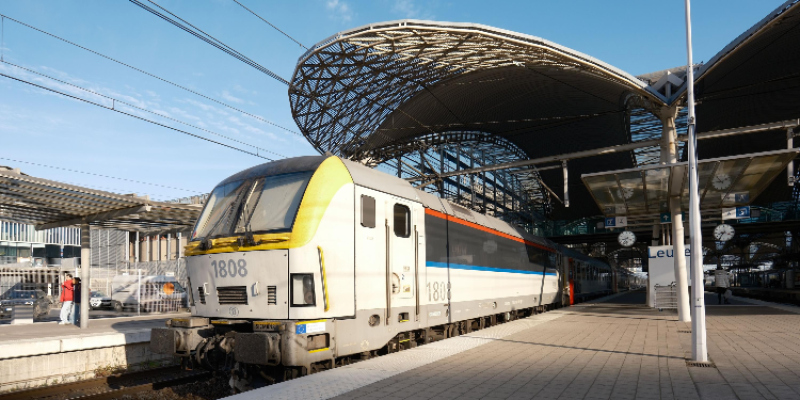
Getting aroundLeuven without a car is not just feasible; it is the way most residents actually live. The city has no metro or tram network, but its compact, largely traffic-free center makes cycling and walking the default for daily errands, while De Lijn buses and SNCB/NMBS trains from Leuven Station cover everything from cross-city trips to the 16-minute direct connection to Brussels Airport. What catches many newcomers off guard is how little of daily life actually requires a bus or train at all: the historic center restricts vehicle access and is built around foot and bicycle traffic. Bicycle theft, however, is a genuine and widely flagged risk in the city; investing in a solid lock from day one is standard practice.
Bicycles and two feet handle most of daily life in Leuven. The historic center is largely car-restricted, neighborhoods are close together, and cycling infrastructure covers virtually the entire city. For trips that go beyond easy cycling range, De Lijn buses serve the full urban area and connect Leuven with neighboring municipalities. For travel to Brussels, Brussels Airport, and other Belgian cities, SNCB/NMBS trains from Leuven Station are the default: fast, frequent, and priced for regular commuters.
Leuven Station sits within walking distance of the city center and shopping streets, and it functions as the practical hub where bus and rail connections meet. Most De Lijn city and regional lines converge here, so the station is not just for train travelers: it is the natural starting point for navigating the whole network.
Three apps cover almost everything a newcomer needs. The De Lijn app handles bus route planning, real-time arrivals, and ticket purchase. The SNCB/NMBS app and website manage train schedules and ticketing across Belgium. The Blue-bike app unlocks shared bikes at station-based locations across the Leuven transport region. All three have English-language interfaces, so day-one navigation is straightforward. Stop names and street signs remain in Dutch, however, so app-based routing is worth using for the first few weeks rather than relying on reading signs alone.
Good to know:
De Lijn adjusted its bus network across the Leuven transport region from July 1, 2026, with changes to route numbers, frequencies, and stopping patterns. Any printed timetable or older schedule you encounter may no longer reflect current service; always check the De Lijn app before traveling an unfamiliar route.
Getting across Leuven on public transit means using De Lijn, the Flemish public bus operator. Its network covers city lines within Leuven and regional routes out to neighboring municipalities, with Leuven Station as the central interchange point where buses and trains connect under one roof.
The main city routes fan out from the station across the urban area. Practical lines for newcomers include line 1 between Kessel-Lo and Bertem via the center, line 2 between Vaartkom and Heverlee Campus, lines 10 and 11 running the outer and inner rings, line 12 linking the station directly to Heverlee Campus, line 41 serving the university hospital at Gasthuisberg, and line 43 connecting Leuven with Haasrode Researchpark. For travel toward Brussels and Tervuren, regional express lines R80, R81, R90, and R92 operate from Leuven. The De Lijn route planner covers buses, trains, trams, and metro connections across Flanders from a single interface, so cross-modal journeys can be planned in one step.
A single De Lijn bus ticket costs EUR 3. Tickets must be bought or activated before boarding, either through the app, online, or by tapping a contactless payment card at the white terminal on the vehicle. Boarding without a valid activated ticket carries a fine regardless of intent, so activating the ticket in the app before stepping on is the safest habit to establish early.
Late-night service runs on Friday and Saturday nights, with Leuven-area night lines running approximately every 90 minutes. For these trips, planning ahead in the app is essential: the spacing between departures is wider than during daytime, and missing a night bus means a longer wait or a taxi.
Students enrolled at KU Leuven, UCLL, or LUCA campus Lemmens can buy a Studentenbuspas Leuven through their institution. Loaded onto a MOBIB card, the pass gives unlimited travel on regular De Lijn lines and night transport within Leuven, including Heverlee, Kessel-Lo, Wijgmaal, and Wilsele. Two city-supported discounts are also worth knowing: the Leuven Evenement ticket, available in the De Lijn app, offers travel on direct buses to participating events for EUR 1 (excluding student express lines 178 and 179), and the Leuven Winkel return ticket gives a EUR 2 round trip on Saturdays and Shopping Sundays.
Join the Leuven community
Get regular tips and advice to make the most of your expat life
How to pay for transport in Leuven
Occasional bus travelers can skip a card entirely. The De Lijn app lets you buy and activate a single ticket before boarding, and contactless bank cards work at the white terminal on the vehicle. For anything more than a few journeys a week, though, loading a pass onto a MOBIB card saves money quickly. The card itself costs a one-time administrative fee of EUR 10 and is issued at De Lijn service points (called Lijnwinkels) or, for student passes, through the relevant institution.
The full De Lijn fare structure for bus travel in Leuven is as follows:
Single ticket: EUR 3
Return ticket: EUR 6
10-trip card: EUR 21
Day ticket: EUR 9
3-day ticket: EUR 18
Monthly pass: EUR 37
Annual pass: EUR 351
The 10-trip card and longer passes require a MOBIB card. At EUR 37 monthly versus EUR 3 per single journey, the pass pays for itself after 13 trips; most people who commute by bus daily will find the monthly or annual option significantly cheaper. Passes and multi-trip tickets can be bought through the De Lijn subscriptions portal, in the app, or in person at a Lijnwinkel, which is the only option for obtaining the physical MOBIB card itself.
A social travel pass is available for eligible residents, including those with BIM status and equivalent low-income entitlements, at EUR 56 per year (the EUR 10 MOBIB card fee applies separately). MOBIB card holders must scan the card at every boarding and at each transfer; contactless bank card users tap the terminal at each boarding. Not scanning is treated the same as traveling without a valid ticket.
For train travel, SNCB/NMBS operates its own separate ticketing system. There is no combined De Lijn and SNCB pass for the Leuven area. A Train+ add-on card is available from SNCB for EUR 6 monthly or EUR 48 annually for adults aged 26 to 64, giving access to combined mobility benefits; the rate drops to EUR 4 monthly or EUR 32 annually for passengers with BIM status, seniors, and young people.
Taxis and ride-hailing in Leuven
A taxi in Leuven starts at EUR 10 for the first 2.5 km. Beyond that, the rate is EUR 2.70 per km for a one-way journey and EUR 1.35 per km for a return. A night supplement of up to EUR 2 applies between 22:00 and 06:00. Taxis can be hailed on the street, found at ranks including at Leuven Station, called by phone, or booked via app. Not all Leuven taxis accept contactless payment, so carrying cash as a backup on late-night or early-morning trips is practical.
Uber operates in Leuven and lists taxi-style rides including larger vehicles, but driver availability is lower than in Brussels. For early flights or late-night returns, a pre-booked local taxi by phone or app is more reliable than waiting for an app-based ride that may take time to arrive in a smaller city.
For residents who need a car occasionally but not daily, Leuven's city mobility pages point to commercial car-sharing operators including Cambio and BattMobility as alternatives to ownership. A dedicated municipal parking card for car-sharing users is also available, making the economics of occasional car access more attractive than owning a vehicle and dealing with daily parking costs.
Cycling and walking in Leuven
More than almost anywhere else in Belgium, Leuven is built to be cycled. The city has dedicated fietspaden (cycle paths), fietsstraten (cycle streets where cyclists have legal priority over cars), and fietssuggestiestroken (advisory cycle lanes) across the urban area, and investment in covered and underground bike parking continues, including the underground facility at Rector De Somerplein. Newcomers arriving from cities where cycling infrastructure is sparse will find the setup here genuinely functional for daily use: the routes exist, the priority rules are enforced, and most central destinations have secure parking nearby.
Walking covers most daily errands within the historic center. The area around KU Leuven buildings, shops, and cafes is largely pedestrian or car-restricted, with vehicle access windows rather than general car circulation. For anyone living within roughly 2 km of the center, a combination of walking and cycling handles the week without needing buses at all.
Two practical rules trip up newcomers. First, cycling is permitted in some pedestrian zones and prohibited in others, depending on the exact zone type and direction. The rules vary street by street across the center, so checking before the first ride in a new area is worth the effort. Second, bicycle theft is a real and frequently reported risk in Leuven. Always use a solid lock, prefer official bike racks over improvised attachment points like fences or sign poles, and be aware that temporary street-cleaning or event measures can result in improperly parked bikes being moved or removed.
For shared bikes, Blue-bike operates at 62 locations across the Leuven transport region, including station-based spots at Leuven Station Tiensevest, Kop van Kessel-Lo, and Heverlee Station. Electric Blue-bikes are available at Leuven Station Tiensevest, Kop van Kessel-Lo, Parking Vaartkom, Rector De Somerplein, and Heverlee Haasrode locations. Bikes are unlocked via the Blue-bike app.
Blue-bike pricing in the Leuven transport region comes in three tiers. The Ticket formula charges EUR 1 per 30 minutes for a city bike (capped at EUR 2.50 for the first 12 hours) or EUR 2 per 30 minutes for an e-bike (capped at EUR 5 for 12 hours). The Member subscription at EUR 2 monthly or EUR 12 annually keeps the same per-ride rates but suits regular users. The Member Plus formula at EUR 35 monthly for a city bike, or EUR 70 monthly for a city bike plus e-bike combination, covers all rides under 12 hours with no additional per-trip charge.
For newcomers wanting a bike for regular daily use, three practical options exist. Fietspunt Leuven Station (at Prof. Van Overstraetenplein 1) rents city bikes, e-bikes, and tandems by the day at EUR 10; a second location at Fietspunt Rector De Somer rents city bikes at the same rate. Swapfiets offers a monthly subscription bike from EUR 20.90, with repairs included and one month's notice to cancel, which suits people who want a personal bike without the upfront cost or theft risk of ownership. For a permanent used bike, Velo vzw (at Hollestraat 1) stocks city bikes, racing bikes, and e-bikes starting from EUR 150, with varying availability; the local marketplace 2dehands.be also lists student and city bikes in Leuven at varying prices, though without the consumer protections of a regulated shop.
Driving in Leuven
The historical center of Leuven is traffic-free. Each district is organized as a loop directing drivers from the ring road to a center car park and back out again; driving through the center is not how the road layout works, and most practical destinations inside the ring are faster to reach on foot, by bike, or by bus. Newcomers who arrive expecting to use a car for central errands will find the city has been deliberately designed to make that inconvenient.
Parking in the center is both scarce and progressively expensive. On-street paid parking applies in zone LEU1 (inside and on the ring, Monday to Saturday 09:00 to 21:00) and zone LEU3 (outside the ring, Monday to Saturday 09:00 to 19:00). The tariff escalates sharply: EUR 2.50 for the first hour, EUR 3.40 added for the second hour, EUR 4.50 for the third, and EUR 5.00 per hour from the fourth hour onward. Sundays, Belgian public holidays, and July 11 are free. A resident parking card costs EUR 60 for the first card per dwelling per year (or EUR 20 for a 3-month first card); a second resident card rises to EUR 300 per year. Households moving into a paid-parking zone should factor this cost into their housing budget from the start.
Leuven has no low-emission zone for private cars and no congestion charge, so the practical constraints for drivers are the traffic-free center, paid parking zones, and limited supply rather than environmental entry fees. Petrol in Belgium is sold at a regulated maximum tariff; the FPS Economy petroleum-price portal publishes live pump prices. A car is most practical for households outside easy cycling or bus distance of the center, for families managing heavy logistics, or for regular trips to destinations that public transport does not serve well. Short-term car rental near Leuven starts at roughly EUR 50 to EUR 60 per day for a standard compact car for those who need occasional vehicle access without ownership.
New arrivals living near the center, the station, KU Leuven, or a reliable bus corridor should trial daily life without a car for the first few weeks before committing to owning or importing one. The combination of cycling, walking, buses, and trains handles the daily routine for most people in central Leuven without a vehicle.
Brussels Airport (Zaventem) is the main international airport serving Leuven, roughly 23 km from the city center by road. The direct SNCB train from Brussels Airport station to Leuven Station takes approximately 16 minutes and is the standard choice for most travelers: it is faster than any road option and drops you directly at the city's main transport hub. An airport supplement of EUR 6.90 applies per journey on top of the standard rail fare whenever the airport station is included in the ticket. Full details on airport rail fares and the supplement are available on the Belgian Rail airport tickets page.
The airport train does not run 24 hours a day. For late-night arrivals or very early departures, the most reliable option is an official taxi from the airport's designated rank outside the arrivals hall. Official Brussels Airport taxis are identified by a "T" in the license plate and a blue-and-yellow logo. Avoid drivers who approach you inside the terminal or away from the official rank; unlicensed solicitation at arrival halls is a common pattern at airports across Europe, and Zaventem is no exception. For airport transfer options, the official rank is clearly signposted from the arrivals exit.
De Lijn buses also serve the Brussels Airport bus station and offer connections to Leuven via several lines. Note that the airport bus station relocated to a temporary site from mid-2026 until approximately 2029-2030 due to terminal development works; check the De Lijn app for current Leuven-specific routes and the temporary stop location before traveling.
For families arriving with significant luggage, a pre-booked taxi or app-based ride offers a door-to-door connection without the need to manage bags between the terminal building, the airport rail station, and Leuven Station. The train remains faster and cheaper for travelers who can handle luggage on platforms, but the taxi eliminates transfers entirely.
Brussels South Charleroi Airport is a secondary option used mainly for low-cost carriers. Rail access from Charleroi requires a bus connection to Charleroi-Central or nearby stations before joining the national rail network toward Leuven; journey times are significantly longer than from Brussels Airport and the route involves at least one transfer. For anyone whose flight options include both airports, the Zaventem route is considerably more practical for reaching Leuven.
Frequently asked questions
For most daily trips inside the city, cycling and walking are the fastest and cheapest options given Leuven's compact, largely car-free center. De Lijn buses cover the full city and connect to neighboring municipalities for longer local journeys. For intercity travel and the airport, SNCB/NMBS trains from Leuven Station are the default. Download the De Lijn app and the SNCB app before your first day so tickets and live routing are available immediately.
Leuven is well served by both buses and trains. De Lijn covers the city and surrounding region, while Leuven Station sits on a major SNCB/NMBS rail line with direct services to Brussels and Brussels Airport. Use live app timing rather than printed timetables, as De Lijn updated its Leuven-region network in mid-2026, so some routes and frequencies differ from older printed information.
No single card covers the whole network, but two apps handle most needs: the De Lijn app for buses and the SNCB app for trains. Contactless bank cards also work directly on De Lijn buses, so occasional travelers can board without any app or card. For frequent bus travel, a MOBIB card loaded with a monthly or annual De Lijn pass saves money over single tickets; the card itself carries a one-time fee of EUR 10. De Lijn and SNCB operate separate ticketing systems with no combined pass for the Leuven area.
Leuven has no metro or subway system. Daily public transport within the city runs on De Lijn buses, and regional and national journeys use SNCB/NMBS trains from Leuven Station. If a journey planner routes you via a metro, it is directing you through another Belgian city, not a Leuven city network.
Uber operates in Leuven and lists taxi-style rides including larger vehicles, but driver availability is lower than in Brussels. For early-morning flights or late-night returns, pre-booking a local taxi by phone or app tends to be more predictable. For regular car access without ownership, car-sharing operators such as Cambio and BattMobility are listed on the city's official mobility pages as alternatives.
Yes. Leuven's compact center, extensive pedestrian zones, dedicated cycle paths, and cycle streets, where cyclists have legal priority, make it one of the more cycle- and pedestrian-friendly cities in Belgium. KU Leuven's transport guidance treats cycling and walking as the primary daily modes for trips that start and end within the city. One important caveat: bicycle theft is a real risk, so always use a solid lock and prefer official bike racks.
Walking costs nothing and covers most of the central city. Cycling is the cheapest practical mode for slightly longer trips once you have a bike. On De Lijn buses, a single ticket costs EUR 3, but a 10-trip card brings the cost down to EUR 2.10 per journey, and a monthly pass costs EUR 37. For certain city-supported events, the Leuven Event ticket drops the fare to EUR 1 on direct bus lines. Train commuters should compare SNCB single tickets against monthly and annual pass options based on their specific route.
For trips inside the city, cycling, walking, and De Lijn buses are the everyday combination. KU Leuven's mobility guidance explicitly positions cycling and walking as the primary modes for any journey that starts and ends within Leuven. For jobs or appointments outside the city, the train from Leuven Station is the practical backbone. Newcomers choosing housing should factor in proximity to the station, a usable cycle route, or a reliable bus corridor.
For daily life near the city center, station, or main bus corridors, a car is rarely necessary. Walking, cycling, buses, and trains cover most routine trips, and the traffic-free center limits where a car can actually go. A car is more useful for family logistics, late-night travel, suburban destinations, or large shopping runs. For occasional use, car-sharing operators such as Cambio and BattMobility offer a lower-cost alternative to ownership, and the city also provides a municipal parking card for car-sharing users.
From Brussels Airport, the direct SNCB train to Leuven Station takes approximately 16 minutes and is the default for most travelers. An airport supplement of EUR 6.90 applies per journey on top of the standard rail fare. For late-night arrivals or families with heavy luggage, an official taxi from the designated rank outside the arrivals hall is the most practical door-to-door option. Official airport taxis are identified by a license plate containing a "T" and a blue-and-yellow logo; avoid drivers who approach you away from the official rank.
ℹ️
We do our best to provide accurate and up to date information. However, if you have noticed any inaccuracies in this article, please let us know in the comments section below.
I fell in love with words at an early age After a break to focus on my studies, I rediscovered the joy of writing while keeping a blog during my years between London and Madrid. This passion for storytelling and for exploring new cultures naturally inspired me to create Expat.com, a space for my own reflections as well as for anyone wishing to share their experiences and journeys abroad.