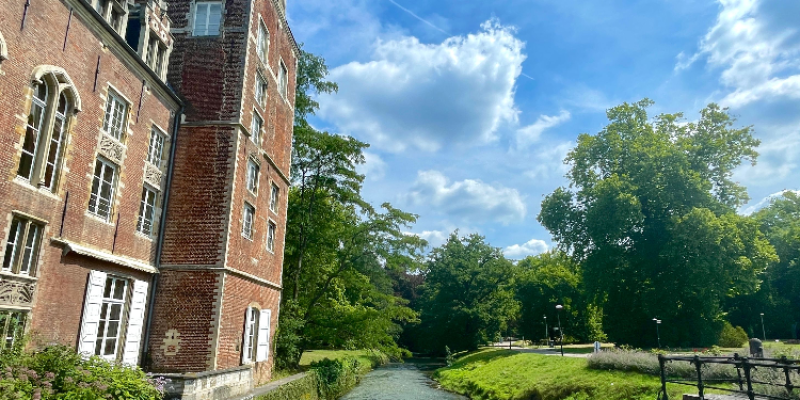
Most people assume that a Belgian university city of 100,000 residents will be affordable, easy to navigate in English, and socially straightforward for newcomers. Leuven complicates each of those assumptions. The housing market is tight and competitive, with one-bedroom apartments in the center running around EUR 1,000 per month. Dutch is the administrative language and the social default outside KU Leuven and the international research environment. And while the city is genuinely internationally oriented, local friendships tend to develop through recurring shared activities rather than instant informality. What Leuven does offer is a rare combination: a compact, walkable city shaped by one of Europe's leading research universities, with a cultural life, cycling infrastructure, and knowledge-economy atmosphere, reinforced by its candidacy for the European Capital of Culture 2030, that far exceed what its size might suggest.
KU Leuven is the fact that shapes everything about daily life in this city. The university's roughly 60,000 students and its global research network give a city of around 100,000 residents an international character that larger Belgian cities rarely match at street level. The historic center is compact and walkable, concentrated around the Gothic town hall, the Oude Markt (the main square), and the university library, all within a few minutes of each other on foot or by bicycle.
People arrive in Leuven for specific reasons: a research position or PhD candidacy at KU Leuven, a role at imec (a globally known microelectronics and nanoelectronics research center), work in the technology and life-sciences sector, or a move with a partner already embedded in the knowledge economy. Families who want a smaller, safer-feeling urban environment with strong cultural programming and fast rail access to Brussels also choose Leuven over the capital. The city sits in Flemish Brabant province, comfortably between Brussels to the west and the wider Belgian university network.
The closest analogy for the feel of the place is a city like Oxford or Cambridge: compact, academic in tone, with strong café and cultural life but without big-city anonymity. Most daily errands, social activity, and commuting happen on foot or bicycle within the historic core. The pace is energetic during the academic year, with busy café terraces, cultural events, and a constant international influx, and noticeably quieter during summer and holiday periods when students leave. Work-life balance is considered good by Belgian standards, with a structured weekday rhythm and an active weekend social life built around terraces, parks, and markets.
First impressions are consistently positive: newcomers notice how manageable the city is, how strong the cycling and café culture is, and how quickly the center becomes familiar. The common adjustment challenges are the housing market (tight supply and competitive rents), Dutch-language administration and signage, and the grey, changeable northern-European weather. Social integration takes deliberate effort: Leuven is internationally oriented, but still Flemish in its social rhythm, and local friendships tend to develop through repeated shared activities rather than instant informality.
Leuven is also a candidate for the European Capital of Culture 2030 under the Leuven & Beyond (LOV2030) program, a trajectory that reflects the city's cultural ambitions and its growing international profile well beyond the university.
Centrum is the densest, most walkable, and most student-heavy district, centered on the Oude Markt, Ladeuzeplein, the Gothic town hall, and the main university buildings. It suits international students, young professionals, and first-time arrivals who want immediate access to services, nightlife, and cafés without needing a car. Rents here are higher than in the outer districts, and transport is excellent: central bus stops throughout and Leuven station at the eastern edge of the center. For researchers and international staff arriving without a local network, Centrum offers the fastest path to feeling oriented.
Heverlee, south of the ring road, is quieter and greener than the historic center. It is strongly shaped by KU Leuven's science faculties and the Arenberg research campus, with leafy residential streets that suit researchers, KU Leuven or imec staff, PhD students, and families wanting more green space while staying within cycling or bus distance of the center. Prices run medium to higher. Within this area, the Arenberg campus zone is particularly campus-oriented rather than nightlife-focused, with a high concentration of STEM students and academic life. The KU Leuven student residence at Arenberg, with 820 rooms and a park setting, anchors this sub-area for doctoral candidates and visiting researchers.
Kessel-Lo, east of the historic core, is the most family-oriented and residential of Leuven's main districts: calmer, more practical, and with access to green space including the Provinciedomein Kessel-Lo recreation park. It is the neighborhood most often mentioned by longer-term residents and families who want quiet residential streets without student nightlife. Prices are medium, making it one of the more affordable options close to central Leuven.
The station area and Vaartkom edge suit commuters needing fast rail access to Brussels and professionals who prefer convenience over a quiet residential setting. The canal-side Vaartkom is developing as an urban edge with bars, creative spaces, and new residential projects. Prices run medium to higher, and transport access around the station is the best in the city. The Centrum-station-Heverlee triangle is where most international researchers and staff look first; Kessel-Lo is the family pick most consistently mentioned by longer-term residents.
Join the Leuven community
Get regular tips and advice to make the most of your expat life
Cost of living in Leuven
Housing is the dominant and most competitive cost in Leuven. One-bedroom city-center apartments typically rent for around EUR 1,000 per month, with demand especially intense around university intake periods. The tight supply and persistent international demand mean newcomers should budget conservatively and start searching well before arrival.
Families with young children should factor in childcare costs alongside housing. Subsidized day-care facilities charge a daily fee based on family taxable income, ranging from approximately EUR 5 to EUR 30 per day (roughly EUR 110 to EUR 660 per month for 22 care days). Non-subsidized facilities charge a fixed lump sum. The International School of Leuven charges approximately EUR 15,200 per year for full-day primary enrollment, with a half-day preschool option at around EUR 9,880 per year.
Leuven has a temperate oceanic climate: moderate temperatures year-round, frequent cloud cover, and rain spread across all seasons rather than concentrated in one. Annual precipitation reaches approximately 807 mm, with no reliably dry season. Newcomers from southern Europe, North Africa, or sunnier parts of North America will need to recalibrate their expectations; the grey, changeable skies are a consistent feature of most months.
Summers are mild: average highs reach 23-24°C in July and August, with nights staying around 12-13°C. The city records roughly 33 days above 25°C and about 6 days above 30°C per year. The practical issue for residents is that air conditioning is not standard in most Belgian housing, including top-floor apartments and older buildings, so warm spells can be uncomfortable indoors. Checking ventilation and window shading before signing a lease in a top-floor central apartment is worth the time.
Winters are cool and damp rather than severe: average daytime highs stay around 6-7°C in December and January, with overnight lows near freezing. Good heating, double glazing, and damp control are the practical housing priorities for the colder months, with around 53 frost days and approximately 14 days of snow-form precipitation per year.
The most comfortable months for daily outdoor life are May, June, and September, when average highs sit between 18°C and 21°C, and rainfall is somewhat lower. Leuven records approximately 1,597 sunshine hours per year, adequate in summer but limited in winter, when short days and grey skies are a common adjustment challenge for arrivals from sunnier climates. Pack waterproof outerwear, shoes that handle wet sidewalks year-round, layered mid-season clothing, and a warm winter coat. An umbrella or compact rain jacket is useful in every month.
Getting around Leuven
Walking and cycling are the easiest, cheapest, and most practical ways to move around within Leuven. The compact historic center and university campuses are designed around pedestrian and bicycle access; a car is rarely needed for daily life in central Leuven. The city's mobility policy separates car-traffic loops from main cycling routes, and short inner-city trips are consistently faster by bike or on foot than by car during peak hours.
De Lijn city buses serve the center, station, and outer districts; the De Lijn app covers journey planning, real-time departures, and ticketing. Leuven station connects to Brussels in approximately 25 minutes by NMBS/SNCB national rail, making it practical for commuters and for reaching Brussels Airport. The SNCB app handles national journey planning, ticket purchase, and real-time train information, and is available in English.
Blue-bike shared bicycles are available at Leuven station for short rentals, complementing private cycling. Bike theft is the most common property crime in Leuven, so a strong frame lock plus a second lock is essential, especially near the station, university buildings, and nightlife streets. Never leave a bicycle unlocked, even briefly. The Stad Leuven mobility portal is the official city reference for current route information and mobility updates.
Language and communication in Leuven
Dutch is the sole administrative language of the city: official communications, municipal documents, school notices, and local authority websites are in Dutch. The city's English-language website contains only a selection of the information available on the full Dutch site, which means some administrative tasks require Dutch or assistance navigating Dutch-language materials. The local everyday variety is Flemish Dutch rather than Netherlands Dutch; pronunciation, vocabulary, and expressions differ from standard classroom Dutch, which can initially be disorienting for learners who studied the language elsewhere.
English is widely usable at KU Leuven, research institutes, international companies, and in the student environment. The language barrier is effectively low in these circles. It rises to moderate in housing paperwork, city services, school enrollment, healthcare reception, and local community life, where Dutch remains the default. Making an effort in Dutch is socially appreciated even when English is understood. Saying Hallo (hello), Dank u wel (thank you), Spreekt u Engels? (do you speak English?), Ik leer Nederlands (I am learning Dutch), and Waar is het station? (where is the station?) covers the most common early interactions.
Several structured options exist for learning Dutch in Leuven. Stad Leuven's newcomers page directs arrivals to the Integration Agency (Agentschap Integratie en Inburgering) for tailored Dutch-course guidance and lists the free Dutch-language discussion group Kom binnen as a practice option for newcomers. International House Leuven maintains an overview of Dutch language schools in Leuven and explains how the Integration Agency helps non-Dutch speakers find an NT2 course (Dutch as a Second Language) at the right level.
For university-affiliated newcomers, KU Leuven's Leuven Language Institute (ILT) offers NT2 courses for students and staff, including on-campus options. CLL Leuven offers Dutch courses for adults, including a summer integration program. Both are accessible to newcomers who are not KU Leuven affiliates.
Culture and social norms in Leuven
Leuven is generally open to foreigners and internationally oriented, but social relationships with locals typically develop through repeated shared activities: sports, language groups, neighborhood events, and cultural programming. The city's social reserve in first encounters is not unfriendliness; it is a cultural baseline. Repeated contact through clubs, sport, language exchange, or local activities typically unlocks a warmer dynamic than cold-introduction networking, so patience and consistency matter more than the first impression.
Punctuality is expected in professional, administrative, and social appointments. Arriving on time is the norm; arriving late without notice is considered impolite in everything from doctor's appointments and parent-teacher meetings to work meetings and dinner invitations. Cycling etiquette is equally part of daily social life: keeping to dedicated cycle paths, signaling clearly before turning, not blocking cycle lanes, and being aware of pedestrians crossing are practical norms in a city where bikes and people share compact streets. Bicycle infrastructure is taken seriously by both authorities and residents.
Dress code in everyday Leuven is smart casual in most contexts: practical, comfortable, and weather-appropriate. University, research, and professional environments follow similar standards, with no strong expectation of formal dress in daily city life.
Religion is present in Leuven's history and architecture, most visibly through KU Leuven's Catholic roots and the many historic churches, but it is generally background rather than intrusive in daily public life. Belgium has 10 statutory public holidays per year, which are paid non-working days for most private-sector employees. Planning work and administrative visits around these dates is a practical necessity; some sectors substitute specific dates.
Integration resources consistently point to the same approach: join recurring activities such as KU Leuven cultural events, sports lessons, language practice groups, or neighborhood initiatives rather than relying on one-off networking. Learning enough Dutch for greetings, signs, appointments, and municipal interactions accelerates integration even for people working entirely in English.
Pace of life and work culture in Leuven
Belgian employment rules set a standard working-day ceiling of 8 hours, and office life in Leuven follows this structured rhythm. Hospitality and retail may run later because the city is recognized as a tourist and student center with permitted extended opening hours, but the overall work-life balance is considered good by European standards. Employment protections including notice periods, sick leave, and vacation entitlements tend to be more extensive than in many anglophone labor markets, which is worth understanding when negotiating a contract.
The lunch break is typically short: a practical midday pause rather than an extended social meal. Social life concentrates in the late afternoon and evening, particularly around café terraces, which become the main informal social space after work and between academic commitments.
Remote and hybrid working is growing in Leuven. International House Leuven hosts co-working sessions, and the city has café and co-working options suitable for remote professionals. The compact center and fast rail connection to Brussels make Leuven a practical base for professionals splitting time between locations.
Leuven's lifestyle rhythm is distinctly seasonal: the city feels compact, international, and energetic during the academic year, with active nightlife (Thursday is notably busy), cultural events, and a constant influx of students. During summer and vacation periods, the city calms noticeably, while July and August bring outdoor festivals, terraces, art routes, and evening events.
Food culture in Leuven
Leuven's everyday food identity is anchored in Belgian café and beer culture: terrace life, classic Belgian dishes, and a strong tradition of quality beer. The city's brewing connections run deep, and choosing the right beer for the right glass is taken seriously in even ordinary cafés. Alongside this local identity, a wide range of international restaurants reflects the student and researcher population; access to international restaurants is high for a city of Leuven's size.
Lunch activity typically runs from noon into the early afternoon; dinner and social eating start from around 19:00, with later drinking and nightlife continuing afterward, particularly around the Oude Markt and the student quarter. The Visit Leuven food and drinks page is the practical starting point for current restaurant listings, seasonal highlights, and local food events including the winter Leuven Christmas Market (Leuvense Kerstmarkt).
Leisure and social life in Leuven
Regular leisure in Leuven centers on café terraces, cycling and walking through the historic center, heritage sites including the university library, city parks, live music, festivals, and student-driven cultural activities. The city also organizes urban sport at dedicated locations, including skating, parkour, BMX, and street basketball through its leisure program.
The arts and entertainment scene is strong for a city of this size. 30CC runs theater, music, literature, circus, and family performances; M Leuven is the main fine arts museum; and KU Leuven programs cultural events year-round. The Leuven & Beyond (LOV2030) European Capital of Culture 2030 candidacy confirms a sustained upward trajectory for cultural investment and international programming. The Leuven Center for Irish Studies, based at the Irish College Leuven, runs Irish cultural and academic events including an annual St. Patrick's Day celebration, a useful English-language social entry point for recently arrived residents.
Nightlife is unusually active for a small city: the student population, café culture, and compact center concentrate evening activity around the Oude Markt, which functions as the main social hub. Thursday is particularly busy because of student schedules. The mix of students, researchers, locals, and international residents gives Leuven's nightlife a more diverse energy than a purely student city would produce.
Main outdoor social spaces include city parks, Park Abbey (Abdij van Park) with its ponds and historic abbey buildings, and canal-side areas near the Vaartkom. Summer weekends are built around terraces, park visits, cycling, and open-air events. The Visit Leuven site is the practical event reference for current listings and seasonal programming.
Leuven has a strong policy commitment to family life. The city invested EUR 25 million extra in after-school care and activities through the Kinderkuren and BOA (Buitenschoolse Opvang en Activiteiten, after-school care) framework, and the city's multi-year plan explicitly targets sufficient, quality, and affordable childcare and education alongside child-friendly cultural programming.
Childcare places are in high demand: Belgian official guidance warns parents that many providers work with long waiting lists. Arriving families should apply for childcare immediately after confirming their move, before arrival if possible. Subsidized day-care fees depend on family taxable income, from approximately EUR 5 to EUR 30 per day (roughly EUR 110 to EUR 660 per month for 22 care days), while non-subsidized facilities charge a fixed lump sum. The city's childcare desk (Loket kinderopvang) at the Huis van het Kind Leuven handles registration inquiries and advice.
Local primary and secondary schooling is in Dutch. Newcomers whose children do not yet speak Dutch should plan for a language transition period and contact the school before enrollment. The city's family help services include support for children starting school and the Boekstart free book program for babies and toddlers.
For families who prefer an English-medium education at primary level, the International School of Leuven (Tervuursesteenweg 282, 3001 Leuven) offers an English-language international curriculum from preschool through Grade 6, with annual fees of approximately EUR 15,200 for full-day enrollment and EUR 9,880 for the half-day preschool option.
The most family-friendly neighborhoods are Kessel-Lo (quieter residential streets, access to Provinciedomein Kessel-Lo recreation park, medium rents) and Heverlee (green campus environment, calmer pace, medium-to-higher rents). Central Leuven suits families who want walkable access to museums, children's trails, and city-center cultural programming.
KU Leuven-affiliated families have access to additional support through the Partner and Family support service, which covers university-run day care, leave systems, sick-child arrangements, babysitting, child benefits, and family advice. This English-language resource is a practical first stop for staff and students arriving with children.
Safety in Leuven
Daytime safety perception in the center, university areas, and residential districts is strong. The most common everyday risks are petty theft, pickpocketing, and bicycle theft: theft and extortion are the largest recorded offense category in the local police data for the Leuven commune. Serious violent crime is not characteristic of the city.
After dark, the risk profile shifts toward nightlife-related nuisance, intoxication, and the need to keep valuables secure around the busy entertainment streets near the Oude Markt and the station approaches. Poorly lit bike routes also require extra caution at night. The practical safety precaution that matters most day-to-day is bicycle security: always use a strong frame lock plus a second lock, especially near the station, university buildings, nightlife streets, and shared housing areas. Never leave a bicycle unlocked, even briefly.
Cybercrime and online fraud are named priorities in the city's local safety plan. Treat unexpected payment requests, parcel-delivery messages, rental-payment pressure, and account-verification links with caution; these are the most common vectors for online fraud targeting residents.
For non-urgent reports, declarations, or appointments with the police, use the Lokale Politie Leuven online appointment system. In an emergency, call 112 for ambulance or fire services and 101 for urgent police assistance. Commune-level crime statistics for Leuven are available through the Belgian Federal Police statistics portal, useful for anyone wanting to review safety trends before or after arrival.
Environment in Leuven
Green space access in Leuven is abundant. The city maintains an official parks and green-places network, promotes de-paving and greening of public and private spaces, and offers resident-facing programs including composting workshops, biodiversity-friendly mowing, rainwater management support, and allotment gardens. The greener residential edges of Heverlee and Kessel-Lo feel noticeably cooler and quieter than the paved historic center, which is worth factoring into a neighborhood choice, particularly for summer comfort.
Tap waterin Leuven is safe to drink. De Watergroepsupplies the area and confirms compliance with strict Belgian drinking-water standards. The main practical newcomer issue is hard water and limescale rather than any potability concern: expect to descale appliances regularly and consider a filter if you are sensitive to taste.
Air quality in Leuven is monitored continuously by the Vlaamse Milieumaatschappij (VMM), which publishes a combined air-quality index, pollutant maps, forecasts, and alerts for high particulate matter or ozone. The main urban contributors are traffic-related pollution and episodic fine-particle or ozone episodes rather than industrial sources.
Noise levels are moderate to locally high: road and rail traffic are the main contributors city-wide, while nightlife noise is managed through a city noise-monitoring program. Central streets and the station corridor are noisier; outer residential areas are significantly quieter. The city center is also the most exposed to urban heat in summer: paved streets and squares absorb and retain heat, with fewer trees and cooling features than greener peripheral areas. Newcomers in top-floor or poorly shaded apartments in the center should check ventilation and shading before signing a lease.
Leuven has a visible sustainability culture: the city operates under a stated climate-neutrality objective through the Leuven 2030 program, with bicycle-priority street design, active de-paving and greening, nature-based flood management, and resident-facing environmental practices. Daily mobility in Leuven is structured to reward cycling and walking over car use, which is a tangible practical benefit for residents who adapt to this rhythm.
Expat community in Leuven
Leuven's international community is large relative to the city's size, shaped primarily by KU Leuven's global student and researcher intake. The main expat nationalities represented include Dutch, Italian, Spanish, French, and German residents, reflecting both European academic mobility and the broader international research environment. The city's organized support infrastructure for newcomers is notably well-developed for a city of this scale.
International House Leuven is the city's main support hub for internationals arriving for work or research. It offers practical advice in English, settlement support, immigration consultation sessions, healthcare information events, and a substantial community program: over 100 volunteers and 347 events in a recent year, including coffee mornings, walks, after-work drinks, and meditation sessions. Newcomers can also join the volunteer network, which is one of the most direct ways to build social connections across the international community.
De Nomade, the City of Leuven's house for newcomers, is open to foreign-language arrivals aged 18 and over. It provides information about life in Leuven, Dutch learning and civic integration, Dutch practice lessons, and guidance on training and work; it is particularly useful for people outside the university environment. The Agentschap Integratie en Inburgering (Integration Agency), referenced by the city as a newcomer resource, provides information and support on residence permits, work permits, rights in Belgium, and family reunification.
For doctoral students and researchers wanting a structured intercultural residential community, Pangaea Intercultural Theme House at Home Vesalius is a KU Leuven-linked community designed for international PhD students and volunteers during their research stays in Leuven.
Leuven Language Buddies organizes language-exchange conversation tables in Leuven, including Spanish, French, and English sessions at WereldcafÉ COOP Leuven, making it a practical social entry point for newcomers wanting both language practice and informal social contact.
The Earls of Leuven GAA club brings together residents interested in Gaelic games and Irish community life, offering a structured social connection for those who want a recurring activity beyond the workplace. The r/Leuven Reddit community is an active informal channel for newcomer questions, peer advice, and neighborhood discussion, covering topics from social groups and language exchange to short-term living tips and PhD relocation practicalities.
Long-term integration reality: Leuven's international community is positive about the city's manageable size and organized social infrastructure, but the city has a notably transitory social dynamic. Many residents arrive for study, research stays, or temporary contracts, which means social circles can turn over frequently. Deeper integration typically requires deliberate effort: learning Dutch, joining structured groups, and building local routines beyond the university or workplace.
Leuven's strengths are specific and consistent. The city is genuinely compact and walkable: most daily errands, social life, cultural events, and commuting happen within cycling or walking distance, and the infrastructure supports this without requiring a car. The international and knowledge-economy atmosphere, driven by KU Leuven and imec, gives the city a globally oriented daily environment that is rare at this scale. The cultural offer also punches above its weight: arts programming through 30CC and M Leuven, the LOV2030 European Capital of Culture trajectory, a lively café and terrace scene, and frequent festivals give residents cultural variety that a city of 100,000 rarely delivers.
The challenges are equally specific. Housing is the dominant constraint: the rental market is tight and competitive, especially for studios and central apartments. Rents in the city center are high relative to city size; around EUR 1,000 per month for a one-bedroom is a realistic benchmark, and competition before academic intake periods can be intense. Newcomers who need an independent apartment should search early and plan a budget that leaves room beyond rent.
Dutch is required for deeper integration. Municipal life, schools, healthcare paperwork, local participation, and neighborhood notices are Dutch-first. English works well in university and international professional contexts, but newcomers who rely only on English will encounter friction in administration, local community life, and long-term social connections. For English-speaking professionals, the combination of an English-language workplace with a Dutch-language daily life is the defining trade-off of living here; most manage it, but few find it entirely frictionless.
The transitory social dynamic is a genuine drawback: a significant portion of Leuven's international population arrives for study, research, or temporary contracts and leaves when the assignment ends. Building stable, long-term friendships takes deliberate effort and typically requires learning Dutch and joining structured recurring activities. The grey, damp winters and changeable temperatures can also be a meaningful adjustment for arrivals from sunnier climates.
Frequently asked questions
Leuven works well for nomads who want a compact, walkable city with strong cafés, reliable public transport, and an internationally oriented atmosphere. International House Leuven hosts co-working sessions, and the city center has café options suitable for remote work. The 25-minute train connection to Brussels extends the practical range considerably. The main constraint is housing: the rental market is tight, and finding short-term accommodation at short notice is genuinely difficult.
The city operates in Dutch (Flemish), which is what you will encounter in municipal offices, schools, healthcare settings, and most neighborhood interactions. English is widely used within KU Leuven, research institutes, and international professional circles, making it a practical starting point for newcomers. Learning Dutch, however, significantly eases housing paperwork, local services, and long-term social integration, and the effort is visibly appreciated by locals even when English is understood.
Housing is the dominant cost: a one-bedroom apartment in the city center typically rents for around EUR 1,000 per month, and the market is competitive. A single adult living independently should budget well above that figure once utilities, food, transport, health insurance, and social life are factored in. Students in shared housing or university residences can spend considerably less, but anyone seeking a standalone apartment should plan conservatively rather than assuming student-city prices apply.
Leuven is generally safe across all its main districts, with no area identified as substantially more dangerous in official sources. Practical choices focus on proximity to daily routines, well-lit streets, and good cycling routes. Kessel-Lo and Heverlee are the quietest residential options, with quieter streets and less student nightlife. After dark, extra awareness is warranted around the Oude Markt nightlife area and the station approaches.
Leuven suits medium- and long-term residents particularly well. The compact city rewards those who settle into routines: cultural programming, cycling infrastructure, café life, and a large international community all become more rewarding over time. Short stays are enjoyable, but the tight housing market makes last-minute or short-term rentals frustrating to arrange. The city's strongest appeal is for people who value quality of daily life and neighborhood routine over constant novelty.
The most common positive surprise is how international and culturally active Leuven feels for a city of around 100,000 people, driven by KU Leuven, imec, and the student population. The recurring adjustment challenge is how quickly Dutch becomes relevant once outside the university or international workplace: municipal administration, school communications, healthcare reception, and neighborhood life all default to Dutch regardless of how English-friendly professional settings may be.
Foreigners can rent in Leuven, but the process takes preparation and lead time. The market is competitive, landlords often receive multiple applications, and arrivals without Belgian administrative documents, local references, or a clear income file may need extra persistence. Starting the search before arrival, preparing income and identity documents in advance, and arranging temporary accommodation while searching in person are practical steps that reduce friction.
The main downsides are: housing costs and availability, with city-center one-bedroom apartments running around EUR 1,000 per month and supply tight; Dutch required for full integration outside university and international professional settings; a transitory social fabric, since many residents are on short academic or professional contracts; and limited big-city options, including no international airport nearby and a nightlife and retail scene smaller than that of larger Belgian cities.
ℹ️
We do our best to provide accurate and up to date information. However, if you have noticed any inaccuracies in this article, please let us know in the comments section below.
I fell in love with words at an early age After a break to focus on my studies, I rediscovered the joy of writing while keeping a blog during my years between London and Madrid. This passion for storytelling and for exploring new cultures naturally inspired me to create Expat.com, a space for my own reflections as well as for anyone wishing to share their experiences and journeys abroad.