The first weeks in Leuven tend to reframe expectations quickly. What reads on paper as a university town turns out to hold a UNESCO-listed medieval beguinage, a collection of Flemish Old Masters almost impossible to see elsewhere, a dense calendar of free outdoor festivals through the summer months, and a city-run family infrastructure that covers everything from supervised holiday playgrounds to free library programs for children. For newcomers without an existing network, three dedicated institutions, International House Leuven, Pangaea, and De Nomade, exist specifically to help internationals build a social life. The city is compact enough to cover on foot or by bike, and major cultural venues publish visitor information in English, which lowers the entry barrier considerably in the early weeks of settling in.
A city of roughly 100,000 people that holds a UNESCO World Heritage site, a collection of Flemish Old Masters rarely seen outside Belgium, a working medieval beguinage, and a new science museum opening in late 2026 has a cultural density that takes most newcomers by surprise. What makes Leuven's offer particularly accessible is that major venues publish visitor information in English, and a substantial portion of the best experiences cost nothing at all.
The main anchor is M Leuven, the city's art museum, which combines Flemish Old Masters with contemporary art across a renovated city-center building. Standard adult entry is EUR 16; residents of Leuven pay EUR 12, visitors aged 19 to 25 pay EUR 6, and a social rate of EUR 3 applies for eligible visitors. Children 18 and under enter free. Leuven residents can also visit free on the first Thursday evening of each month after 18:00. The collection is particularly strong on the Flemish Primitives, with works by Dieric Bouts that are almost impossible to see elsewhere; Sint-Pieterskerk (Saint Peter's Church), a short walk away, holds additional Bouts treasures alongside a HoloLens augmented-reality tour of the altarpiece.
The Groot Begijnhof (Great Beguinage) is free to walk through and represents one of the most complete surviving medieval beguinage complexes in Europe, now inscribed on the UNESCO World Heritage List. Part of the quarter is used as KU Leuven student housing, which gives it an unusual quality: historic architecture inhabited and lived in, not simply preserved behind glass. The Saint John the Baptist Church within the beguinage is open Tuesday to Friday, 13:30 to 16:30.
At the edge of the city in Heverlee, Abdij van Park (Park Abbey) is Belgium's best-preserved abbey and home to Museum PARCUM. The abbey grounds, including ponds and walking paths, are freely accessible year-round. The full complex is reopening after a fourteen-year restoration campaign, with a major international exhibition scheduled for autumn 2026 into spring 2027.
For contemporary and performing arts, STUK (Huis voor Dans, Beeld en Geluid) and Het Depot are the main venues. STUK programs dance, sound art, exhibitions, and concerts, with its season opening each September with the STUK START festival. Het Depot focuses on live music and artist residencies, with concerts running through the autumn. Theater tickets across Leuven venues range from EUR 6 to EUR 30, and concerts from EUR 6 to EUR 48. The Vesalius Museum, a new KU Leuven institution dedicated to healthcare and science, opens in central Leuven in December 2026, adding a significant indoor cultural destination.
Two free self-guided routes are worth building into an early weekend. The street-art walks cover a 6 km city-center route past 16 artworks, linking murals with churches, green spaces, and hidden playgrounds; a printed brochure is available from Visit Leuven for EUR 1, or free to download, and the Street Art Cities app can be used alongside the walk. Separately, the "Walk through the universe" is a free 2 km self-guided route through the city center dedicated to physicist and priest Georges Lemaître and the Big Bang theory. The Vaartkom, Leuven's former canal-basin industrial district, rounds out the street-level cultural picture: now a regenerating waterfront quarter with cafés, terraces, and a water garden along the Dijle canal, it hosts cultural events alongside the urban renewal. For the most current listings, the Stad Leuven agenda and the Visit Leuven events page cover everything from free carillon concerts to gallery openings.
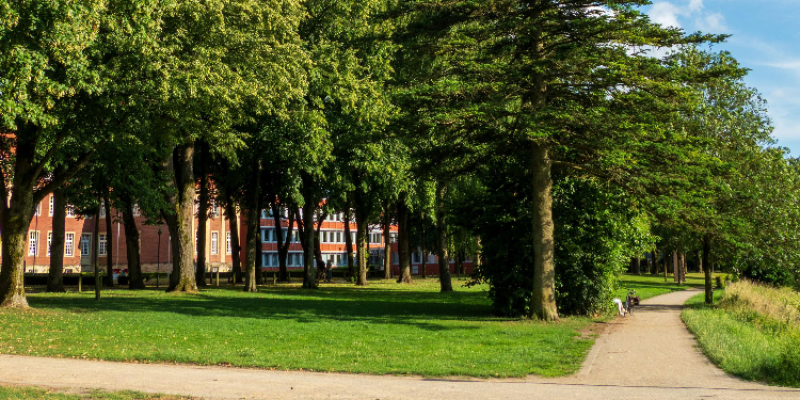
Most of what makes Leuven good for outdoor recreation is free and within walking or cycling distance of the center. The city's parks range from a formal landscape garden in the heart of town to an abbey landscape with fishponds on its edge, and two waterways open up options for paddling and swimming through the warmer months.
Sint-Donatuspark is the central municipal park, designed in English landscape-garden style with remains of the old town wall, lawns for picnicking, and a children's playground. It keeps extended hours from April through September (07:00 to 21:30) and shorter hours the rest of the year (07:00 to 19:00), closing during storms or severe winds. A short walk away, the Kruidtuin (Botanical Garden), Belgium's oldest, is free to enter and makes an easy detour for a quiet hour. For a larger space, Provinciedomein Kessel-Lo (Holsbeeksesteenweg 55) is a free family recreation park with tennis courts, football and volleyball fields, a skate ramp, a skating track, walking routes, a traffic park, a bee house, and a water ecocentre. Park De Bruul, which reopened after full renewal in 2026, adds a water-and-sand play zone, sport fields, and a range of play structures; a skate plaza is planned for the coming months. Along the Vaart canal in Wilsele, about 3.5 km from the center, the Vijvers van Bellefroid (Bellefroid Ponds) offer a quieter waterside spot for walking and picnicking.
Both of Leuven's main waterways, the Dijle River and the Leuven-Dijle canal (De Vaart), are used for leisure paddling. Kayaking and stand-up paddleboarding are the main formats; KU Leuven Sport offers kayaking on the Dijle for participants who can swim. On the last two weekends of August each year, a pop-up open-water swimming zone in the Vaart canal near the KU Leuven boathouse provides a free seasonal alternative to the pools.
Cycling is practical transport and leisure in equal measure in Belgium, with bike lanes and shared-bike schemes woven into daily city life rather than treated as weekend recreation. Shared bikes and rental bikes are available across Leuven, and the city supports a mapped leisure network. The annual Ride Leuven event each August offers a guided cycle tour that includes parts of the route used in the 2021 UCI Road World Championships, which was held in the city. The Leuven Urban Sports program runs through autumn with scheduled sessions of skating, parkour, BMX, and streetbasket at different neighborhood locations, and free neighborhood football initiations run through the school summer holidays. Spring and summer are the strongest seasons for all outdoor options: Sint-Donatuspark keeps its longest hours from April, the summer sports program launches in July, and pop-up swimming and cycling events run through August. Autumn and winter remain walkable but bring shorter park hours and wetter conditions.
Get regular tips and advice to make the most of your expat life
Shopping in Leuven
Leuven's shopping is built around distinct pedestrian streets rather than any single enclosed mall; the experience is walkable and compact, with each street carrying a different character. The main axis runs from the train station along Bondgenotenlaan, a broad boulevard, into the pedestrian Diestsestraat, where chain stores and boutiques sit side by side. Brusselsestraat adds a further stretch of shopping with both chains and independent options.
For a different feel, Mechelsestraat and Vismarkt lean toward culinary shops and a trendier mix, while Parijsstraat and Pensstraat are known for specialty, gift, and world-cuisine shops alongside original boutiques. Second-hand and sustainable retail is scattered across the center, reflecting the city's large student population.
Markets add a reliable weekly rhythm for residents. The Saturday market in the city center runs every week with food specialties (dried meats, cheese, mushrooms) and antiques alongside it. The Friday market covers the city center each Friday, a Thursday flower market takes place on Brusselsestraat, and neighborhood markets run in Kessel-Lo (Wednesday afternoon), Heverlee (Sunday morning), and Wijgmaal (Monday). For something less routine, the Camping Flamingo makers and second-hand market runs monthly with 45 new vendors each time, ranging from artisans to second-hand clothing, and The Blue Market is a creative pop-up celebrating local makers. The annual Jaarmarkt Leuven, held each September, combines a street fair, braderie (open-air sale), brocante (flea market), cattle show, and children's market across the city center.
Events and festivals in Leuven
Leuven's event calendar is unusually dense for a city of its size, organized around a summer core of free outdoor programming and a busy autumn season of ticketed contemporary arts. The three main discovery platforms, Visit Leuven events, the Stad Leuven agenda, and UiT in Leuven, together cover everything from neighborhood block parties to major festivals.
The summer anchor is Het Groot Verlof, Leuven's main summer festival running through late July and into early August across the historic city center. It brings free open-air concerts (the Beleuvenissen series), DJ sets, outdoor films (Zomerfilms), and the Hapje-Tapje food and drink market. Entry to all outdoor programming is free. For a dedicated free hip-hop culture day in July, the Burn Festival at the Romaanse Poort brings rap, graffiti, breaking, and beatmaking with local Leuven talent and invited artists.
Spring is the season for Leuven Jazz, a multi-day city-wide jazz festival held each March that has placed Leuven on the Belgian and international jazz calendar since 2011. The program mixes ticketed concerts, living-room concerts, family events, daytime shows, and a free formula. Around the same season, Paasfeesten Leuven is an international folk dance and folk music festival welcoming participants and visitors from many countries, with visitor information available in English. June brings Wereldfeest Leuven in Paul Van Ostaijenpark, a festival that reflects the diversity of the city's population and makes a natural early connection point for newcomers.
Autumn fills quickly. Leuven Kermis, the city's traditional annual fair, runs for about three weeks each September, combining fairground attractions with a street fair, brocante, and a cattle show: a distinctly Belgian civic occasion quite different from a standard funfair. October brings Festival 20·21, a contemporary music festival, and November is anchored by two events: Playground Festival, an arts and performance event, and the Rode Hond Family Festival, which programs theater, circus, film, dance, games, workshops, and literature for families with children.
Nightlife in Leuven
Leuven's after-dark scene runs on café culture rather than clubs, shaped by a large student population and a compact city center where bar-hopping happens on foot. Oude Markt, a square ringed by 45 hospitality businesses, is the permanent social center of gravity: terraces packed most evenings, an informal atmosphere, casual dress throughout, and entry to most venues free with drinks as the primary spend. Standard hospitality permits allow bars to open from 05:00 to 02:00.
The dedicated club scene is limited. The strongest format in that direction, during summer, is Club Vismarkt, free open-air club nights at Vismarkt running as part of Het Groot Verlof each summer. Where club entry applies at other venues, it typically ranges from free to EUR 10.
Live music and cultural evening programming compensate for the small club footprint. Het Depot is the main live-music venue with artist residencies and concerts running through the autumn. STUK programs contemporary arts evenings. Olevodroom runs cultural events including summer live performances in reggae and dance-with-live-music formats, and the M Leuven summer bar, a seasonal museum garden bar with a live radio soundtrack, is open through the summer months. In July and August, the historic center transforms into a broader evening destination under Het Groot Verlof, with free open-air concerts and DJ sets across city squares adding a layer that extends well beyond the regular bar scene. The Visit Leuven events calendar is the most reliable way to track evening programming outside the permanent bar circuit.
Family activities in Leuven
The city directly organizes and funds a structured set of family programs through the school holidays, which goes further than what many expats arrive expecting. Rather than simply pointing families toward parks and museums, the municipality runs free summer villages, supervised playgrounds, and library activity programs across multiple neighborhoods. The result is a practical calendar that families can plan around from the moment they arrive.
The Zomerdorpen (summer villages) run through the school summer holidays, with free open-air city play spaces for children requiring no registration, spread across Wijgmaal, Kessel-Lo, Heverlee, and Wilsele. Running alongside them, the supervised holiday playground program (Speelpleinen) is open to children aged 2.5 to 15 (youngest children must be toilet-trained and already attending school). Daily activity blocks run 09:00 to 12:00 and 13:30 to 16:00, with before-care from 08:00 and after-care until 17:30 at the summer locations.
For park-based outings, Park De Bruul is the strongest option for a wide age range, with a water-and-sand play zone, toddler and nest swings, a carousel, a seesaw, a wide slide, a climbing cube, play towers with bridges, and sport fields. Provinciedomein Kessel-Lo adds free sports courts, a skate ramp, a skating track, walking routes, a traffic park, a bee house, and a water ecocentre.
Three self-guided family trails run across central Leuven sites through the end of August each summer: the "Ontdek M met Vlieg" trail at M Leuven uses a sticker sheet for looking, drawing, and imagination tasks; the "Schatten van Vlieg" trail visits the University Library with a Vic de Muis indoor activity; and an extended version leads children to Abdij van Park, where eight hidden stops around the abbey grounds collect letters and numbers for a secret code. Alongside these, M Leuven's Museumspelstraat summer program runs through August with adapted play material for young children, large outdoor games (kubb, hoops, giant Connect Four) in the museum garden, and creative Saturday activities during summer weekends.
Bib Leuven (the public library) offers free children's summer activities through July and August at Tweebronnen, Heverlee, Kessel-Lo, and Wilsele branches. Bib Leuven Tweebronnen also runs free summer search trails for children up to age 12 through late August, making it a reliable rainy-day option in the center. The Museum of Zoology (KU Leuven) holds the university's zoological collection and provides another indoor cultural option for curious children. In autumn, the Rode Hond Family Festival in November programs theater, circus, film, dance, games, workshops, and literature for families. The Vesalius Museum, opening in central Leuven in December 2026 as a new science-and-healthcare museum, will add a winter indoor destination for families with older children interested in science. September brings free sport-club trial sessions through Leuven Beweegt and Leuven Kermis, both suitable for children.
Wellness and relaxation in Leuven
The strongest everyday wellness offer in Leuven is free. The city's network of parks and green spaces functions as its main relaxation infrastructure: the Kruidtuin (Belgium's oldest botanical garden), Sint-Donatuspark with its lawns and old town-wall remains, the Keizersberg Abbey garden with its views over the city, the grounds of Abdij van Park with abbey ponds and walking paths, and the renewed Park De Bruul are all free and within cycling or walking distance of the center. Outdoor yoga takes place at Abdij van Park on Saturday mornings in summer, adding a free or low-cost structured option in a quiet setting.
For organized fitness, KU Leuven Sport runs yoga, Pilates, cycling, padel, tennis, badminton, athletics, parkour, Zumba, and other group sports. The membership is open to the public, not restricted to university students or staff, which makes it a practical option for any newcomer. Yoga is available as a drop-in session at EUR 10 per class from September through May. For a commercial gym membership, Basic-Fit gyms in Leuven start at approximately EUR 30 per month. JIMS Leuven offers tiered memberships: fitness-only access from EUR 39.99 per four weeks, group classes included from EUR 49.99, and an all-in coaching package from EUR 59.99 per four weeks. The pop-up open-water swimming zone in the Vaart canal on the last two weekends of August provides a free seasonal complement to the year-round gym and studio offer.
Getting a social life started in a new city without an existing network takes deliberate effort, and Leuven has more entry points for that than most comparable-sized cities. The clearest starting point for non-student internationals is International House Leuven, whose activities calendar runs in English and is explicitly designed for internationals living and working in the city. Its Meetup group, "Internationals and expats in Leuven," lists recurring evening events including the Tuesday Night Philosophy Club, practical information sessions on topics like healthcare in Belgium, and themed newcomer gatherings.
For incoming KU Leuven international students, Pangaea Intercultural Meeting Center is the primary social hub, with language tables, language walks, conversation groups, intercultural evenings, debates, yoga, mindfulness, quizzes, and parties. Pangaea is not restricted to students; it also runs a September orientation program alongside ESN Leuven and LOKO International. De Nomade, the city's official newcomer hub open to all foreign nationals regardless of university affiliation, offers orientation sessions on living in Leuven, Dutch-language practice groups, legal information for foreign nationals, and UiTPAS registration guidance.
Beyond organized programs, the city's social geography offers easy low-barrier entry points. Oude Markt, with 45 hospitality businesses on its perimeter, is the city's main informal meeting point for after-work drinks and student evenings; the terraces are packed from early spring, and the atmosphere is casual and unpretentious. The Vaartkom and Sluispark waterfront adds a more relaxed alternative, with cafés, terraces, boats on the canal, and a growing creative scene that draws a slightly different crowd.
UiT in Leuven lists a broad range of social-entry workshops and classes each week, including photography for beginners, acting, improvisation theater, hip hop, beatmaking, and West African dance, alongside Dutch practice and conversation sessions that serve as practical socializing routes for newcomers building language skills. The Leuven Urban Sports program, running through autumn, offers skating, parkour, BMX, and streetbasket at neighborhood locations as low-barrier ways to meet people through shared physical activity, with free football initiations running through the summer holidays at various city sites. For professional networking and career-oriented events, the dedicated Leuven networking resources are the appropriate next step beyond these leisure-based connections.
Frequently asked questions
Leuven combines museums, live arts venues, free parks, weekly markets, and a dense annual festival calendar. The city is compact and walkable, making it easy to cover on foot or by bike. In summer, Het Groot Verlof brings free open-air concerts, DJ sets, and outdoor films across the historic center each year. The Stad Leuven agenda and UiT in Leuven are the most reliable sources for finding what is on each week.
M Leuven is the city's main art museum, with standard adult entry at EUR 16; it holds a strong collection of Flemish Old Masters, particularly works by Dieric Bouts, a painter rarely seen outside Belgian collections. Sint-Pieterskerk displays art treasures alongside a HoloLens augmented-reality tour of the Bouts altarpiece. The Groot Begijnhof, a UNESCO World Heritage site, is free to walk through at any time. Self-guided free options include the 'Walk through the universe' route and a mapped street-art walk covering 16 artworks across 6 km of the city center; the Vesalius Museum, a new science and healthcare museum, is set to open in the city center in late 2026.
The main parks, including Sint-Donatuspark, the Kruidtuin (Belgium's oldest botanical garden), the recently renewed Park De Bruul, and the Abdij van Park grounds, are all free to enter. The Dijle River and the Vaart canal support kayaking, canoeing, and stand-up paddleboarding; KU Leuven Sport offers kayaking on the Dijle for participants who can swim. Provinciedomein Kessel-Lo is a free family recreation park with sports facilities, walking routes, a skate ramp, and a traffic park. The city hosts organized cycling events each summer, including a route that covers part of the 2021 UCI Road World Championships circuit.
The main shopping axis runs from the station along Bondgenotenlaan into the pedestrian Diestsestraat, with a mix of chain stores, boutiques, and second-hand shops; Brusselsestraat adds independent boutiques and further choice. Mechelsestraat and Vismarkt are trendier, with culinary and specialty retailers, while Parijsstraat and Pensstraat focus on gift and world-cuisine shops. The Saturday market in the city center runs every week with food specialties and antiques; the Friday market also runs weekly in the city center, and the Thursday flower market is on Brusselsestraat. Neighborhood markets operate in Kessel-Lo on Wednesday afternoons, Heverlee on Sunday mornings, and Wijgmaal on Mondays.
Het Groot Verlof is the main summer festival, running through July and August each year with free open-air concerts, DJ sets, outdoor films, and the Hapje-Tapje food market. Spring brings Leuven Jazz, a multi-day city-wide jazz festival, and the international folk festival Paasfeesten. Autumn fills quickly: Leuven Kermis, a traditional Belgian fair, runs each September, followed by Festival 20·21 in October and both Playground Festival and Rode Hond Family Festival in November. The Visit Leuven events page and UiT in Leuven carry the complete live calendar.
Leuven's nightlife centers on its café and bar culture, shaped by the city's large student population. Oude Markt, with 45 hospitality businesses packed around one square, is the main after-dark hub; bars typically trade until 02:00. The dedicated club scene is limited, but summer brings free open-air club nights at Vismarkt as part of the Het Groot Verlof program. Het Depot and STUK program live music and arts events throughout the academic year.
The city directly runs free Zomerdorpen (summer villages), open-air play spaces for children during school holidays each year with no registration required. The recently renewed Park De Bruul is the city's largest family park, with a water-and-sand play zone, climbing structures, and sports fields designed for toddlers through to older children. Provinciedomein Kessel-Lo adds a free outdoor park with a skate ramp, traffic park, and water ecocentre. Bib Leuven public libraries run free children's summer activities in July and August, and the Rode Hond Family Festival each November presents theater, circus, film, and dance for families.
The strongest everyday wellness options are free: the Kruidtuin, Sint-Donatuspark, Abdij van Park grounds, the Keizersberg Abbey garden, and the recently renewed Park De Bruul are all within walking or cycling distance of the center. KU Leuven Sport, open to non-students, runs yoga at EUR 10 per drop-in session, along with Pilates, swimming, and a broad group fitness program. Commercial gym memberships start from around EUR 30 monthly at Basic-Fit, rising to around EUR 60 with coaching included at JIMS Leuven. Dedicated spa and sauna venues serve the broader area but are limited within the city itself.
International House Leuven is the main starting point for non-student internationals, with a Meetup group running English-language social events, info sessions, and recurring evening gatherings such as the Tuesday Night Philosophy Club. KU Leuven's Pangaea intercultural center runs language tables, conversation groups, quizzes, and cultural evenings open to both students and non-students. De Nomade, the city's newcomer hub, offers orientation sessions, Dutch-practice groups, and legal information for foreign nationals. Workshops and classes listed on UiT in Leuven each week, from improvisation theater to photography and West African dance, are practical low-barrier ways to meet people.
All central parks and abbey grounds are free to enter, and the Groot Begijnhof UNESCO site is free to walk through at any time. The street-art walk covering 16 artworks across 6 km and the 'Walk through the universe' self-guided route both cost nothing. Each summer, Het Groot Verlof brings free open-air concerts, DJ sets, and outdoor films to the historic city center. M Leuven is free for visitors aged 18 and under, and Leuven residents enter free on the first Thursday evening of each month after 18:00.
ℹ️
We do our best to provide accurate and up to date information. However, if you have noticed any inaccuracies in this article, please let us know in the comments section below.
I fell in love with words at an early age After a break to focus on my studies, I rediscovered the joy of writing while keeping a blog during my years between London and Madrid. This passion for storytelling and for exploring new cultures naturally inspired me to create Expat.com, a space for my own reflections as well as for anyone wishing to share their experiences and journeys abroad.