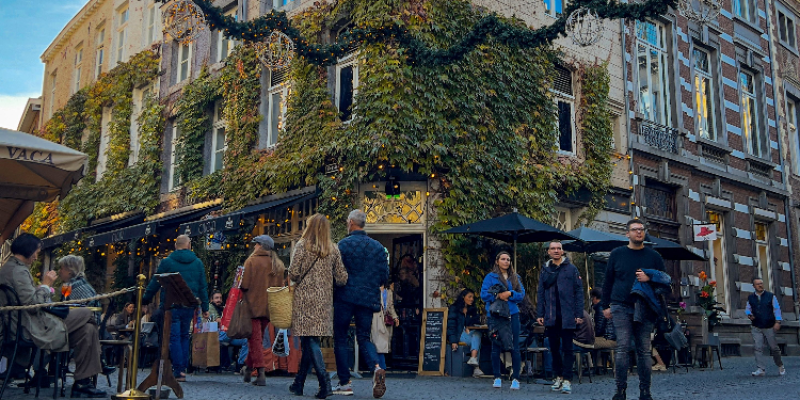
Your first evening in Leuven, you'll likely end up on the Oude Markt without quite planning to: 45 cafés and bars ring the square, and the terraces fill quickly once the working day ends. That concentration of social eating and drinking is a practical entry point to how the city actually functions day to day. Leuven is both a Flemish city with a serious beer heritage (Stella Artois is brewed here) and a university town drawing students and researchers from 166 nationalities, and both facts shape what you'll find to eat. Budget frituur snacks and Michelin-starred restaurants coexist within a few minutes' walk of each other, weekly markets carry fresh produce and specialty ingredients, and a growing number of dedicated groceries serve South Asian, African, and Italian communities alongside the Belgian mainstream.
Leuven's food identity runs on two parallel tracks: the deep Flemish culinary tradition of beer, fries, waffles, chocolate, and brasserie cooking, and the international dynamism of a university that draws students and researchers from around the world. Both tracks are visible every day, from the Belgian classics served in canal-side brasseries to the Korean grocery tucked beside a vegan chip shop. Understanding how those two threads interact is the quickest way to get oriented as a newcomer.
Cafés, bars, and terraces are not simply places to eat in Leuven; they function as the primary social venue for locals, students, and international residents alike. Shared meals and cooking are among the main ways newcomers build connections in the city, as the International House Leuven community demonstrates. The city's horeca sector (restaurants, cafés, bars, and terraces) is officially categorized by the municipality into distinct zones, a formalization that reflects how central eating and drinking out is to daily Leuven life.
Belgian dining culture is unhurried by design. Dinner is the main restaurant occasion for social meals, and kitchens are organized around an early-to-mid-evening window. Plan bookings between 18:30 and 20:00; most kitchens are not set up for late arrivals. Within that window, meals are conducted at a leisurely pace: staff clear plates only once everyone at the table has finished, and clearing before that point is considered impolite. Stella Artois, one of the world's most widely distributed lagers, is brewed in Leuven, so the café culture here has a particular gravity. A Leuven café is closer to a place you'd linger for two hours over a few drinks and a snack than a quick stop, with beer variety and food quality central to the experience. Current trends shaping the scene include sustainable dining, plant-forward menus, and healthier fast-casual concepts, alongside a fine-dining presence recognized in the Michelin Belgium and Luxembourg guide. Weekend eating commonly revolves around brunch cafés, market outings, and long social meals.
Good to know:
The KU Leuven campus presence shapes the rhythm of Leuven's food scene noticeably. Many city-center restaurants fill quickly at lunchtime on weekdays during the academic year, and reservations become more necessary during that period than in vacation months.
Beer is the single most distinctive Leuven specialty, and the city takes the designation seriously. Stella Artois is brewed here, and brewery visits are available at the Stella Artois facility, Brewery de Coureur, and Adept Brewery. The city's social heart for beer-led dining and drinking is the Oude Markt square, which counts 45 café and bar venues and is informally known as the Langste Toog (Belgium's longest bar). Browsing the full offer of Belgian ales, lambics, and abbey beers available at Oude Markt's terraces is a practical education in the breadth of the country's brewing culture, well beyond the pilsner styles more familiar internationally.
Beyond beer, the Belgian food staples available across Leuven's central restaurants include beef stew, mussels, croquettes, and waffles. Brouwerij De Hoorn in the Vaartkom district is a key destination for Belgian classics paired with local beer; it's a practical first stop for any newcomer wanting to understand Leuven's culinary heritage in a single sitting.
The frituur (Belgian chips shop) is the city's most accessible street-food format. Belgian fries are thicker and chunkier than most international styles, and mayonnaise is the default sauce rather than ketchup. Friet Markt Leuven serves fries, burgers, sandwiches, and snack items in the city center, with fries priced at around EUR 6.50. For plant-based eaters, Pepas Vegan Frituur offers the full frituur format: fries, loaded fries, meatless snacks, and sauces at similar prices, making it one of the few fully vegan takes on the Belgian chip-shop tradition.
Hapje-Tapje is a recurring gastronomic trail event in the city center where participants move between participating venues for small food-and-drink stops, sampling Leuven's culinary range in a single outing. It's worth checking the Visit Leuven calendar for upcoming editions, especially if you've just arrived and want a structured introduction to the local scene.
Join the Leuven community
Get regular tips and advice to make the most of your expat life
Types of dining in Leuven
KU Leuven's Alma restaurant network provides subsidized meals for enrolled students and university staff, making everyday eating genuinely affordable for anyone affiliated with the university. This is the budget floor of Leuven's dining spectrum, with student-facing options typically landing at EUR 5.50 to EUR 10 per meal. The KU Leuven restaurant guide also lists nearby restaurant recommendations for those coming to the university for shorter visits or conferences.
Cafés and brunch venues fill the daytime gap between the Alma canteens and sit-down restaurants. Central options such as Bar Leuv and Kanela position themselves around coffee, pastry, and brunch formats, functioning as practical spaces for solo stops, informal meetings, or low-key social eating. Visit Leuven groups terraces, lunch addresses, and cozy cafés as a distinct part of its eating-and-drinking offer, reflecting how well-established the midday café stop is in local daily life.
Local fast food in Leuven centers on the frituur format alongside casual international options such as Thai bowls and tacos. This student-friendly eat-in and takeaway culture works well on a tight budget or a short lunch break, and the city center has enough variety that it doesn't become repetitive quickly.
Restaurant EED holds a Michelin star and describes itself as a refined gastronomy restaurant. Additional Leuven venues appear in the Michelin Belgium and Luxembourg guide and on the Gault&Millau Belgium platform, including Cum Laude near the Groot Begijnhof. For everyday life in the city, fine dining is an occasional option rather than the dominant mode; the practical daily choice for most residents sits somewhere between the casual café and the mid-range bistro.
Neighborhoods for food in Leuven
The clearest way to navigate Leuven's eating options by area is through the three official horeca zones designated by the City of Leuven, supplemented by two distinct districts that each have their own food character.
Muntstraat and Tiensestraat form the primary restaurant street in the city. The Muntstraat traders' association describes it as Leuven's culinary heart, with more than 25 restaurants and cafés offering a broad mix of cuisine styles, atmospheres, and price points. The street is also part of the city's formal terrace-agreement program, with marked outdoor seating zones visible in warmer months. Expect mid-range prices and a varied mix of Belgian, international, and casual dining; this is where most newcomers naturally gravitate for a sit-down dinner.
The Oude Markt square, Leuven's main café and bar zone, officially counts 45 horeca businesses. It's best for beer-led social eating, terrace dining in warm weather, and casual meals rather than quiet restaurant dinners. Central Leuven restaurants in the Oude Markt area price at around EUR 49 per person for a sit-down evening meal.
Martelarenplein and the station area are designated by the city as primarily daghoreca: daytime cafés, lunch spots, and grab-and-go eating rather than evening restaurant dining. It's the most practical budget zone for quick weekday meals and the natural first stop for anyone arriving by train who needs to orient themselves before exploring the center.
The Vaartkom district, Leuven's former industrial canal quarter, is best for brewery-linked dining and Belgian classics. Brouwerij De Hoorn in Vaartkom combines classic Belgian food with local beer culture in a single venue, making it a practical early destination for newcomers.
The area around the Groot Begijnhof is Leuven's upscale dining pocket, with venues such as Cum Laude (listed on Gault&Millau Belgium) priced at around EUR 42 per person. The setting is quieter and more historic than the student-facing central streets, which makes it a natural choice for special-occasion dinners.
Leuven's weekly outdoor markets add a sixth food zone to this map. The Friday market on Monseigneur Ladeuzeplein and Herbert Hooverplein runs on Friday mornings and covers food, flowers, textiles, and plants. The Saturday market in the city center features specialty items including dried charcuterie, cheese, and mushrooms alongside an antiques section.
International cuisine in Leuven
Italian cuisine is strongly represented. The Italian restobar Zoff on Mechelsestraat is a central dining option, and the linked Italian food store Gigi operates on the same street opposite the restaurant, giving both a dining and a grocery option for Italian products in one location.
Ethiopian cuisine has a dedicated presence through Lalibela, a restaurant close to the Grote Markt specializing in Ethiopian food. Thai, Lebanese, and Syrian cuisines are all part of Leuven's international restaurant mix: New Mexico on Muntstraat covers Mexican food, Donki on Oude Markt adds another international casual option, and Palmyra on Parijsstraat serves Syrian cuisine.
South Asian food has an established presence through both restaurants and dedicated grocery shops. Ashoka Asian Supermarket, Circle Indian Supermarket, and Newro Market together cover a wide range of South Asian pantry staples: Ashoka stocks products from India, Nepal, Pakistan, Bangladesh, and Sri Lanka; Circle focuses on Indian ingredients; and Newro specializes increasingly in Nepalese products. These shops function as community reference points as much as grocery stores.
Voodoo combines an African grocery store, a beauty shop, and a hair salon in one space, with a Haitian connection. International House Leuven describes it as a Leuven landmark where food, beauty, and African culture come together, making it a practical reference point for expats from Sub-Saharan Africa or the Caribbean looking for familiar ingredients.
For specialty imported products more broadly, Mechelsestraat is the street to know for Italian goods (via Gigi), while the South Asian cluster covers a broad range of Asian pantry staples for anyone cooking from a wider regional tradition.
Grocery shopping in Leuven
Leuven's supermarket options cover a clear range of price tiers. Colruyt is the budget-oriented mainstream choice, operating on a low-price model across its Belgian network. Albert Heijn at Bondgenotenlaan 64 offers a mid-market alternative in the heart of the city's main shopping street, convenient for residents who want a solid general supermarket within walking distance of the center. Expats who have lived in the Netherlands will find it familiar in format and positioning.
Both Delhaize and Carrefour cover online grocery ordering for Leuven residents. Delhaize's home delivery service operates with next-day delivery and a minimum order of EUR 60. Carrefour's Fast Delivery service, integrated into its app and online shop, enables same-day home delivery where the service is available in Leuven. Collect&Go (Colruyt Group) also runs home delivery in Leuven, including a pilot using unmanned electric vehicles in the city center.
Leuven's outdoor market circuit is particularly useful for fresh produce and specialty items. The Friday market (Monseigneur Ladeuzeplein and Herbert Hooverplein, Friday mornings) is the city's main weekly fresh market. The Saturday market in the city center carries specialty items including dried charcuterie, cheese, and mushrooms. The Wednesday market in Kessel-Lo (Baron August de Becker-Remyplein, Wednesday afternoons) serves that neighborhood. The Sunday market in Heverlee and the Monday market in Wijgmaal are practical for residents outside the historic center who want a local market closer to home.
Eating out costs in Leuven
Street food and café stops are the most accessible price point. A quick snack at a frituur or sandwich shop costs around EUR 5.50, a coffee in a central café runs approximately EUR 3.20, and a draft beer at a bar averages around EUR 6.23. These prices make casual daytime eating manageable on most budgets, and the density of options in the center means there's rarely a need to spend more than this for a filling midday meal.
For a sit-down meal, a budget casual restaurant costs around EUR 19 per person, with the Heverlee and university dining area offering the lowest prices in Leuven. The most cost-effective way to eat at a restaurant table in the central area is the weekday lunch menu, which typically runs around EUR 26 per person, usually more generous in portion and quality than the price suggests.
For evening dining, a mid-range dinner at a central Leuven restaurant such as BARBA costs around EUR 49 per person. In the upscale dining pocket near the Groot Begijnhof, venues such as Cum Laude price at around EUR 42 per person. The crossover between the mid-range and upscale tiers is unusually tight in Leuven; the Groot Begijnhof area can actually be slightly cheaper than the busiest central streets for a comparable meal quality.
Service charges are included in Belgian restaurant prices by law. There is no customary tipping percentage, and rounding up the bill or leaving a few coins for good service is the most common gesture.
Dietary requirements in Leuven
Vegetarian and vegan dining is straightforward in Leuven. Dedicated plant-based venues such as BODHI (a plant-based Asian restaurant) operate in the city center, and mainstream restaurants increasingly advertise vegetarian and vegan menus. The Pepas Vegan Frituur brings the classic chip-shop format fully into plant-based territory, so even the most traditional Belgian street-food experience has a vegan-compatible option. KU Leuven's guidance to newcomers confirms that vegetarian and vegan choices are easy to find in Leuven specifically, not just in Belgian cities generally.
Halal availability is moderate. Medina Leuven presents itself as a halal Moroccan restaurant, and other venues self-describe similarly. Certification standards vary by venue, and for strict halal requirements it is worth confirming sourcing directly with the restaurant before ordering rather than relying on self-labeling alone.
Gluten-free options exist at a moderate level. Mykene and La Vignette both advertise gluten-free preparations, but fully gluten-free or strict coeliac-safe venues are harder to identify in the center. Belgian law requires restaurants to disclose the presence of 14 allergens (including gluten-containing cereals, shellfish, eggs, fish, peanuts, soya, milk, nuts, celery, mustard, sesame, mollusks, lupins, and sulfur dioxide), so the disclosure framework is solid. However, cross-contamination risk is a separate question and should be raised explicitly with kitchen staff before ordering for coeliac disease.
Belgian restaurants are legally required to inform customers about all 14 allergens, but this information is not always printed on menus and may need to be requested verbally. Tell staff before ordering, and specify whether the need is a preference, an intolerance, or a clinical allergy. The following Dutch phrases cover the most common situations at the table:
"Ik ben vegetarisch" (I am vegetarian)
"Ik eet veganistisch" (I eat vegan)
"Is dit halal?" (Is this halal?)
"Ik heb coeliakie / ik mag geen gluten eten" (I have celiac disease / I cannot eat gluten)
"Ik heb een ernstige allergie voor ..." (I have a serious allergy to ...)
Food delivery in Leuven
Four platforms are actively operating across Leuven: Takeaway.com, Deliveroo, Uber Eats, and Bolt Food. Takeaway.com operates the broadest established delivery network in Belgium and carries a dedicated Leuven marketplace; it is the local brand of the Just Eat Takeaway group, familiar to expats who have used that platform elsewhere in Europe. Coverage and restaurant variety are strongest in Leuven Centrum, with outer districts having fewer listed options on all platforms.
Typical delivery fees run from EUR 0 to EUR 1.49 depending on the restaurant and any active platform promotion. Most Leuven restaurant listings carry no minimum order, though some promotions require a minimum spend. Estimated delivery times run 15 to 35 minutes for central Leuven addresses, with Deliveroo advertising Leuven Centrum delivery from 30 minutes.
Grocery delivery is available through multiple channels alongside restaurant food delivery. Bolt Market (within the Bolt Food app) offers quick-commerce grocery delivery; Deliveroo covers both restaurant food and groceries in Belgium; Carrefour Fast Delivery enables same-day supermarket delivery via app; and Collect&Go (Colruyt Group) runs a home delivery service that includes a pilot using unmanned electric vehicles in Leuven city center. Tipping delivery riders is optional in Leuven, consistent with Belgium's broader tipping culture where a supplementary gratuity is not expected.
Advance bookings are recommended for popular restaurants, group meals, and all fine dining in Leuven. TheFork lists Leuven restaurants with bookable time slots, cuisine filters, and price guides. For smaller venues and fine dining such as Restaurant EED, direct booking by website, email, or phone remains the standard approach.
The pace of restaurant meals in Leuven is deliberately slow. Staff clear plates only after everyone at the table has finished; removing plates before that is considered impolite, not efficient. Newcomers from dining cultures built around fast table turnover should read this as intentional rather than inattentive: the table is yours for the duration of the meal. The absence of tipping pressure reinforces this; there is no financial incentive for a server to rush you out.
Card payment is the norm across Leuven restaurants, shops, and hotels. Most transactions can be completed by debit or credit card, but some smaller or independent restaurants may not accept all credit card types. Carrying a debit card or a small cash backup avoids any awkwardness at neighborhood venues that might not accept certain international cards.
Bill splitting is practical and common in Leuven's student and international dining environment. Tell staff at the start of the meal, or clearly when asking for the bill, that you want to pay separately. Larger venues and fine-dining restaurants may prefer a single table payment, with diners settling among themselves afterward. Plan dinner for 18:30 to 20:00; kitchens still accepting orders at 21:00 to 21:30 are the exception rather than the rule, so arriving late without a reservation risks finding the kitchen closed.
Leuven is most closely associated with Belgian beer: Stella Artois is brewed here, and the city counts itself as Belgium's beer capital. Alongside beer, Belgian classics such as fries, waffles, chocolate, and brasserie-style cooking are central to the local food identity. The university draws residents from various countries, so the restaurant and grocery scene is genuinely international, covering Asian, African, Latin American, and European options. Vegetarian and vegan choices are increasingly easy to find across the city.
Café culture is strong and woven into daily social life in Leuven. Cafés, bars, and terraces function as everyday meeting places for locals, students, and international residents, not merely venues for a quick drink. Oude Markt, with its 45 cafés and bars, is the heart of this culture and is informally known as Belgium's longest bar. Beer is central to the experience, and the atmosphere is relaxed and unhurried.
Restaurant dinner service in Leuven runs primarily between 18:30 and 20:00. Arriving after 20:30 without a reservation risks finding kitchens closed or fully booked. Expats accustomed to dining later in the evening will find this one of the more noticeable adjustments to Belgian restaurant culture.
Eating out every day adds up, but Leuven has genuine budget options at every tier. A street-food snack such as fries costs around EUR 5.50, a casual sit-down meal around EUR 19 per person, and a weekday lunch menu at a mid-range restaurant around EUR 26. Students and university staff affiliated with KU Leuven can access subsidized Alma canteens for the lowest prices in the city. Most people mix home cooking, weekday lunch deals, and occasional restaurant dinners to keep costs manageable.
Card payment is widely accepted across restaurants, shops, and hotels in Leuven. Most transactions go through without issue using a debit or credit card. For smaller or independent venues, it is worth checking accepted payment methods before ordering, as not all card types are accepted everywhere. Keeping a debit card or a small amount of cash as backup is a sensible habit.
No. Service charges are included in restaurant prices by law in Belgium, so tipping carries no social obligation. Leaving a few coins or rounding up the bill for good service is appreciated but entirely optional. There is no customary percentage to calculate, and staff do not expect a tip as part of their income.
Four platforms operate across the city: Takeaway.com, Deliveroo, Uber Eats, and Bolt Food. Coverage and restaurant choice are strongest in Leuven Centrum, where typical delivery windows run 15 to 35 minutes. Outer districts have fewer listed options. Grocery delivery is also available through Bolt Market, Deliveroo, and Carrefour Fast Delivery for same-day or next-day orders.
The most common surprises are: plates are not cleared until everyone at the table has finished, since clearing earlier is considered impolite in Belgian dining culture; tipping is not expected and service is legally included in the bill; free tap water is not automatically offered in restaurants; and kitchens close earlier than in many other countries, so plan dinner for 18:30 to 20:00. Belgian restaurants are also legally required to disclose 14 allergens, but cross-contamination should still be raised directly with staff for serious dietary needs.
Most restaurant kitchens in Leuven close between 21:00 and 21:30, with many stopping orders earlier on quieter nights. Some cafés and casual venues stay open later as drinking spots, but kitchen hours often end before the venue itself closes. Booking a table for any time after 19:30 is advisable to avoid finding the kitchen already shut.
ℹ️
We do our best to provide accurate and up to date information. However, if you have noticed any inaccuracies in this article, please let us know in the comments section below.
I fell in love with words at an early age After a break to focus on my studies, I rediscovered the joy of writing while keeping a blog during my years between London and Madrid. This passion for storytelling and for exploring new cultures naturally inspired me to create Expat.com, a space for my own reflections as well as for anyone wishing to share their experiences and journeys abroad.