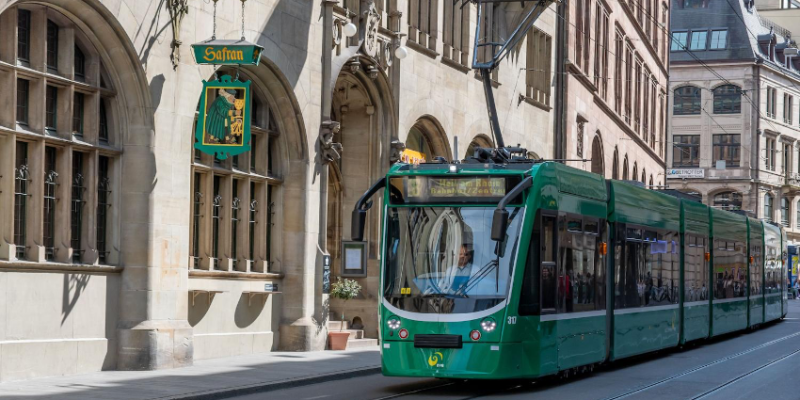
In the first days after arriving in Basel, transport decisions set the pattern for daily life. The city is compact enough that a car is unnecessary for most residents, but navigating without one means quickly understanding the TNW (Tarifverbund Nordwestschweiz), the integrated fare network that covers every tram, bus, and regional train in the area under a single ticketing system. What makes Basel unusual among European cities is its position at the junction of Switzerland, Germany, and France: cross-border commuting by public transit is a practical daily reality for residents near either border, not an edge case. Over 20% of all resident trips are made by bicycle, placing the city among the most cycle-intensive in Switzerland, and the tram network run by BVB fills the role that an underground metro plays elsewhere.
The single most useful thing to understand about getting around Basel is the TNW (Tarifverbund Nordwestschweiz, or Northwest Switzerland fare network): every tram, bus, and regional train in the city operates under this one ticketing framework. Buy a ticket for the right zone, and that ticket covers any combination of modes within the validity window. You don't need to buy a separate ticket when stepping off a tram and onto a bus or boarding a regional train at Basel SBB station. You plan by destination and zone, not by which operator is running the vehicle.
Trams and buses within the city are run by BVB (Basler Verkehrs-Betriebe), while SBB (Swiss Federal Railways) and partner operators handle regional and national rail from Basel SBB station. Both systems share TNW ticketing infrastructure, with SBB connections extending the network across Switzerland and into neighboring countries. Transport information from TNW and BVB is available in English alongside German, so planning a first commute does not depend on reading German.
Basel's location at the junction of Switzerland, Germany, and France gives its transport network a cross-border dimension that sets it apart from most European cities. The TNW network explicitly covers Basel's interfaces with both neighboring countries, and BVB buses hold TNW validity into French and German territory on several routes. Cross-border commuting by public transit is a practical, everyday reality for residents living near either border, not an exception.
Newcomers arriving at hotel accommodation before finding a permanent address can request the BaselCard from participating accommodation providers. Issued for the duration of your stay up to 30 days, it gives free travel in TNW zones 10, 11, 13, 14, and 15, including the zone covering EuroAirport. Once settled, the recommended starting sequence is: install the TNW Tickets app for single and day tickets, add SBB Mobile for regional and national rail, and then evaluate whether a U-Abo subscription saves money once your regular commute is clear.
BVB buses operate within the TNW fare network alongside trams, regional rail, and PostAuto services, and a single zone ticket covers all of them interchangeably. Which operator runs the vehicle you board is irrelevant to how you ticket the journey.
The bus network serves destinations the tram lines do not reach directly, making buses particularly important for suburban and cross-border movement. BVB buses connect central Basel with Allschwil, Bettingen, Binningen, Birsfelden, Bottmingen, Haltingen, Muttenz, Pratteln, Riehen, Schönenbuch, Weil am Rhein, and Saint-Louis, among others; BVB lines 3, 8, 38, and 55 carry TNW ticket validity into neighboring cross-border territory. If you live or work in any of these areas, your regular commute will run partly on buses rather than trams, and your TNW ticket covers it without a separate purchase.
Bus 50 is the direct link between Basel SBB and EuroAirport, running with frequent daytime departures and a journey time of approximately 17 minutes. The airport sits in TNW zone 13, so a Basel day ticket covers the trip. Bus 50 does not run on a 24-hour basis, so check the current timetable if you have a late-night or early-morning arrival. The TNW Tickets app or SBB Mobile both display current timetable information, including construction-related disruptions that periodically cause diversions on central routes.
Join the Basel community
Get regular tips and advice to make the most of your expat life
Trams in Basel
The tram network run by BVB is what residents use for cross-city journeys. Trams cover the city core and close suburbs with frequent, reliable service, and a single TNW zone ticket buys unlimited travel across trams, buses, and regional trains within the same zone and validity window. For most daily trips within the city, a tram is the fastest practical choice.
Real-time departure information is available through the BVB website and the TNW Tickets app, which is especially useful during construction periods when particular routes are diverted. Service runs throughout the day, with good consistency across the network.
The rule newcomers most often miss: trams have right of way even in pedestrian zones. In the Innenstadt pedestrian areas where motor vehicles are generally excluded, trams continue to operate on their tracks and pedestrians must yield to them. This applies directly in the market and riverside areas where tram corridors and pedestrianized streets overlap. In dense pedestrian streets, cyclists must also dismount unless local signs explicitly permit riding.
How to pay for transport in Basel
The TNW zone fare system requires you to buy a ticket covering the correct zone before or during travel. Basel city is covered by zones 10, 11, 13, 14, and 15; zone 13 includes EuroAirport. One point that catches newcomers off guard: tap-to-pay at tram or bus validators is not available as a pay-as-you-go method. Always buy your ticket before boarding or through an app. BVB runs ticket inspections around the clock.
For occasional travel, the standard single-trip options are:
The Basel day ticket (Tageskarte "Basel") costs CHF 9.90 (approx. EUR 10.62, adult, 2nd class) and gives unlimited travel in zones 10, 11, 13, 14, and 15 from validation until 05:00 the following morning, including the airport zone. Three trips in a day make it better value than singles. A wider TNW network day ticket covering the full regional network costs CHF 20.20 (approx. EUR 21.67).
For residents with a regular commute, the U-Abo monthly pass costs CHF 67 (approx. EUR 72) for unlimited travel across the entire TNW network. The U-Abo annual pass costs CHF 824 (approx. EUR 883) for the same coverage. Both give cross-border validity in RVL zones 1-3 in Germany and the Distribus area in France, though not on SNCF TER trains. Subscriptions are managed through the U-Abo app; pricing and zone plans are available at the U-Abo pricing page.
For those who travel regularly but not often enough to justify a subscription, a 6-trip multi-ride card (Mehrfahrtenkarte, 2-zone adult) costs CHF 20.50 (approx. EUR 22.00).
Discounted products exist for several groups. Those up to age 25 with tax domicile in Canton Basel-Stadt can buy a youth annual U-Abo at CHF 365 (approx. EUR 391). Seniors and disability-benefit recipients can access a reduced monthly U-Abo at the same CHF 67 monthly price under the Senioren/IV-Bezüger category. Children and youth up to age 15, as well as Swiss Half-Fare Travelcard (Halbtax) holders, receive reduced fares on single, multi-ride, and day tickets. The Halbtax costs around CHF 185 (approx. EUR 198) annually from SBB and halves the price of most TNW tickets, making it worth considering for anyone who travels frequently beyond their U-Abo zone.
Tickets are available through four main channels:
The TNW Tickets app for single, day, and multi-ride tickets.
The U-Abo app for monthly and annual subscriptions.
SBB Mobile or the SBB website for regional network and national rail tickets.
Ticket machines and service counters at BVB (Barfüsserplatz), BLT (Heuwaage), and Basel SBB station.
The ÖV Plus app also sells TNW tickets as a fourth app-based option. For personalized U-Abo passes, carry official ID matching the pass unless you have registered your photo in the U-Abo app.
Taxis and ride-hailing in Basel
Licensed taxis in Basel operate under an official tariff set by Taxi-Zentrale AG: a base fare of CHF 6.50 (approx. EUR 6.96), plus CHF 4.00 per km during the day within Basel, Riehen, and Bettingen (Rate 1), and CHF 4.50 per km at night, on Sundays, and on public holidays, or outside those districts (Rate 2). A booking surcharge of CHF 2.80 (approx. EUR 3.00) applies per ride. A typical 3 km city trip works out to approximately CHF 18.50 (approx. EUR 19.80), before any waiting time. Fares are substantially higher than in most cities: treat taxis as an airport transfer or late-night emergency option rather than a routine mode.
Taxis can be hailed on the street, found at designated taxi ranks across the city, including at EuroAirport and Basel SBB, booked by phone, or requested via app. Cashless payment is accepted. Uber also operates in Basel, with surge pricing possible during peak periods or major events; confirm the price estimate in the app before accepting a ride, as fares vary by ride type, demand, and trip duration.
At EuroAirport, use only the signed official taxi rank or a pre-booked licensed operator. Avoid unsolicited drivers who approach arrivals inside the terminal or offer cash fares outside the designated area.
Cycling and walking in Basel
More than 20% of all resident trips in Basel are made by bicycle, a figure that ranks the city among the most cycle-intensive in Switzerland. The canton treats cycling as a central component of everyday mobility, with a network of Velovorzugsrouten (commuter priority routes), Velostrassen (bicycle streets where cyclists take priority over other traffic), Bike and Ride facilities at public transport stops, and secure cycle parking recognized as infrastructure of cantonal importance. A planned revision to the cycling sector plan aims to create a more continuous and comfortable network across the city in the coming years.
Cycling safety is good overall but uneven. Basel placed third among Swiss large cities in the Prix Velo survey, with the route network rated positively; however, comfort and traffic safety scored below expectations, with large junctions repeatedly identified as the weakest point. Ongoing district-heating construction also creates temporary detours on some central routes. Practical advice for newcomers: choose basic routes (calmer, lower-traffic alternatives suited to riders who prefer less exposure) over commuter routes (faster and more direct but busier) until you know the network well; slow down at large intersections; and check for active construction diversions before setting out. Secure cycle parking at your destination is worth planning before you leave home, not on arrival.
For those without a personal bike, Velospot (operated by PubliBike, the official bike-rental system of Canton Basel-Stadt) offers standard bikes and e-bikes at docking stations across the city. A day pass costs CHF 29 (approx. EUR 31); an annual subscription costs CHF 69 (approx. EUR 74). Usage beyond the included minutes is charged at CHF 3 per 30 minutes (approx. EUR 3.22) for standard bikes. Bikes are unlocked and managed through the Velospot app. E-bikes are separately available through Pick-e-Bike for those who prefer electric-assisted cycling.
Walking is practical throughout the city. Canton Basel-Stadt designates extensive pedestrian zones, traffic-calmed streets, Begegnungszonen (shared spaces where pedestrians hold priority), and Tempo 30 zones. In pedestrian zones, motor vehicles are generally excluded; where exceptions apply, vehicles must move at walking pace, and pedestrians take priority over all vehicles except trams, which always retain right of way. In dense pedestrianized streets, cyclists must dismount unless local signs explicitly permit riding.
Driving in Basel
A car is not a practical necessity for most people living and working in Basel. A vehicle becomes genuinely useful for heavy shopping, trips to rural or mountain destinations, work sites beyond the city, or regular cross-border errands where public transit connections are indirect. Starting without a car, learning your actual movement patterns over a few months, and deciding then is the approach the city itself recommends.
Fuel costs approximately CHF 1.94 per liter (Super 95, approx. EUR 2.08) at Basel stations. All vehicles using Swiss motorways must display the annual motorway vignette, which costs CHF 40 (approx. EUR 43) and is valid from December 1 of the previous year through January 31 of the following year. There is no short-stay vignette: even a single motorway trip requires the full annual purchase. Basel imposes no congestion charge and no low-emission zone for ordinary private cars.
Parking is actively managed and deliberately constrained to reduce search traffic and improve availability for residents. Street parking operates on a blue zone system (free, 1 hour plus the current half-hour with a parking disc during controlled hours) or paid white-space parking where tariffs are shown at the meter. City-center parking garages such as Parkhaus Steinen charge CHF 3 per hour (approx. EUR 3.22, Monday through Saturday, 08:00-19:00) and CHF 25 for a 24-hour flat rate (approx. EUR 27).
Residents can apply for an Anwohnerparkkarte (residential parking permit) through the Canton Basel-Stadt mobility portal. This gives unlimited blue-zone parking in your postal code area. The annual cost is CHF 312-492 (approx. EUR 334-527) for vehicles registered in Basel-Stadt, and CHF 564-744 (approx. EUR 604-797) for residents still holding foreign or out-of-canton plates, including recent arrivals from abroad. A CHF 20 (approx. EUR 21) processing fee applies per new card. General parking information by area is available in the canton's parking guide.
Cross-border road approaches can become congested during peak commuting hours where motorway and border traffic feeds into the city. During major events around the Rhine banks, Barfüsserplatz, Marktplatz, and central tram routes, public transit is the sensible choice: car access becomes restricted, and parking fills quickly. Car rental for occasional use costs approximately CHF 57-114 per day (approx. EUR 61-122) for a small car.
EuroAirport Basel Mulhouse Freiburg, approximately 6 km from the city center, is Basel's main international airport. Although it sits in French territory, it falls within TNW zone 13, which means standard Basel ticketing covers the journey in both directions.
The budget option is Bus 50, operated by BVB, running between EuroAirport and Basel SBB with frequent daytime departures and a journey time of approximately 17 minutes. The fare is a standard 1-zone TNW single ticket at CHF 4.20 (approx. EUR 4.52), or the trip is fully covered by a Basel day ticket. Bus 50 is not a 24-hour service: check the timetable for late-night or very early arrivals before you land.
For families arriving with children, heavy luggage, or car seats, or for late-night arrivals when Bus 50 is not running, a taxi from the official airport taxi rank is the practical alternative. The official licensed tariff applies: CHF 6.50 base fare plus CHF 4.00 per km (Rate 1, daytime) or CHF 4.50 per km (Rate 2, nights and Sundays), plus a CHF 2.80 booking surcharge. Uber is also available at the airport, but fares depend on ride type, demand, and trip duration; confirm the price in the app before committing, since the final cost is harder to predict in advance than the official taxi tariff.
At the airport, use only the signed official taxi rank or a pre-booked licensed operator. Avoid unsolicited drivers who approach arrivals inside the terminal or offer cash fares outside the designated area.
Good to know:
EuroAirport is officially a French airport, located in Saint-Louis, Alsace. French customs and border formalities apply on the French side, and non-EU travelers should allow extra time for passport control. Bus 50 crosses the Swiss-French border during the journey; your TNW ticket covers this crossing at no extra cost.
Frequently asked questions
The tram and bus network covers the city, close suburbs, and the airport zone under a single TNW zone ticket, making it the most practical starting point. You can buy tickets before boarding through the TNW Tickets app, SBB Mobile, ticket machines, or sales counters at BVB, BLT, and Basel SBB. For short trips in the center, walking is often faster than any vehicle. Download the TNW Tickets app before your first journey to avoid queuing at machines on arrival.
Basel's integrated tram, bus, and regional rail network is rated excellent for daily life. Trams and buses run regularly throughout the day, and the airport is included in the standard Basel day-ticket zone. Check the TNW Tickets or SBB Mobile app before peak-hour journeys for real-time information on any construction-related disruptions.
No physical card is required for every trip, but an app saves time from day one. The TNW Tickets app handles single and day tickets; SBB Mobile covers regional and national journeys; the U-Abo app manages monthly and annual subscriptions. Ticket machines and sales counters at BVB, BLT, and Basel SBB are also available for those who prefer buying in person. Tap-to-pay at validators is not available, so always buy your ticket before boarding.
Basel has no metro or subway. The tram network run by BVB fills this role, covering the city core and close suburbs with frequent service on a single TNW zone ticket that is also valid across buses and regional trains. For most daily journeys, including trips to EuroAirport, the tram and bus network serves the same practical purpose as a metro would in other cities.
Uber operates in Basel and at EuroAirport, but fares depend on ride type, demand, and city fees, and you must confirm them in the app before booking. This makes budgeting less predictable than the published TNW fare or the official taxi tariff. For regular trips, public transport is easier to plan and significantly cheaper; treat ride-hailing as a backup for late-night journeys or when traveling with heavy luggage.
The city center has well-established pedestrian zones and traffic-calmed streets, making walking practical for most central errands. Over 20% of all resident trips are made by bicycle, among the highest in Switzerland, and the canton actively expands cycling infrastructure. Large junctions remain a noted weak spot, and construction detours affect some corridors; when first arriving, it makes sense to choose quieter basic routes over faster commuter corridors.
Walking costs nothing, and cycling is low cost with the Velospot bike-share scheme charging CHF 3 per 30 minutes for standard bikes. For public transport, the Basel day ticket at CHF 9.90 gives unlimited tram and bus travel in the city and airport zones until 05:00 the next morning, making it practical value from three or more trips in a day. A single 1-zone ticket costs CHF 4.20 for occasional use.
Trams and buses handle most cross-city trips, and cycling accounts for a substantial share of shorter journeys, with over 20% of all resident trips made by bike. Regional rail connects those working or studying beyond the immediate city. Residents with a regular commute typically use a U-Abo monthly or annual subscription covering the full TNW network.
For most newcomers living and working in the city, starting without a car is the practical approach. The tram, bus, walking, and cycling network covers everyday life well, parking is actively constrained and expensive, and the annual Swiss motorway vignette at CHF 40 is an additional fixed cost. Car rental at CHF 57 to CHF 114 per day is available for occasional trips where public transport is indirect, such as mountain destinations or bulky shopping runs.
Bus 50 to Basel SBB is the recommended option: it runs frequently during the day, takes around 17 minutes, and costs CHF 4.20 for a standard TNW 1-zone single ticket, or is free with a valid Basel day ticket since EuroAirport falls within TNW zone 13. For late-night arrivals or travel with heavy luggage, use the official airport taxi rank; licensed taxis operate around the clock. Uber is available at the airport, but confirm the fare in the app before accepting, as prices vary by demand and ride type.
ℹ️
We do our best to provide accurate and up to date information. However, if you have noticed any inaccuracies in this article, please let us know in the comments section below.
I fell in love with words at an early age After a break to focus on my studies, I rediscovered the joy of writing while keeping a blog during my years between London and Madrid. This passion for storytelling and for exploring new cultures naturally inspired me to create Expat.com, a space for my own reflections as well as for anyone wishing to share their experiences and journeys abroad.