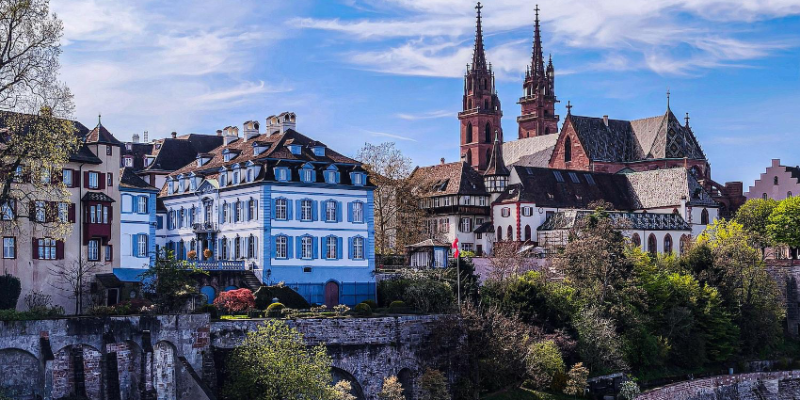
With 79,744 foreign nationals resident in the canton in 2025, Basel is genuinely diverse in its workplaces and public institutions, yet daily life runs on German-speaking Swiss rhythms that take real adjustment to enter fully. The gap between Basel's cosmopolitan professional environment and its structured, orderly social culture is the central tension most newcomers navigate: English carries well in the offices of Novartis and Roche and in the galleries of Art Basel each June, but housing searches, school enrollment, and neighborhood friendships all become noticeably easier with German.
At the Dreiländereck, the point where Switzerland, Germany, and France converge, Basel occupies a geographic position that has shaped its entire character. Cross-border shopping, cross-border commuting, and cross-border weekend trips are ordinary routines here, not novelties. The city sits in Canton Basel-Stadt, divided into 19 districts, and its scale is genuinely compact: most workplaces, cultural venues, and daily services are reachable on foot, by tram, or by bicycle, and the Rhine runs through the center, functioning as both a landmark and the city's main outdoor social space in summer.
What makes Basel punch well above its size is its combination of economic weight and cultural density. Novartis and Roche, two of the world's largest pharmaceutical companies, are both headquartered in or directly adjacent to the city, making life-sciences and pharmaceutical employment the dominant international draw. Alongside this, Art Basel, one of the world's most prominent international contemporary art fairs, takes place here each June, and the year-round museum and gallery calendar rivals cities several times larger. For internationally mobile professionals, researchers, students, and artists, the city offers a combination of serious employment, strong public infrastructure, and cultural richness that is unusual at this scale. The foreign-resident population of Canton Basel-Town stood at 79,744 in 2025, giving everyday Basel a noticeably international character in workplaces, schools, and public life.
The daily rhythm is calm and purposeful. Commutes are short, public transport runs reliably, and residents tend to organize leisure around Rhine-side walks, museum visits, neighborhood markets, cycling, and short regional outings. Work-life balance in Swiss employment is generally good, and the city's compactness means less time lost to logistics than in larger European capitals. First impressions for most newcomers are positive: the city feels clean, safe, efficient, and more international than expected for its size. The most common adjustment challenges are the high cost of living, the need to engage with German for anything beyond international work circles, and the discovery that local social life takes time and deliberate effort to enter. Basel's social culture favors planned encounters over spontaneous warmth, which is an adjustment for many arrivals.
Basel divides into Grossbasel on the left bank, the older and more polished side encompassing the old town and most established residential districts, and Kleinbasel on the right bank, which is more urban, socially mixed, and generally more affordable. Understanding this distinction helps narrow a housing search quickly, since the two sides have noticeably different feels even though tram connections make both equally accessible to most workplaces.
Altstadt Grossbasel and Vorstädte form the historic center: walkable, culture-heavy, and close to major museums, the Rhine, and Basel SBB, the main national rail station. This area suits professionals and culture-focused newcomers who want central convenience, though rents are at the top of the Basel scale and apartments are often in older Wilhelminian-era buildings. Gundeldingen, commonly called "Gundeli," sits directly beside Basel SBB and is one of the first areas newcomers are typically directed to. It has a mixed residential character, strong everyday shopping, good restaurants, and dense public transport coverage. Rents are mid-range, the area is practical for commuters and students alike, and it attracts young professionals, new arrivals, and expat families who want city life without old-town price levels.
St. Johann is a mid-priced urban neighborhood on the northwest side, well suited to life-sciences professionals given its proximity to the Novartis campus, and to families who value Rhine access and parks. The city's German integration program for parents runs courses linked to schools in this district, which points to an active family-integration infrastructure in the area. On the right bank, Matthäus and Kleinbasel more broadly form the most urban, diverse, and street-life-oriented part of Basel. This is popular with students, younger expats, and people who want cafés, bars, and Rhine access without the formality of Grossbasel. Rents are mid-range. Wettstein, slightly east within Kleinbasel, offers a calmer, more premium feel: quieter than the busier lower Matthäus area, mid-to-high in price, and typically attracting professionals and couples who want riverside calm while staying on the right bank.
Bachletten is leafier and quieter than Basel's denser inner districts, associated with parks, the zoo area, and a more residential pace. It is expensive and best suited to families and retirees. Bruderholz, by contrast, is Basel's most suburban residential zone: elevated, villa-lined, and characterized by tranquillity rather than proximity to nightlife or the rail station. Rents are high; the trade-off is space and greenery. Iselin, a practical and relatively affordable Grossbasel option near Kannenfeldpark, suits budget-conscious professionals and families who want green space without prestige pricing. At the northern edge, Klybeck and Kleinhüningen form Basel's most affordable and most transitional zone: lower rents, an industrial-river character, and new development energy make this a realistic option for students, creatives, and budget-conscious renters comfortable being further from the old-town core. Resident discussions identify this area as one of Basel's evolving zones, alongside the Dreispitz edge near Gundeldingen.
Good to know:
Every Basel neighborhood has at least one park and several playgrounds, so green space is not exclusive to the leafier outer districts. The difference lies in density and quiet, not the absence of nature.
Join the Basel community
Get regular tips and advice to make the most of your expat life
Cost of living in Basel
Numbeo's quality-of-life data for Basel classifies its cost-of-living index as very high. Living well here is realistic for residents on Swiss-level salaries, but the same budget stretches considerably further in most other European cities. Newcomers arriving on savings, internship stipends, or remote income benchmarked outside Switzerland face a noticeably tighter position than those in local employment.
Rent is the dominant monthly expense for most newcomers. Choosing a neighborhood carefully makes a real difference: Klybeck, Iselin, and inner Kleinbasel offer lower housing costs than Altstadt or Bruderholz, and the difference is substantial enough to affect the entire monthly budget. Beyond rent, mandatory Krankenkasse (health insurance) adds a significant fixed cost for every resident regardless of employment status, and this is sometimes overlooked in initial budgeting. A realistic starting estimate for a single person, covering housing, food, transport, and basic services but excluding health insurance, is CHF 3,000 to CHF 4,000 per month (approximately USD 3,700 to USD 4,900); families need considerably more.
Many Basel residents routinely shop across the border in France (Alsace) or Germany to reduce everyday grocery and household costs. This is a practical and widely used coping strategy, not an occasional trip, and Basel's unique border position makes it genuinely convenient. For families considering international schooling, annual fees range from approximately CHF 11,640 (USD 14,400) at the lower end to CHF 38,000 (USD 47,000) at the top, and these costs are covered in the family life section below.
Climate and weather in Basel
Basel has a temperate Central European climate at low elevation, making it one of Switzerland's warmer lowland regions. Summers can be genuinely hot and occasionally oppressive, while winters bring cold spells but rarely the severe alpine cold of higher Swiss cantons. The most comfortable seasons are late spring and early autumn: daylight is good, temperatures are moderate, and outdoor life is most usable. Midsummer in July and August can bring intense heat, especially in dense urban neighborhoods, while December to February is the coldest and often greyest period, with frequent low cloud or fog known locally as Hochnebel blocking sunlight for extended stretches.
Newcomers should not expect Mediterranean-style dry summers. The wettest months by long-term climate normals are May, June, July, and August, with May averaging the highest rainfall. Warm-season showers andthunderstorms are common. A layered clothing approach works best: light breathable clothes for summer, reliable rain protection for spring and summer, warm coats for winter, and transitional layers for cool mornings year-round.
When choosing an apartment, summer heat management has become a practical selection issue. Older buildings often lack air conditioning, and portable cooling units are the main way to cope during hot spells. Before signing a lease, check for cross-ventilation, external blinds or shutters, top-floor exposure, and courtyard shade. Residents adapt to peak summer heat through Rhine-side routines, shade, fans, and flexible outdoor schedules, especially in the evening when temperatures ease. The Swiss Meteorological Office annual climate data provides detailed seasonal breakdowns by location.
Getting around Basel
A car is rarely needed for everyday life inside Basel-Stadt. The city is compact and highly walkable, and trams, buses, walking, and cycling cover the vast majority of daily journeys. Most newcomers manage comfortably without a vehicle from day one.
The BVB (Basler Verkehrs-Betriebe) operates Basel's tram and bus network, including cross-border lines into France and Germany. Trams are the backbone of the network, serving all main neighborhoods, central workplaces, Basel SBB, and the Messe convention area. The Basel Go! app is the main digital tool for route planning and ticketing within the Basel transit system and is the practical starting point for new arrivals.
Cycling is both practical and genuinely embedded in daily life: the WettsteinBrücke was Switzerland's busiest urban bicycle-counting point in 2025, with an average of 8,881 bicycle crossings per day. The canton supports a wide range of shared vehicles, including rental bikes, e-bikes, cargo bikes, e-scooters, and car-sharing, most of which are accessible via provider apps. Uber also operates in Basel, and local taxi firms include 33er Taxi AG, Taxi-Zentrale AG Basel, and mini-cab AG, among others; taxis and app-based rides are supplementary rather than essential in a city where trams and cycling reach almost everywhere.
Language and communication in Basel
German is the administrative language of Canton Basel-Stadt. Written notices, official forms, school communications, and formal service interactions all operate in Standard German (Hochdeutsch). In everyday social life, residents frequently switch to Basel German (Baseldytsch), the local Swiss German dialect, which can be harder to follow even for fluent Standard German speakers. The practical gap between written administrative German and spoken street German is one of the more surprising adjustments for newcomers who arrive with classroom-level language skills.
English is commonly useful in international professional, university, and expat-facing contexts, and Basel's life-sciences and pharmaceutical employers make it a genuine working language in many offices. In everyday street and shop interactions, though, Standard German is more natural, and public administration remains German-language throughout. In practice, English can support international work and study, but German matters for housing searches, local services, school life, and deeper social integration. Investing in German from the outset makes every part of daily life in Basel more navigable.
Newcomers with a B residence permit who plan to stay in Basel-Stadt receive, at their welcome interview with the residents' office, a voucher for a free German course of 80 lessons, valid for one year. This is the clearest immediate language-learning action for eligible arrivals. GGG Migration provides counseling on integration offers and German-course options for voucher holders. Several language schools are compatible with the voucher: K5 Basler Kurszentrum lists a "German immediately" program of 60 lessons; ECAP Basel offers German from A1 level with childcare available during lessons; and SLA Basel runs intensive courses from A1.1 to C1.2. University of Basel students can access the University Language Center for German courses, and FHNW students with a B permit may also access the free first-year voucher. The canton publishes a broader overview of German-learning options in Basel-Stadt.
A few phrases are worth knowing for the early days: Grüezi is the standard Swiss German greeting; Danke is thank you; Ich lerne Deutsch (I am learning German) signals goodwill and usually prompts patience from locals; and Könnten Sie das bitte auf Hochdeutsch sagen? (Could you say that in Standard German, please?) is widely understood and generally welcomed when the dialect is difficult to follow.
Culture and social norms in Basel
Basel presents a cultured, orderly, and internationally accustomed social identity shaped by its Rhine position, its three-border setting, and a dense year-round cultural calendar. Fasnacht, Basel's three-day winter carnival held in February or March, is one of the most distinctive local events in the Swiss cultural calendar: a costumed procession with its own music, satire, and social rituals unique to the city, drawing the whole community into a specific collective rhythm during the darkest months. Alongside Fasnacht, the calendar includes Art Basel, Kunsttage Basel, museum programming, and neighborhood festivals. For newcomers, the practical social texture is formal politeness, respect for quiet public space, and a preference for planned encounters over spontaneous invitations.
Punctuality is a firm social norm, not merely a professional one. Arriving on time is expected for doctor's appointments, dinners with new acquaintances, and social events equally. Dress code in everyday Basel life is smart casual: neat and presentable without being formal. Religion plays a minimal role in public daily life in Basel-Stadt, though the city's nine statutory public holidays (New Year's Day, Good Friday, Easter Monday, Labour Day, Ascension Day, Whit Monday, Swiss National Day on August 1, Christmas Day, and St. Stephen's Day on December 26) are work-free days when most shops close, so newcomers should plan groceries, appointments, and deliveries around them.
Joining structured clubs, courses, neighborhood activities, or volunteering is a more reliable route into local social circles than casual small talk. The social culture favors deepening relationships through repeated shared contexts rather than through spontaneous warmth on first meetings. German, even at a basic level, visibly signals commitment to local life and opens conversations that remain closed to English-only interaction. The canton supports this through its free 80-lesson course for eligible B-permit holders and through reduced-price courses for other residents.
Pace of life and work culture in Basel
Full-time work in Basel is structured around 40 to 42.5 hours per week with at least four weeks of paid vacation. Swiss labor law sets minimum daily breaks: 15 minutes for work exceeding 5.5 hours, 30 minutes for more than 7 hours, and 1 hour for more than 9 hours. Lunch breaks tend to be short rather than leisurely, which is a common adjustment for those accustomed to longer midday pauses. Within those hours, expectations for focus and efficiency can be high.
Work-life balance in Basel is genuinely good by European standards. The Canton of Basel-Stadt, as a major employer, explicitly offers flexitime, annual working-time accounts, trust-based working time, job sharing, and home office where operationally possible. Remote work is growing across sectors in Basel's international employers, though it is not universally available; checking the specific terms of your contract rather than assuming flexibility is the practical approach. The University of Basel similarly offers flexible working-time models and family-friendly conditions.
What distinguishes Basel from smaller Swiss cities is its cross-border labor market and its large international employers. Daily working life feels more international and urban than equivalent-sized cities elsewhere in Switzerland, which means professional integration tends to be faster even for newcomers without German fluency. Beyond work, daily life follows a strong seasonal rhythm: summer is dominated by outdoor river life, most distinctively Rhine swimming (Rheinschwimmen), where residents float downstream with the current using a waterproof bag called a Wickelfisch to carry their belongings. The Official Basel Rhine Swim is an institution rather than a tourist activity, and it defines the city's warm-weather social calendar. Fasnacht in late winter provides the equivalent anchor for the colder months.
Food culture in Basel
Basel's food identity blends Swiss, Baden, and Alsatian influences: hearty regional cooking sits alongside a lively and internationally diverse restaurant scene. The city's border position means Alsatian dishes like Flammkuchen (a thin-crust flatbread with crème fraîche, onion, and lardons) appear naturally on menus alongside Swiss classics and international cuisines. The most distinctively local specialty is Basler Läckerli, a traditional gingerbread biscuit flavored with honey, spices, and almonds, available throughout the city and often the first local food product newcomers encounter.
Market culture is strong. The city market runs Tuesday through Thursday 08:00-14:00 and Friday through Saturday 08:00-17:00, with fresh produce, local food, and coffee available on site. The Markthalle, an indoor market hall in the city center, provides a covered food and dining space that many residents use regularly alongside supermarkets. Neighborhood markets complement the main market schedule and are a practical entry point for discovering local Swiss produce.
Access to international cuisine is high for a city of Basel's size. A wide variety of cuisines and dining styles are well represented, from traditional restaurants to current food trends, and most traditional restaurants operate into the evening. Restaurant prices are in line with Swiss norms: higher than in most European countries but consistent with local salary levels for those employed in Switzerland.
Leisure and social life in Basel
Summer leisure in Basel centers almost entirely on the Rhine. Rhine swimming, floating downstream with the current using a waterproof Wickelfisch bag, is a genuinely local habit rather than a tourist activity and defines the city's warm-weather social rhythm from June through August. Rhine-side walks, picnics on the banks, and outdoor bars along the water fill out the seasonal calendar. This is the aspect of Basel life that most consistently surprises newcomers who arrive expecting a more formal Swiss experience.
The arts and entertainment scene is strong relative to the city's scale. Art Basel, held each June, draws a genuinely global audience and transforms the city for its duration. Year-round, a dense museum culture, recurring festivals, fairs, and exhibitions, and neighborhood-scale cultural programming make the city feel well-resourced for culture regardless of the season. The museum concentration in the Altstadt and along the Rhine is particularly notable: for a city this size, the density of significant collections is unusual.
Nightlife is moderate and event-led rather than constantly high-energy. Active bars, clubs, DJ nights, and event venues exist, especially around Kleinbasel and at venues such as Nordstern and Kuppel Basel. However, residents consistently describe Basel as quieter and earlier-closing than larger nightlife cities, and social life is more organized around events and specific circles than around spontaneous bar culture. For some newcomers this is a frustration; for others it is exactly the pace they want. Weekends typically mix cultural visits, outdoor movement, Rhine walks or swims in warm weather, food and drink, and quick rail trips into Switzerland or across nearby borders into France or Germany.
Family life in Basel
Basel holds UNICEF child-friendly municipality recognition and treats family policy as a genuine priority, investing in childcare capacity, neighborhood parks and playgrounds, traffic-calming measures, and pediatric care through the University Children's Hospital Basel. Every neighborhood has at least one park and several playgrounds, so access to outdoor child-friendly space is city-wide rather than concentrated in particular districts.
The public school system covers 11 years of compulsory schooling: 2 years of Kindergarten (starting at age 4-5), 6 years of primary school, and 3 years of secondary school. German is the language of instruction throughout. Newly arrived children with little or no German receive structured support: before Kindergarten, they must attend a German-supported playgroup or daycare for at least three half-days per week in the year before entry. School-age newcomers receive DaZ (Deutsch als Zweitsprache) support, meaning dedicated German-as-a-second-language instruction integrated into the school day. Registration is handled through Basel-Stadt school authorities.
Four international and bilingual schools serve families in Basel. International School Basel offers a full IB program from PYP through to Diploma, with annual fees ranging from CHF 23,980 to CHF 38,000 (approximately USD 29,600 to USD 47,000). SIS Swiss International School Basel offers a bilingual German-English program with an IB Diploma option, with annual fees from CHF 11,640 to CHF 17,350 (approximately USD 14,400 to USD 21,400). ELA Basel, The Swiss British School, located at Gartenstrasse 93, offers a British and Cambridge pathway with fees published on their admissions page. BKA International School is a bilingual IB World school running from daycare through upper secondary, with Kindergarten fees starting from CHF 11,850 per year (approximately USD 14,650). English-speaking families who choose the Swiss public school system should also be aware that HSK English Basel runs native English-language literacy classes for children attending Swiss schools, which helps maintain children's English while they integrate into the German-medium system.
Subsidized Kita (Kindertagesstätte, daycare center) places cost eligible parents at most CHF 1,600 per month (USD 1,978) for full-time care including meals, activities, and diapers. However, demand for both daycare and school-day care (Tagesstruktur, the before- and after-school care program) has been rising for years, and availability depends on registration timing and local capacity. Families should register as early as possible, ideally before arrival, rather than assuming a place will be available on demand. The Beratungs- und Vermittlungsstelle (childcare advice and placement office) is located at Aeschenvorstadt 52/54, 4051 Basel. Telephone advice is available Monday through Friday 08:30-12:30 at +41 61 267 46 14; drop-in consultations without an appointment run Monday through Friday 09:00-12:00.
For non-German-speaking parents, Basel-Stadt offers a school-linked German program called "German for Mothers and Fathers of School Children," which combines everyday German with practical information about the Basel school system and parental roles. New courses typically start with the school year in August at multiple school locations including St. Johann and Erlenmatt. Beyond language support, a range of free and low-cost family services is available: Elternberatung Basel-Stadt offers free drop-in counseling for parents of babies and small children at Aeschenvorstadt 52-54; fabe provides family, couple, and parenting counseling with a Monday drop-in at CHF 10 (USD 12); and the Zentrum für Frühförderung runs early language development sessions and parent events. The annual Infomesse für Eltern mit Kleinkindern, a free information fair for parents of children up to age 4, offers guided tours in several languages and is a useful first contact for newly arrived families.
Family-friendly neighborhoods include Grossbasel (walkable, cultural amenities, parks), Gundeldingen (practical base near Basel SBB), St. Johann (Rhine access, near the Novartis campus), Erlenmatt and Rosental (newer urban development with tram access), Bachletten (leafy, near the zoo), and Bruderholz (quietest and most residential, with more space but less central convenience).
Safety in Basel
Basel is a safe city by European standards. Day-to-day life requires normal urban caution: watch your belongings in busy public spaces such as the central train station and market areas, use well-lit routes after dark, and avoid isolated situations at night. The Kantonspolizei Basel-Stadt (cantonal police) is the primary law enforcement body, and police reports can be made in English.
The most common everyday risks in Basel are petty theft, particularly in crowded areas, traffic incidents, and a documented rise in cybercrime. The overall risk profile is consistent with a safe Central European city. Emergency numbers to save on arrival:
117: police (Kantonspolizei Basel-Stadt)
118: fire brigade
144: ambulance
112: European and international emergency number, works in Switzerland
142: victim support and counseling helpline
143: The Helping Hand
147: telephone help for children and young people
Using a mobile phone where possible helps emergency services locate callers more easily. The Hallo Basel-Stadt website provides a resident-facing guide to emergency numbers, when to call them, and counseling service pathways, available in English, French, Spanish, and Italian. It is one of the most practical first references for newly arrived residents of all language backgrounds.
Environment in Basel
Basel's environmental profile is one of its practical lifestyle advantages. Compact distances, a strong tram and cycling culture, abundant Rhine-side open space, parks, public drinking fountains, and a stated net-zero target for 2037 reflect a city that takes sustainability seriously at a planning level. Basel Tourism was certified to the TourCert sustainability standard in December 2024, and the WettsteinBrücke's status as Switzerland's busiest urban bicycle-counting point in 2025 illustrates how embedded active mobility has become in daily life.
Tap water in Basel is safe and high quality: the Basel-Stadt cantonal laboratory's checks found that the public drinking-water supply fully met legal requirements, with all regulated chemical substances clearly below maximum values. This is worth knowing for newcomers accustomed to cities where tap water quality varies.
Urban heat is the most practically relevant environmental challenge for residents. Basel-Stadt's urban climate planning framework identifies dense, low-green-share neighborhoods as more vulnerable to nighttime heat retention. The main cooling air flows come from wooded hills in Riehen and Bettingen; denser inner-city areas with less green coverage stay hotter. When choosing an apartment, proximity to parks, green courtyards, or the Rhine is a meaningful comfort factor in summer, not just an aesthetic one.
The city is actively improving street-level liveability. Superblocks, modeled on Barcelona's Superilles and designed to reduce through-traffic and create more pedestrian-friendly street space, are being tested in the Matthäus and St. Johann districts, with the Superblock program running as a pilot in those neighborhoods. Noise levels are moderate to locally higher near major road corridors and in areas affected by airport flight paths from EuroAirport Basel-Mulhouse-Freiburg. The canton publishes an official road-noise register; residents can check their specific street's noise exposure at the Basel-Stadt environmental data portal before committing to a rental.
Expat community in Basel
With 79,744 foreign nationals resident in Canton Basel-Stadt in 2025, Basel's international community is large relative to its total population. Cross-border European residents, life-sciences professionals, university researchers, and students form the most visible international groups, and the foreign-resident share gives everyday Basel a genuinely international character in workplaces, schools, and public life.
Centrepoint Basel, located at Im Lohnhof 8, 4051 Basel, is a volunteer-run, English-speaking community organization that Basel-Stadt describes as the largest organization for the international community in the city. It offers events, activity groups, language conversation groups, and volunteering opportunities for people wanting to connect and build a social circle. The American Women's Club of Basel, founded in 1947, is a nonprofit social and philanthropic organization open to English-speaking women of all nationalities, offering activities, interest groups, newsletters, and volunteering. habs queer Basel runs an English-speaking "Expats Welcome" group and is an active touchpoint for LGBTQ+ newcomers.
Several online resources have been built by and for Basel's international community. BaselConnect supports collaboration between expats and locals, shares information on the local school system in English, and provides a forum for parents comparing Swiss schooling experiences. BaselCommunity.com and Basel Life are English-language online resources created by expats for English-speaking newcomers settling in the city. The Fiesta Española Basel is the main cultural gathering point for Spanish-speaking residents, organized around the Quartiertreffpunkt Gleis 58 community space in Klybeck. The Circolo Arci Basilea, founded in November 2024, is an associative space for the Italian community in Basel, also open to other nationalities interested in Italian culture, and is the most direct entry point into that community network.
For face-to-face social entry, two active Meetup groups stand out: ExPatting In Basel (EIB) and Basel Together, which runs regular newcomer, social, language-exchange, and bar meetups open to both expats and locals. These are among the most practical first-contact options for new arrivals without an existing network. The official integration entry point for newcomers is GGG Migration, the Basel-Stadt integration partner, which provides counseling on integration offers, German-course options, and support for residents using the B-permit free language-course voucher.
Overall, the city is valued for its international working environment, cultural density, Rhine-side quality of life, and cross-border access. The most common challenge is that making close local friends takes deliberate effort: Swiss social culture in Basel rewards patience and repeated shared contexts over spontaneous connection. German or Swiss German exposure makes a meaningful difference to integration beyond English-speaking professional and community circles, and most long-term residents describe moving gradually toward a mix of both expat and local social life rather than remaining entirely in one sphere.
The case for Basel is grounded in infrastructure satisfaction that is unusually high for a city its size. Over 80% of Basel-Stadt residents were satisfied with public transport in the canton's own resident survey, and local shopping, waste disposal, healthcare, green spaces, and parks all scored well. The city is compact, safe, and highly functional for everyday life. Numbeo's quality-of-life data records a very high quality-of-life index for Basel alongside high safety and healthcare indices, a very high purchasing-power index, and low pollution. For internationally mobile professionals comparing European relocation options, this is a genuinely strong overall profile. The Superblock program in Matthäus and St. Johann signals ongoing investment in street-level liveability, and the city's ambition to reach net-zero by 2037 reflects a planning culture oriented toward long-term resident quality of life.
The main challenge is cost. Numbeo classifies Basel's cost-of-living index as very high, and rent is the dominant monthly expense regardless of neighborhood. The city suits people with Swiss-level incomes comfortably; newcomers arriving on savings, internship stipends, or remote salaries benchmarked outside Switzerland face a noticeably tighter financial position. Residents' own survey responses identify traffic and public safety as the main everyday irritants, not safety in a crisis sense, but as livability friction points in a compact, busy city. Summer heat is an increasingly visible concern, with residents in denser neighborhoods noting the need for fans or cooling solutions in older building stock that lacks air conditioning.
Frequently asked questions
Many newcomers manage daily life in English, especially in international workplaces, universities, and expat-heavy professional circles. German is the administrative language of Canton Basel-Stadt, and Swiss German shapes everyday local life, so relying only on English makes housing searches, neighbor relations, and local bureaucracy noticeably harder. Newcomers with a B permit receive a voucher for a free 80-lesson German course at their welcome interview with the residents' office, which is the most direct first step toward broader integration. Deeper social connections outside professional settings tend to open up more readily with at least basic German.
Basel has a very high cost-of-living index, with rent as the dominant monthly expense. As a starting point, a single person needs at least CHF 3,000 to CHF 4,000 per month, excluding mandatory health insurance (Krankenkasse); families need significantly more. Cross-border shopping in France or Germany is a practical and widely used strategy to reduce grocery costs. The exact figure depends heavily on your rent, health-insurance plan, and appetite for restaurants, travel, and cultural events.
Basel is safe across all its main neighborhoods by European standards, so where you live depends more on commute, school access, river or city-center preference, and apartment availability than on sharply different safety profiles between districts. Expats commonly settle in Gundeldingen, St. Johann, Kleinbasel, Wettstein, and Bachletten, each offering a different balance of price, character, and convenience. For a cautious first move, focus on individual building condition, night-time transport routes, and proximity to your workplace or school.
Basel is better suited to medium- and long-term living. Its strengths, including excellent public transport, high quality of life, stable employment, universities, museums, and cross-border access, become more valuable once you are settled and earning locally. For short stays, the same qualities apply, but high rent and Swiss prices can feel disproportionate unless the visit is funded by work, study, or relocation support.
The most common surprise is how international yet compact and orderly Basel feels: major global employers, prominent museums, and cross-border access coexist with daily life that can feel quiet and rule-conscious. Newcomers are also frequently struck by how much ordinary items cost, and by how central German and Swiss German remain to local life despite widespread English in professional settings. Summer heat in dense urban neighborhoods is another adjustment that catches many arrivals off guard, particularly in older apartments without air conditioning.
Foreigners can rent in Basel, but ease depends on budget, timing, documentation, and whether residence and employment paperwork is already in order. The rental market is competitive, and newcomers should prepare all documents, including a residence permit, employment contract, and references, before starting their search. Beginning the search several months before arrival is advisable, as well-located apartments attract multiple applicants. Rent is the largest single monthly cost, so neighborhood choice has a meaningful impact on overall budget.
The main downsides are high housing and everyday costs, the need to engage with German and Swiss German for fuller local integration, and a social rhythm that can feel slow to enter for newcomers. Some residents also find the city small after larger capitals, despite its strong cultural offering. Summer heat in dense neighborhoods is an increasingly common concern, and older apartments often lack air conditioning, making flat selection an important practical decision.
Both patterns are sustainable in Basel. The city's international employers, university environment, and cross-border setting make it easy to remain in English-speaking or sector-based expat circles, especially in the early months. Deeper integration into local life usually requires German, patience with Swiss social norms, and regular involvement in local routines such as clubs, neighborhood activities, volunteering, or children's school activities. Most long-term expats report moving gradually toward a mix of both rather than one or the other exclusively.
ℹ️
We do our best to provide accurate and up to date information. However, if you have noticed any inaccuracies in this article, please let us know in the comments section below.
I fell in love with words at an early age After a break to focus on my studies, I rediscovered the joy of writing while keeping a blog during my years between London and Madrid. This passion for storytelling and for exploring new cultures naturally inspired me to create Expat.com, a space for my own reflections as well as for anyone wishing to share their experiences and journeys abroad.