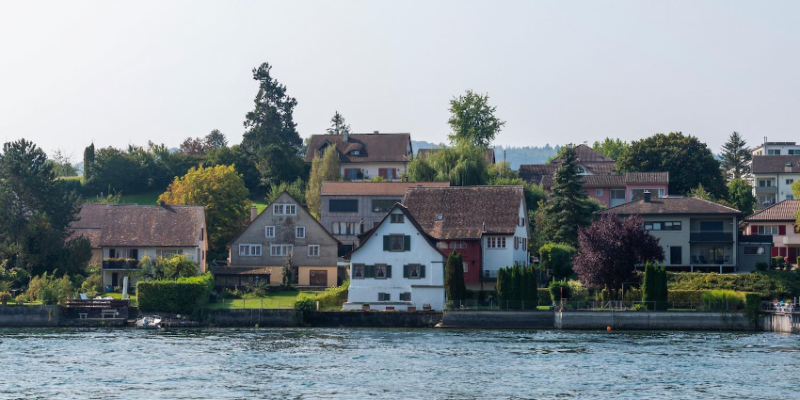
Housing supply across Switzerland is officially described as scarce, yet the national price index tells only part of the story for a foreign buyer weighing a purchase in Zurich, Geneva, or a smaller canton. The real gatekeeper is Lex Koller, the federal framework that decides whether someone counts as a "person abroad" and therefore needs cantonal authorization before completing a purchase, a process the Federal Council is actively working to tighten. Prices themselves range widely, from roughly CHF 9,300 per square meter in Bern to nearly CHF 17,000 in Zurich, but eligibility, not budget, is usually the first wall a foreign buyer hits. Ownership, once secured, still creates no right to live in the country.
What the real estate market looks like in Switzerland
Switzerland's national Residential Property Price Index stood at 125.0 points in the fourth quarter, up 0.5% from the previous quarter, with single-family houses gaining 0.4% and condominiums 0.6% (Federal Statistical Office). Federal authorities describe housing supply as scarce, and that shortage is one reason the Federal Council opened a consultation on tightening the Lex Koller rules governing the acquisition of Swiss real estate by persons abroad. For a foreign buyer, that legal filter matters more than the national price trend, because authorization decisions are made by the canton where the property is located. Two buyers with an identical profile can receive different answers depending on which canton they choose, entirely apart from what the price index is doing that quarter.
Whatever the advertised price, budget on top of it for a cantonal property-transfer tax or land-register fee, generally 1% to 3.3% of the purchase price where a canton levies one as a percentage-based tax rather than a flat administrative charge.
Foreigners can buy real estate in Switzerland, but the decisive question is not nationality alone: it is legal connection to the country. Under Lex Koller, persons classified as "abroad" generally need cantonal authorization before completing a purchase, while EU and EFTA nationals with a right of residence and a main residence in Switzerland are treated like Swiss citizens when buying property. This advantage flows from the Agreement on the Free Movement of Persons, which pairs free movement with equal property-acquisition rights.
The practical line runs between resident and non-resident, not between nationalities. Foreigners not permanently established in Switzerland, along with companies headquartered abroad or under foreign control, fall under the authorization requirement. Buyers who remain outside this category, mainly EU/EFTA residents, do not need it.
One point applies to every foreign buyer regardless of authorization status: owning property creates no right to live in Switzerland. Anyone staying more than three months needs a residence permit, obtained through the ordinary immigration process, and a completed property purchase does not shortcut that requirement or improve the odds of approval.
What a foreign buyer can realistically acquire depends as much on ownership structure as on bricks and mortar. Apartments are almost always bought through condominium ownership (Stockwerkeigentum), where the buyer holds a co-ownership share of the land and building together with an exclusive right to use one defined unit. Ownership only transfers once the acquisition is entered in the land register, not at signing.
Three ownership forms apply to private buyers generally:
Sole ownership: one person entered alone in the land register.
Co-ownership: two or more people owning defined shares stated in the purchase contract, common for detached houses and row houses.
Condominium ownership: a co-ownership share combined with exclusive rights over one apartment unit.
Detached houses and villas are bought as sole or co-ownership, and the same EU/EFTA versus non-resident distinction applies: residents with their main residence in Switzerland acquire on the same terms as Swiss citizens, while other foreign nationals may need authorization. Row or terraced houses follow whichever structure is recorded in the contract and land register, and buyers should check shared access, easements, building rights, and condominium regulations before signing, since these can be complex enough to warrant expert review. A separate building right can also exist on a plot and should always be checked in the land register, as it can affect use, duration, cost, and resale value.
Vacant land bought purely as a capital investment sits in more restricted territory: EU nationals without a principal residence in Switzerland need permission to hold land this way, and agricultural real estate is generally off-limits to persons abroad unless an exemption applies. New-build and off-plan purchases follow the same registration principle as any resale, and the sale contract must be publicly notarized in every case; Switzerland has no single central land register, since each canton maintains its own under federal supervision.
Holiday homes and aparthotel units require cantonal authorization for persons abroad, and this is precisely the category the Federal Council's 2026 consultation targets for tighter annual quotas. For a foreign resident planning a long-term move, the most workable property types remain main-residence apartments under condominium ownership and houses held as sole or co-ownership, since EU/EFTA residents are treated exactly like Swiss buyers in these categories. Holiday homes, second homes, and residential investment property fall into a more restricted tier.
Join the Switzerland community
Get regular tips and advice to make the most of your expat life
Best areas for property buyers in Switzerland
Prices per square meter vary enough across Swiss cities that budgeting should start with the specific city rather than a national average, and because Lex Koller authorization is decided canton by canton, the choice of location is as much a legal question as a financial one.
City
Average asking price (CHF per m²)
Zurich
16,968
Geneva
15,541
Lausanne
13,019
Basel
11,009
Lugano
10,486
Bern
9,339
Zurich and Geneva sit well above the other cities tracked here, while Bern and Lugano are the most accessible of the group. None of this changes the authorization question: a buyer eligible in one canton is not automatically eligible in another, so the eligibility check should happen before a city becomes a firm choice, not after.
Restrictions on foreign property buyers in Switzerland
Switzerland defines restrictions by what the property will be used for and who the buyer is, not by a blanket nationality ban. For foreigners not permanently established in the country, several uses are prohibited outright: purely financial real-estate investment, running a real-estate business, professionally acquiring holiday apartments or similar facilities other than hotels, and acquiring agricultural real estate.
Holiday homes and aparthotel units sit in a separate, quota-controlled category. Persons abroad generally need cantonal authorization for these, and the Federal Council's 2026 consultation proposes further reducing the annual cantonal authorization quotas. A related 2026 proposal would go further: it would require non-EU/EFTA nationals ("third-country nationals" in legal terms) to obtain authorization even for a main residence, and would require resale within two years of leaving Switzerland if the owner departs. This proposal opened for public consultation and had not been enacted at the time of writing, so always check the rule in force when a specific purchase closes directly with the competent authority rather than assuming it from general reporting.
Before signing anything, have the notary or the cantonal authority confirm two things: whether the buyer counts as a "person abroad" under Lex Koller, and whether the target property is agricultural, a holiday or second home, an investment property, a business property, or a personal dwelling. The Federal Office of Justice is the federal contact point for these questions, and each canton's own authority makes the final call for property located within its borders.
Conditions and formalities for buying property in Switzerland
A Swiss purchase follows a straightforward notarial and land-registry process, but a foreign buyer faces one extra gate that a Swiss buyer does not: cantonal clearance under Lex Koller has to be resolved before the notarized deed is signed, not after. The sequence generally runs as follows:
Determine whether the buyer counts as a "person abroad" under Lex Koller.
Determine whether the property type in question requires authorization.
Determine whether the legal right being acquired counts as a real-estate acquisition at all.
If authorization is required, obtain cantonal approval before the acquisition can be entered in the land register.
Monitor the ongoing legislative consultation, since the applicable rules can change before completion.
Before signing, check the land register for rights and encumbrances attached to the property; anyone with a demonstrable interest can request an extract for a fee, and complex building-law or condominium entries can justify bringing in outside expertise. The contract of sale must be publicly notarized, and that notarized document underlies the subsequent land-register registration. Ownership passes to the buyer only once the acquisition is entered in the local land register, and since Switzerland has no single central register, each canton runs its own under federal supervision. EU/EFTA nationals with a right of residence and main residence in Switzerland are exempt from the authorization step altogether and move straight to notarization and registration.
Required documents for buying property in Switzerland
Because eligibility in Switzerland is status-based rather than governed by one fixed national checklist, the documents a foreign buyer needs depend on where they fall under Lex Koller. The core file generally centers on:
Proof of legal and effective domicile in Switzerland.
Evidence of residence or settlement permit status.
For foreign nationals without a C settlement permit, evidence that the dwelling is being bought as a main residence in the buyer's own name.
A person abroad, or a company under foreign control, should expect the acquisition to be treated as restricted from the outset. A foreign national domiciled in Switzerland without a C settlement permit can buy a main residence without authorization only if the federal conditions on domicile and main-residence use are met and properly documented.
One procedural detail catches buyers who sign remotely: when a private signature must be legalized for submission to a Swiss authority such as a land register, the signer must appear in person at the relevant Swiss diplomatic representation abroad with valid identification and the document requiring the signature. Because the cantonal authority where the property sits decides whether a specific transaction requires authorization and whether it can be granted, questions about a particular purchase are best addressed directly to that authority rather than relying on a general checklist.
Working with real estate professionals in Switzerland
The notary, not a real estate agent or a lawyer, is the mandatory professional in a Swiss purchase. The buyer submits the required documents to a notary, who prepares and executes the deed of sale; this notarized deed is the legal step required before land-register registration, which finalizes ownership. Legal counsel is optional and mainly worth engaging when the buyer's lender, risk profile, or cross-border tax situation calls for it.
That last point matters for anyone who stays tax-resident outside Switzerland. Property taxes are levied where the property is located: buyers pay a transfer tax or at least a land-register fee in every canton, an imputed rental value is taxable for owner-occupiers, more than half of the cantons levy an annual property tax, real estate must be declared for wealth tax, and capital gains tax applies on a profitable sale. Coordinating all of this with a cross-border tax adviser is worthwhile precisely because these layers stack on top of whatever the buyer already owes at home.
If eligibility is in doubt, ask the competent cantonal authority, not the seller's agent. EU/EFTA nationals living in Switzerland need no authorization for an apartment, house, or plot of land. Third-country nationals with a valid residence permit generally do not need authorization for a first home they will occupy themselves and not rent out, but they do need it for a holiday home, an aparthotel unit, or a second residence. Treat as a red flag any professional who implies that buying property creates a right to reside in Switzerland, or who brushes past the Lex Koller question instead of directing doubtful cases to the competent cantonal authority.
Property prices and buying costs in Switzerland
The common shorthand "notary fees" is misleading in Switzerland, and this is worth knowing before setting a budget. Geneva's chamber of notaries confirms the amount typically bundles the cantonal transfer tax and land-register registration charges with the notary's own remuneration, so plan the figure due at completion as one combined line rather than a separate notary invoice on top of a tax bill.
Beyond the purchase price itself, buyers should set money aside for the cantonal property-transfer tax or land-register fee (generally 1% to 3.3% of the purchase price where charged as a percentage tax), the notary's costs for preparing the mandatory notarized deed, the land-register entry itself, and, if financing is used, the costs of creating or registering a mortgage note. All of these charges, along with the purchase price, are payable in Swiss francs (CHF); buyers earning or holding funds in another currency should treat exchange-rate movement as a separate risk from these statutory and notarial costs, since none of it is fixed by the transaction itself.
Financing and mortgages for foreign buyers in Switzerland
Getting a Swiss mortgage is a second gate that only opens after Lex Koller clearance, and mainstream lenders can be more restrictive than the purchase authorization itself. PostFinance, for instance, states that its mortgage products are for natural persons with permanent domicile in Switzerland, so non-resident buyers should expect lender availability to be case-specific rather than guaranteed.
Where a mortgage is available, the standard terms are demanding. Buyers must usually provide at least 20% of the property value from their own funds, with at least half of that equity coming from assets other than occupational pension provision. Lenders also apply an affordability rule: monthly housing costs should not exceed 33% of gross income, and foreign nationals must provide a copy of their residence permit. A full mortgage application typically requires:
Official identification.
A copy of the residence permit (for foreign nationals).
Recent salary statements or pension receipts.
A debt-enforcement-register extract no more than six months old.
Proof of own funds through account statements, tax returns, and pension-fund statements.
Property documents including a land-register extract no more than six months old, a floor plan, a zoning plan, and any energy-efficiency certificate.
Current lending terms illustrate the range a buyer might see quoted for a standard owner-occupied property with strong creditworthiness:
Mortgage type
Rate
2-year fixed rate
1.25%
15-year fixed rate
1.99%
3-year SARON mortgage
Compounded SARON plus a margin of 1.00%
Fixed-rate terms typically run from 2 to 15 years, while SARON-based mortgages are commonly offered on a 3-year term and can be converted into a fixed rate at any point. This matters for anyone whose income or savings sit outside Swiss francs: the SARON-linked rate can move on its own, and non-CHF funds can also change value against the franc before completion or during repayment, effectively doubling the currency risk. Typical mortgage-related bank fees include a renewal fee of CHF 100, a credit-modification fee of CHF 250 for changes such as switching provider at maturity or converting a SARON mortgage to fixed, an early-termination fee of CHF 500, and a reminder fee of CHF 20, with the first reminder issued free of charge; land-register and notary costs are billed separately to the borrower.
Paying in cash does not bypass any of this on the eligibility side: foreign non-resident acquisitions still generally require cantonal authorization regardless of financing, and the applicable registration, land-register, and notarial charges apply whether or not a mortgage is used. A cash buyer avoids the lender's paperwork, though banks and cantonal authorities alike will still expect traceable documentation of the source and movement of purchase funds, such as account statements, tax returns, pension-fund statements, or gift and inheritance contracts, before notarial completion.
Risks and pitfalls when buying property in Switzerland
The costliest mistake a foreign buyer can make in Switzerland is not overpaying or missing a hidden lien on the property; it is assuming legal eligibility is already settled. A canton's authorization decision, a municipality's own restriction on holiday homes, or a change introduced by the ongoing Lex Koller consultation can each unravel a deal that looked straightforward on paper. Confirmed pitfalls include:
Assuming a foreign buyer can purchase without authorization when it is in fact required.
Treating one canton's answer as valid for a different canton.
Signing before the cantonal authority has actually assessed the transaction.
Assuming a property purchase supports a future residence-permit application.
Restrictions can also be municipality-specific: some municipalities restrict the acquisition of holiday homes and aparthotel apartments beyond what the canton itself requires, so confirm local practice directly rather than assuming it from the cantonal rule alone. A buyer who signs a reservation, an off-plan contract, or a delayed-completion contract should check the law and cantonal practice again on the actual date of acquisition, not only at the reservation date, given that the 2026 consultation to tighten Lex Koller remains active.
Authorities assess a transaction by its substance rather than the label used in the paperwork, so the deed, the buyer's declarations, evidence of residence status, and any company-control information must align consistently with the cantonal authorization file before anything is signed. Before paying a deposit, ask the competent cantonal authority directly whether the specific acquisition requires authorization, verify that a statutory ground for that authorization actually exists, and make completion conditional on the cantonal decision where authorization may apply, rather than relying on a seller's or agent's assurance that everything is in order.
Property taxes and ongoing costs in Switzerland
Annual ownership costs in Switzerland stack several distinct layers rather than arriving as a single property tax bill, and almost all of them are set at cantonal or communal level. Where a canton levies a residential property tax, it generally runs around 0.01% to 0.3% of the estimated property value, payable by whoever is named as owner or co-owner in the land register, on top of the one-time transfer tax paid at purchase.
Owned real estate also counts toward taxable assets for cantonal and communal wealth tax, and the thresholds vary considerably by canton: for a married taxpayer without children, the exempt amount ranged from CHF 51,000 to CHF 402,000 of net assets depending on canton in the most recent figures. This functions more like a US-style local property tax paid to the county than a UK-style council tax, since it is assessed on the value of the property itself rather than on who happens to be occupying it. If the property is rented out, the rental income is added to taxable income; if the owner lives in it, an imputed rental value is taxed instead as part of that owner's income.
Selling at a profit triggers real-estate gains tax at the cantonal level, using either a monistic system, where gains are always subject to a special tax, or a dualistic one, where treatment depends on whether the property counts as private or business wealth; most cantons tax shorter holding periods more heavily to discourage speculation. Inheritance and gift taxes on Swiss property are likewise set at the cantonal level rather than through a single federal rate. Switzerland has eight bilateral agreements specifically covering double taxation on inheritance and estate taxes, separate from its much wider network of over 100 double-taxation agreements on income and capital; buyers who remain tax-resident abroad should check whether their home country's treaty with Switzerland extends to wealth or inheritance tax, since coverage varies by treaty.
Owning a condominium unit adds its own recurring costs: administration fees, common-area operating costs, and contributions to a renewal or renovation fund, which run at a rough rate of 0.2% to 0.5% annually of the building's insurance value. Building insurance itself is obligatory in most cantons; for a solidly built house with a CHF 800,000 replacement value, annual premiums generally run about CHF 260 to CHF 570 with cantonal building insurers and CHF 340 to CHF 800 with private providers, covering hazards such as windstorms, hail, floods, avalanches, and snow-load damage. Total ancillary and maintenance costs for a typical single-family house average 1.0% to 1.5% of the purchase price annually, which works out to roughly CHF 15,000 to CHF 22,500 a year on a CHF 1.5 million property, plus separate heating costs of about CHF 1,500 to CHF 3,500 depending on energy source and building condition. Banks use their own shorthand for affordability calculations: Migros Bank, for example, applies 0.8% of property value per year for combined running and maintenance costs, reduced to 0.6% for Minergie-certified or high-efficiency-rated properties.
Ownership only becomes formal once the acquisition is entered in the cantonal land register following the publicly notarized sale contract, the same registration principle that applies again at resale. From there, most of what a new owner has to handle runs through local rather than federal channels. Moving in requires notifying both the old and new commune of residence. Electricity and gas supply is arranged through the local distribution company serving the property's municipality, since there is no single national utility to contact. Any building or renovation work that changes the property can require a building permit, and both the rules and the responsible authority are set locally, so checking with the commune or canton before starting work is the safer route.
Renting out a purchased dwelling later depends on the authorization basis under which it was acquired. Because acquisitions by foreign non-residents are generally subject to cantonal authorization, the permitted use recorded at purchase, owner-occupation versus letting, can determine whether renting it out is even allowed. EU/EFTA nationals living in Switzerland keep the same property rights as Swiss citizens throughout; EU/EFTA nationals entitled to stay but without a principal residence in Switzerland have Swiss-equivalent rights only for property used for professional purposes, and a second residence or holiday home still requires separate permission.
The 2026 consultation proposal that would tighten main-residence purchases for non-EU/EFTA nationals also touches resale: it would require owners who bought under the tightened rules to resell within two years of leaving Switzerland, and would reintroduce authorization for resales of holiday homes between persons abroad. Since this remained open for consultation at the time of writing, the rule actually in force at the moment of any future sale should be checked directly rather than assumed from current reporting.
One financing detail applies specifically to buyers already working in Switzerland: owners can withdraw funds from their occupational pension (the "second pillar") early to buy a main residence or to amortize a mortgage, subject to conditions that include spousal or registered-partner consent where applicable, a five-year interval between withdrawal requests, and an obligation to repay the withdrawn amount if the home is later sold.
Frequently asked questions
It depends on residence status, not nationality alone. Non-resident foreign nationals fall under Lex Koller, the federal law restricting acquisitions by persons abroad, foreign-domiciled companies, and Swiss companies under foreign control. Some purchases, including holiday homes and aparthotel units, require cantonal authorization and are subject to annual quotas, while EU/EFTA nationals living in Switzerland can buy on the same terms as Swiss citizens.
The determining factor is your legal status under Lex Koller, not physical presence at signing. The property transfer contract must be publicly notarized, and ownership passes only once it is entered in the cantonal land register. Buyers unable to attend in person typically arrange representation through the notary, though the eligibility check still applies.
No. Owning property in Switzerland does not create any right to a residence permit. Foreign nationals staying more than three months still need the appropriate permit, and eligibility depends on nationality, purpose, and duration of stay, handled entirely separately from the property purchase.
Timelines depend on whether cantonal authorization is required. Where Lex Koller applies, the cantonal authority must decide on the request before the acquisition can be entered in the land register, and ownership only transfers once that entry is made. Where no authorization is needed, the process follows the standard notarization and land-register timeline.
There is no single national rule requiring a Swiss bank account to buy property, but purchase funds must be traceable. Lenders typically require documentation of the source and movement of funds, such as account statements, tax returns, or gift or inheritance contracts, before completion.
Mortgage eligibility is separate from Lex Koller purchase authorization, and availability is restricted and case-specific. Some lenders restrict standard mortgage products to buyers with permanent domicile in Switzerland. Where a mortgage is available, foreign nationals must provide a copy of their residence permit, along with at least 20% of the property value in their own funds.
Budget for a cantonal property-transfer tax or land-register fee, typically 1% to 3.3% of the purchase price, plus notary and land-register registration charges. The common label "notary fees" actually bundles these taxes and charges together with the notary's own remuneration, so treat it as one combined line rather than a separate invoice.
There is no universal requirement to instruct a separate lawyer. The notarized deed of sale and, where applicable, cantonal Lex Koller authorization are the mandatory legal steps. A lawyer remains optional and is mainly useful for contract review or cross-border tax questions.
No. Restrictions depend on canton, property use, and buyer status. Holiday-home and aparthotel purchases require cantonal authorization and follow annual quotas that vary by canton; some municipalities also apply limits beyond cantonal rules, so confirm eligibility with the relevant cantonal authority before signing.
Expect cantonal or communal property tax where levied, wealth tax on the property's value, income tax on rental income or on an imputed rental value if you live in the home, and real estate gains tax if you later sell at a profit. Exact rates and thresholds are set canton by canton rather than at the federal level.
This depends on the authorization basis under which you acquired the property. A recent proposal specifically targets acquisitions made only for investment purposes and would prevent persons abroad from acquiring commercial real estate in order to lease or rent it out, while still allowing acquisition for the owner's own business use.
A future sale can trigger real estate gains tax, with most cantons taxing shorter holding periods more heavily. A proposal under consultation would also require third-country nationals who bought a main residence under tightened rules to resell within two years of leaving Switzerland, and would reintroduce authorization for resales of holiday homes between persons abroad.
ℹ️
We do our best to provide accurate and up to date information. However, if you have noticed any inaccuracies in this article, please let us know in the comments section below.
I fell in love with words at an early age After a break to focus on my studies, I rediscovered the joy of writing while keeping a blog during my years between London and Madrid. This passion for storytelling and for exploring new cultures naturally inspired me to create Expat.com, a space for my own reflections as well as for anyone wishing to share their experiences and journeys abroad.