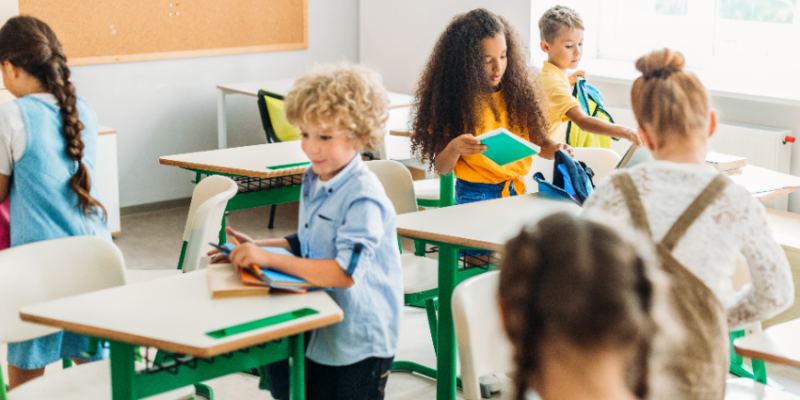
What is education like in São Paulo?
São Paulo gives families a choice of Brazilian public and private schools, English-language international schools, a French lycée, and German-Brazilian and Swiss-Brazilian schools. Children can continue a familiar curriculum or join the Brazilian system. The choice shapes both their everyday learning and the qualifications they will work toward at the end of high school.
Under Brazilian education law, schooling is compulsory from ages 4 to 17. Early childhood education, known as educação infantil, includes compulsory preschool from age 4. Children start ensino fundamental at 6 and complete nine years before moving on to ensino médio, the final stage before university. Grade numbers in British, American, and French schools do not automatically match these stages.
For families with more than one child, finding places in the right grades can be as important as choosing a curriculum. Siblings may attend different campuses even within the same school. International school options are available in areas including Pinheiros, Jardim Paulistano, Vila Mariana, Morumbi, Chácara Flora, and Alto da Boa Vista, so your school choice also affects where you live and how you organize your day.
Types of schools in São Paulo
Public schools are tuition-free and teach in Portuguese. They belong to either the municipal system or the São Paulo state system. Brazilian private schools charge fees and follow the national curriculum; some also offer bilingual teaching or a particular educational approach.
In a bilingual school, children learn subjects through two languages, rather than simply taking additional language classes. International schools offer British, American, French, German, Swiss, and International Baccalaureate programs. Several also prepare students for a Brazilian diploma. Families seeking a school with a religious tradition can choose options such as the Catholic Chapel School.
For a different educational approach, Escola Waldorf Rudolf Steiner, at Rua Job Lane, 900, in Alto da Boa Vista, covers early childhood through high school. Alongside language and fees, consider how its teaching approach suits your child and how a later transfer to another school would work.
International schools in São Paulo
English-speaking families can choose among schools offering British, American, and IB programs, as well as bilingual schools that combine Brazilian and international studies. The International Baccalaureate (IB) has several programs for different ages. Its Diploma Program is taken toward the end of high school and is separate from the French baccalauréat. Authorization to offer the IB diploma does not, by itself, mean a school offers IB programs from preschool onward.
Graded, in the Morumbi and Vila Andrade area
Graded, The American School of São Paulo, enrolls children from age 3 through high school. Students work toward an American diploma and can also pursue IB and Brazilian diplomas. The school is accredited by the New England Association of Schools and Colleges (NEASC) and the São Paulo state education authorities. The campus entrance is on Avenida José Galante, 425. Tuition is BRL 12,818 (about USD 2,410) a month from preschool through Grade 5 and BRL 15,906 (about USD 2,990) for Grades 6-12, paid in 12 installments. That brings annual tuition to BRL 153,816 (about USD 28,900) and BRL 190,872 (about USD 35,800), respectively.
St Paul's School, in Jardim Paulistano
St Paul's School, at Rua Juquiá, 166, has its main entry point at age 3. Students follow a British curriculum, take IGCSE examinations during secondary school, and then prepare for the IB diploma. The school has British School Overseas recognition and Brazilian authorization as a bilingual and bicultural school. Applications exceed the number of places. British and international applicants receive priority, and international students may apply throughout the year. Other entry points, for ages 4-16, are intended for international students and families returning to Brazil, under the school's admissions criteria. Fee information is available from admissions.
The British College of Brazil, in Cidade Jardim and Chácara Flora
The British College of Brazil (BCB) serves children ages 2-18. Its English curriculum leads to IGCSE examinations and the IB diploma. The two campuses are at Avenida Engenheiro Oscar Americano, 630, in Cidade Jardim, and Rua Álvares de Azevedo, 50, in Chácara Flora. Confirm which campus offers your child's year group and has space available. Annual tuition ranges from BRL 97,520 (about USD 18,300) for the youngest year groups to BRL 149,542 (about USD 28,100) for Years 7-13. Years 1-5 cost BRL 126,496 (about USD 23,700) a year. A new student's initial application and admission fees total BRL 16,200 (about USD 3,040), with a partial exemption for certain students from the Nord Anglia network. From Year 7, applicants have an interview and an assessment.
St Nicholas School, in Pinheiros
The Pinheiros campus of St Nicholas School takes children from 18 months through age 18. It offers IB-based programs and the Diploma Program in the final years of secondary school. The campus contact address is Praça Joaquim Roberto, 30, in Pinheiros. Admissions provides the prospectus and fees for your child's age group. The school year begins in August, with June 30 as the age cutoff for year-group placement. St Nicholas also has an Alphaville campus in Santana de Parnaíba, outside the municipality of São Paulo. Be clear which campus you are applying to when arranging a visit or looking for housing.
St Francis College, in Pinheiros
St Francis College offers all three IB programs, from the Primary Years Program through the Diploma Program. It teaches Brazilian and international students from early childhood through high school.
Chapel School, in Chácara Flora
Chapel School, at Rua Vigário João de Pontes, 537, is a school in the Catholic tradition offering early childhood through high school education. It is authorized to teach the IB Diploma Program in English and also offers American and Brazilian programs. For fees, entry requirements, and included services, contact admissions@chapelschool.com.
Avenues São Paulo, in the Morumbi area
Avenues São Paulo, at Rua Pedro Avancine, 73, covers early childhood through high school. Graduates receive an American diploma accredited by NEASC and a Brazilian diploma. The curriculum incorporates English, Portuguese, and Brazilian studies. For Grades 1-12, the payment schedule consists of an initial BRL 37,000 (about USD 6,950), followed by 11 installments of BRL 17,945 (about USD 3,370). The annual total is BRL 234,395 (about USD 44,000).
Beacon School, in Vila Leopoldina and Alto de Pinheiros
Beacon School combines the Brazilian curriculum with IB programs from early childhood through high school. It has three sites: Campus, Villa, and Berlioz. Campus, at Rua Mergenthaler, 1138, in Vila Leopoldina, serves G5-Y12; Berlioz is in Alto de Pinheiros. Admissions can identify the appropriate site for younger children. The Campus facilities include spaces for art and music, laboratories, sports grounds, and libraries. Fees are available by grade level.
The French lycée, in Vila Mariana
The Lycée international français de São Paulo, also known as Lycée Pasteur, offers schooling from preschool through the final year of secondary school. It has a partnership agreement with the Agency for French Education Abroad (AEFE). French approval covers the preschool petite section through terminale, the final secondary year. The younger preschool toute petite section is also offered, but without that French approval of its curriculum. Located at Rua Vergueiro, 3799, in Vila Mariana, the lycée allows students to continue a French education and prepare for the baccalauréat. Its school year begins early in the calendar year, following the Southern Hemisphere schedule.
German-language and Swiss-Brazilian options
At Colégio Visconde de Porto Seguro, the Morumbi campus at Rua Floriano Peixoto Santos, 55, offers a German international curriculum from early childhood through the Abitur, Germany's school-leaving qualification, with Brazilian and German certification. Its bilingual curriculum strengthens German and English while retaining subject teaching in Portuguese. The Panamby campus, at Rua Itapaiúna, 1355, also offers an IB pathway in the final years of secondary school. The chosen curriculum determines the campus, admission conditions, and fee quote.
Escola Suíço-Brasileira de São Paulo, at Rua Visconde de Porto Seguro, 391, in Alto da Boa Vista, covers early childhood through high school. Portuguese and German are the languages of bilingual instruction, with English and French also taught. The school combines the Brazilian curriculum, the Swiss education plan, and the IB diploma. It is recognized by the Swiss authorities and São Paulo education authorities. Fees are available directly from the school.
School calendars and admissions in São Paulo
The municipal school year usually runs from February through December, with a break in July. The French lycée also follows a Southern Hemisphere calendar. Some international schools, including St Nicholas and Graded, start in August; Graded also allows some January entries. Depending on the school, your move may fall between grades or partway through the academic year.
At the French lycée, admissions handles visit and enrollment requests. At private international schools more generally, the first conversation establishes the appropriate grade for your child's previous schooling and whether the relevant campus has a place. The application may then involve school reports, references, an interview, and an assessment. Graded's application requires the child's identification and CPF (the Brazilian taxpayer identification number), results from the previous two school years, teachers' contact details, and health and vaccination information. Reports must be translated into English where necessary.
Submitting an application does not guarantee admission. St Paul's has more applicants than places, while January admission at Graded depends on students leaving. Once your move becomes likely, applying to several suitable schools gives you alternatives. If your child joins a waiting list, find out whether you need to keep the application active, which applicants receive priority, and when it will next be reviewed. You can explore public school enrollment in parallel, with Portuguese-language support discussed with the school.
Planning a school budget in São Paulo
Annual tuition gives a clearer comparison than a monthly installment alone. Graded spreads its fees over 12 payments, while Avenues requires a larger initial payment followed by 11 installments. Starting after the school year has begun does not necessarily mean paying only for the months your child attends: Graded may charge for earlier months in a quarter that has already started. Avenues recalculates the payment schedule according to when payments begin.
Some schools offer financial assistance. Avenues offers partial, means-tested aid and a separate social program called Care. However, financial aid applications are separate from school enrollment. BCB offers sibling discounts of 10% for the second child and 5% for subsequent children. Where an employer contributes to education costs, the relocation agreement should specify the limit and whether entry fees and additional services are covered.
To compare complete costs, request an itemized quote covering:
- Annual tuition and initial application, admission, or capital contribution fees
- Meals, books, classroom materials, and digital equipment
- Uniforms, daily transportation, and after-school activities
- Language support, trips, and examination fees
- Early withdrawal and refund conditions
Brazilian school-fee law provides for a contractual annual or semester total. Schools may offer alternative installment schedules, provided they do not exceed that total. They cannot charge families separately for shared materials needed to deliver the teaching covered by the contract.
Public schools for expat children in São Paulo
Foreign children can attend public schools free of tuition. Portuguese is the language of mainstream instruction. Municipal and state schools belong to separate systems, even when they are in the same neighborhood.
For a child arriving from abroad, the state education service advises contacting a school directly so staff can review their previous education. In the municipal system, families first register a request and are then assigned a place. For ensino fundamental, placement is based on home address; living close to a particular school does not guarantee a place there.
Bring the documents you have: identification for the child and their parent or guardian, proof of address, contact information, and previous school reports or certificates. Under municipal enrollment rules, missing documents must not prevent a migrant child from enrolling. The procedures for migrant students also allow grade placement to take account of previous education and age when school records are missing. Schools must seek ways to interpret the documents families provide.
The municipality provides enrollment forms in English, French, and Spanish to help families with the initial paperwork. For a child who is new to Portuguese, discuss how they will take part in lessons, how their existing knowledge will be assessed, and who will communicate with the family. Translated welcome materials do not mean every school provides the same amount of Portuguese-language teaching.
In municipal schools, assistance with materials and uniforms helps reduce back-to-school spending. Purchases use the CPF of the parent or guardian recorded in the school file and must be made at approved retailers. Uniform assistance covers children from age 4 through the end of ensino fundamental; material assistance extends to more grade levels. Families still need to account for travel and purchases above the assistance provided.
Choosing a school in São Paulo
Neighborhoods, travel, and daily life
St Nicholas, St Francis, and St Paul's are located in Pinheiros and Jardim Paulistano. The French lycée is in Vila Mariana. To the west and southwest, Morumbi, Vila Andrade, and Panamby are the areas associated with Graded, Avenues, and Porto Seguro. Farther south, Chácara Flora and Alto da Boa Vista have Chapel, a BCB campus, and the Swiss-Brazilian school. Beacon adds options in Vila Leopoldina and Alto de Pinheiros.
Choose a home with the actual campus and daily school journey in mind, along with dismissal times and parents' workplaces. For school transportation, set the pickup point, departure time, route length, and arrangements for getting home after activities. Testing the journey at school arrival time tells you more than measuring the distance between two neighborhoods.
A part-day place, an extended day, and after-school activities produce different pickup schedules. Facilities also vary by campus: sports grounds, laboratories, or music rooms described for one site may not be available at another school in the same network.
During a visit, discuss the size of your child's prospective class, homework, recess, how staff handles conflict, and how the school keeps parents informed. Municipal school calendars include family meetings and opportunities for parent participation. International schools have varying mixes of Brazilian and foreign students; the curriculum alone does not tell you which language children use with one another.
Language support and special educational needs
A child who chats comfortably in English may still need help understanding lessons and classroom instructions. Graded's English Language Learners support combines classroom assistance and small-group work as needed. The school also has a team supporting learning and student well-being. BCB charges BRL 940 (about USD 180) a month for English support.
If your child has a disability or additional learning needs, bring existing assessments, details of adjustments that already help, and their learning goals to the admissions discussion. Confirm which staff can support your child, what accommodations are available, and whether there are additional charges.
In municipal schools, Atendimento Educacional Especializado (AEE) provides additional educational support. Start with the school's teaching team. It works with the Centro de Formação e Acompanhamento à Inclusão (CEFAI), the regional center that helps schools organize inclusive education. Access is based on an educational assessment; a medical diagnosis is not a prerequisite. Existing reports from abroad can still help staff understand your child's needs.
The city also has municipal bilingual schools for deaf students. EMEBS Helen Keller, at Rua Pedra Azul, 314, in Aclimação, is one such option. Bilingual education for deaf students uses Libras (Brazilian Sign Language) and Portuguese. Families whose child uses another sign language should discuss that transition with the school team.
Higher education pathways in São Paulo
The Brazilian curriculum prepares students for university entrance examinations. The Universidade de São Paulo (USP) has several admission routes, including FUVEST, with its own examinations, and ENEM-USP, which uses results from the Exame Nacional do Ensino Médio (ENEM), the national examination taken at the end of secondary school. For an international-school student who wants to study locally, written Portuguese and familiarity with Brazilian curriculum subjects matter.
French, German, American, and IB qualifications also support applications abroad, subject to each university's requirements. Subjects chosen in the final school years may open or restrict access to particular degree programs. If your family is considering several countries, discuss the subjects offered, the qualification your child will actually receive, and any recognition requirements with the school's university guidance team.
Several schools offer both Brazilian and international qualifications, allowing students to maintain a Brazilian pathway while preparing another diploma. Holding both does not replace university selection. Plan these choices before the final years of high school, when switching curriculum or teaching language becomes a bigger undertaking.