In São Paulo, a weekday lunch might come from a neighborhood buffet, breakfast from a bakery counter, and dinner from an Italian family restaurant or a contemporary Brazilian kitchen. Immigrant food traditions shape both everyday meals and special occasions, with open-air markets, specialty groceries, and delivery services adding to your options when you settle in.
A bakery counter, a neighborhood lunch buffet, and an Italian family restaurant are all part of everyday eating in São Paulo. Brazilian cooking shares the city with the food traditions of its immigrant communities, particularly Italian, Japanese, and Arab communities. Pizza, pasta, and esfiha, a filled bread of Levantine origin, are familiar everyday choices. The city's international food scene also includes Armenian, Palestinian, and Nepalese restaurants.
Lunch is a substantial meal, with neighborhood restaurants serving composed plates, buffets, and set menus for nearby workers. In the evening, people gather in restaurants, pizzerias, and botecos, informal bars that also serve food. In Pinheiros, counters, outdoor tables, and bars are part of neighborhood life from the late afternoon into the evening.
You'll generally find lunch around noon and into the early afternoon. Many restaurants begin dinner service at about 7 or 7:30 p.m. and fill up later. Kitchens often close between 11 p.m. and midnight, although some places serve later. A restaurant specializing in lunch may close in the afternoon, so the neighborhood and type of establishment matter when planning an evening meal.
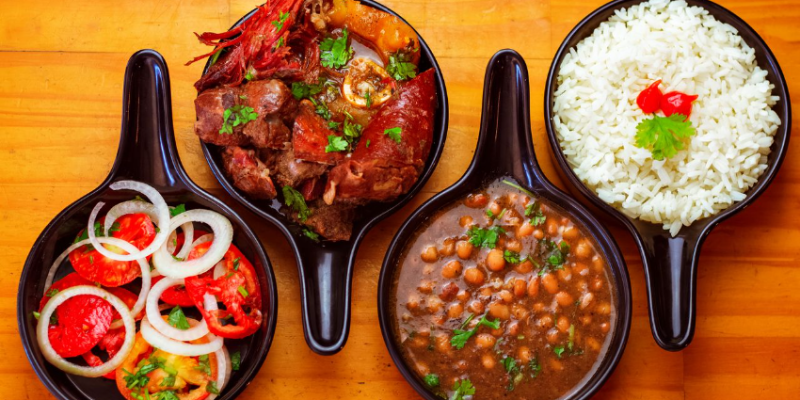
The virado à paulista is one of the city's signature meals. Rice, beans mixed with flour, greens, an egg, and several pork preparations make up a generous plate. It traditionally appears on Monday menus. Feijoada, a black bean and meat stew, is often served on Wednesdays and Saturdays with rice, greens, seasoned cassava flour, and orange. These dishes associated with particular weekdays remain part of the routine in casual restaurants and bars serving lunch.
At bakery and bar counters, look for coxinha, a breaded, fried snack usually filled with shredded chicken. Creamy cheese is a common addition, and some plant-based versions use jackfruit. You can order one as a snack or a portion to share. At bars, coxinhas are often served alongside chope, draft beer, or a caipirinha. Cafes serving meals and neighborhood bakeries are other places to try them.
Open-air markets have their own food traditions. A pastel de feira is a thin, filled pastry fried until crisp, with meat, cheese, and hearts of palm among the classic fillings. Stalls also sell caldo de cana, freshly pressed sugarcane juice. The Mercadão, the central municipal market, is especially associated with mortadella sandwiches and cod-filled pastels, both available to eat on site.
Coffee fits into the breaks between meals as well as breakfast. A bakery order might be pão na chapa, a buttered bread roll toasted on a hot plate, with coffee or a pingado, coffee with milk. Alongside these traditional counters, specialty cafes offer filtered preparations and tastings of Brazilian coffees. Cafes in the Triângulo Histórico in the city center offer both approaches.
For something sweet, pudim is a flan usually made with condensed milk, while brigadeiro is a chocolate confection also made with condensed milk. Both appear in bakery displays and restaurant menus alongside slices of cake. Long-established bakeries and restaurants serve these familiar sweets, while Italian pastries and Japanese-inspired desserts add to the city's options.
Join the Sao Paulo community
Get regular tips and advice to make the most of your expat life
Dining culture in São Paulo
For a regular lunch, the prato feito, usually shortened to PF, is a complete meal arranged on a plate. A prato executivo is a set lunch, with the included courses or accompaniments specified on the menu. Another everyday option is a buffet charged by weight, or por quilo: you fill your plate, then the food is weighed to calculate the bill. A fixed-price buffet charges the advertised amount for its meal offering. These lunch formats let you choose a meal without committing to several courses.
A PF or a buffet by weight works well when you're eating alone. For a family meal, it helps to establish how many people a shared dish is intended to feed. Pizzerias, Italian family restaurants, and places offering rodízio also suit groups. With rodízio, you get a succession of dishes for a set price. Drinks, desserts, and other extras are charged separately.
Padarias are bakeries that also serve drinks and food, from breakfast and sandwiches to lunch at some locations. Brunch is well established, particularly in Pinheiros. Breakfast and brunch options range from individual meals to combinations for two, bringing together bread, eggs, fruit, coffee, and juice.
For a special evening, contemporary restaurants work with Brazilian ingredients and seasonal produce. At Tuju, both the food and drink pairings change with the seasons; you book through the restaurant's channel. A tasting menu makes dinner the main event. An à la carte meal gives you more choice over the number of courses, while takeout and delivery are options for everyday meals.
Food neighborhoods in São Paulo
Liberdade brings together Japanese, Chinese, and Korean restaurants, pastry shops, and stores. Around Rua Galvão Bueno, you can combine a meal with shopping for Asian ingredients. On weekends, the Liberdade fair adds food and craft stalls to the neighborhood's permanent businesses. Sit-down restaurants offer an alternative when you'd rather have a table than eat at a stall.
Bixiga, within Bela Vista, is associated with Italian family restaurants and pasta. Mooca also has a tradition of Italian restaurants and bakeries. Both offer pizza and shared meals. Across Bela Vista, Liberdade, Sé, and República, the central districts offer restaurants, cafes, pastry shops, and food stores.
In Pinheiros, Rua dos Pinheiros and the streets around Fradique Coutinho have Brazilian and international restaurants, bars, and cafes. The municipal market combines ingredient shopping with places to eat. Nearby Vila Madalena adds more bars and contemporary restaurants. Jardins and Itaim Bibi have a concentration of fine-dining and upscale restaurants for a more formal meal.
Bom Retiro is especially useful for Korean restaurants and groceries, along with other cuisines, including Greek food. Its multicultural food businesses reflect the neighborhood's immigrant history. On a typical workday, lunch places near your home or workplace are just as much a part of eating in São Paulo as the neighborhoods you visit for a night out.
International cuisine in São Paulo
The range of international food runs from community restaurants to dishes that blend several traditions. Italian options include family restaurants, pizzerias, and contemporary dining. Japanese restaurants serve everything from everyday meals to menus focused on fish, while Arab food is available as both a quick meal and a sit-down dinner. The menu format matters: hot dishes, an all-you-can-eat offering, and a tasting menu can give you very different meals within the same national cuisine.
Local adaptations are part of the food scene, too. Momonoki, a cafe in Vila Madalena, serves Japanese breads and dishes that blend Japanese and Brazilian influences. Contemporary restaurants also bring international techniques to São Paulo's seasonal produce. These approaches coexist with cooking rooted in particular regional traditions.
Specialist stores make it possible to use imported ingredients at home. In Liberdade, Marukai at Rua Galvão Bueno, 34, sells Asian imports, including miso, seasonings, and sake. In Jardins, Casa Santa Luzia at Alameda Lorena, 1471, stocks imported foods and drinks, with a selection also available online. These stores complement the groceries you'll find in supermarkets.
Grocery shopping in São Paulo
Everyday shopping spans supermarkets, small neighborhood stores, covered markets, and open-air feiras livres. Pão de Açúcar and Sonda are among the supermarket chains offering online orders. Carrefour has several store formats, from convenience stores to hypermarkets. Neighborhood shops provide another option for nearby purchases.
Traditional open-air markets generally run from 8 a.m. to 2 p.m. on a fixed day for each street. Evening markets also run from 4 p.m. to 9 p.m., and there are organic markets. The municipal market map helps you locate your neighborhood's feira. You can combine fruit and vegetable shopping with a stop at the prepared-food stalls.
For a covered market, Pinheiros market at Rua Pedro Cristi, 89, brings together food shops, regional ingredients, and restaurants. It opens Monday through Saturday, from 8 a.m. to 6 p.m. Lapa market, at Rua Herbart, 47, keeps the same days and hours. These municipal markets serve neighborhood grocery needs with fresh produce, fish, meat, and spices.
Pinheiros also hosts the art and antiques fair on Praça Benedito Calixto. It takes place on Saturdays from 9 a.m. to 7 p.m., with a food area alongside the stalls. It offers a different outing from a regular produce market.
For grocery delivery, your CEP (Brazilian postal code) determines which stores, time slots, and services are available. Enter your delivery address on Pão de Açúcar's website. At Sonda, availability also depends on stock on the day of delivery. Imported foods and specialist dietary products are also available from dedicated grocers; the selection won't be identical across supermarket branches.
Eating out costs in São Paulo
Prices are charged in Brazilian reais (BRL). For everyday lunches, the following rounded averages cover 350 restaurants in the city. The difference between a meal price and a price per kilogram matters most at buffets:
Meal format
Average price
Approximate USD equivalent
Prato feito or dish of the day
BRL 40 per meal
USD 7.50
Chicken set lunch
BRL 45 per meal
USD 8.45
Fixed-price buffet
BRL 60 per meal
USD 11.25
Buffet charged by weight
BRL 89 per kg
USD 16.70 per kg
For a PF, the average price is around BRL 31 in the eastern part of the city and BRL 47 in the west, approximately USD 5.80 and USD 8.80. These are averages for establishments in broad areas, not prices to expect at every restaurant in a neighborhood. Drinks, dessert, and service may add to the bill.
At a bakery, a buttered roll toasted on the hot plate averages about BRL 7.50 (USD 1.40). For the roll together with a glass of filtered coffee, regional averages run from roughly BRL 14 to BRL 20 (USD 2.60-3.75). These bakery prices reflect a simple coffee stop, not a full brunch.
A rough allowance for a midrange dinner is BRL 80-150 per person (about USD 15-28), depending on the food and drinks ordered. At the top end, tasting menus can cost considerably more. Evvai and Tuju have menus priced at around BRL 1,250 and BRL 1,500 per person, respectively, approximately USD 235 and USD 280, before drink pairings and service.
Dietary requirements in São Paulo
São Paulo has vegetarian and vegan restaurants as well as specialist bakeries. For an entirely plant-based meal, POP Vegan Food offers a lunch buffet in Consolação, along with pizzas and burgers. Brazilian snacks also have plant-based versions, including jackfruit coxinha. In a general restaurant, ask about the ingredients in beans, sauces, and side dishes if you avoid all animal products.
For gluten-free and dairy-free food, Grão Fino at Rua Simão Álvares, 49, in Pinheiros prepares breads, pastries, and meals without gluten or dairy products. Lactose-free food meets a different requirement from excluding milk altogether. If you have an allergy or celiac disease, your conversation with the restaurant should cover both the ingredients and possible cross-contact during preparation, including when you're ordering delivery.
On packaged food, alérgicos: contém means that a named allergen is present. Alérgicos: pode conter warns of possible presence through cross-contact. These phrases are part of the national food-labeling rules. At a restaurant, Tenho alergia a... means "I'm allergic to..." and Sou celíaco/celíaca means "I have celiac disease."
For halal meals, Almalek in Liberdade is listed locally as halal-certified; the certificate's current validity and the food it covers need direct confirmation with the restaurant. FAMBRAS Halal lists certified food companies and provides a contact for authenticating certificates. Keep in mind that an Arab menu alone doesn't establish whether the food is halal.
For kosher shopping, BDK's business listings distinguish fully kosher businesses from those with only certain approved products. Branches and product restrictions are specified in some entries. Options include Macolet Kosher Foods in Pacaembu and ice cream businesses in Higienópolis. Where certification is partial, use the approved menu or product list to choose what to buy.
Food delivery in São Paulo
iFood plays a central role in meal delivery, with 99Food, Rappi, and Keeta also operating in São Paulo. The restaurants you can order from and their hours depend on your delivery address. Enter your address first to see the options that serve your location.
Once you've chosen your food, the order summary separates the meal from additional charges, including delivery. Some promotions require a minimum order. Rappi displays an estimated delivery time, delivery charges, and minimum spending for certain offers. That time estimate applies to the particular order, rather than promising the same speed every evening.
A courier tip, where offered, is optional and separate from the fees charged. In an apartment building, you may collect the order at the portaria, the entrance or reception desk, according to the building's rules. Include your apartment number and useful access instructions. You can follow the order's progress and contact the platform's support service or the restaurant if there's a problem.
For quick grocery orders, Dakidelivers food and everyday essentials in several parts of São Paulo, including Pinheiros, Itaim, Moema, and Vila Mariana. Scheduled supermarket deliveries are another option for a larger grocery shop. Available time slots and the final total depend on the address entered.
Reservations help at sought-after restaurants, especially on Friday and Saturday evenings, but some places use a waiting list or take walk-ins only. Even upscale restaurants differ. At some places, bookings are restricted to certain guests and groups; other diners are seated in order of arrival, and smart dress is required. For a formal dinner, the restaurant's own policy sets out both booking arrangements and what to wear.
Friends commonly share dishes and split the bill. You can tell the server how much each person will pay or ask Podemos dividir a conta?, meaning "Can we split the bill?" In some bakeries and bars, a comanda is a ticket or card used to record your orders. You use it to settle the bill when you leave.
Cards are widely used, and many establishments also offer Pix payments. Accepted payment methods must be made clear before you order, although individual restaurants may have their own restrictions. If you've just arrived and don't have an account that allows you to use Pix, a card or cash is an alternative wherever accepted.
The taxa de serviço is a suggested tip, often 10%, which may already appear on the bill. Payment is optional, and some establishments suggest a higher percentage. Look at the total before automatically adding another tip. A couvert artístico is a charge for a live artistic performance; both the charge and its amount must be announced in advance. These restaurant payment rules apply in São Paulo. Bread or small appetizers offered as couvert are a separate potential charge, so establish their price as well.
Frequently asked questions
Virado à paulista, pizza, coxinhas, and market pastels are among the classics. The Mercadão is known for mortadella sandwiches and cod-filled pastels. Italian, Japanese, and Arab cooking also play an important role in everyday dining.
Both bakery counters and specialty cafes are part of coffee culture. A buttered roll toasted on a hot plate with coffee or coffee with milk is a familiar order. Specialty cafes also offer filtered preparations and tastings of Brazilian coffees.
Dinner service often starts at around 7 or 7:30 p.m., with restaurants filling up later. Many kitchens close between 11 p.m. and midnight, though hours vary by restaurant.
The meal format makes a substantial difference. A prato feito averages around BRL 40, approximately USD 7.50, among the restaurants surveyed across the city. Drinks and extras may increase the total. A more elaborate dinner or tasting menu costs considerably more.
Card payments are widespread, and restaurants must announce accepted methods before you order. Pix is also common, but using it depends on whether you have access to that payment system. A card is useful when you first arrive.
A suggested service tip, the taxa de serviço, may appear on the bill, often at 10%. Paying it is optional. Check whether it has already been included before adding a separate tip.
Buffets charged by weight, bakeries serving full meals, and dishes associated with particular weekdays are worth knowing about. Virado à paulista traditionally appears on Mondays, while feijoada is often served on Wednesdays and Saturdays.
Some Italian restaurants, pizzerias, and other dining spots stay open until midnight or later. Others serve lunch only. The kitchen may close before the establishment itself, so its last ordering time matters if you plan to arrive late.
ℹ️
We do our best to provide accurate and up to date information. However, if you have noticed any inaccuracies in this article, please let us know in the comments section below.
A journalist, holder of the DALF C1 and C2 and a diploma from the University of Mauritius, I have nearly twenty years of writing experience. After six years in the Mauritian press, I joined Expat.com, where I have been working for over a decade, including five years as editorial assistant, and now as editorial manager.